In our society, the idea of self-reliance is often viewed positively. And yet, it is our nature to benefit in numerous ways from others. As Albert Einstein beautifully articulated in a book titled, Living Philosophies: A Series of Intimate Credos:
Einstein in his later years
“From the standpoint of daily life…there is one thing we do know: that man is here for the sake of other men–above all for those upon whose smile and well-being our own happiness depends, and also for the countless unknown souls with whose fate we are connected by a bond of sympathy. Many times a day I realize how much my own outer and inner life is built upon the labors of my fellow-men, both living and dead, and how earnestly I must exert myself in order to give in return as much as I have received. My peace of mind is often troubled by the depressing sense that I have borrowed too heavily from the work of other men.” (p. 3)
Despite all that we benefit from the lives of other human beings, there are times when we come into conflict with them. How we handle conflicts can have an enormous effect on how much respect we have for ourselves, and others have for us.
An important step toward learning how to better handle conflicts, is to come to understand more precisely than most people what a conflict is. This will lead to a deeper understanding of how conflicts are connected to blame, guilt, and responsibility, and how this understanding can be used in a practical manner. We’ll then return to the example of Einstein, looking at how he utilized the skills that were discussed today, and how this led to the high degree of respect that millions have long had for him.
What is a Conflict?
According to the DIG CONFLICT MODELthat we have been utilizing on this blog, From Insults to Respect, a conflict occurs when the following three conditions occur:
Party A desires an act will occur.
Party A perceives that another party is likely to act in a manner that interferes with the desire.
Party A perceives that the other party would be guilty of doing something wrong if he or she carries out the interfering act.
Notice that each of the three conditions has a key word italicized—desire for the first condition, interference for the second, and guilt for the third. If we take the first letter of each of these key words and put them together, they spell DIG; hence the DIG Conflict Model’s name.
Party A, in the above definition, indicates the individual who is theoretically engaged in a conflict and from whose perspective the conflict will first be described.
The word “DIG” provides us a way to remember a technique to quickly and succinctly describe a conflict. First, we describe the “desire,” then the “interference,” and then the “guilt” condition.
The DIG model is also helpful because sometimes we can come up with an idea to make a change in just one of the easier to understand parts that then leads to the rest of the conflict becoming easier to manage. In earlier posts we looked at examples that illustrated using these ideas, and in one particular post we focussed particularly on ways to change the guilt condition (see here).
Since I wrote that post, I received some feedback indicating that there is some confusion about the nature of blame, guilt, and responsibility. Thus, today I shall undertake an effort to reduce this confusion, and then relate this understanding to respect.
Blame, Guilt, and Responsibility
Why does Lucy, in this comic, go out of her way to get people she knows to absolve her of all blame regardless of what happens? Here’s my take on this.
The word, blame, has a variety of meanings. So, to avoid confusion, on this blog when we are discussing the DIG Conflict Model we’ll be sticking to one particular meaning, e.g., “When a person blames someone, that person has the belief that someone is guilty of doing something wrong and deserves some type of punishment.”
Punishment is typically not a pleasant experience to undergo. In the above comic, perhaps Lucy wants to avoid punishment by absolving herself from blame.
According to the DIG Conflict Model, when someone has a conflict with you, or you have a conflict with yourself, part of what is going on is that the person who has a conflict with you believes that if you carry out the interfering act you would be guilty of being wrong, and therefore you would deserve to be punished. If you can transform that guilt into something other than guilt, it would eliminate one of the essential conditions of a conflict and thus resolve it.
One way to transform guilt, is to take responsibility for what went wrong. When we do so, we have some of the same very strong feelings that go along with guilt, but rather than believing punishment is the proper response, another is offered; we admit that we played at least a part in what went wrong, and then make it clear that we will take steps to improve our actions in the future. The genuine feeling that comes with taking responsibility, leads us to do a search for improvements.
What are the benefits that come from resolving a conflict in this way? There are many, but on this blog we’re all about how to transform insults into respect, so let’s focus just on this issue.
The Benefits of Transforming Guilt into Responsibility, and then, into Respect
From his research, David found that President John F. Kennedy enjoyed very high public approval ratings compared with most modern presidents. Over the whole of his presidency, Kennedy averaged a 70.1 percent approval rating, comfortably the highest of any post-World War II president. By comparison, the average for all presidents between 1938 and 2012 is 54 percent.
On April 17th, 1961, Kennedy ordered what became known as the “Bay of Pigs Invasion”: 1,500 U.S.-trained Cubans, called “Brigade 2506”, landed on the island in an attempt to overthrow the country’s dictator, Fidel Castro. The plan failed within three days.
By April 19, 1961, the Cuban government had captured or killed the invading exiles, and Kennedy was forced to negotiate for the release of the 1,189 survivors. After twenty months, Cuba released the captured exiles in exchange for $53 million worth of food and medicine.
When the invasion had failed, many felt Kennedy was guilty of doing something terribly wrong, and more than a few insults were being hurled at him. However, when he went before the press, he took responsibility for the failure, and pledged to take several specific steps to make sure that what happened would never happen again. Immediately afterwards his approval rating spiked, going up to 83 percent, the highest level of his presidency.
From my own experience, I have learned that using a similar type of response can be very helpful. When I find that someone has a conflict with me because of something that I have done, I have often been able to turn those angry feelings that come along with a conflict into a respectful resolution by making it clear that I recognize my responsibility in what happened and I plan to take some action to improve.
Back to Einstein
Returning to Einstein, let us ask, what was it about this man who lived many years ago and somehow still captures the respectful imagination of so many of us? Surely, his awe-inspiring achievements in science is a major reason for this. But today, I would like to ask whether it has, as well, something to do with his profound sense of responsibility to his fellow human beings, a sense of responsibility that led him to set aside, for periods of time, his passionate interest in his research so that he might speak out against injustice, and to put forth his vision for a more peaceful world.
———————————
Some people will enjoy reading this blog by beginning with the first post and then moving forward to the next more recent one; then to the next one; and so on. This permits readers to catch up on some ideas that were presented earlier and to move through all of the ideas in a systematic fashion to develop their emotional intelligence. To begin at the very first post you can click HERE.
It’s the bottom of the eighth inning. The talented star, Bryce Harper, front runner for the National League Most Valuable Player Award, hits a pop fly to left field that a professional outfielder is very likely to catch. However, there are times when such fielders do lose the ball in the sun or the stadium lights, and the ball ends up being dropped, allowing the batter to safely reach base if he had bothered to run. It is for this reason that Mr. Harper is supposed to hustle down to first base even if he has a pretty good reason to think that the ball he hit is, in all likelihood, going to be caught. Instead of sprinting down to first, Mr. Harper slowly steps out of the batter’s box and then heads to the dugout where he runs into a very angry teammate, Jonathan Papelbon.
According to several sports reporters, Mr. Papelbon, an incredibly talented pitcher, began to criticize Mr. Harper about his lack of hustle, and after a very brief exchange, he charged into Mr. Harper, putting his hands on his throat and shoving him into the back wall of the Washington dugout. Fortunately, Mr. Harper was still wearing his batting helmet because his head smacked hard into the wall, and his helmet came flying off. Several Nationals players and coaches responded immediately and physically separated the two.
How Mature was Mr. Papelbon’s Style of Providing Negative Criticism in this Situation?
Regular readers of this blog know that when it comes to providing negative criticism, we are encouraged to consider a tentative model that describes five levels of maturity. Level one is viewed as the most immature, and each higher level is viewed as a little more mature. Let’s take a quick look at these levels, and as we do so, let’s see if we can figure out which of the five levels best describes Mr. Papelbon’s approach.
PROVIDING NEGATIVE CRITICISM: FIVE LEVELS OF MATURITY
1. The criticizer displays one or more of the following behaviors:
Cries without stating what the crying is about
Physically attacks the person being criticized
Damages property
2. Those who are at this level display one or both of the following behaviors:
The criticizer does not explain what the offending behavior is, but instead expresses displeasure with glares, insults, shouting, silence, or threats that do not involve bodily harm. (For example, someone might be making too much noise and the criticizer might turn to the noise maker and glare, or cry out, “Jerk!”)
Threatens bodily harm regardless of what else is said.
3. Those who are at this level clearly state the criticism with enough detail so the criticized person, if he or she wills, can improve the behavior, idea, or appearance, but couple it with glares, insults, shouts, or threats that are not about bodily harm.
4. Those who are at this level state the criticism without bodily attacks, damaging property, glares, insults, threats, or shouts, and with enough details so that the criticized person, if he or she wills, can improve the behavior, idea, or appearance. If the person receiving the criticism becomes defensive or angry, these criticizers empathize without returning glares, insults, threats, or shouts.
5. Those who are at this level provide criticism in a manner very similar to a level four style of criticism but beforehand, they consider the person who is the target of the criticism, and the situation that he or she is in. As a result of such considerations, they may decide to alter the criticism.
According to the Above Model, What Level of Maturity Best Describes Mr. Papelbon’s Form of Negative Criticism?
While criticizing Mr. Harper’s lack of hustle to first base, Mr. Papelbon physically attacked him. Of the five levels described in the above model, level one, the most immature level, best describes what he had done.
Why is such a style considered immature? Well, one reason is that when people respond at the more mature levels, it demonstrates that they can consider the consequences of their actions before they choose what actions to take. In this case, the consequences for Mr. Papelbon has been a suspension for the rest of the season, a fine of thousands of dollars, and he has been displayed on national news in a negative light, thus tarnishing his reputation. A little forethought would have led to avoiding these clearly negative consequences.
Now, it is important to note that the specific negative criticism that Mr. Papelbon wanted to deliver to Mr. Hudson, was, according to my own value system, correct. Mr. Hudson does owe it to his teammates to hustle down to first base in these situations. However, I disagree with how Mr. Papelbon provided the criticism.
Mr. Papelbon, center, after lunging at Mr. Harper.
What would have been a more mature response? A little forethought would have led to realizing that Mr. Harper was very frustrated with his own pop out in the game. Thus, to wait until the next day would give both parties time to calm down.
Moreover, providing negative criticism to someone in front of lots of other people is often a huge mistake. Face-saving actions tend to increase defensiveness for both parties. Asking to discuss such matters in private is often a kinder, wiser approach.
Finally, Mr. Papelbon would have been wise to first consider if he was the best person to present the criticism. Usually managers of a team are the ones who are considered to have the legitimate authority to bring these types of issues up to a player. If Mr. Papelbon felt he had a particularly close relationship with Mr. Harper, or an established mentor relationship, there could be some exceptions to this general rule. Otherwise, Mr. Papelbon might have been wise to privately discuss his displeasure about his teammate’s lack of hustle with his manager and urge him to take firm action.
Sports Illustrated Article on “Abusive Coaches”
In big time sports, Mr. Papelbon is in no way the only one who provides negative criticism in a manner that matches the most immature levels of our model. In a special report of the September 28, 2015 issue of Sports Illustrated, Alexander Wolff (with reporting by Lauren Shute) writes:,
“Why do college coaches continue to yell, demean and demoralize? That’s yesterday’s tactic. Today’s athletes can’t-and won’t-take it. What’s more, it doesn’t work: Study after study shows the benefits of a more positive approach.” (p. 51)
What are the negative consequences of providing negative criticism in these low maturity level styles? The Sports Illustrated writer tells us about excellent players leaving their teams, and in rare cases, committing suicide.
Many coaches have lost their jobs after an athletic director’s investigation. Over the past 28 months at least seven Division I schools have had an investigation, and then parted ways with coaches following player complaints of mistreatment.
Moreover, some colleges end up getting sued. In one case, seven former players have filed a $10 million civil suit that charges the school and coaches were fostering a racially hostile environment.
There is some relatively good news in the Sports Illustrated article. Apparently, most players are not being treated in a demeaning manner judging from one recent NCAA survey. Of Division I players, 31% of men’s basketball players and 22% of football players reported that a coach “puts me down in front of others.” Although this indicates that there is still plenty of room for improvement, it can nevertheless be viewed as a hopeful sign that most coaches are finding more positive ways to bring out quality performances in their players.
Why Do Many Coaches Continue to Use Abusive Tactics?
As reported in the Sports Illustrated article, according to Ramogi Huma, executive director to the National College Players Association, which often hears from abused athletes:
“I believe this is a cultural problem. A lot of coaches, they were hollered at and abused when they were players.” (p. 52)
There is also undoubtedly a great deal of pressure on the coaches. If they don’t win, they are very likely to be replaced.
But perhaps the major reason is that coaches are not provided enough inspiring stories about how successful coaches find ways to win by fostering bonding, loyalty, and commitment to a team in a positive manner. Dramatic enthusiasm when explaining to players what specifically they can do to improve, rather than belittling them about what they did wrong, is one such positive approach. Celebrating each step toward improvement is another.
Conclusion
Thinking about what happens when immature styles of criticism occur in the world of big time sports can provide us an important lesson with regards to how we provide criticism to others in non-athletic situations. The five levels of maturity provides guidance not only to big time athletic teammates and their coaches, but also to the rest of us.
Real change from lower levels of maturity to higher levels rarely occurs from reading a single article. More typically, it requires bringing examples of people utilizing the higher level skills before one’s consciousness at least weekly for several months, and, on each of these occasions, an effort must be put forth to consider how these skills can be specifically applied to one’s own life. Following this blog is a no cost way to help make this happen.
I hope you join us again real soon.
My Best, Jeff
——————————-
Some people will enjoy reading this blog by beginning with the first post and then moving forward to the next more recent one; then to the next one; and so on. This permits readers to catch up on some ideas that were presented earlier and to move through all of the ideas in a systematic fashion to develop their emotional intelligence. To begin at the very first post you can click HERE.
Of late, more and more evidence has been coming to light demonstrating the importance of youth learning how to get along with others. For example, recently, researchers from Penn State and Duke University published a study that looked at what happened to kindergarten students who were rated by their teachers as having strong social competence skills 13 to 19 years later. When compared to those who had below average social competence skills, they were more likely to graduate from high school on time, get college degrees, have stable or full-time employment as young adults; and they were less likely to live in public housing, receive public assistance, be held in juvenile detention or be arrested as adults.
Dr. Mark T. Greenberg
In an interview reported by the New York Times, Mark T. Greenberg, a professor of Human Development and Psychology at Penn State University and a co-author of the study stated:
“These early abilities, especially the ability to get along with others, are the abilities that make other kids like you, and make teachers like kids. And when kids feel liked, they’re more likely to settle down and pay attention, and keep out of the principal’s office, and reap the benefits of being in a classroom. And this builds over time; it’s like a cascade. They become more bonded with peers and healthy adults and they become more bonded to school as an institution, and all those skills lead them, independent of their I.Q., to be less at risk for problems.”
Now, some might argue that these abilities are innate, and thus really can’t be learned. But researchers from Teachers College at Columbia University did some number crunching to estimate the economic value of six different social and emotional learning programs. They looked at the programs’ impact on things like future wages and social costs (pdf). Here’s the summary of their findings:
“The most important empirical finding is that each of the six interventions for improving SEL [social and emotional learning] shows measurable benefits that exceed its costs, often by considerable amounts. There is a positive return on investments for all of these educational reforms on social and emotional learning. And the aggregate result also shows considerable benefits relative to costs, with an average benefit-cost ratio of about 11 to 1 among the six interventions. This means that, on average, for every dollar invested equally across the six SEL interventions, there is a return of eleven dollars, a substantial economic return.”
Despite these findings, only a small minority of schools provide a fully developed curriculum for teaching SEL. In contrast, many schools that I have worked for have made statements to the public that they take teaching SEL seriously, but their programs amount to little more than a counselor coming into classes a few times a year to give a brief presentation on the value of everyone getting along in a respectful manner. As someone who has implemented SEL programs in schools and sat on a research committee that evaluated the effectiveness of such programs, it is my impression that without a program that at least weekly provides instruction in SEL, lasting effects tend to be minuscule at best.
Advocating for A SEL Program In Your Community Schools
Thus, I highly recommend that interested community members such as parent groups and educators organize presentations to their school boards that assertively advocate that a full scale SEL program becomes standard practice throughout the grades in each of their community schools.
What Can You Do At Home To Promote SEL
For those who are less given to community organizing, there is still a great deal that can be done within your own homes. If you have youngsters living with you, or if you are a grandparent, uncle, or aunt that regularly meets with the youngsters in the family, here are some suggestions that do not cost any money:
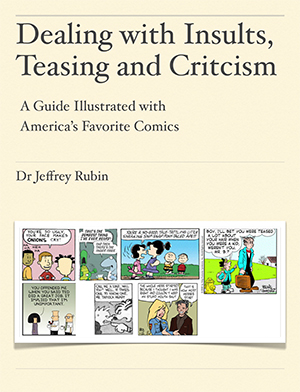
At the very top of any of my blog posts, you will see a heading that says, FREE BOOK: DEALING WITH INSULTS, TEASING AND CRITICISM. By clicking on this heading, you can download for free a PDF version of a book that utilizes America’s favorite comics to teach a number of important SEL skills. Once you download it, I recommend reading a chapter of the book once a week with your youngsters, and then discussing with them how the ideas might be used in something currently going on in their lives.
Once you finished all of the chapters of the book, I recommend playing a game designed to further enhance the learning of the skills taught in the book. The details of this game are provided in my post titled Teaching Children How to Deal with Criticism, and by clicking HEREyou can go directly to that post.
Briefly, the game is played in the following manner: One of the skills that the free book teaches people is to be able to recognize four levels of maturity for responding to criticism, with level one being the most immature, and each higher level viewed as being a little more mature. Your job, when playing the game, is to make up a brief story in which someone criticizes someone else. In your story, you explain how the criticized person responds to the criticism. Then the child guesses what level the response was at. So, for example, I could make up a simple story in which Lucy says to her brother, Linus, “You’re stupid!” Linus responds by saying “Oh yeah, well at least I’m not as stupid as you!” You would then ask your youngster, “What level is Linus’s response?”
After you discuss the youngster’s answer, you would then role-play the situation so that you provide the criticism and the child acts out a more mature response. If the child fails to do this correctly, reverse the roles by having the child criticize you and you provide a more mature response. Then let the child try to imitate your response.
By playing this game, youth become very familiar with how to respond to criticism in a mature manner, and learn to construe name calling, insults, and violent responses as signs of immaturity. Moreover, you will find that the game leads to your youngster sharing with you real life experiences with criticism, and together, you can both problem solve how to constructively handle them.
There are, of course, far more social and emotional skills for youth to learn besides how to respond maturely to criticism. Identifying different levels of maturity when it comes to providing criticism (see HERE) and learning how to deal with anger arousing situations (see HERE) are just a couple of important other examples.
These skills are not at all adequately learned by reading a single book. We must bring these issues before the youth’s mind at regular intervals over the course of several months, and then do so again and again for each year the youth is growing from childhood, to teenage years, and finally into adulthood. By reading with your youngsters, each of my blog posts, beginning from the first one, then moving on to the next one, and the next at a reasonable pace, perhaps once per week, this can be done in a fun manner for free. Directions for using this blog in this manner as a free SEL curriculum, see the paragraph below this post.
Finally, a wonderful way to have youth learn how to apply the skills into real life situations is by presenting a dramatic narrative that has characters the youth can easily identify with, struggling with tough issues. A Hero Grows in Brooklyn is one such narrative that is suitable for a general audience, and I have made it free for downloading on any computer or ebook reader (see HERE).
Okay then, there you have it, several suggestions for helping our youth learn SEL skills. Your efforts can play an important role in helping communities prevent violence, save an enormous amount of money, and increase the likelihood of a number of other highly valuable outcomes.
——————————-
Some people will enjoy reading this blog by beginning with the first post and then moving forward to the next more recent one; then to the next one; and so on. This permits readers to catch up on some ideas that were presented earlier and to move through all of the ideas in a systematic fashion to develop their emotional intelligence. To begin at the very first post you can click HERE.
“Good morning, Barbara,” I say, as my first counseling case walks into my office. I notice she looks a little angry. Upon sitting down, she declares, “I’m terribly frustrated. I’ve been depressed now for over two weeks, and I just can’t shake it!”
It’s easy for me to empathize because I regularly have bouts of what I refer to as melancholy. A deep anguish comes over me, and during this period I often begin to think about how I went through my father’s death when I was twelve, how I’m getting older and can no longer do the many athletic things that thrilled me when I was younger, and on and on. Sometimes these dark melancholy experiences come about because something clearly happened that upset me, and sometimes they seem to come out of the blue.
Beyond Listening in a Caring Manner
After listening in a caring way to Barbara for a few minutes, I ask her if something specifically happened that led her into her current emotional experience. Then I explore with her a question about how often she has these experiences and if she feels she has them more frequently than most people, about as often as most, or less than most. Then, I ask her about how she has been functioning in other areas of her life–sleep, eating, exercise, interpersonal relationships, work/school, household responsibilities.
You see, as people experience depression, or other concerns that often lead to a classification of having a mental disorder, some people go about their lives functioning as they typically were doing before the concern arose, while some find that in some areas they begin to function below the levels that are typical for them, while some find that their functioning increases in one or more areas. For example, some sleep about the same amount, some less, and some more. I have met people who, when they are depressed, start cleaning every inch of their home, while others find it difficult to get out of bed.
Also of interest when exploring a person’s expressed concern is to look at how the person had been functioning before the onset of the presenting concern. If some important relationships had begun to function below average, or if the person had been sleeping less than average to keep up with work demands, these facts can be insightful when seeking ways to address the presenting concern.
Now, once I found out what Barbara was concerned about, what might have precipitated the concern, and how she had been functioning in various areas of her life, I had a pretty good idea as to how to proceed in addressing her concern. I had no need to decide whether or not she had a mental disorder. However, many mental health practitioners are required to declare that the person seeking mental health services has a mental disorder if they want to get paid. Is this mental illness labeling really necessary?
Mental Illness Labeling Versus an Addressing Concern Approach
There are those who embrace this mental illness/disorder labeling. One reason is the pharmaceutical industry’s promotion of this idea to sell people on the idea that they need certain drugs to live a more normal, healthier life.
Beyond that, another major reason for this is that these individuals have a group of people in their lives that blame them for the way that they have been feeling or acting. When a doctor has declared, for example, that John Smith has a mental disorder, he may feel vindicated. “You see, there really is something wrong with me!” he may cry out in his defense.
In actuality, those who are doing the blaming may continue their blaming despite the doctor’s opinion. Moreover, many of us don’t blame people whenever they find some concern has arisen in their lives even if they are going through a non-illness experience. I know I’m not blaming myself when I experience melancholy, and I was not at all blaming Barbara for what she was going through.
Those who are uncomfortable about the use of “mental illness” terminology point out they are stigmatizing because they are used as put downs in our society. Moreover, the media associates the most heinous crimes with those referred to as the mentally ill even though the vast majority of those classified in this manner are not violent.
Among the most articulate individuals to voice objections to the mental disorder labeling was Harvard psychologist and philosopher William James. Over one hundred years ago he wrote a book titled, The Varieties of Religious Experience (1902). At that time many medical doctors argued that people who were religious were all mentally ill. In response, Professor James wrote:
Medical materialism seems indeed a good appellation for the too simple-mindedsystem of thought which we are considering. Medical materialism finishesup Saint Paul by calling his vision on the road to Damascus a discharginglesion of the occipital cortex, he being an epileptic.
Girl (6-8) praying, profile, close-up
It snuffs out Saint Teresa as an hysteric, Saint Francis of Assisi as an hereditary degenerate.George Fox’s discontent with the shams of his age, and his pining for spiritualveracity, it treats as a symptom of a disordered colon. Carlyle’s organ-tonesof misery it accounts for by a gastro-duodenal catarrh. All such mentalovertensions, it says, are, when you come to the bottom of the matter,mere affairs of diathesis (auto-intoxications most probably), due to theperverted action of various glands which physiology will yet discover.(p. 29)
James goes on from here to point out that it is true, of course, that psychology has found that there are definite psycho-physical connections that “hold good” (p. 30). Psychology, therefore:
assumes as a convenient hypothesis that the dependence of mental stateson bodily conditions must be thoroughgoing and complete. If we adopt theassumption, then of course what medical materialism insists on must betrue in a general way, if not every detail…. But now, I ask you, howcan such an existential account of facts of mental history decide in oneway or another on their spiritual significance? According to the generalpostulate of psychology just referred to, there is not a single one ofour states of mind, high or low, healthy or morbid, that has not some organic process as its condition. Scientific theories are organically conditionedjust as much as religious emotions are; and if we only knew the facts intimatelyenough, we should doubtless see “the liver” determining the dicta of thesturdy atheist as decisively as it does those of the Methodist under convictionanxious about his soul. When it alters one way the blood that percolatesit, we get the Methodist, when in another way, we get the atheist formof mind. So of all our raptures and our drynesses, our longings and pantings,our questions and beliefs. They are equally organically founded, be theyreligious or of non-religious content. (p. 30)
James points out that in the natural sciences and the arts it never occurs to anyone to refute opinions, beliefs and experiences by putting down their author’s neurological constitution. Value is determined by “judgments based on our own immediate feelings primarily; and secondarily on what we can ascertain of their experiential relations to our moral needs and to the rest of what we hold as true” (p. 33).
James was additionally concerned that medical materialism greatly overgeneralizes its knowledge of the connections between physiological variables and mind states. In James’s day, the pathology writers would take the few psychophysical correlations that they obtained under highly specialized conditions and then vaguely generalize their findings to discredit, to their satisfaction, all of the states of mind that they disliked.
The Modern Day View
Now, modern day psychiatrists sometimes respond,
“Well, certainly in James’s day we indeed knew almost nothing about such matters, but today our knowledge has vastly increased! Thus, James’s position is no longervalid because we can now make sound statements about the connections betweenphysiological states and mind states.”
To this, I respond that in point of fact there is currently a renewed respect for the extraordinary complexity
that exists during the integration process between mind, physiology, behavior, and environmental variables. Whereas it is true that there have been large gains in our knowledge, these gains are best likened to moving from a few drops of knowledge to a glass almost full; yet, to really understand the integration process, we would need oceans and oceans of knowledge. Trillions and trillions of interactions are involved.
It is for these reasons that the mental illness/disorder terminology is misleading. As Dr. Thomas Insel, the former director of the National Institute of Mental Health, recently said about the psychiatric labeling process known as the DSM.
The weakness [of the DSM] is its lack of validity. Unlike our definitions of ischemic heart disease, lymphoma, or AIDS, the DSM diagnoses are based on a consensus about clusters of clinical symptoms, not any objective laboratory measure. In the rest of medicine, this would be equivalent to creating diagnostic systems based on the nature of chest pain or the quality of fever. Indeed, symptom-based diagnosis, once common in other areas of medicine, has been largely replaced in the past half-century as we have understood that symptoms alone rarely indicate the best choice of treatment.
To hear and view other leading scientists further make this point, I highly recommend the following free video:
When individuals express a concern, exploring how they are functioning in the main areas of their life can be enormously helpful. Someone who reports a concern about experiencing depression, whom, by some gentle questioning, we find out has been functioning below average in the areas of sleep, interpersonal relationships, and exercise may benefit enormously if we work together on getting these areas of functioning in a more optimal range. This is true for those who report other types of concerns such as experiencing anxiety, hearing voices, below average range of attention, obsessive thoughts, and on and on. With a model that includes addressing concerns and exploring ways to improve functioning, labeling someone as having a mental disorder becomes unnecessary and may actually interfere with the aims of a counseling/psychotheraputic relationship.
For those who desire, for whatever reason, to be labeled as having a mental disorder, I am not proposing that we interfere with this. But for those who desire to have their concerns addressed by well trained mental health professionals without being referred to as having a mental illness or disorder, I do propose that we do provide a reasonable option for them to access mental health services. In my view, mental health professionals, once we hear our clients’ concerns and how they are functioning in the various areas of their lives, we have the basics to formulate, in full cooperation with our clients, a plan for addressing these concerns. I hope you give this some thought.
For those of you who would like to learn more about how an addressing concern approach would work and be consistent with science if adopted by mental health providers, you can access my peer reviewed article for free by clicking HERE.
Until next week, may you find some kindness out there in this fascinating world of ours.
My Best,
Jeff
———————————
Some people will enjoy reading this blog by beginning with the first post and then moving forward to the next more recent one; then to the next one; and so on. This permits readers to catch up on some ideas that were presented earlier and to move through all of the ideas in a systematic fashion to develop their emotional intelligence. To begin at the very first post you can click HERE.
Have you ever noticed that some rich people like to say insulting things about the poor, and some poor people like to say some insulting things about the rich. Well, since this blog is all about insults, as well as respect, let’s see if today we can throw a little sunshine on this.
As followers of this blog know, from time to time, I enjoy selecting one of Bob Dylan’s Theme Time Radio Hour shows to help us with these kinds of endeavors. Today, we’ll be utilizing Bob’s “Rich Man, Poor Man” theme.
Bob’s Introduction
Time for Theme Time Radio Hour. This week we’re going to take a look at two different kinds of people, them that’s got, and them that needs. We’re going to talk about a dichotomy between the rich man and the poor man.
As soon as Bob finishes this sentence, we hear an audio clip from a movie I can’t quite put my finger on, “If you permit me to say so, sir, the subject is not an interesting one. The poor know all about poverty, and only the morbid rich would find the topic glamorous.”
Then, Bob’s voice returns.
Bob Miller
Bob Miller wrote a song about both of them. He knew that poor people had something that no millionaire had–poverty. Here’s a story about a rich man and a poor man. The rich man steals a million from the bank that he controls, and the poor man steals a penny for a loaf of bread or a penny worth of rolls. One goes away laughing, while the other goes away in tears. The rich man gets an apology while the poor man gets ten years. All kinds of life lessons in this song with no crapola.
Then Bob plays Miller’s song, “The Rich Man and the Poor Man.” We get a pretty good sense of some of the resentment that poor folks feel in many societies from the opening lyrics:
There’s just two kinds of people, the sinner and the saint; There’s one that gets and always got while the other poor one ain’t. Oh, the rich man drives his Lincoln past the red light with a grin, And the poor man follows right behind in his little hunk of tin. There’s a motorcycle copper following upon their trail; Oh, the rich man tears his ticket, but the poor man goes to jail.
Here we get a pretty vivid sense of the resentment that can boil up within the hearts of many poor folks when they see incidents of being treated unfairly. This can lead some to start throwing around a few insults.
Bob’s Show Continues
After Bob’s introduction to his theme and his first song, he goes on to say:
That was Bob Miller, “The Rich Man and the Poor Man.” I’ve known both and there’s good in each.
Soon afterwards, Bob tells us about some people who have gone from rags to riches.
Little Richard
Some of the songs he subsequently plays are about the dreams some poor people have about becoming rich, including “Get Rich Quick” by Little Richard. Apparently, one day this guy he’s singing about dreams of going to the track with twenty dollars and coming home with twenty-thousand. And, of course, in his imagination, when this happens “every thing will be OK.” I hate to be the bearer of bad news, but I’ve read a few biographies and have come away thinking that for people who have gone from rags to riches, pure happiness doesn’t always come by quite so easily. Still, the rocking saxophones on that song makes it well worth a listen.
Next up, Bob plays “Charming Betsy” by the Farmer’s Boys.
Rich girl got married in a long white veil
Poor girl would like to have a train
My girl never said I do
But she does just the same
Here, I get the sense that the song writer, while recognizing that the poor may have the desire to have what rich folks have, if you have the love of your girl, well, in some ways it’s just the same.
Soon after the Farmer’s Boys song, Bob plays us another audio clip from a movie:
You see sir, rich people think of poverty as in the negative, as the lack of riches, as a disease might be called a lack of health. But it isn’t sir. Poverty isn’t the lack of anything, but a positive plague, virulent in itself, and contagious as cholera, with filth, criminology, vice and despair as only a few of its symptoms.
Instead of Looking Down Their Noses At the Poor, The Rich Would be Wise to Remember How Easily They Too Can Become Poor
Although some of the rich may look down at the poor, Bob wisely reminds all of us that with a little twist of society’s fortunes, the rich can turn rapidly into the poor. Thus, he says:
On October 24th, 1929 the stock market fell. On Black Friday, many rich men turned into poor men. Suddenly many of them were on the street corners selling apples. Whether it was Black Friday or today, there are too many people out there who need to ask, Brother, can you spare a dime? Here’s Bing Crosby on Theme Time Radio Hour.
Here are some of the words from Crosby’s touching song:
Bing Crosby
They used to tell me I was building a dream With peace and glory ahead Why should I be standing in line Just waiting for bread?
Once I built a railroad, I made it run Made it race against time Once I built a railroad, now it’s done Brother, can you spare a dime?
Once I built a tower up to the sun Brick and rivet and lime Once I built a tower, now it’s done Brother, can you spare a dime?
Say, don’t you remember? They called me ‘Al’ It was ‘Al’ all the time Why don’t you remember? I’m your pal Say buddy, can you spare a dime?
Shortly after the song, Bob provides us a quote from Confucius: “In a country well governed, poverty is something to be ashamed of; in a country badly governed, wealth is something to be ashamed of.” Hmmm, I think this is Bob’s way of reminding people that sometimes the wealthy have some responsibility for working toward a well governed country that gives everyone a fair chance.
When the Wealthy Hold Down the Poor
Louis Armstrong
When the show continues, we get to an uncomfortable situation, which Louis Armstrong emotionally captures in a song titled, “Hobo, You Can’t Ride the Train.” It tells about how the rich has put this middle class railroad brakeman in charge of making sure the hobos don’t sneak on the train. Let’s look at some of its words, sung in Armstrong’s familiar raspy voice:
Oh Hobo, hobo you know you can’t ride this train
Now hobo now listen here hobo
I told you you can’t ride this train
You done forgot I’m the brakesman on this train boy, I’m awful tough I’m awful mad
I’m telling you (ha, ha, ha)
You gotta give me something boy oh yeah
Hobo you can’t ride this train
As I said before, hobo hobo
You know you can’t ride this train
Ah hobo hobo you know what big boy I’ll let go
I’ll give you a break, you’re all right
Here we get a sense that the singer knows he’s getting paid to keep the hobo off the train, and he’s trying to be light about it. At one point he thinks, maybe he can get something out of the hobo, by saying, “You gotta give me something boy oh yeah.” But in the end, the singer decides to give the hobo a break.
Clark Gable
In case we are too quick to think that hobos were just a bunch of rotten, no good folks who deserved to be poor, Bob tells us about a number of people who many of us have come to admire who had been hobos at various points in their lives–heavy weight champion Jack Dempsey, actor Clark Gable, singer Woody Guthrie, and writer Eugene O’Neill.
The next song Bob plays, Woody Guthrie’s “Do Re Mi,” is very sad. It tells the tale of folks during the great depression trying to get to California to find a way to escape desperate poverty.
Woody Guthrie
Lots of folks back East, they say, is leavin’ home every day, Beatin’ the hot old dusty way to the California line. ‘Cross the desert sands they roll, gettin’ out of that old dust bowl, They think they’re goin’ to a sugar bowl, but here’s what they find Now, the police at the port of entry say, “You’re number fourteen thousand for today.”
Oh, if you ain’t got the do re mi, folks, you ain’t got the do re mi, Why, you better go back to beautiful Texas, Oklahoma, Kansas, Georgia, Tennessee. California is a garden of Eden, a paradise to live in or see; But believe it or not, you won’t find it so hot If you ain’t got the do re mi.
The Perspective of the Rich
About halfway into the show, Bob say:
We’re talking a lot about poor people; let’s go on the other side of the track. I like talking about the rich men a little better. They’re a little more happy go lucky. You know what’s better than a little money? A lot of money.
Liliane Bettencourt
The richest woman in America in 2005 was Liliane Bettencourt, the daughter of L’Oreal founder. She’s worth around 16 billion. That’s billion, with a “B.” Wow! That’s a lot of bazoma! Another rich woman is Betty Nesmith Graham. She invented liquid paper, and when she passed away, she left her 50 million dollar estate to her son, former Monkey, Mike Nesmith. Gives new meaning to be rich on paper.
Back to the Other Side of the Tracks
Bob only spends a few minutes discussing the rich person’s experience, quickly returning us to songs like Johnny Rivers’s popular “Wrong Side of The Track” and Emmylou Harris’s lovely “Hobo Lullaby.” I would have liked him to try to get more into why so many of the rich look down on the poor, but his sympathy clearly is on those less well off.
Ben Franklin
As the show begins to close, Bob tells us, “If you are poor, I hope you get rich, and if you are rich, I hope you get happy.” Finally, he says, “I’ll leave you with the words of Benjamin Franklin, ‘He that is of the opinion that money will do anything may be suspected of doing everything for money.’ Thank you Ben. Peace out.”
And so, with those words, Bob ends his show. But before I sign off today, here’s a few parting words of my own.
Throwing insults at anyone, whether at the rich or poor, is not going to help anyone. If you experience a twinge of resentment over these types of issues, I can certainly understand that. But it is whether or not you can transform these twinges into something really positive that will determine whether you end up with just a bunch of awful feelings, or, alternatively, increase the respect you have for yourself.
Here’s one suggestion that has worked for me. When I notice this experience within myself, I find a time to sit for five minutes with my eyes closed. During these five minutes, I experience fully how this resentment is being expressed within my body. Maybe it is felt as a tightness in my chest, a wringing in the pit of my stomach, a clenching of my fist, or a crunching of my muscles around my forehead. I just fully observe these physical sensations for a full five minutes. Then I plant a seed by saying to myself, “I hope that at some point I can come up with a way to transform this experience into something useful and genuinely helpful.”
At one point, what came out of this experience is this idea that although it is certainly kind to give a hungry person a fish, in the long run it is even more kind to find ways to teach a hungry person to fish. With this in mind, I worked for many years in school systems doing my best to remove blocks that were getting in the way of students learning. And more recently, I have created this blog, “From Insults to Respect,” as a curriculum that is free to both the poor and the rich. It is designed to be a tool that can help people to learn some crucial skills for climbing the true ladder of success.
And with that, I hope you visit “From Insults to Respect” again real soon. Until then, as Bob says, “Peace out!”
——————————-
Some people will enjoy reading this blog by beginning with the first post and then moving forward to the next more recent one; then to the next one; and so on. This permits readers to catch up on some ideas that were presented earlier and to move through all of the ideas in a systematic fashion to develop their emotional and social intelligence. To begin at the very first post you can click HERE.
Republican presidential candidate Donald Trump gestures and declares "You're fired!" at a rally in Manchester, New Hampshire, June 17, 2015. REUTERS/Dominick Reuter TPX IMAGES OF THE DAY - RTX1GZCO
When it comes to insulting people, Mr. Donald Trump is New Jersey Governor Chris Christie on steroids.
The Paradox
Among Mr. Trump’s insults are calling some people “fat pigs” and “disgusting animals.” During his first presidential campaign, I observed him on national TV calling Senator Lindsey Graham “a stiff,” Governor Rick Perry “stupid,” and numerous other political opponents, “idiots.” He has denigrated federal judges who ruled against his efforts that sought to suspend refugee flows.
In an earlier post about Gov. Chris Christie’s use of insults, I described the following apparent paradox. On the one hand, there is a considerable amount of evidence that people who are very insulting tend to be less liked and respected. On the other hand, Former Gov. Chris Christie is well known to be very insulting, and despite this, he was twice elected governor of New Jersey, and at one point he was viewed as a front runner for the next U.S. presidential election. Here is a man that many people came to admire.
Now we see that Gov. Chris Christie has fallen in the respect others had had for him, while Mr. Trump has taken his place as a big time insulter who, despite his insulting ways, has gained respect from some and in 2016 received enough votes to get him elected US president. As I did when Gov. Christie was the king of insults, in today’s post I want to take this opportunity to explain this apparent paradox.
Explaining the Paradox
First of all, the negative effects of being insulting is strongest in interpersonal and intrapersonal relationships. As I define these terms, your interpersonal relationships are your interactions with people with whom you have direct, face to face interactions on an ongoing basis; your intrapersonal relationships involve interactions that you have with yourself.
The relationship that politicians have with voters is best viewed as an intergroup relationship, rather than either an interpersonal or intrapersonal relationship. The intergroup relationship I’m discussing today regarding politicians involves the group of people who might potentially vote for them, the group of people who have a vested interest in getting the politician elected, and the groups of people who are working to get someone else elected. Although insulting people is relevant to intergroup relationships, other issues often become more important. In an interpersonal relationship, if you attempt to insult the person with whom you are personally interacting, that person might insult you back and the interaction can escalate into violence. In fact, the most common reason people turn to violence is because they felt someone treated them disrespectfully.
When we see politicians seeking to insult someone, they are modeling for others this type of violence producing behavior. But what makes this type of behavior very different for politicians is that they almost always have a group of supporters standing behind them and a team of armed security personnel well trained to intervene if an insulted party makes any moves at all that can be viewed as violent. Under this set of circumstances, it is far safer to play the part of a tough guy who doesn’t take any crap. Meanwhile, as politicians like Mr. Trump model this behavior for people without the protections afforded to politicians, it can potentially increase levels of violence for non-politicians.
Here’s another difference between what typically happens during your interpersonal relationships and the intergroup interactions that involve politicians. When someone directly seeks to insult you, unless you are well trained in handling this in a peaceful manner, you are likely to take the insult personally. The emotions that arise in this situation are more likely to be stronger than typically experienced when groups of people see on TV or in a large arena a politician throwing insults at someone they don’t personally know.
Politicians, moreover, are not seeking to develop a sound interpersonal relationship with you. They are, instead, seeking your vote. They know very well that not everyone is going to vote for them. If they anger the voters who aren’t likely to vote for them anyway, and end up getting 51 percent of the vote, this, to them, is success.
Now, when it comes to interpersonal relationships, if you act in a manner that leads to even a minority not liking you, this can lead to far more direct problems for you than if a minority of people don’t vote for some politician. If those who personally know you don’t like you, they can begin to say things behind your back to people who actually personally interact with you. Some of what gets said can be untrue and very unfair, but you may never hear about this. This behind your back treatment may result in people that you like no longer inviting you to parties. When you used to be invited to go bowling, now someone else is getting invited. In a work setting, you may be passed up for promotion. These types of consequences can have direct effects on your personal life. For Mr. Trump, the personal effects that may occur if he angers a minority of people who would have been unlikely to vote for him, would be far less important to him than getting elected.
Also, note that when people decide on who to vote for, they consider many issues, not just whether or not the candidate insults anyone. When Mr. Trump insults someone, many voters are apt to say to themselves, he isn’t doing anything much different than all the other politicians. These voters then choose a candidate based on other issues. If some voters recognize that Mr. Trump insults others a bit more than other candidates, they may feel that his stand on immigration is a far more important issue for them.
Others will actually like the insulting because the insults are aimed not at them, but at people whom they have come to dislike. If you have become angry because you like to use the “N-word” and people have criticized you about it, you may have become angry about what strikes you as political correctness. When Carl Tomanelli, a 68-year old retired New York City police officer was asked by a New York Times reporter why he is supporting Mr. Trump, he answered, “People are starting to see, I believe, that all this political correctness is garbage. I think he’s echoing what a lot of people feel and say.”
Other voters are very angry at the lack of progress being made by current career politicians on solving immigration, economic, and other problems. Many of these voters’ own personal style for dealing with this anger is to throw insults at these politicians. When Mr. Trump does the same thing, these voters see him as one of them. These same individuals are apparently unable to see that if he was throwing the same types of insults at them, they would not like this. To them, it’s perfectly okay to insult people they have come to not like. If someone insults them, however, their blood would boil. It seems to me that because it is wrong for people to insult them when someone disagrees with them, it is equally wrong for them to insult others when they disagree with others.
Many like to characterize Mr. Trump’s use of insults as his way of being a tough no-nonsense kind of guy. But in my view a person can surely be a tough no-nonsense kind of guy without seeking to insult people.
When asked why he uses insults, Mr. Trump at times says that those whom he insults, insulted him first. It is true that he does often get insulted. Recently I’ve seen him called a“feckless blowhard,” a “jackass,” “reprehensible,” “vile,” “absurd,” “pathological lier,” a narcissist, and “shameful.” But those who insult him often say they do it because he insulted either them, or someone they personally know. And so many who are either leaders of our nation, or hope to be so, are choosing to engage in this “You Started it First” name-calling game.
It is simply not true that if someone throws an insult at you the only intelligent way to respond is to seek to insult them back. In my view, within the political arena, one way to respond in a manner that I would respect is to state firmly, “I’m not here to get into this name-calling game. I’m here to let the public know what my positions are on the problems of this nation, and how I, if elected, plan to go about fixing them.”
Yes, initially politicians can get a great deal of attention for being extra insulting. This increases name recognition, and a subgroup of people will initially admire the politician for it. But is it a lasting valuable asset? Although Mr. Trump won the most electoral votes in 2016, polls regularly indicated he was the most disliked candidate in history. Moreover, Mr. Trump had millions of dollars of contracts cancelled when he made a comment that many immigrants found offensive. And he lost the following election. So, perhaps his insulting behavior is not such a winning tactic as some may think.
I hope this post will help you to think twice if you think that the type of insulting behavior Mr. Trump uses is effective in your own interpersonal and intrapersonal relationships.
———————
Some people will enjoy reading this blog by beginning with the first post and then moving forward to the next more recent one; then to the next one; and so on. This permits readers to catch up on some ideas that were presented earlier and to move through all of the ideas in a systematic fashion to develop their emotional intelligence. To begin at the very first post you can click HERE
On August 8, 2015, I spoke at the American Psychological Association’s annual convention that was held in Toronto, Canada. My speech was part of a two hour symposium titled: “Beyond the DSM–Current Trends in Devising New Diagnostic Alternatives.” The DSM’s letters stand for the Diagnostic and Statistical Manual of Mental Disorders. It is currently used by most mental health professionals to classify people seeking mental health services.
When the latest version of this manual came out, it was widely criticized. Consequently, a group of psychologists began to work together to think about possible alternatives. Several members of that group spoke at this symposium.
My Speech
Of late, I have been discussing today’s symposium theme with quite a few people. I have found that supporters of the DSM say that it is a classification system that has been helpful because it provides a common language for mental health professionals to communicate about those utilizing their services; its various diagnostic terms, such as Major Depressive Disorder, Anxiety Disorder, etc., are short phrases that are convenient for placing them into article titles, book titles, and search engines to retrieve valued relevant information; third party payers of mental health services have found that the DSM coding system works well as part of a practical method for their record keeping; with the aid of these codes, people do manage to access mental health services, mental health service providers do manage to get paid, and for-profit health companies do tend to make a profit.
So, from my discussions, those are the basic reasons supporters of the DSM say that it is useful. Actually, there is another usefulness of the DSM that, interestingly, I never hear supporters of the DSM mention, and yet critics of the DSM often mention. That usefulness is this: by using medical sounding terms to refer to all of the experiences that the DSM classifies as “mental disorders” it legitimizes in the minds of many the prescribing of drugs for these experiences.
There is an enormous amount of money being made from this approach because it takes less than a penny to manufacture each pill, and it can be sold for more than one thousand times that amount. With so much money being generated from this enterprise, the drug companies have managed to make it clear to powerful groups that what benefits the drug companies also benefits them. Examples are, major media outlets gain enormous revenues from drug company advertisements, and political campaigns get substantial support from the industry.
So this benefit is in a sense the elephant in the room. I fully see it, but nevertheless, I want to move it off to the side of the room for now, and ask you all to briefly ignore it. After I complete my main ideas, I’ll return to the elephant in my concluding remarks.
Keeping in mind just the usefulness of the DSM that its supporters tend to mention, it seems to me that if we are to have any hope that an alternative to the DSM might be widely adopted, we would have to be able to make an excellent case that the alternative would be just as helpful while, at the same time, have significantly less shortcomings.
What are these shortcomings? Well, in brief, critics of the DSM have expressed concerns that it tends to be stigmatizing to mental health service users; the DSM also simplistically devalues all of the experiences that it classifies as mental disorders despite the fact that there are a great number of people who have testified that having gone through these very types of experiences it brought forth valued fruits.
Leo Tolstoy
For example, Leo Tolstoy reported in his biography, My Confession, that by going through a period of suicidal depression, it led to one valued insight after another.
Joni Mitchell
As another example, the fine song writer, Joni Mitchell apparently went through, during her life, a number of very challenging emotional experiences that first received the full DSM psychopathologizing treatment. In time, her perspective changed, and at one point she expressed her new perspective in a song titled, “Hejira.” She wrote, “There’s comfort in melancholy where there is no need to explain, it’s just as natural as the weather in this moody sky today.” Thus, for many, the framing of their experiences as mental disorders dramatically misses the mark; critics of the DSM also point out that it violates basic principles of science because of its vaguely defined constructs and thus low inter-rater reliability; the DSM also violates basic principles of humanistic psychology; and within the mental health field the DSM is a monopoly, with all of the drawbacks associated with such an organizational situation.
So, those are, in brief, the DSM shortcomings. Keeping them in mind along with its perceived benefits, is it possible to come up with an alternative that indeed does achieve all of the benefits that the DSM supporters claim for it, while, at the same time, has far fewer shortcomings? Well, for your consideration, I offer you the Classification and Statistical Manual of Mental Health Concerns, or, for short, the CSM. Not the DSM, but the CSM! Let’s look at what each chapter would contain.
Chapter 1
The first chapter would begin by stating that the developers of the CSM fully recognize that individuality outruns any classification system. It is for this reason that the CSM does not seek to classify anyone. Instead, it classifies the expressed concerns of individuals seeking to have their concerns addressed by a mental health service provider.
This first chapter would go on from here to explain that the CSM begins from the perspective of the person seeking services. Because the expression of a mental health concern is a clearly observable event that occurs at a specific time and place, by making it the event being classified in the CSM it solves the reliability problems that have been plaguing the DSM’s far more abstract concept of “mental disorders.”
After this statement, the CSM would clearly define its main construct:
A mental health concern occurs when a person seeking mental health services expresses to a mental health service provider a concern about any of these topics: behavior, emotion, mood, addictions, meaning of life, death, dying, managing chronic pain, work, relationships, education, eating, cognition, sleep, and challenging life situation.
So, those are the basic ingredients of Chapter 1.
Chapter 2
Chapter 2 would begin by explaining that the CSM has two classes of expressed concerns–Concerns expressed about oneself, and concerns expressed about someone else. An example of the first class is, Sally is seeking mental health services and expresses a concern to a mental health service provider that she has been experiencing a great deal of anxiety when she enters social situations. An example of the second class is Bob, a father, upon seeking counseling for his son, expresses a concern about his child’s behavior.
Each of these two classes of concerns would have under each of its headings a list of specific concerns, along with an assigned code to be used for third-party payer record keeping.
So, let’s quickly return to the example of Sally expressing a concern that she has been experiencing a great deal of anxiety in social situations. This would be referred to, for classification purposes, as a “social situation anxiety” concern. Notice that “social situation anxiety” is just three words, thus it is short enough to be used in article titles, book titles and search engines.
Each of the actual expressed concerns would be just as useful as the DSM terms for providing those in the mental health profession a common language for communication about those utilizing their services.
In this chapter 2, it would be explained how the creators of the CSM identified the list of concerns included in the CSM. These concerns would be identified by a survey of a sample of mental health service providers. Those filling out the survey would first read the definition of a mental health concern. Then they would list, in order of frequency, the various concerns that they had been asked to address in their practice over the course of the previous year. At the back of the CSM would be a summary of the findings of this survey and its related statistics.
Moving on to Chapter 3
As noted, the previous chapter would be designed to provide the method for identifying and coding a set of brief mental health concern descriptors suitable for a number of practical purposes. Once this is achieved the CSM then provides a method to develop a lengthier psychological formulation approach that is designed to fill in additional details about the expressed concern. Thus, Chapter 3 of the CSM would be devoted to describing good practice guidelines for the use of a type of psychological formulation that is consistent with the CSM’s philosophy of not psychopathologizing individuals. This type of psychological formulation provides an approach that expands on the brief expressed concerns of individuals by developing a narrative of several paragraphs. It can be defined as the process involving a mental health service user and a mental health service provider co-constructing a hypothesis or ‘best guess’ about the origins of the mental health service user’s concerns in the context of his or her strengths, relationships, social circumstances, cultural heritage, life events, and the sense that he or she has made of them.
Defending the CSM
Okay, these are the basic chapters of the CSM. Now let’s quickly recall that supporters of the DSM believe that it is a classification system that is useful because it provides a common language for mental health professionals to communicate with one another. I hope from what I have already said, that you can plainly see that the CSM would provide an alternative plain, humane language that would be just as practical as the DSM. But let’s look a little more closely at this via an example.
When I was doing my practicum at the University of Minnesota’s Counseling Center, I worked there for a whole year and we had no need to use the “mental disorder” jargon of the DSM to communicate. When my advisor asked me to quickly tell him about my morning cases, I would reply with words like, “My 9:00 a.m. case is concerned about feeling depressed, my 10:00 case is concerned about his failing grades, my 11:00 case is concerned about how anxious she is in social situations. If my advisor wanted to know more about a case, we went into the psychological formulation type of information. Communication flowed easily. This is how the CSM would work in practice.
The idea that the DSM’s coding system is a practical approach for third party payers’ record keeping is an essential point made by DSM supporters. With the following description, I think you will readily see that the CSM approach is just as practical.
Third party payer systems have a form that must be filled out whenever someone seeks mental health services under their plan. This form has a little box that currently says, “Diagnosis.” In that box, mental health professionals are required to fill in the DSM code that corresponds to their so-called diagnosis of the person seeking services.
With the CSM proposal, all that we would be asking third-party payer institutions to do differently in order to add value for their customers, is to slightly change that little box. Instead of just saying “Diagnosis” as it currently says, that box would add two simple words, so it would end up saying “Diagnosis or Concern.” Then, when mental health professionals fill in the box, they would be given the choice to either write in the letters “DSM-5” and its code number that corresponds to its so-called diagnosis, or they would write the letters CSM and its code number that corresponds to the expressed concern.
With the creation of the CSM, not only will mental health providers have a new option to choose from, but so too will mental health consumers. They would be given the choice to go to psychopathologizing mental health service providers or those using the CSM approach.
So, for third party payers, that’s all the change that would be required in order to increase value for a significant number of mental health providers and service users. And a major goal that all third-party payers have is to increase value for their customers. The cost and effort for adding this new option for these payers would be minimum.
Conclusion
In conclusion, the creation of the CSM would improve value for consumers of mental health services. It would provide a practical approach that offers a new choice for those mental health service users and providers who are dissatisfied with the DSM. It does so in a manner that is more scientific and humanistic. Moreover, the creation of the CSM would break up the DSM monopoly.
Now, let’s return to the elephant in the room. Let’s bring it forth, front and center.
Yes, the DSM’s medical jargon has an enormous benefit to the pharmaceutical industry. However, with the creation of the CSM, the elephant would still get fed. Those who prefer the DSM to the CSM would be able to continue to use it. The pharmaceutical industry will still be able to promote the drugs with images of a patient looking miserable and family members distraught, all in grey, black and white, followed by images of the same patient taking a pill, now smiling in vibrant living color, with the sun shining, and family members gathered around, and bouquets of flowers brightening the whole world. There will be plenty of people who will still seek to have their concerns washed away with the ease of swallowing a pill.
Despite drug companies being able to still make a great deal of money even if the CSM was to become widely adopted, no doubt the industry as a whole would still seek to try with all its might to maintain the monopoly it currently enjoys. No doubt, big money can be very influential in putting a stop to competition. I get that. But to help us to think a little more clearly about this, let’s use a metaphor fitting to our country’s current enormous interest in the presidential primary campaigns.
You all know about the discussions going on about how a few billionaires has so much influence on who will get to win. There is much truth to this concern, but I ask you to keep in mind that every now and then, a dark horse comes along that does manage to win despite all of the big money that went to supporting the favorite of the super-rich.
In my view, the CSM has the potential to be that type of dark horse. I’m hoping that this is so because there exists enough psychologists out there who are willing to roll up their sleeves and get down to do the necessary work of joining their efforts with those of other allied professionals and mental health consumer advocacy groups because they believe this is in the best interest of those they seek to serve.
——————–
Some people will enjoy reading this blog by beginning with the first post and then moving forward to the next more recent one; then to the next one; and so on. This permits readers to catch up on some ideas that were presented earlier and to move through all of the ideas in a systematic fashion to develop their emotional intelligence. To begin at the very first post you can click HERE.
You say that you’re down on your luck. Well, most of us have found ourselves down there. I know I have, so, welcome to the club.
It just so happens that how you handle this period of time can lead you to lose your self-respect, and for others to also lose their respect for you; or it can be a great period of time during which you end up dramatically increasing your self-respect, and the respect others have for you.
How do we go about taking the preferable course? Bob Dylan’s Theme Time Radio Show on “Luck” provides some important lessons.
Bob starts the show off with Paul Evans singing, “Happy Go Lucky Me.”
I can laugh When things aint funny (A haha) happy go lucky me
Yeah, I can smile When I aint got no money (A haha) happy go lucky me
Paul Evans
It may sound silly but Mmm, I don’t care I got the moonlight I got the sun I’ve got the stars above
Me and my filly well, we both share This slappy go happy, happy go lucky looovve
Well! Life is sweet whooa sweet as honey (A haha) happy go lucky me
The song tells us about a guy who, even when he’s down on his luck, can appreciate moonlight, the sun and the stars. At the same time, there is a laugh at the end of the song that sounds clearly strained. This is indeed part of the experience, and it is normal to spend some time being with the strained feelings. As we do, some find it helpful to gently remind themselves that there are aspects of life that are “sweet whooa sweet as honey.”
Next up on Bob’s show is B. B. King, king of the blues, singing “Bad Luck Soul.”
I ain’t got nobody and I don’t know what to do They say things will get better But I don’t believe it’s true I thought I had friends, but they all disappeared Doggone bad luck soul
Everything I do people Everything I do seems to be wrong It wouldn’t be so bad if I knew I had a home
With blues like this, there is an acceptance that spending time experiencing sadness, anguish, and tears is part of life and something all human beings have in common. Blues music is popular with many of us precisely because as we listen, we experience a sharing of our personal grief with the blues artist. As down as we may feel, there is some comfort in knowing others go through this as well.
Today, it is popular to just try to snap out of these experiences, perhaps by going to a psychiatrist to get some pills. For me, personally, in addition to listening to some blues music, I meditate twice a day. I find that as I meditate, there are times when I experience waves and waves of bluesy feelings. In meditation, during these times, there is no need to explain, no need to try to talk myself out of this experience. I just experience its fullness, its richness as it enriches my soul.
In the most difficult of these kinds of experiences, it can feel like an awful punch in the gut, and the such feelings can sometimes drag on hour after lonely hour, then spill over from one day to the next, and at various points I might cry out in anguish, “Please god, please make it stop!” So, in no way do I mean to suggest that with meditation such experiences can be a breeze to get through.
Ralph Waldo Emerson
On Bob’s Theme Time Radio show, he likes to read us some poetry from time to time. On his “luck” show, he tells us that Ralph Waldo Emerson once said, “Shallow men believe in luck, strong men believe in cause and effect.”
A little later, he tells us that,
Emily Dickinson had some feelings about luck. She didn’t think it was chance at all. Here’s what she had to say, “Luck is not chance, it’s toil. Fortune’s expensive smile is earned.”
Hmm. Upon thinking bout this, I think the quote is worth thinking about, but at the same time, it’s important to recognize that we can experience some bad luck that is in no way our fault. The families that lost love ones from the World Trade bombings, and suffered from that loss, hardly could be blamed for what had occurred.
This point is relevant as we move on to the part of Bob’s show when he answers his emails.
This one’s from William McDuff. He writes, “Dear Bob, I heard that next weeks’s subject is going to be about luck. Well, I’m the original bad luck kid. If it started raining soup, I’d be stuck with a fork. What can I do to turn my luck around?”
Well, Bill, you don’t mind if I call you Bill, do you, there is no such thing as bad luck. As Ray Kroc, who started McDonald’s once said, “Luck is a dividend of sweat. The more you sweat, the luckier you get.” Henry Ward Beecher, believed pretty much the same thing. “I never knew an early rising, careful, prudent man, careful of his earnings, and strictly honest who complained of bad luck.”
I hope your luck turns around Bill, and even if it doesn’t, you’re always welcome here on Theme Time Radio Hour, where we like to remind you that in the words of Roosevelt Sykes, “You can’t be lucky all of the time.”
I think Bob’s point is well worth thinking about, but at the same time, if you take from it the belief that falling on bad luck is always your fault, that would, in my opinion, be a mistake.
After Bob’s response to this email, he plays Sykes’ blues song, “You Can’t Be Lucky All of the Time,” which tells us about a woman who has been, of late, very lucky, but she may not want to rest too comfortably upon this luck for long because hard luck may be just around the corner.
After a few more songs, it’s poetry time once again:
Robert Burns
The poet, Robert Burns had a few words to tell us about the fickle fortune of luck. Let me share them with ya.
Though fickle Fortune has deceived me, She promis’d fair and perform’d but ill; Of mistress, friends, and wealth bereav’d me, Yet I bear a heart shall support me still.
I’ll act with prudence as far ‘s I’m able, But if success I must never find, Then come misfortune, I bid thee welcome, I’ll meet thee with an undaunted mind.
Of the last few great songs that Bob plays on this edition of “Theme Time Radio Hour,” I liked the best, Wynn Stewart’s “Three Cheers for the Loser.”
Wynn Stewart
Now gather around me blues I’d like to make a toast Let’s all extend three cheers To a guy that’s lost the most
I don’t want your pity Or your sympathy Just three cheers for the loser That’s me
Well, I set out to win her Knowin’ I might lose I didn’t think I’d end up Talkin’ to the blues
The only thing I didn’t lose Is her haunting memory Three cheers for the loser That’s me
Now blues I stand before you And I’m still hurtin’ yet The things I’ve been through You know I won’t forget
Still I took it like a man You know I set her free Three cheers for the loser That’s me
Frank Sinatra
Bob closes his “Luck” show with a great, swinging rendition of “Here’s to the Losers,” sung by old blue eyes, Frank Sinatra:
Here’s to those who love not too wisely, know not wisely, but too well To the girl who sighs with envy when she hears that wedding bell To the guy who’d throw a party if he knew someone to call Here’s to the losers, bless them all
Here’s to those who drink their dinners when that lady doesn’t show To the girl who’ll wait for kisses underneath that mistletoe To the lonely summer lovers when the leaves begin to fall Here’s to the losers, a-bless them all
Hey, Tom, Dick and Harry, come in out of the rain Those torches you carry must be drowned in champagne
Here’s the last toast of the evening, here’s to those who still believe All the losers will be winners, all the givers shall receive Here’s to trouble-free tomorrows, may your sorrows all be small Here’s to the losers, bless them all
Well, that’s my show for this week. Till next time, whether your luck is up or down, you can count on the mighty wheel of fortune to keep turning round.
———————————
Some people will enjoy reading this blog by beginning with the first post and then moving forward to the next more recent one; then to the next one; and so on. This permits readers to catch up on some ideas that were presented earlier and to move through all of the ideas in a systematic fashion to develop their emotional intelligence. To begin at the very first post you can click HERE.
This blog has frequently advocated that it is beneficial for all if we treat others respectfully. At times we focussed on a respectful way to provide negative criticism–no glares, insults, threats, or shouts, and with enough details so that the criticized person, if he or she wills, can improve the behavior, idea, or appearance. At other times, we focussed on the best way to respond to negative criticism–listen in a supportive, warm, friendly style, and then make it clear that we fully understand what was said by providing a summary.
Although posts like these were generally well received, some comments argued that they didn’t apply to work settings. “A good boss doesn’t have time to be nice!” claimed one person. Another argued that “A boss has to be tough or he or she will be taken advantage of, and the whole organization will end up suffering.”
Well, an excellent article once appeared in the New York Times that delves into this issue. Titled “No Time to Be Nice,” the author, Christine Porath, tells us that how we treat one another at work matters. “Insensitive interactions have a way of whittling away at people’s health, performance and souls.”
Early in the article, Ms. Porath reviews research demonstrating that stressful jobs increase the risk of a cardiovascular event by 38 percent, and a major source of work related stress is how the boss treats employees.
Bosses produce demoralized employees through a string of actions: walking away from a conversation because they lose interest; answering calls in the middle of meetings without leaving the room; openly mocking people by pointing out their flaws or personality quirks in front of others; reminding their subordinates of their “role” in the organization and “title”; taking credit for wins, but pointing the finger at others when problems arise.
Although in surveys people say they are afraid they will not rise in an organization if they are really friendly and helpful, research evidence indicates the opposite is true–behavior involving politeness and regard for others in the workplace pays off. Those seen as civil were twice as likely to be viewed as leaders.
Ms. Porath tells us:
Civility elicits perceptions of warmth and competence….these two traits drive our impressions of others, accounting for more than 90 percent of the variation in the positive or negative impressions we form of those around us. These impressions dictate whether people will trust you, build relationships with you, follow you and support you.
The reason that some people don’t believe the research findings is that they see mean bosses who seem to succeed despite being rude and thoughtless. Whereas it is true that some bosses can be highly successful while being mean, it is not being mean that makes them successful. They succeed despite their incivility, not because of it. If they happen to have highly talented people working for them, or their company is particularly profitable because their product is much better than the competition, the boss may get the credit. But studies reviewed by Ms. Porath demonstrate that the No. 1 characteristic associated with an executive’s failure is an insensitive, abrasive or bullying style.
Power can force compliance. But insensitivity or disrespect often sabotages support in crucial situations. Employees may fail to share important information and withhold efforts or resources. Sooner or later, uncivil people sabotage their success — or at least their potential. Payback may come immediately or when they least expect it, and it may be intentional or unconscious.
There is far more in the “No Time to Be Nice” article worth studying, and I highly recommend giving it a thorough read. Ms. Porath’s article is a breath of fresh air to all of us who advocate that treating people respectfully is in all of our best interests.
———————————
Some people will enjoy reading this blog by beginning with the first post and then moving forward to the next more recent one; then to the next one; and so on. This permits readers to catch up on some ideas that were presented earlier and to move through all of the ideas in a systematic fashion to develop their emotional intelligence. To begin at the very first post you can click HERE.
Habitual ways of acting often can’t be overcome by a single discussion. Thus, it helps to bring before our conscience some ideas a few times over the course of several months. With that in mind, let’s review some of the ideas we have discussed earlier on this blog about conflict and the desire to be liked. By utilizing a fresh new batch of comics I hope to demonstrate that we can have some fun as we go about this.
Letting Someone You Like Know You Like Them is a Key to Resolving Many a Conflict
As good old Charlie Brown makes clear, it is hugely important for him to be liked. This happens to be true for most of us.
As we discussed in an earlier post, this desire to be liked often becomes threatened when we find that we are embroiled in a conflict. To settle things down to a level at which reasonableness has a chance to prevail, if you happen to like the other party, you might find it helpful to mention this.
I remember one time long ago when I was a mere eighteen years old, I had planned to go to see a movie with a friend. He arrived so late that we missed the show and I became angry.
Did I have a conflict with my friend? On this blog, when we look to see if there is a conflict in a situation, we use the phrase “DIG for the conflict” to help us to answer this question. The word DIG helps us to remember to look for a desire, something that interferes with the desire, and if someone feels someone is guilty of doing something wrong. In the situation I described, I desired to go see this movie and my friend interfered with this desire by arriving late. I felt he was guilty of being inconsiderate. And so I did end up having a conflict with my friend for coming late.
When we use the DIG Conflict Model, we also use the word DIG to remind us to dig a little deeper when thinking about a conflict. A tool that we use to dig deeper is to remember that people typically desire to be liked. With that in mind, can I describe a different type of conflict that occurred within me when my friend came late? Here’s one. I desired to be liked and when my friend came late I felt he interfered with this desire because it seemed to me that if he really liked me, he would have shown up on time. I felt he was guilty of treating me disrespectfully.
Back then when I was eighteen, how did I react to my friend coming late? I started shouting and calling him names. A popular way for people to respond to the way I was acting is to shout louder and to try to return the insults with insults. But rather than throwing insults at me, this friend of mine quietly heard me out, and then he looked sadly down at the ground for a few seconds, then he looked up into my eyes, and said softly, “Jeff, your friendship means a lot to me. I like you a ton and a half. I’m real sorry I was late.”
My anger eased, and within a few minutes we were having our usual good time together.
Responding to Criticism Immaturely Can Leave You All Alone
Here we see that Lucy interprets Charlie Brown’s question as criticism. She responds by shouting and displaying other signs of defensiveness such as wildly waving her fists all around. Charlie Brown soon hurries away.
Using the DIG Conflict Model, we might describe this situation as follows: As we know, Charlie Brown desires to be liked. Lucy’s response to his question perhaps interfered with this desire because he believes that when people like you they don’t speak to you in the tone of voice that Lucy used. He might have also felt she was guilty of treating him disrespectfully. Perhaps Charlie Brown abruptly left in response to this conflict he had with Lucy.
In an earlier post titled “Responding to Criticism: Four Levels Of Maturity” we see that Lucy’s style of responding to criticism tends to decrease one’s likability. It also increases the chance that it will create unnecessary conflicts.
What would be a more mature response? In my earlier post, I described one of the most mature ways to respond to criticism as follows:
4. Level 4 individuals listen to the criticizer in a supportive, warm, friendly style, and then make it clear that they fully understand what was said. Moreover, they put the criticizer at ease by making statements that indicate that the wise learn from criticism. Some time is spent on showing that they are thinking about the criticism. If, after thinking about the criticism the criticism is deemed to be correct, they make a statement frankly indicating, “I can see your ideas have merit and I intend to use them in the future.” If they are not sure if they agree, they make a statement indicating that they are very interested in what was said, plan to think a little more about this over the next few days and then they will be ready to discuss this further. If, after thinking about the criticism, the criticism is deemed to be incorrect, a statement is made designed to disagree without being disagreeable. More specifically, a sense of humor, some listening in a caring way and a few smiles help to traverse rough terrain. As the episode winds down, the criticizer is encouraged to feel comfortable communicating suggestions in the future.
What response could have Lucy made in response to Charlie Brown’s question that would have earned her a level closer to a 4 rating? It might be worth discussing this with a few friends. One answer might be something like this:
Lucy smiles and says, “That’s a reasonable question, Charlie Brown. Let me think about this for a few seconds.” She then pauses and rubs her chin, thus showing that she is taking his question seriously. Then she might have said, “I just thought I’d see if I could make more money in the winter by raising my rates.” If Lucy did this without any defensiveness, I think it probably would have come off as more likable than the way she did act in the comic. And perhaps Charlie Brown’s desire to be liked would have become less threatened.
Even Mature People Find It Difficult to Deal With Too Much Criticism In Too Short A Period Of Time
Here Dagwood and Blondie Bumstead end up having a conflict with their neighbors. That is, the Bumsteads had a desire to have a pleasant evening with their new neighbors, but the neighbors constant negative comments interfered with this desire. In the end, the Bumsteads perhaps felt their new neighbors were guilty of being too negative.
One of the main desires that people have is to be liked. If we criticize people before we establish that we like them, they are much more likely to feel that we will not like them. This dramatically increases the likelihood of heightened levels of defensiveness. If, instead, we seek first to establish that we do esteem our new companions, while holding off any negative criticism until a close, friendly relationship has been established, perhaps this would be a wiser course of action. Even after establishing a close friendly relationship, perhaps it still makes sense to avoid giving too much criticism in too short a period of time.
Well, those are some ideas I wanted to review today. In sum, when you are in the midst of a conflict, if you happen to like the other party, it often makes sense to do something to let him or her know it. Even if you don’t particularly like or dislike the other party in a conflict, it is often better if you avoided acting in ways that might be interpreted as disliking him or her. The more mature levels of responding to criticism are less likely to lead others to feel you don’t like them and increases the chances that they will like you. When you are just beginning a new relationship, it is usually better to keep any negative criticism to a minimum until you establish that you genuinely like the other party, and even then, be careful to avoid too much negative criticism in too short a period of time.
I hope you had some fun while we went about reviewing these ideas. May the rest of your week be filled with delightful human interactions.
——————————-
Some people will enjoy reading this blog by beginning with the first post and then moving forward to the next more recent one; then to the next one; and so on. This permits readers to catch up on some ideas that were presented earlier and to move through all of the ideas in a systematic fashion to develop their emotional and social intelligence. To begin at the very first post you can click HERE.