Categories
respect social skills William James

Why Was William James Respected?

Welcome to From Insults To Respect.

Here on this blog, I aim to shed light upon how folks might improve their self-respect and the respect others have for them. With this end in mind, from time to time I describe someone who has handled a difficult situation in a respect enhancing manner. For example, in one post I describe how Abraham Lincoln skillfully handled insults (see HERE). In another, I describe how Joni Mitchell wisely dealt with her experiences with depression (see HERE). Utilizing the same educational technique, today, I provide a brief look at how the astonishingly well respected psychologist and philosopher William James deftly dealt with his interpersonal relationships.

James’s Interpersonal Relationship Skills

In 1920, ten years after William James passed away, his son, Henry, published many of his father’s letters in a two volume set titled, The Letters of William James.

William with his brother, Henry

This Henry James was not the famous author, Henry James, who was William’s brother. He, nevertheless, reveals an accomplished talent for writing as he provides in the volumes’s beautifully written context for the letters.

The two volumes were very well received as we see in this excerpt of a review published in the New Republic. 

The very tones of his [William James’s] voice are audible in them, his wit is here, his fine considerateness, his friendships, naturalness, variety, sincerity. Nobody’s humor draws closer likenesses of persons and ideas and point of view. Nobody’s seriousness is more informal. Is there a better book of letters in English?

William James’s sons, Willie on the left, and Henry on the right.

Henry begins his two volumes with a brief biography of his dad. As this draws to a close, he summarizes his dad’s interpersonal style:

 He enjoyed being generous and hated to spoil a gift of praise by “stingy” qualifications. He might have said that the great point was not to let any unique virtue in a man evaporate or be wasted. At any rate, he said, that should be seen to in a university. He was quite unconventional in recognizing originality, and preferred all risks in hailing potentialities that might never come to fruition, to a policy of playing safe in his estimates. Yet on the whole he seldom “fooled himself.” Few men who have possessed a comparable gift of discovering special virtues in different individuals have combined with it so just a sense of what could not be expected of those same individuals in the way of other virtues.

But there would be danger of misunderstanding if this trait were mentioned without an important qualification. The reader will do well, in interpreting any judgment of James’s to consider whether the book, or theory, or man under consideration was new and unrecognized, or was already established and secure of a place in men’s esteem. In the former case, especially if there were anything in the situation to appeal to James’s natural “inclination to succor the under-dog,” his praise was likely to be extravagantly expressed and his reservations were apt to be withheld. In the latter case he was no less certain to give free rein to his critical discernment. Men who knew him as a teacher are likely to remember how he encouraged them in their efforts on the one hand, and on the other how stimulating to them and enlarging to their mental horizons were his free and often destructive comments upon famous books and illustrious men.

With regards to this trait of James to provide “free and often destructive comments upon famous books and illustrious men,” it is important to add that critical comments were not directed at the person, but at the ideas of the person. In fact, James often communicated to the person advocating an idea with which he had very much disagreed, some kind words about the author of the idea.

Prof. Hodgson

For  example, in a letter to the eminent Professor Shadworth H. Hodgson in which James severely criticizes his ideas that had been put forth in a philosophy article, James concludes his letter, with the following friendly words:

Farewell! Heaven bless you all the same — and enable you to forgive me. We are well and I hope you are the same. Let me add a wish for a happy New Year and the expression of my undying regard. You are tenfold more precious to me now that I have braved you thus! Adieu! 

James’s son, Henry, concludes this point thusly:

If more critics, and more of the criticized, were to cultivate the manliness, and generosity with which James always entered discussions, there would be less reviewers “never forgiven,” and less feuds in the world of science. 

Henry ends his description of his dad’s interpersonal style with these words:

…he helped many a troubled soul to face the problems of the universe in an independent and gallant spirit. He helped them by example as well as by precept, for it was plain to everyone who knew him or read him that his genius was ardently adventurous and humane. 

Discussion

Dr Jeff Rubin

Today, William James is largely respected because of his insightful ideas that he shared in his writings. In past posts, I discuss some of those ideas such as his highly practical suggestions about child discipline (see HERE), and his fatherly advice to his depressed daughter (see HERE). To get some sense of why James was respected for his interpersonal interactions, it makes sense to go beyond his writings and turn to someone who knew him well. James’s loving son, Henry is a good fit for this task for there is hardly anyone who knew him better. And yet, in doing so, it makes sense to surmise it is, to a certain extent, biased.

Recognizing this, we need not assume Henry’s description is absolutely accurate in every respect to obtain from it something of value. Taken solely as a narrative of someone who just might have acted thusly, it provides us an opportunity to reflect upon our own conduct to see if we can glean from it some skills we just might usefully seek to incorporate into our own conduct.

Wishing all of my readers a colorful autumn,
Jeff

Categories
conflict resolution emotional skills social and emotional skills learning social skills

Social and Emotional Learning: For Each Dollar Spent, Eleven Dollars Saved

social skills 1Of late, more and more evidence has been coming to light demonstrating the importance of youth learning how to get along with others. For example, recently, researchers from Penn State and Duke University published a study that looked at what happened to kindergarten students who were rated by their teachers as having strong social competence skills 13 to 19 years later. When compared to those who had below average social competence skills, they were more likely to graduate from high school on time, get college degrees, have stable or full-time employment as young adults; and they were less likely to live in public housing, receive public assistance, be held in juvenile detention or be arrested as adults.

Dr. Mark T. Greenberg

In an interview reported by the New York Times, Mark T. Greenberg, a professor of Human Development and Psychology at Penn State University and a co-author of the study stated:

“These early abilities, especially the ability to get along with others, are the abilities that make other kids like you, and make teachers like kids. And when kids feel liked, they’re more likely to settle down and pay attention, and keep out of the principal’s office, and reap the benefits of being in a classroom. And this builds over time; it’s like a cascade. They become more bonded with peers and healthy adults and they become more bonded to school as an institution, and all those skills lead them, independent of their I.Q., to be less at risk for problems.”

Now, some might argue that these abilities are innate, and thus really can’t be learned. Columbia UBut researchers from Teachers College at Columbia University did some number crunching to estimate the economic value of six different social and emotional learning programs. They looked at the programs’ impact on things like future wages and social costs (pdf). Here’s the summary of their findings:

“The most important empirical finding is that each of the six interventions for improving SEL [social and emotional learning] shows measurable benefits that exceed its costs, often by considerable amounts. There is a positive return on investments for all of these educational reforms on social and emotional learning. And the aggregate result also shows considerable benefits relative to costs, with an average benefit-cost ratio of about 11 to 1 among the six interventions. This means that, on average, for every dollar invested equally across the six SEL interventions, there is a return of eleven dollars, a substantial economic return.”

social skills 2Despite these findings, only a small minority of schools provide a fully developed curriculum for teaching SEL. In contrast, many schools that I have worked for have made statements to the public that they take teaching SEL seriously, but their programs amount to little more than a counselor coming into classes a few times a year to give a brief presentation on the value of everyone getting along in a respectful manner. As someone who has implemented SEL programs in schools and sat on a research committee that evaluated the effectiveness of such programs, it is my impression that without a program that at least weekly provides instruction in SEL, lasting effects tend to be minuscule at best.

Advocating for A SEL Program In Your Community Schools

GOLDEN, CO - OCTOBER 02: Community members attend a JEFFCO Public Schools Board of Education meeting as part of a protest on October 2, 2014 in Golden, Colorado. (Photo by Jason Bahr/Getty Images for MoveOn.org Civic Action)

Thus, I highly recommend that interested community members such as parent groups and educators organize presentations to their school boards that assertively advocate that a full scale SEL program becomes standard practice throughout the grades in each of their community schools.

What Can You Do At Home To Promote SEL

For those who are less given to community organizing, there is still a great deal that can be done within your own homes. If you have youngsters living with you, or if you are a grandparent, uncle, or aunt that regularly meets with the youngsters in the family, here are some suggestions that do not cost any money:

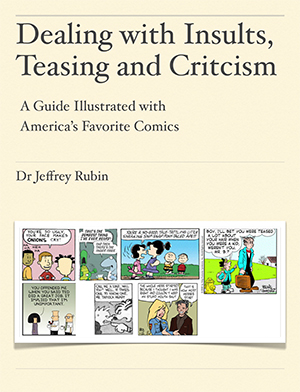
At the very top of any of my blog posts, you will see a heading that says, FREE BOOK: DEALING WITH INSULTS, TEASING AND CRITICISM.  Cover newBy clicking on this heading, you can download for free a PDF version of a book that utilizes America’s favorite comics to teach a number of important SEL skills. Once you download it, I recommend reading a chapter of the book once a week with your youngsters, and then discussing with them how the ideas might be used in something currently going on in their lives.

Once you finished all of the chapters of the book, I recommend playing a game designed to further enhance the learning of the skills taught in the book. The details of this game are provided in my post titled Teaching Children How to Deal with Criticism, and by clicking HERE you can go directly to that post.

Briefly, the game is played in the following manner: One of the skills that the free book teaches people is to be able to recognize four levels of maturity for responding to criticism, with level one being the most immature, and each higher level viewed as being a little more mature. Your job, when playing the game, is to make up a brief story in which someone criticizes someone else. In your story, you explain how the criticized person responds to the criticism. Then the child guesses what level the response was at.  Lucy and LinusSo, for example, I could make up a simple story in which Lucy says to her brother, Linus, “You’re stupid!” Linus responds by saying “Oh yeah, well at least I’m not as stupid as you!”  You would then ask your youngster, “What level is Linus’s response?”

After you discuss the youngster’s answer, you would then role-play the situation so that you provide the criticism and the child acts out a more mature response.  If the child fails to do this correctly, reverse the roles by having the child criticize you and you provide a more mature response.  Then let the child try to imitate your response.

By playing this game, youth become very familiar with how to respond to criticism in a mature manner, and learn to construe name calling, insults, and violent responses as signs of immaturity. Moreover, you will find that the game leads to your youngster sharing with you real life experiences with criticism, and together, you can both problem solve how to constructively handle them.

social skills 3There are, of course, far more social and emotional skills for youth to learn besides how to respond maturely to criticism. Identifying different levels of maturity when it comes to providing criticism (see HERE) and learning how to deal with anger arousing situations (see HERE) are just a couple of important other examples.

These skills are not at all adequately learned by reading a single book. We must bring these issues before the youth’s mind at regular intervals over the course of several months, and then do so again and again for each year the youth is growing from childhood, to teenage years, and finally into adulthood. By reading with your youngsters, each of my blog posts, beginning from the first one, then moving on to the next one, and the next at a reasonable pace, perhaps once per week, this can be done in a fun manner for free. Directions for using this blog in this manner as a free SEL curriculum, see the paragraph below this post.

hero coverFinally, a wonderful way to have youth learn how to apply the skills into real life situations is by presenting a dramatic narrative that has characters the youth can easily identify with, struggling with tough issues. A Hero Grows in Brooklyn is one such narrative that is suitable for a general audience, and I have made it free for downloading on any computer or ebook reader (see HERE).

Okay then, there you have it, several suggestions for helping our youth learn SEL skills. Your efforts can play an important role in helping communities prevent violence, save an enormous amount of money, and increase the likelihood of a number of other highly valuable outcomes.

——————————-

Some people will enjoy reading this blog by beginning with the first post and then moving forward to the next more recent one; then to the next one; and so on. This permits readers to catch up on some ideas that were presented earlier and to move through all of the ideas in a systematic fashion to develop their emotional intelligence. To begin at the very first post you can click HERE.