Categories
Across the Borderline anger toward immigrants Immigrants immigration policy Statue of Liberty

Anger Toward Immigrants

Welcome to From Insults to Respect.

Today, I happened to be listening to some songs when “Across the Borderline” came on. This touching version features Jackson Browne, who is joined with Gaby Moreno and Van Dyke Parks. Other artists covering this magnificent sad and mournful song are Bob Dylan, Willie Nelson, and Ry Cooder. Cooder, along with John Hiatt and Jim Dickinson, are the song’s writers.

Some of the lyrics are:

There’s a place where I’ve been told
Every street is paved with gold
And it’s just across the borderline
And when it’s time to take your turn
Here’s one lesson that you must learn
You could lose more than you’ll ever hope to find

When you reach the broken promised land
And every dream slips through your hands
Then you’ll know that it’s too late to change your mind
‘Cause you’ve paid the price to come so far

The plaintive voices along with the emotionally evocative music convey so much more than the lyrics themselves.

As I listened, a vision of the Statue of Liberty came to me. In New York Harbor there she stands, classically robed, with her right arm holding above her head the lamp of liberty, symbolizing the welcoming of immigrants, and with a plaque inscribed with the words,

Give me your tired, your poor,

Your huddled masses yearning to breathe free,
The wretched refuse of your teeming shore.
Send these, the homeless, tempest-tossed to me,

I lift my lamp beside the golden door!

This led to a soaring in my heart. Images came to me of my ancestors, along with the vast majority of my fellow American ancestors, arriving on our shores escaping awful conditions while praying for a better life. Along with this came images of the many gifts immigrants have contributed to our nation in the arts and sciences. I thought about the many, many employers who had been struggling to find workers to do certain difficult jobs finding relief as these immigrants arrive.

Oh, I’m not blind to the fact that there are times when the arrival of immigrants can lead to frustrating experiences. I remember when I was growing up in Brooklyn’s Brighton Beach neighborhood and suddenly a wave of Russian immigrants arrived. I didn’t ask any of them if they were here legally or not, because regardless, their presence could be exasperating. For example, at one point, I was in my local supermarket and was having trouble finding a particular product. I asked a worker who was stocking a shelf for help. He responded with such a thick Russian accent I couldn’t make out what he was saying. I was frustrated, and maybe even a little angry, but I took a deep breath and found someone else to help me.

In my neighborhood, others were complaining that some of the services had been stretched way beyond what everyone had become used to. For example, at the local hospital patients had a much longer time in the waiting room until a doctor could be seen. A couple remembered how it was to go to school when they were kids in the neighborhood, and since the new immigrants flooded in, their own children’s classrooms had way more students and the teachers had less time to teach them because so much time was being used to try to teach children who didn’t speak English.

Now, many communities in our country are not experiencing such a wave of immigrants suddenly arriving, but for those that are, I wonder if a plan can be put in place so the frustrating aspects of their arrivals can be eased. Perhaps the nation could set up a special waiting list for people who want to legally start a new life by coming to America. This would serve two purposes; first, if these people know that in time they will be able to enter our country legally with all the protections that status provides, fewer folks would be trying to sneak in illegally; second, those on the list would indicate specifically where in the country they wish to begin their new life, and with this knowledge communities that are expecting to get a significant wave of immigrant arrivals would be able to prepare for their arrivals by seeking special grants to adequately fund the needed revenues so local services would not be inundated.

Now, obviously, not all people who want to come to America are going to be willing to wait until their number comes up. And yet perhaps a significant number will find a way to wait because it would be such a powerful attraction to get legal status, thereby eliminating the constant fear that some ICE agent might, at any moment, track that immigrant down and send him or her back. If it would work with enough people, it just might significantly ease some of the most significant challenges that arises when large groups of immigrants suddenly arrive.

As for the frustrations that occur when so many arrive in American communities who don’t speak clear English, it just so happens that recent apps on cell phones solve this. These apps can, when spoken into the phone, instantly verbally convert an immigrant’s language into English, and the reply can be instantly converted back to a language the immigrant can easily understand. In addition to be generally helpful in the neighborhood, these apps can smooth the difficulties teachers have when they deal with non-English speaking students.

It seems to me that if we remain mindful of the great values that our immigrants bring to our shores, along with our knowledge that our own ancestors were once immigrants, we can convert any anger that their arrivals provoke into a challenge to fix the various problems that arise.This would be a kind and generous thing to do.

———————————
Some people will enjoy reading this blog by beginning with the first post and then moving forward to the next more recent one; then to the next one; and so on. This permits readers to catch up on some ideas that were presented earlier and to move through all of the ideas in a systematic fashion to develop their emotional intelligence. To begin at the very first post you can click HERE.

Categories
Iran War Nuclear Weapons Uselessness of Nuclear Weapons

Nuclear Weapons: Useless Military Tool?

By Jeffrey Rubin, PhD

Welcome To From Insults To Respect. 

As I write this post, the United States, having provoked a destructive war with Iran, is currently engaged in seeking a lasting peace agreement. A primary U.S. goal in this negotiation process is to arrange for a process that will assure that Iran will never develop nuclear weapons. Many billions of dollars have been spent toward achieving this goal, along with lives lost, including school children, and widespread building and infrastructure destruction. Given these losses, it is time to ask, how important is it to spend even more effort and resources to get an agreement with Iran to give up its nuclear bomb ambitions?

Asking this question leads me to think about how effective these types of weapons are for achieving military goals.

Consider these facts. The U.S. engaged in a lengthy, deadly war with Vietnam, the military goal of which was to prevent Vietnam from becoming a communist country. Despite the U.S. having many nuclear bombs, they were never used, ended up serving no military purpose, and the U.S. lost the war.

The U.S. has since engaged in several other wars, one with Iraq, one with Afghanistan, and most recently, with Iran. Its goal for fighting them was regime changes that would be cooperative with the U.S. Throughout these wars, the U.S. has had plenty of nuclear weapons. Nevertheless, they ended up serving absolutely no military purpose, and the U.S. failed to accomplish its military goal.

Russia has plenty of nuclear weapons. It engaged in a war with Afghanistan and is currently engaged in one with Ukraine. Its nuclear arsenal has been absolutely zero in helping achieve its military goals. Meanwhile, China has long desired to take over the government of Taiwan. Despite having numerous nuclear bombs, it has not achieved its goal.

Now, let’s consider what would happen if Iran did obtain nuclear bombs. It has the goal of getting people living in Israel to leave so the Palestinians can return to lands now inhabited by the Israelis. If Iran was to use a nuclear bomb on Israel, the radiation fallout would drift over to where the Palestinians are currently residing, killing and sickening tens of thousands, and the very land that the Palestinians want to return to would become poisonous.

Since nuclear bombs have become available to numerous countries, I fail to see any way they helped any to achieve a single military purpose. Though some may argue that since the two atomic bombs used on Japan did manage to quickly end World War II eighty years ago, they may yet serve a military purpose in the future. But let’s think about why such bombs have not been used since then?

First of all, when the U.S. used the atomic bombs they were the only country to have them. Therefore, there was no chance of an atomic bomb being used to retaliate. This is no longer the case. Moreover, because of the incredible loss of life of civilians, including numerous children when those bombs were used, the morality of again using such weapons has been viewed as unforgivable. And since the creation of atomic bombs, there have been new developments to these weapons, moving them from fission explosions to fusion explosions which is several hundred times more deadly. Radiation spread from such explosions would not just kill and sicken the perceived enemies, it would also kill and sicken millions of people in countries that are friends with the country using the bomb, thus making their use unthinkable.

In light of the uselessness of these types of bombs for achieving military objectives, is it not ridiculous that the U.S. has already spent several hundred billions of dollars to prevent Iran from gaining these types of weapons? Would Iran really benefit from laying out the cost to develop them? Is it not completely a waste of time for the U.S. to be continuing to offer enormous concessions to Iran as it negotiates a treaty that is hoped to reduce the chances of Iran to ever acquire such weapons, despite the likelihood Iran is very likely to secretly get around any such agreements?

From the arguments that I provided above, my guess is the U.S. is wasting an enormous amount of resources to try to prevent such weapon development. I invite readers to express their thoughts on this hot topic.

Categories
conflict resolution

On Israel’s Right to Exist

Welcome to From Insults to Respect.

Recently, I happened to be at a social gathering, and I ran into a guy I hadn’t seen in a few years. When we had last met, I said something that he took to be criticism of Israel, and he angrily rebuked me, making furious statements that Israel has a right to exist.

I don’t remember exactly what I said that set him off, but it in no way was it meant to argue against Israel in some general way. Probably I had read something in the news about one of its leaders having said something that I found objectionable, and I had mentioned it to him. In any case, what amazed me, is this. When I recently met him, I happened to ask him if he was still a huge supporter of Israel, and he had a total conniption, crying out that Israel had committed genocide against the Palestinians and that the country is an apartheid state. The change in his attitude toward Israel astounded me.

Afterwards, I did some research and discovered his attitude change extends far beyond just him. A Pew Research Center survey, for example, found that as of March of this year, 60 percent of Americans now hold an unfavorable view of Israel, compared with 42 percent in 2022.

I then did some research regarding the notion that Israel has “a right to exist.” I quickly came upon an article in the New Republic by John Patrick Leary titled: “Israel’s ‘Right to Exist’ Is a Rhetorical Trap: No country has a right to exist, so what do people really mean when they say Israel does?”

Early in the article, it says Dani Dayan, the Israeli consul general in New York, wrote, “The day Palestinians accept Israel’s right to exist as the legitimate homeland of the Jewish people, a real peace process will begin.” It goes on to say,

Just last month, the House of Representatives passed a resolution that “denying Israel’s right to exist is a form of antisemitism.” The phrase and its long history compels us to ask: What does it mean for a nation to “exist,” and who judges its right to do so?

The article goes on to mention that the 1967 U.N. Joint Resolution 242 affirms every Middle Eastern nation’s “right to live in peace within secure and recognized boundaries free from threats or acts of force.”

The article concludes,

Israel has no right to exist because no nation does; only people do. Israelis exist; so do Palestinians. They all have a right to exist but only because they are human beings. And there is no justice in securing your own right to exist by denying it to others.

Relevant to this issue, just before the creation of Israel, the Jews that were rounded up from Nazi concentration camps were held in another camp while discussions about what to do with them was being ironed out. At that time, a survey was conducted asking those in the camp what they wanted to happen to them. Approximately 70 percent wanted to be sent to live with relatives in various countries like the U.S.. Canada, Great Britain, and Argentina. The idea of sending them to a section in the Middle East which was surrounded by people who didn’t want them was not at all appealing to them, especially after what happened to them in regions controlled by Nazis. A minority were religiously Zionist–those who believe in the establishment and development of the state of Israel. In 1948, due to, not Jews, but the powerful political influences of many Christians, the United Nations partitioned Palestine into a Jewish region and a region for people who viewed themselves as Palestinians. Ever since, violence has regularly sprung up between Israel and the surrounding Mideast countries. The stated issue is Israel has been defending against entities that have been violently opposed to the existence of the Jewish state.

Certainly, there are people in this region that are indeed against Israel’s existence, and many Palestinians are bitterly angry that they were forced to leave land that is now part of Israel, land that had been their home for many years. No doubt, if the Israelis were now forced to leave the land that has become their home for about eighty years, they, too, would be bitterly angry. However, I would like to make the argument that the loss of land of people who had grown attached to it is not really the central reason for the violence in this region.

A Theory Of The Real Reason For Violence
In The Middle East

This theory argues that the real central violent conflict in the Middle East region is due to the desert geographical conditions of large sections of the region which cannot be escaped by the inhabitants.

Why do I support this theory? First of all, if you check any history book specializing on this region, you will find that violence has been recurring there for well over a thousand years, and certainly began well before the partitioning of the land by the United Nations.

Also note that in the land where Israelis and Palestinians are living, there are regions where we see land beside the beautiful Mediterranean Sea. There, many people are thriving. Their jobs support seafood harvesting, international trade, and tourists arriving on ships. There are a few other regions where the inhabitants do very well, such as where the religious sites are. There, tourists flock, and by engaging in the restaurant, tour guide, and hotel industries, many in the region make out very well. There are also regions where the land is relatively fertile, and life on farms can be rather fulfilling. Regions in which universities and other educational institutions that have sprung up tend to be laid out on fairly attractive grounds. Earning a living by supporting these facilities tends to lead to a reasonably comfortable way of life.

In stark contrast to these regions, very nearby we find land that approaches desert conditions, with stony, rocky grounds, very scarce water supplies, and a few sparsely growing green shrubs here and there. The rest of the area is dominated by the Negev desert and the Judean desert. More than half of the region’s total land area is desert.

Where the Palestinians live, the terrain of the Gaza Strip is flat or rolling with dunes near the coast. It is intersected by the Wadi Ghazza (Gaza River), which is only replenished with water during the rainy season in the winter, running dry for the rest of the year.

The other area where most Palestinians live is the West Bank, which is mostly rugged dissected upland, with some vegetation in the west, but somewhat barren in the east. In springtime, the khamsini, a dry, warm easterly wind, often blows from the extensive deserts of Jordan, Syria, and Saudi Arabia. This continues for a period of roughly fifty days. The khamsini carries fine desert sand that lends the sultry air an ominous yellow hue during the day. The desert sand falls to the ground as a result of short rain showers. The fine sand is a health hazard for people suffering from bronchitis, and is detrimental to vegetation, motors, and machinery.

The water situation in Palestine (the West Bank and Gaza Strip) is dire and it affects the quality of life, health and economic situation of every Palestinian. In some rural areas the water supply is far below the amount recommended by the World Health Organization (WHO). Where most of the Israelis live, the water situation is somewhat better, but it is far more expensive to keep it flowing than what most Americans and Europeans have to deal with. Currently, those who are living in this Middle East region have every reason to believe they are stuck there–with armed guards stationed at their borders.

Now, in considering this theory, I note that I grew up in Brooklyn’s Brighton Beach community which, at the time, was made up largely of Jewish folks. Separating this community from an adjacent community is Ocean Parkway. On one side of the parkway sits a Jewish temple, while a few feet down from it, on the other side of the parkway sits a Catholic Church. Members of both religious groups never engaged in any organized violence against one another, and one of my best friends belonged to the church. Why the lack of violence? In this theory, it is because we did not live in the midst of desert conditions, there was plenty of drinking water, there was plenty of fruits and vegetables available in our grocery stores, and if we wanted to move to another neighborhood within the 50 U.S. States, there were no armed guards preventing us from doing so.

Strong additional evidence for my theory comes from further knowledge of Brooklyn, New York. There we find a vibrant neighborhood officially known as Bay Ridge, but it has been given the nickname “Little Palestine.” Thousands of Arab-Americans live there. They have their share of rally’s advocating for the freeing of Palestine, but they are peaceful. Another neighborhood, Bensonhurst, is an easy walk from Bay Ridge. Thousands of Jews live there, and yet there are no rockets being fired from Bay Ridge into Bensonhurst. Nor do we find any of the Arab-Americans flinging rocks at anyone.

In another Brooklyn neighborhood, a yeshiva (a Jewish school) sits across the street from a mosque without any incidents of violence between the members of these two institutions and their community members. And if you go on line and do a Google search to verify what I am saying, you will find not a single hit indicating an incident of violence between Jews and Arab-Americans in Brooklyn.

Why such peaceful cohabitation? Viewed in light of my theory, the reason is that Jews and Arab-Americans have in Brooklyn plenty of running water with the massive Hudson River flowing year round. Then there are the numerous tree-lined streets and green, wooded Prospect Park with rowers enjoying its lovely lake.

It is now over seventy years since the United Nations General Assembly declared its majority recommendation that Palestine be partitioned into separate Jewish and Arab regions, and both sides have been violently fighting over this ever since. It is not that there is something inherently evil about Palestinian or Jewish people. When Jews were seeking to establish the Israel lands as theirs, a  group of them organized a terrorist organization. Palestinians have found that sections of their population are willing to carry out terrorists acts. Why can’t this be settled peacefully? If my theory is correct, it doesn’t matter if you are Palestinian, Jewish, Christian or anything else. When any people find themselves living on lands that are too hard to thrive, and they are stuck living there, some of them will act violently to seek a better life. Blaming such groups, viewing them as being entirely evil serves nothing but to further hate and distractions.

According to the theory I am proposing, if folks truly want to create peace for the people in this region, there must be the creation of a plan that would allow them to migrate to regions where water is plentiful, the soil is richly fertile, and no armed guards are preventing them from integrating with other surrounding communities.

———————————
Some people will enjoy reading this blog by beginning with the first post and then moving forward to the next more recent one; then to the next one; and so on. This permits readers to catch up on some ideas that were presented earlier and to move through all of the ideas in a systematic fashion to develop their emotional intelligence. To begin at the very first post you can click HERE.

Categories
Being Macho insults Key & Peele comedians

On Calling One’s Wife A Bitch

Welcome to From Insults To Respect.

Recently, a friend sent me the link for a YouTube comedy skit titled, “I Said Bitch.” It’s performed by the comedians, Key & Peele. Here’s the link.– https://youtu.be/5LGEiIL1__s.

It begins with Peele and a woman playing the part of Peele’s wife warmly greeting the arrival of Key and a woman playing the part of Key’s wife. When the wives go off together to see something new in Peele’s house, it leaves the two comedians alone to have the following conversation:

Key: Dude, I’m sorry that we’re late.
Peele: It happens, man.
Key: She (referring to his wife) talked about how we’re
suppose to be in the car by 6:45 and I say ‘alright’.
Peele: Uh Oh.
Key: Tell me my dumb ass ain’t sitting in the car until 7:15. Okay, when I track my wife down 20 minutes later, she’s stepping out of the shower talking about, can I help you? See, that’s crazy right there! Can I help you? I looked this woman right in the eye, I said, “Bitch, you told me 6:45.”

As Key says “Bitch, you told me 6:45,” both look to check to make sure their wives are not within earshot. As the conversation continues, Peele double checks to make sure he heard what was said by asking Key, “You said, ‘Bitch.'” Key replies, “Yeah.”

At this point we hear the wives coming and the guys, nervous that their wives might hear their discussion, decide to go down to the basement. There, Key continues expressing his frustration with his wife, and Peele expresses empathy, and then he shares a story in which his wife had acted in a way that led to frustration, and ending with him calling his wife a bitch. But before he gets to actually saying the “B” word, he looks cautiously around to make certain his wife won’t hear.

Just then, the wives look into the basement, and ask, “What are you boys up to?”

The boys, upon seeing them, immediately change their expression from outrage to delightful cheerfulness, and claim they were just talking about looking over the new washing machine that is in the basement.

Now, in order to continue their conversation in a place their wives won’t hear, the boys go outside, climb a tree, and hiding their lips behind the tree’s limb, they tell each other about other times their wives’ actions led to frustration, and it led to calling them bitches. But each time they claim to have used the “B” word, they pause to make absolutely certain their wives won’t hear them.

The humor is created by how self-righteous they look when telling of their frustration at their wives’ actions, and their contrasting look of terrible fearfulness at the prospect that their wives might overhear them engaging in this type of conversation. Their fearfulness leads them to go to extreme privacy places so they can safely continue their conversation, ending with them going up in a rocket to outer space, and even out there they fearfully look about each time they say the word bitch to make sure there is no way their wives will catch them.

The skit works because one can imagine real people having a somewhat similar experience; though, as comedies are apt to do, the characters’ actions are super exaggerated. From their actions, I got the impression that the characters being portrayed would never actually call their wives bitches. Nevertheless, I got to wondering why the two guys would value sharing with each other various times they claimed to have called their wives bitches. Why would they make such a claim to a friend? What value would they get from this? Why would they try to hide from their wives that they are making such a claim?

Perhaps they had adopted the desire to be macho, that is to be strong and to display dominance, aggression, and to not being nurturing. If you want to be macho, you seek to settle all differences with anger and violence as opposed to diplomacy. You treat your wife with displays of being tough and aloof.

If the two characters in the skit have adopted this desire and came to believe their friend has also, then calling their wives bitches would fit this attitude. However, if you really are crazy about your wife, then, although you might want to think you are macho and you might want your friend to think you are macho, you might find yourself in a bind. I think the skit is acting out two folks in this bind. They love their wives, know well that their wives won’t respect them if they call them bitches, but haven’t managed to relinquish their desire to be macho, especially when their wives have done something very frustrating.

This macho style is something with which I personally became very familiar as a boy growing up in Brooklyn, especially as a junior high student. There was a clear exception to the violence characteristic–it was definitely not okay for a boy to hit a girl. Occasionally girls got into physical “girl fights,” but the boys stayed out of these.

When I got to high school  and began dating, occasionally, I faced a frustrating conflict I had with a girl. I would become angry and during such episodes I would cry out an insult, typically something like, “You’re acting like a jerk!” or “You’re being an idiot!” More frequently, I would have these types of angry experiences with my stepdad.

I didn’t think I was doing anything wrong with such outbursts because it seemed to me the natural way to respond to such frustrations, and there was a theory going around that to suppress one’s emotions was harmful. However, during my last two years of college, I took psychology courses that included in the curriculum reviews of studies that described conflict resolution ideas. They didn’t require suppressing emotions, were less likely to lead to the conflict spinning out of control, and were more likely to lead to satisfactory outcomes.

I found initial attempts at utilizing such approaches often failed as my anger would lead me into old habits; but in time, and with practice, I got better and better at these alternatives. And they were so effective for me that when I retired from my job as a psychologist, I decided to write these blog posts as a noncommercial way to spread these ideas for free. I’m hoping you consider giving the approaches described a try.

On this blog, what would be the type of suggestion I might offer for dealing with the type of frustrating, angry conflict described in the Key and Peele skit? First, recognize you are frustrated and angry, and feel it fully within your body. Then, before confronting your wife, decide how to handle it in a way that won’t have lasting negative effects on your relationship. Rehearse three or four times in your mind the approach you came up with, taking care that you won’t include any insults or a tone of voice that comes off as insulting. A soft voice is usually best.

Here’s a suggestion for what you might say to your wife: “I’m feeling frustrated because we are going to be late for our friends’ get-together, and you told me to be in the car at 6:45 so we could be on time. I agreed, and after waiting there for a half hour, I now come up here and see you are just getting out of the shower.”

I would then pause to let my wife reply. Then I would softly summarize what she said, and then I would wait to see if she wants to add anything more. I would then leave the conversation at this point for the time being, thus giving my wife some time to think over my expressed frustration, as well as giving me time to calm down. In a day or two, I would consider if it makes sense to further the discussion.

This approach is very likely, in time, to lead to your wife feeling you treated her respectfully because you’ve given her time to express her views. Moreover, it recognizes that an extensive discussion about the issue when you are angry could lead to saying something you will end up regretting. And what you had prepared to say will be brief enough so a three or four repetition rehearsal can be effectively achieved.

Notice that with this approach, there is no suppression of your frustration and anger. Inwardly, your feelings are there, you express them fully to yourself, while avoiding weakening a relationship you care about.

Of course, there is far more to be said about handling such conflicts, but I leave the topic here, giving readers some ideas to reflect upon.

My Best,
Jeff

———————————
Some people will enjoy reading this blog by beginning with the first post and then moving forward to the next more recent one; then to the next one; and so on. This permits readers to catch up on some ideas that were presented earlier and to move through all of the ideas in a systematic fashion to develop their emotional intelligence. To begin at the very first post you can click HERE.

Categories
Jeff Rubin's novel

Cool Steve Explores The Nature Of Respect

Welcome to From Insults To Respect.

On this blog, every now and then, I present a little section from one of my three Cool Steve novelsA Hero Grows In Brooklyn, Fights In The Streets, Tears In The Sand, and Love, Sex and Respect. It is my hope each of these sections will provide an opportunity to deepen our thoughts regarding the nature of respect.

Today’s section is from Love, Sex and Respect, and presents a discussion that occurs during an evening on a Coney Island beach with insecure Jeff Star, and his fellow Lincoln High School students, Cool Steve, and  Ray Wong.

“Hey, Jeff,” says Ray, “you look lost somewhere way up by that twinkling star.”

“Oh, I was just thinking about that Jiminy Cricket song, you know the one–oh it goes–‘When you wish upon a star, makes no difference who you are, anything your heart desires, will come true.'”

Ray and Steve smile. 

Hey Ray,” I say, “if you could, by wishing for something make it come true, what do you think you’d wish for?”

“I guess… well, to see my mom again. I barely knew her when she died of cancer.”

“Seeing your mom again,” I say. “Hmmm. Okay. Steve, how about you? What would you wish for?”

“A cure for everything, peace on Earth, stuff like that I suppose.”

“Yeah, Yeah,” I say. “Let’s hear something more personal.”

“I don’t know. Well, ever since I remember, I wished I would someday be the next great Yankee centerfielder. Anyway what about you, Jeff? What do you think you’d wish for?”

“Hmmm. I remember when I first entered Lincoln I wanted to be respected. In Boody Junior High, I had made all of these enemies and I had this burning desire to turn my life around.”

Love cover“Well, your wish came true,” says Steve. I bet if you asked the average Joes or Jills at Lincoln if they respect you, they’d say, ‘Yeah. He’s okay.'”

“Maybe a little,” I say, “but I don’t think they really, really respect me.”

“If you want someone to respect you,” says Ray, “all you gotta do is treat them with respect.”

“Hmmm, maybe that’s part of it,” I say.

“What are you after, Jeff,” asks Steve, “a critical analysis of how you can be more respected then you currently are?”

“Something like that might be helpful,” I reply.

“How about complementing people from time to time?” Steve asks grinning. “I’ve noticed you rarely ever pat anyone on the back, Jeff.”

“What?! I do so! I can’t believe you just said that! I’m always complimenting people!” As these words spring from my lips, I notice anger spilling from me like lava from a volcano.

Some awkward seconds go by with my lips squeezed together and then I say: “Ya know, I came down here to try to find some peace and then you go ahead and say something like that. I went 0 for 4 in yesterday’s baseball game. I was feeling rotten, and when I was finally calming down, and now this!”

“Sorry,” says Steve.

“Ray,” I say, “don’t I compliment people?”

“Well, I’ve certainly heard you compliment people. Just a hair more compliments would be nice. I wouldn’t want you to be obsequious about it.”

“Obsequious!” cries Steve. “Man! If I would use that word with my lunch table crowd, they’d lynch me to the highest limb.”

“Well,” says Ray, “what I mean is we don’t want Jeff to end up overdoing the compliments. That would be just as bad as too little.”

“There.” says Steve, “It’s settled then. Jeff, you gotta compliment a little more, but not too much. Ray, in some settings, depending on who you’re speaking to, you might want to go easy on your highfalutin words. How about me? What do you think I can improve on?”

“Well, for one thing,” I reply, “you could learn to cut out the ridiculous criticism, especially when you don’t know what the hell you’re talking about.”

“You know,” says Ray, “there’s an old saying, Jeff, that if you want people to respect you for your wisdom, all you gotta do is agree with everything they tell you. Is that the kind of respect you want from us?”

“I’m not saying that!” I holler.

A seagull walking by on the sand a few yards away starts screeching, as if mocking me. I flash a glare at it. With its pointed beak, it rearranges a few feathers and then takes to flight.

I resume gazing up at the heavens. The stars are becoming more distinct. With a few deep breaths, calmness begins to settle in. Maybe there is some merit to what Steve and Ray had said. And, unlike seagulls, I would mind if Steve and Ray took to flight.

“A lot of people respect Sandy,” says Steve after a while, “because when they have something to say to her, she has a way of listening, and she seems to really care about what’s going on in your life. And she’s quick to offer to help in some way. I bet that has something to do with respect.”

“Respect,” says Ray. “You know, when I was in junior high, kids would tease me because I’m Chinese and a little different. I lost a  lot of respect for them. I guess if you want people to respect you, maybe you shouldn’t tease them.”

“Well,” says Steve, “a little teasing may be okay if you do it with a twinkle in your eyes… I mean, as long as you’re prepared to back off and apologize if your teasing hits a sensitive spot.” 

“Depends on the person you’re teasing,” Ray replies.

“I guess,” says Steve. “Some people are so sensitive whenever they get teased, maybe with them you’re better off not teasing them at all.”

After some reflection, Ray says, “I suppose some mature, respected people enjoy some teasing as the friendly dual of wits gets played out, but mature people have a sensitivity within them so they aren’t looking to hurt anyone in the dual. Anyway, Jeff, I agree with Steve. I think most people respect you.”

“Thanks,” I say. But as I say thanks, I begin to think maybe I have a little more I can do in this regard.

Well, that’s my post for today. I hope you find it provides a little food for thought.

My Best,
Jeff

———————————
Some people will enjoy reading this blog by beginning with the first post and then moving forward to the next more recent one; then to the next one; and so on. This permits readers to catch up on some ideas that were presented earlier and to move through all of the ideas in a systematic fashion to develop their emotional intelligence. To begin at the very first post you can click HERE.

Categories
anger conflict resolution criticism Unfriending over politics

Unfriending Over Politics

Welcome to From Insults to Respect.

Please consider the following quote by Mathias Risse of Harvard University:

“Surely, political debate about what America should be, and which kind of economic system it should have, must count among the most basic themes in democratic discourse.”

Add to this, if you will, that the very first amendment declares that U.S citizens have, as a basic right, freedom of speech.

There is something so basic about the value of free exchanges of views that we hardly ever question it. If we are moved to question it, there are research studies that document that such exchanges are the mechanism by which better solutions are found and better decisions are made. Providing readers here with a formal review of the literature discussing these studies is too lengthy a process for our current purposes. It will suffice for today, I think, if I merely encourage you to imagine yourself seeking justice for yourself in a court of law that provides only the prosecutor getting to make the case against you, without your having any opportunity to present your side. Such an image, it seems to me, provides more than enough intuitive understanding that hearing both sides of an issue is crucial for increasing the chance of arriving at just decisions.

Something Appears To Have Changed

Since Donald Trump has been reelected to the U.S. presidency, I have been hearing more and more from friends, family members, and neighbors about an increase in the number of people who are being unfriended because they have expressed their contrary political views. Thus, opportunities for lively exchanges of different views that had been a regular part of our democracy appear to have diminished.

When I use the term, “unfriending,” I am not referring to how the term is used on Facebook. Rather than referring to this type of internet relationships, I am referring to the ending of what I view as real life, actual in-person relationships. Here are a couple of examples: One guy I know, told me about two of his cousins with whom he has always been close since they were children. A few months after Trump’s reelection, he and his cousins had a conversation expressing different political views. Ever since, these two family members have been refusing to talk to him. When he has made his usual seasonal calls to wish them happy holiday and to catch up with family doings, they now hang up on him. Another person has told me about how, after a brief discussion with a neighbor regarding Trump’s healthcare policy, this neighbor has now begun to turn a cold shoulder to her whenever they pass one another.

In an effort to avoid unfriending, but also leading to a diminishing of exchanges between people with different views, I’ve been seeing more and more folks only willing to discuss political issues when they are among others they know are in agreement with them. These talks are enjoyed for the support that one gets from likeminded folks. If they are with people with whom they disagree regarding their positions, they avoid the discomfort of hearing contrary opinions by insisting they will not engage in discussing political topics.

If we add to this, the current media programming situation in which people can tune into shows that solely express opinions that completely agree with them, we can see why more and more in our society have been losing out on the value that comes from hearing a variety of opinions.

Can We Improve This Situation?

It can be argued that the reason for the changed situation is because Trump has been modeling insulting, disrespectful behavior. Among the insults that I have heard Trump use are “fat pigs” and “disgusting animals.” I observed him on national TV calling Senator Lindsey Graham “a stiff,” Governor Rick Perry “stupid,” and numerous other political opponents, idiots.” He has denigrated federal judges who ruled against his efforts as well as the chairman of the Federal Reserve for not lowering interest rates.

However, whenever Mr. Trump insults his opponents, many voters are apt to defend him by saying he isn’t doing anything much different than all the other politicians. Meanwhile, I’ve heard Trump, when criticized for his insulting style, defend himself by declaring that no one has been more maligned than he. And he can certainly point to instances in which he has indeed been maligned.

That said, permit me to suggest that in an effort to change the current situation in which our fellow citizens are less likely to share their differing political concerns, we leave this maligning issue behind. I just don’t think it likely to  lead to anything productive. Instead, I would like you to consider some suggestions I have personally found helpful.

When a political issue comes up, I say I think the topic is very interesting. Then I encourage the person who first brought up the topic to express his or her opinion. I then give the person an opportunity to fully express it, without my throwing out any insults, or displaying behavior that could in anyway be viewed as disrespectful. I listen without expressing anger and will only interrupt to briefly ask for some clarification of what was said. People value being listened to, and I seek to provide this value.

When the person has clearly finished, I thank the person, summarize what was said, and add that what was said was very helpful to me. I then again thank the person. Then I say, “I’ve heard a different position and I would love to describe it and then get your reaction to it.” I have found that when expressed this way, most will let me proceed. As I describe the different opinion, I use no insults or any tone of voice that might suggest I am maligning the position the other party had expressed. I then ask respectfully for the reaction of the person who had been listening to me, and again I respectfully listen. If I see the person responds angrily, I don’t express return anger. When the person completes the reply, I again summarize what was said using a soft friendly voice and leave the exchange at that. If the person had responded civilly, I would be open to further expand the discussion. Otherwise, I leave the discussion with the hope that in due time both of us will further think about what was said.

This respectful exchange typically works very well for me, and I continue our relationship on friendly terms.

In situations in which people say they don’t want to discuss political issues, I gently encourage them to at least give me a try. I explain that I realize political discussions can get heated and lead to bad feelings, but, with me, they will find me listening respectfully and discuss the issues civilly. I also explain the value that comes from hearing diverse political views. If this leads to an agreement to go ahead with such a discussion, and the person with whom I am having a discussion starts to get heated, I encourage that we return to a civil style. If that doesn’t work, I let the person finish the point that is being made, without my returning the anger, and then suggest we take some time to calm down.

Well, there are my thoughts and suggestions for dealing with this type of situation. I surely encourage readers to express their views regarding this, even if they are contrary to my own.

My Best,
Jeff

———————————
Some people will enjoy reading this blog by beginning with the first post and then moving forward to the next more recent one; then to the next one; and so on. This permits readers to catch up on some ideas that were presented earlier and to move through all of the ideas in a systematic fashion to develop their emotional intelligence. To begin at the very first post you can click HERE.
Categories
Abraham Lincoln Beleving in Trump Donald Trump

Believing in Trump: Crazy?

Welcome to From Insults To Respect.

Today, millions of people continue to believe in President Trump. Given what we have learned about him, does it make sense to insult these believers by viewing them as crazy? Let’s give this question some thought.

*                        *                      *

This week, I went to a community theater to see a play. It involved two married couples arguing over how to discipline the 11-year old son of one of the couples who had violently attacked the son of the other couple. In no way did the subject of the play have anything to do with political issues. Nevertheless, one of the audience members proudly came wearing a huge red, white, and blue bucket hat– puffy on top, and prominently displaying Trump’s name. He also wore a shirt that looked like it could have been made from the red, white, blue and stars of the American flag. In all appearance, this guy plainly looked like he worships our current president. In light of the series of actions of President Trump, many Americans view such worshipers as crazy.

I’m not suggesting all of those who still support Trump actually worship him. I have met voters who say they still support him even though they don’t particularly like him, but nevertheless believe he is better than any of the candidates who are likely to be put up by the Democrats in the next presidential election. What I am here referring to are just the Trump supporters who truly worship him despite knowing the current situation.

The Current Situation

Here, I describe just some of the major events that might lead people who had in the past believed in Trump to change their minds.

September 2005, Trump is caught on tape advocating “grabbing women by the pussy.”

Between 2005 and 2010, Trump ran a costly course promising to help real estate hopefuls break into the business, something he called Trump University – only its false promises of success proved a total flop. In 2018, a judge ruled that Trump must pay out $25 million as part of a settlement.

Federal judge upholds verdict in E. Jean Carroll case

In the Spring 2023, E. Jean Carroll won her case when a jury found Trump was liable for sexually abusing and defaming her.

On January 13,  2023: The Trump Organization was convicted of tax fraud and fined $1.6 million in relation to 17 charges, which included falsifying documents and allegedly inflating asset values for loans and insurance purposes, while simultaneously undervaluing them for tax purposes.

On May 30, 2023, Trump was convicted by a jury on 34 counts of falsifying business records “to conceal damaging information and unlawful activity.” The records pertained to money allegedly paid to adult-film actress Stormy Daniels to not reveal details of an extramarital affair she said she had had with Trump in 2006.

Very early in Trump’s current administration, he pardoned people who assaulted the capital, including those who were convicted of violently attacking police officers.

By early 2026, hundreds of legal cases had been filed against different parts of his agenda, meaning his administration has spent millions of dollars of tax payer money fighting court battles alongside governing. One of the most recent involves the Supreme Court declaring his tariffs are unconstitutional, thereby leaving his administration to figure out how to pay back the millions of dollars his tariffs had collected. That’s one hell of a mess. Meanwhile, the tariffs never led to the great boom in U.S.manufacturing jobs that Trump had promised.

Trump had claimed that to close our southern border, a border wall had to be built. Despite most of the border wall having not been built, he now brags he has closed the border and claims no one else was able to do it until he did.

Well, there is no way to fully determine how many people are currently illegally crossing the border, but authorities say the best way to estimate this is by determining the number of apprehensions that are currently occurring there. Below, in Figure 1, the record of apprehensions is laid out for the past 25 years. It indicates that during the Obama Administration (2009 to 2017) the border crossings had been at about the level that it is now. This continued for the most part during Trump’s first term (2017 to 2021) with a large bump around 2019, and then quickly returning to the Obama era levels. Shortly after Biden took over, there was a huge jump in border crossings until bipartisan efforts began to strongly complain. Biden responded with much stricter policies and by his last year in office border crossings began to drop, quickly returning to the Obama era levels.

Figure 1: 25 Years of Apprehensions at the Southern Border

As we can see below in Figure 2, it continued to drop a little more during the first month Trump began his second term, a period prior to any of Trump’s border policies actually having time to be instituted. This lower level has remained through the rest of his first year back in office.

This current level is somewhat questionable because Trump has installed an administration that he selected to make him look as good as possible. Some of their efforts have not always been viewed as completely on the level. For example, Trump had promised to release the Epstein files upon his return to the presidency. He refused to do it until Congress passed a law that was veto proof requiring him to do so by a specific date. It is now several months past that date, and Trump is now refusing to release over a million of them. His current administration is backing him on this clear violation of the law. Meanwhile, FBI agents have been quiting, refusing to carry out his demands. So any evidence Trump’s administration provides must be taken with a pinch of salt.

Figure 2:

Returning to the issue of immigration, a poll conducted in January by The New York Times and Siena University found that 63 percent of voters disapproved of Trump’s Immigration and Customs Enforcement’s tactics, feeling it had gone too far. Particularly upsetting is that upon ICE killing two Americans, his administration made statements about what had occurred clearly in contrast to what the American public could see with their own eyes in video recordings. Then, even more egregious, the administration officials declared before any investigation that those who were killed were domestic terrorists.

Trump’s Justice Department recently filed a lawsuit against Fed Chairman Jerome Powell that a federal judge quashed saying it was obviously just for retribution because Powell had refused to lower interest rates that Trump wanted. This is costly, and completely wastes the time of judges who have better things to be doing then dealing with such frivolous cases.

Now, Trump has started a war with Iran, after pledging, when running for office, he would not engage the U.S. in foreign wars instead focusing on problems right here at home.

He had promised to lower consumer prices; they have instead risen.

Finally, recent polls indicate many who voted for him in the last election have turned against him, with his current approval level sitting at about 38 percent.

Given The Above Well Known Set Of Facts, Is It Useful For People To Consider Believers In Trump Crazy?

Considering someone as crazy is typically viewed as an insult. If you call someone crazy, it is likely to elicit an angry response such as, “No, I’m not crazy, you are!” Perhaps creating such animosity is fine with you, but here on this blog I advocate considering the value of converting your insults to respectful exchanges. To that end, let’s consider the great master of such endeavors–Abraham Lincoln (See HERE for a full discussion of this).

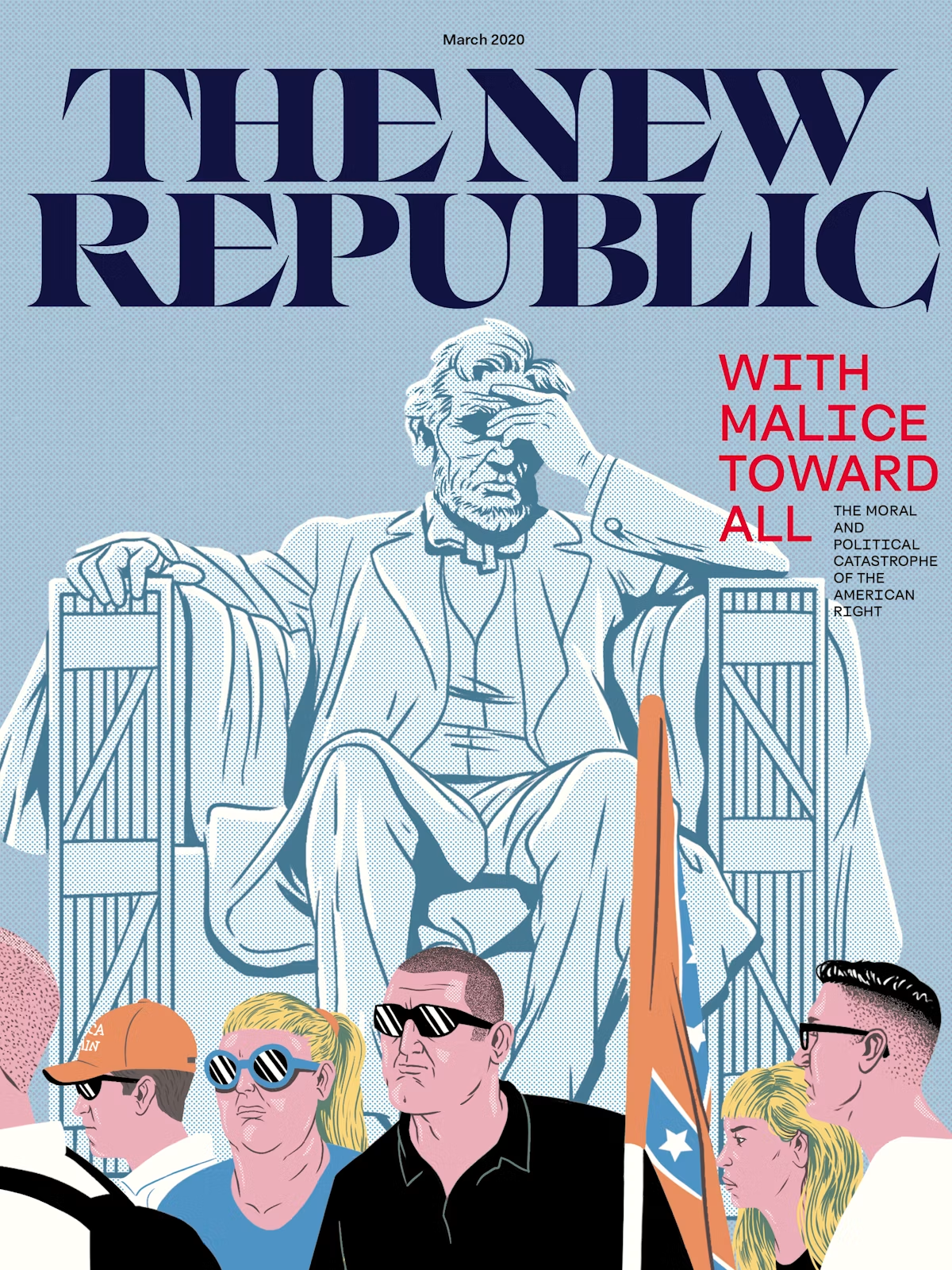
In 1865, Old Abe had been reelected president for a second term. Seeking to unify the nation as the end of the brutal four-year Civil War was in sight, he attempted to rise above the anger and divisiveness and start the process of healing. In his inaugural address, he asked his fellow country folk, referencing the Sermon on the Mount (Matthew 7:1) to “let us judge not that we be not judged.” He concludes with these immortal words:

“With malice toward none with charity for all, with firmness in the right as God gives us to see the right let us strive on to finish the work we are in to bind up the nation’s wounds, to care for him who shall have borne the battle and for his widow and his orphan ~ to do all which may achieve and cherish a just and lasting peace among ourselves and with all nations.”

Throughout the Civil War, many in the southern states truly and passionately believed they were fighting for a noble cause consistent entirely with their religious beliefs. Although Lincoln felt differently, he still asked his citizens to have malice toward none with charity for all. And in America, we honor the principle of religious freedom.

Can we not find it in our hearts to view the people whom I symbolize as the man wearing that huge red, white, and blue bucket hat– puffy on top, and prominently displaying Trump’s name, not as crazy, but rather as having deeply religious views. This doesn’t mean we should or shouldn’t vote for Trump supporters, but, rather, it provides us the understanding that those who believe in him, when he speaks, provides the spark that lights up their religious faith.

My Best,
Jeff

——————————-

Some people will enjoy reading this blog by beginning with the first post and then moving forward to the next more recent one; then to the next one; and so on.  This permits readers to catch up on some ideas that were presented earlier and to move through all of the ideas in a systematic fashion to develop their emotional intelligence.  To begin at the very first post you can click HERE.

 

Categories
conflict conflict intensity

U.S. and Israel Attack Iran

Welcome to From Insults To Respect.

I just watched President Trump’s speech about what he hopes the U.S. hopes will be achieved by joining forces with Israel to attack Iran. Since the attack began three days ago, some friends have asked for my reaction. Here’s my response.

There are only four things that I am certain of:

  1. Billions of tax dollars will be spent on this intervention,
  2. A great number of buildings and infrastructures that had been built by the hard work of thousands will be destroyed,
  3. Many will be seriously wounded,
  4. Many, including children, will be killed.

According to a New York Times report, a strike on a girls’ elementary school in southern Iran killed at least 175 people, most of them likely children,

Several videos and images verified by The New York Times showed that at least half of the two-story school was destroyed in the explosion. Emergency workers with the Red Crescent could be seen alongside families desperately combing through the rubble, which was littered with schoolbooks and book bags covered in blood and ashes. Portions of the building jutted out from the rubble, with bits of colorful murals visible on what were once the walls of the school. Desks were piled with debris.

As to what positives will come from the horrors of all of this, we will have to wait and see.

With deep sadness,

Jeff


Categories
American Indigenous People conflict resolution Indians Israel-Palistinian conflict Native Americans Palestinians

Native Americans vs Palestinians

Welcome to From Insults to Respect. 

Today we’re going to take a few minutes to compare a Palestinian conflict to one that Native Americans had been engaged in. Doing so, will suggest a path toward peace for the very violence-prone Middle East region.

The Comparison

The conflict Palestinians are engaged in can be briefly described by using the mnemonic DIG. These letters serve to remind us to dig to identify what party A in the conflict desires, what is interfering with that desire, and what that party believes the other party in the conflict is guilty of doing wrong. (see my “DIG for the Conflict” post for a more complete description of the DIG model.) In the conflict involving the Palestinians, they desire to regain land they lost when the United Nations members voted to create a partition that separated some of the land in the region. Some went to the Palestinians, and some went to what became the country of Israel. Interfering with the Palestinians’ desire is Israel and its supporters refusing to comply with their desire. The Palestinians generally believe Israel and its supporters are guilty of unjustly taking land rightfully belonging to them. For the past eighty years, many Palestinians have engaged in violence in an effort to regain the land taken from them. A similar conflict had befallen the America Natives (often referred to as American Indigenous People or American Indians).

For several hundred years, American Natives freely resided in the lands we now call the United States (U.S.). When the European settlers came to the U.S., they sought to gain ownership of various parcels of this land. The different authorities that existed over the course of several hundred years organized military forces that supported the settlers. The Native Americans fell into conflict with these settlers, desiring to regain the land they lost to the settlers. Interfering with this desire were military forces supporting the settlers. The Natives believed the military forces were guilty of wrongfully backing the settlers. For several hundred years, many Natives engaged in violence against the settlers in an effort to regain the land taken from them.

Significantly, unlike the Palestinians, for approximately one hundred years the Native Americans have no longer engaged in violence against the settlers. What can account for this?

Why Native Americans No Longer Engage In Violence Against American Citizens?

When I asked a friend this question, he theorized the Natives have simply been subdued by the sheer might of the American military. I am not convinced of this because the Palestinians have not been subdued despite being acutely aware that the same U.S. military that has supposedly subdued the Native Americans is currently supporting Israel. It seems to me a far more plausible reason Native Americans have ceased to continue the violence is that they successfully negotiated an agreement that established Native American reservations.

It might be thought that the Palestinians were given a reservation–the current partitioned Palestinian lands. However, the conditions for the Palestinians to reside in those lands are dramatically different than what is provided to Native Americans. That is, the Palestinian land is guarded by Israeli military forces. Palestinians are basically imprisoned in this land. In contrast, there are no military forces on the Native American reservation borders. There is nothing preventing Native Americans from leaving their reservations and to return there at will. Without any need for a passport or any other paperwork, Native Americans are free to go anywhere within the U.S. and by 1924 they have been declared U.S. citizens. Moreover, they can just as easily obtain a visa to visit other countries as other U.S. citizens.

Now, I’m not suggesting that the negotiated agreement concerning reservations has led to an ideal set of conditions for all Native Americans. There remain additional conflicts to be sure. For example, although 75 percent of Native Americans are living better than where the poverty line has been set by economists, understandably there is a desire to further reduce poverty. I’m only saying that the reservation agreement has led to a toning down of aggressive feelings sufficiently so alternative non-violent negotiations have been substituted. To further that end, the U.S. government has a Bureau of Indian Affairs. Past presidential administrations have provided hundreds of millions of dollars to hear and address the concerns of our Native neighbors.

Might this agreement permitting Native Americans to have control of the reservation lands along with being able to freely integrate with the rest of the United States if they so choose, be the reason why Native Americans have ceased their violent ways? We get convincing evidence for this when we take a look at a section of Brooklyn referred to as “Little Palestine.”

Peace Between Jewish and Palestinian Brooklyn Neighborhoods

In Brooklyn, New York, there is a vibrant neighborhood officially known as Bay Ridge. In the last few generations it has been given the nickname “Little Palestine” because thousands of people had somehow escaped there from the Palestinian region and have become American citizens. Another neighborhood, Bensonhurst, is an easy walk from Bay Ridge. Thousands of Jews live there, and yet there are no rockets being fired from Bay Ridge into Bensonhurst.

In another Brooklyn neighborhood, a yeshiva (a Jewish school) sits across the street from a mosque without any incidents of violence between the members of these two religious institutions. And if you go online and do a Google search to verify what I am saying, you will find not a single hit indicating an incident of violence between Brooklyn Jews and the Brooklyn Palestinians.

Why such peaceful cohabitation? Viewed in light of my theory, the land that the Brooklyn Palestinians are living on is, in essential ways, similar to Native American reservations.

Like those living on Native American reservations, Palestinians living in Brooklyn’s neighborhood can choose to continue living there, or they could freely move to any of the fifty U.S. states. If they desire, they can freely move back to their old Brooklyn neighborhood. They can obtain visas to visit other countries. In my view, this freedom takes enough of an edge off of any disagreements to eliminate violence.

So, if the members of the United Nations were to fully understand this, it would provide them the answer to what is required for bringing peace to those currently living on Palestinian lands within the Middle East. It would direct their attention to the task of identifying regions that can be purchased for Palestinian reservations. Permitting the Palestinians who freely chose to move to these purchased lands and to freely live under the same conditions existing for those living on Native American reservations will bring the violence to a final end.

Is This Plan Realistic?

Is the idea that the United Nations might come up with a successful plan to purchase such reservations realistic? I think it is.

Please note that the world population of Jews, Muslims, and Christians combined is over four billion people. All of them have some religious interest in promoting peace in the region we are discussing. If they think about the cost of war and preparations for war that has been spent during the centuries of violent interactions, and then think of the cost to continue the conflict forever, this will lead to the funds that could be raised to bring this Native American reservation type plan to life.

If I am right, once the new reservation lands have been purchased and have become available for settlements, even those who would choose to remain on Palestinian lands would discover that just knowing they are not trapped there, all of the other issues currently being bitterly fought over would be able to be peacefully negotiated. Likely, neither side would be fully delighted with the final agreement, but the heat that now leads to continuing violence would be replaced by visions of possible improved economic conditions, and a better future for their children.

———————————
Some people will enjoy reading this blog by beginning with the first post and then moving forward to the next more recent one; then to the next one; and so on. This permits readers to catch up on some ideas that were presented earlier and to move through all of the ideas in a systematic fashion to develop their emotional intelligence. To begin at the very first post you can click HERE.
Categories
addiction alchohol drugs Getting High Pot

Getting High, Why?

Welcome to From Insults To Respect. Today, we begin with the question, Why do we like getting high?

Many people, for their New Year’s resolution, seek to cut back, or even completely give up, drinking or consuming other drugs. They have begun to wonder why they have been spending so much money and time on this activity. They may recognize that although for many the use of these substances is an enormously popular pastime, it comes with known and unknown risks. Yes, it may lead to feelings of pleasure, relaxation, euphoria, and pleasant distortions of perceptions. It may also help to escape discomfort, or to enhance certain experiences such as social interactions, music listening, or the enjoyment of meals.

Moreover, certain substances can temporarily ease feelings of stress, anxiety, or depression; or boost confidence, energy or attention. Although these experiences are often viewed as positive, their use can enter into intrapersonal and interpersonal negative situations. If one becomes viewed as a sloppy drinker or an addict, respect can suffer. The recognition that the perceived positive effects are so very temporary, can be physically harmful as well as mask the need to address underlying issues, are frequent reasons I hear for drug and alcohol New Year’s resolutions.

Social and Cultural Influences

Peer pressure, cultural norms, and media portrayals are powerful influencers of drug use. Media are particularly powerful for normalizing, encouraging, romanticizing, and glamorizing drug use, making it seem appealing.

For adolescents, experimenting with drugs can be an exciting form of rebellion, a way to assert independence, or define their identity. Moreover, if peers believe that a substance will make one feel happy, relaxed, or adventurous, one may be more likely to have these experiences when consuming them.

In time, tolerance to these substances typically occurs, and a person may feel compelled to use larger and larger amounts.This can lead to damaged relationships, job loss, and create significant financial strain. Or it can be a reason to entirely give the drug up.

The Getting High Experience As Expressed In Songs

Above, I’ve tried to give you a pretty good idea why people get high, and why they might resolve to ease off these substances that lead one there. But, it seems to me, that we can get a much better sense of such experiences by considering the lyrics of a few songs.

The first of these is “The Bottle Let Me Down,” an introspective piece sung by Willie Nelson in his relaxed, behind-the-beat, off-center phrasing that is accompanied by his distinctive guitar playing. If you think alcohol can always pick you up no matter what, here’s a little tale that just might change your mind.

“The Bottle Let Me Down”

Each night I leave the bar room when it’s over
Not feeling any pain at closing time
But tonight your memory found me much too sober
Couldn’t drink enough to keep you off my mind

Tonight the bottle let me down
And let your memory come around
The one true friend I thought I’d found
Tonight the bottle let me down

I’ve always had a bottle I could turn to
And lately I’ve been turnin’ every day
But the wine don’t take effect the way it used to
And I’m hurtin’ in old familiar ways

Tonight the bottle let me down
and let your memory come around
The one true friend I thought I’d found
Tonight the bottle let me down

The next song, “Seeds And Stems (Again)” is by Commander Cody and His Lost Planet Airmen. Its heartfelt piano and violin playing captures beautifully the mournful feeling that occurs when a pot smoker is left with just seeds and stems. For those of you who buy pot from fancy legal stores, you might become confused about what the title is referring to, so, let me explain. In the old days, your purchase didn’t just come with leaves and buds, the part of the plant that, when smoked, got you high. You also got useless seeds and stems, which is what you would end up with when the intoxicating part of your purchase was all gone.

“Seeds And Stems (Again)”

There’s some fine piano and violin playing on this one.

I’m sittin alone, Saturday night, watching the Late Late Show
A bottle of wine, some cigarettes, I got no place to go
Well, I saw your other man today; he was wearing my brand new shoes
And I’m down to seeds and stems again, too

Well, I met my old friend Bob today from up in Bowling Green
He had the prettiest little gal that I’d ever seen
But I couldn’t hide my tears at all, cause she looked just like you
And I’m down to seeds and stems again, too

Now everybody tells me there’s other ways to get high
They don’t seem to understand I’m too far gone to try
Now these lonely memories, they’re all I can’t lose
And I’m down to seeds and stems again, too

Well, my dog died just yesterday and left me all alone
The finance company dropped by today and repossessed my home
That’s just a drop in the bucket compared to losing you
And I’m down to seeds and stems again, too
Got the down to seeds and stems again blues

This Commander Cody song along with the previous one by Willie Nelson, make it clear that we can’t depend on alcohol and other drugs to protect us from all miseries.
The final song for today’s post is sung by Waylon Jennings and Willie Nelson. It tells us about another way one might get high.

“I Can Get Off On You”

Take back the weed, take back the cocaine baby
Take back the pills, take back the whiskey too
I don’t need them now
Your love was all I was after

I’ll make it now,
I can get off on you.
I can get by on little
Or nothing at all
I know I can get high
just thinkin’ about you and so.

Well, take back the weed, take back the cocaine baby
Take back the pills, take back the whiskey too
I don’t need them now, your love was all I was after
I’ll make it now, I can get off on you.
Who would have thought
This was somethin’ that I’d ever do

I’m working it out
Mellowing out on you.
Take back the weed, take back the cocaine baby
Take back the pills, take back the whiskey too
I don’t need them now, your love was all I was after
I’ll make it now, I can get off on you

Well, that’s my post for today. I hope it deepens your thoughts about the nature of the getting high experience.

My Best,
Jeff

——————————-

Some people will enjoy reading this blog by beginning with the first post and then moving forward to the next more recent one; then to the next one; and so on.  This permits readers to catch up on some ideas that were presented earlier and to move through all of the ideas in a systematic fashion to develop their emotional intelligence.  To begin at the very first post you can click HERE.