Categories
anger Bullied child discipline conflict resolution criticism emotional intelligence negative criticism parenting types of criticism William James wisdom

TEACHING CHILDREN HOW TO DEAL WITH CRITICISM

For the past few weeks we have been discussing how to deal with criticism.  As I have noted, because criticism is often accompanied by name calling, insults, threats, and even violence, it can be very hard to handle.  Even when criticism is provided in a more supportive manner, threats to our desires to be liked and to be free to do whatever we want can arise, bringing with them feelings of frustration, defensiveness and anger (see post titled WHY IS CRITICISM SO HARD TO BEAR?).

Because these feeling can be so very strong, simply reading about mature ways to respond to criticism, although oftentimes helpful, is not enough to become a master at dealing with criticism.  I have therefore been encouraging exercises that lead us to practice the skills sufficiently so that they become so second-nature to us that even in the most stressful situations we can expertly carry them out.  One of the best ways to practice these skills is to teach them to children.

Teaching Children to Handle Criticism

You notice your five-year old is not making his “B” correctly.  “That’s not quite right,” you say.  “Here, watch me.”

As you begin to demonstrate, your child becomes defensive, crumbles up the paper, and shouts, “I hate you!  I hate you!  I hate you.”

“How dare you speak that way to me!” you respond.  And the conflict escalates from here.

A parent is often confronted with what William James liked to call the “balky will.”  Certain children, if they do not succeed immediately in doing something just right and are then criticized, flare up in anger and refuse to cooperate.  Such children are oftentimes treated as sinful and are punished; or else the parent pits his or her will against the child’s will.

John Wesley
John Wesley
William James
William James

Some have argued that children should be forced to do as they are told, even if one has to whip them ten times running.  “Break its will, in order that his soul may live!” exclaimed John Wesley, an eighteenth century theologian.  But William James disagreed.  “Such will breaking is always a scene with a great deal of nervous wear and tear on both sides, a bad state of feeling left behind it, and the victory not always with the would-be will breaker.”

When a situation of this kind occurs, and the child is all tense and excited, James believed that it is best to drop the subject for awhile.  Direct the child’s mind to something else, and then, a little later on, bring it up again.  As likely as not, the child will go over it now without any difficulty.

“It is in no other way that we overcome balkiness in a horse,” said James.  “We divert his attention, do something to his nose or ear, lead him around in a circle, and thus get him over a place where flogging would only have made him more invincible.”

Of course, nothing works perfectly all the time, and this technique is no exception.  I have found that I can greatly increase the success rate of James’s approach by playing a game with children called “Criticism.”  It can be played during car rides, walks in the neighborhood, and waiting for the food to come in a restaurant.  To teach your children the game you first have to go over the first four levels of responding to criticism.  Let’s take a look at these levels:

Four Levels of Responding to Criticism

Level 1 is viewed as the most immature, and each higher level is viewed as more mature (see HERE and HERE for an explanation of how this model was developed as well as the evidence that utilizing the higher levels lead to more respect by others.

1.  This level requires displaying one or more of the following:

  • Weeps or sobs with tears or pouts without also using level 4 responses
  • Physically attacks the criticizer
  • Damages property

2.  This level requires displaying one or more of the following:

  • Insults the criticizer (either with words, hand gestures, the sticking out of a tongue, the rolling of the eyes, or smirks)
  • Glares at the criticizer
  • Threatens the criticizer
  • Punches, kicks, or throws an object without physically hurting someone or damaging anything
  • Criticizes the criticizer without first fully addressing the original criticism.

3.  This level requires displaying one or both of the following:

  • Displays defensiveness without directly insulting the criticizer (raising voice’s volume or pitch)
  • Displays a lack of interest either by verbally indicating this, or with nonverbal cues, or complete silence. 

Illustration by Deanna Martinez4.  Level 4 individuals listen to the criticizer in a supportive, warm, friendly style, and then make it clear that they fully understand what was said.  Moreover, they put the criticizer at ease by making statements that indicate that the wise learn from criticism.  Some time is spent on showing that they are thinking about the criticism.  If, after thinking about the criticism the criticism is deemed to be correct, they make a statement frankly indicating, “I can see your ideas have merit and I intend to use them in the future.”  If they are not sure if they agree, they make a statement indicating that they are very interested in what was said, plan to think a little more about this over the next few days and then they will be ready to discuss this further.  If, after thinking about the criticism, the criticism is deemed to be incorrect, a statement is made designed to disagree without being disagreeable.  More specifically, a sense of humor, some listening in a caring way and a few smiles help to traverse rough terrain.  As the episode winds down, the criticizer is encouraged to feel comfortable communicating suggestions in the future.

Using This Model to Teach Children To Deal With Criticism

It’s important to tell the children first not to worry if they remember everything you are about to tell them because once you start to play, they will catch on before long.

To introduce this game, I like to use the Peanuts comic that has Charlie Brown criticizing Sally’s swirls and Sally getting defensive.

In this comic, when Sally hears Charlie Brown’s criticism of her swirls, it’s not long before Snoopy’s shades are sent flying.

Once you explain what criticism is and then go over the four levels of responding to criticism, you describe a situation in which Charlie criticizes Sally and Sally responds.  Then the child guesses what level Sally’s response was at.  So, in addition to the example depicted in the above comic, I could say, “Charlie says to Sally, ‘Those sneakers you’re wearing are ugly.’  Sally responds by saying, ‘Oh yeah?!  Well what do you know about sneakers?  You’re the worst dresser around here, you jerk!’  What level is Sally at?”

After you discuss the child’s answer, then role-play with the child the situation so that you provide the criticism and the child acts out a level four response.  If the child fails to do this correctly, reverse the roles by having the child criticize you and you provide the level four response.  Then let the child try to imitate your level four response.

I have found that kids, rather quickly, get a thorough understanding of the four levels by playing this game.  Once they do, during a typical day I catch them responding to criticism.  When I do, I ask them to rate the level of their response.  I also try to catch them using a level four response, and then I play up like it’s a big deal that such a young kid can be so mature.

One way to come up with fun descriptions of a character being criticized and another character responding, is to cut out newspaper comics that depict these kinds of scenarios.

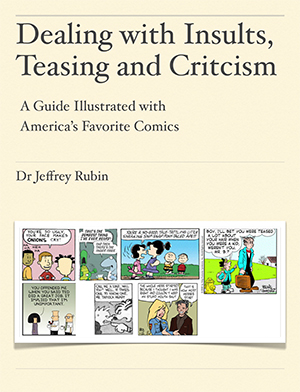
Or you can go to the top of this page where it says “Free Book: Dealing with Insults, Teasing, and Criticism” and click on it. This will permit you to download a free PDF book that utilizes, to teach these skills, many of the comics kids of all ages love.

In addition to James’s approach of dropping the subject for awhile and my approach of playing the “Criticism” game, there is one more crucial point I shall make here about teaching children to handle criticism.  Children are very dependent on their parents.  There is a theory that in the back of the minds of children they are aware of their dependence.  They somehow realize that without their parent’s support they would be in big trouble and this is associated with anxiety and even terror.  Each time children are criticized by their parents, it brings this fear to the fore of their thoughts, and they can only take so much of it without attempting to banish this fear, either by running away, dreaming magical thoughts, or screaming to drown out the feeling of terror.  As a rule of thumb, parents would be wise to say at least ten supportive comments for every one negative critical comment that they make.  And if more than two or three negative criticisms have been made in a single day, perhaps it would be wise to put off the next one until the morrow.

Be patient then, and don’t be afraid to drop a subject until a more suitable time.  This will make you, not weaker, but a stronger parent.  During fun times, teach your children how you expect them to act when criticized.  Be on guard against too much negative criticism all at once.  And above all, let your children know you love them.
———————————
Some people will enjoy reading this blog by beginning with the first post and then moving forward to the next more recent one; then to the next one; and so on. This permits readers to catch up on some ideas that were presented earlier and to move through all of the ideas in a systematic fashion to develop their emotional intelligence. To begin at the very first post you can click HERE.

Categories
anger Bullied child discipline conflict resolution criticism emotional intelligence negative criticism parenting psychological maturity types of criticism wisdom

PROVIDING NEGATIVE CRITICISM: DEFENDING THE FIVE LEVELS

In my previous post I provided readers a discussion titled PROVIDING NEGATIVE CRITICISM: FIVE LEVELS OF MATURITY.  Several of the same arguments that I used earlier to defend the FIVE LEVELS OF RESPONDING TO CRITICISM are equally true for defending the five levels of providing negative criticism.  Perhaps the best argument for the five levels can be derived from the golden rule—Treat others as you want to be treated.  If this strikes you as containing wisdom, then I suggest asking yourself the following.  Do you personally desire, when criticized, to be provided clear, usable information without being bombarded with insults, glares, threats or physical attacks?

If your answer is yes, then to be consistent with the golden rule, it makes sense that you provide negative criticism to others in a manner that is described as level 5.

Although it has been my experience that most people, after some practice, come to agree that the five levels do a pretty good job helping to clarify in their minds the most mature way to provide negative criticism, there are a few questions that come up from time to time.  To address these questions, I will present a discussion based on one I had with a counseling client whom we will call Beatrice.

Discussion with Beatrice 

“Hi, Beatrice.  Say, I was wondering if you read over the pages I gave you that describe the five levels of providing negative criticism?”

“I sure did, Jeff.  I do have some questions, though.”

“I’m very interested in what you have to say, Beatrice.”

“Jeff, when you describe the lowest levels of providing negative criticism, you take a dim view of using physical attacks and shouting.  But I’m a mom.  Just like my mom did with me, when my son Mickey does something wrong, I do shout at him and smack him on his butt.  There’s nothing wrong with that, is there?”

After a few seconds, I say gently, “You know, Beatrice, if I answer you, part of what I say might provide negative criticism to you.”

“Are you saying I’m doing something wrong?!” Beatrice shouts.

Illustration by Aviva Maltin

I pause, and then express my empathy for what she appears to be experiencing.  “I realize discussing this, Beatrice, can be difficult.  If I did think you did something wrong, maybe you’re not up to hearing my opinion?”

Beatrice taps her foot for a few seconds and takes a deep breath.  “Okay, Jeff, I’m ready.  Let me hear what’s on your mind.”

I think to myself, Beatrice seems pretty fragile about this issue.  I better tread lightly.

“Well, Beatrice, first of all, I must admit, I – along with the vast majority of us parents – have come to a point where we were at least mighty tempted to give our kids a good whack.”

“You’re darn toot-in!” Beatrice emphatically replies.

“Some people might raise the following question:  If you hit Mickey when he does something wrong, are you teaching him that it’s okay for him to hit others when they do something he doesn’t like?”

“I don’t think so, Jeff.  The first time I see Mickey hit another kid I’ll smack him good while yelling at him, ‘You’re not the kid’s mother.  It’s only okay for a mother to hit her kid.  Don’t you ever let me see you hit another kid!’”

“I see, Beatrice.  You feel that you can teach him that it’s not okay for him to hit even though you hit him by explaining that it’s only okay for mothers to hit their kids.”

“Yes.”

I pause to think about this for a few seconds.  Then I say, “I think I understand your position, Beatrice.  Having heard what you said, here’s my negative criticism, if you’re still up to hear it.”

Frowning, Beatrice says, “Let’s hear it.”

“I do know kids often pick up more of what their parents do than what their parents say, and some things the kids pick up aren’t always what their parents might want.”

Illustration by Lynn Johnston from her wonderful book, DO THEY EVER GROW UP?

Beatrice shifts in her chair a bit, and then looks up at me.  “Go ahead, Jeff,” she says.

“Well, Beatrice, I’m concerned that hitting Mickey might make it harder for him to get the message that hitting others is not usually the best way to provide criticism.”

“I guess you feel it’s never okay for a mother to strike her child,” she says after a while.

“Well, first of all, I know many, many people who were raised with shouting, spanking mothers, and most of them turned out just fine.  But a few years ago this psychologist, Elizabeth Thompson Gershoff, looked at both positive and negative behaviors in children.  Some parents used hitting and some didn’t.  Gershoff found that the use of hitting was associated with an increase in child aggression and antisocial behavior.

“If you’d like, Beatrice, tell me about the last time you provided negative criticism to Mickey so I can better picture what typically is occurring.”

“We were at the kitchen table and he tipped over his glass of milk.

Illustration by Aviva Maltin

 I yelled at him and smacked him on his bottom.”

Illustration by Aviva Maltin

“I see.  It sure is frustrating when someone spills a glass of milk—the waste, the clean-up.”

“Yes, it is.  So, what would you do with Mickey when he tips over his glass of milk?  You can’t reason with him.”

“If Mickey’s not ready to drink out of a regular glass, there are these cups for children that have a cover with a small opening to drink from.  When these cups are tipped over, they don’t spill.  Now, children do like to learn to act like older people.  For example, Mickey, when he was younger, used to crawl, but he saw older people walking about and he began to try to master that skill, and now he walks just fine.

“If you begin to use this children’s cup, you can, at some point, ask Mickey if he wants to learn to drink out of a ‘big boy’ glass, and show him what it looks like.  When he indicates an interest in doing this, you can tell him that he must show you he can drink from the children’s cup for a while without tipping it over.  Show him what you mean by tipping it over, and see if he understands by asking him to tip it over.  Once he shows you he understands this, you can watch him during meals to see if he is being careful.  When he goes for a few minutes without tipping the cup over, you can praise him enthusiastically, smile, pat his back, and remind him that if he keeps doing a good job he can soon use a ‘big boy’ glass.

“Now, once you feel he’s ready for the ‘big boy’ glass, you can let him try it out and, when you do, remind him to be careful.  Only fill it up about an inch high so if it spills it won’t make as big a mess.  After about a minute, if he hasn’t tipped it over, praise him enthusiastically, smile, pat his back, and remind him that if he keeps doing a good job, he can drink from now on like the big boys.

“Of course, from time to time, there will be an accident.  Then, you can look sad, and have him help you clean up the mess.  If there are too many messes for you to put up with, you may want to decide to go back to the children’s cup for a while.  If you do, you could tell Mickey that it’s just for a little while, just until he can show you that he can learn to use the cup without tipping it over.  Then, again, when he does a good job, you praise him enthusiastically, pat his back, and remind him why you are pleased.”

“I guess, Jeff, I can give that a try.  I like how specific you are.  I understand that more mature people, when providing criticism, are clear enough so that the person being criticized can, if he or she wills, improve the behavior.  You just provided a good example of this.”

“Thanks, Beatrice.  I like the way you were able to hear me out on a topic that is obviously a very sensitive one for you.”

———————————
Some people will enjoy reading this blog by beginning with the first post and then moving forward to the next more recent one; then to the next one; and so on. This permits readers to catch up on some ideas that were presented earlier and to move through all of the ideas in a systematic fashion to develop their emotional intelligence. To begin at the very first post you can click HERE.

Categories
anger Bullied conflict resolution criticism emotional intelligence jealousy negative criticism psychological maturity stress types of criticism wisdom

PROVIDING NEGATIVE CRITICISM: FIVE LEVELS OF MATURITY

Welcome to From Insults to Respect. Recently I have been discussing a model that describes five levels of maturity when responding to criticism. Today, we switch gears, and take a look at a model that describes five levels of maturity when providing criticism.

The Five Levels

Below you will find preliminary descriptions of how people at five developmental levels of maturity provide criticism, that is, criticism that points out what we don’t like about someone’s actions, beliefs, or appearance.  Level one is the most immature and uses observations of babies as its starting point.  Each successive level is more mature:

  1. This level requires displaying one or more of the following:
  • Cries without stating what the crying is about
  • Physically attacks the person being criticized
  • Damages property

Although these three descriptors may not sound like providing criticism, in some situations we can see that it is the very beginning of the development of this skill.  Let’s say Jill takes baby Bob’s crayon away believing he is done with it.  Bob begins to cry and takes a swipe at Jill.  She manages, by moving away, to avoid Bob’s swipe. Bob now looks even angrier and crumbles up a piece of paper and flings it on the floor.  An observer to this may conclude that Bob, in a sense, is criticizing Jill for taking the crayon.   


   2.  This level requires displaying one or both of the following:

  • The criticizer does not explain what the offending behavior is, but instead expresses displeasure with glares, insults, shouting, silence, or threats that do not involve bodily harm. (For example, someone might be making too much noise and the criticizer might turn to the noise maker and glare, or cry out, “Jerk!”)
  • Threatens bodily harm regardless of what else is said.


     3.  The criticizer clearly states the criticism with enough detail so the criticized person, if he or she wills, can improve the behavior, idea, or appearance, but couples it with glares, insults, shouts, or threats that are not about bodily harm.


   4.   The criticizer states the criticism without bodily attacks, damaging property, glares, insults, threats, or shouts, and with enough details so that the criticized person, if he or she wills, can improve the behavior, idea, or appearance.  If the person receiving the criticism becomes defensive or angry, the criticizer empathizes without returning, glares, insults, threats, or shouts.

   5.  When the criticizer provides criticism, he or she does so in a manner very similar to a level four response, but beforehand, the criticizer considers the person who is the target of the criticism, and the situation that he or she is in.  As a result of such considerations, the criticizer may decide to alter the criticism.

  • Person variables that are considered:  From observing how the person to be criticized handled criticism in the past, he or she determines which of the five levels of responding to criticism is most characteristic of the individual. (For example, if someone tends to physically attack the criticizer when criticized and is big enough to cause real bodily harm, then a decision is made either to not provide the criticism or to provide it only when there is sufficient security, or else someone else is employed to provide the criticism who is capable of dealing safely with the attack prone person.)  Other person variables considered are how sensitive the person is when criticized, is the person to be criticized currently in an angry or sad mood, is the criticism likely to be perceived as particularly difficult to bear, versus something likely to be viewed as a relatively minor matter, and if the criticizer’s relationship with the person to be criticized is less than ideal.  Depending on such variables, consideration is given to waiting until the person is in a pleasant mood and enlisting someone else to provide the criticism such as a more neutral person, a friend, or someone who is admired by the person who will be criticized.  When the person to be criticized is particularly sensitive about an issue, a fictionalized story with a character who displays the offending behavior may be presented, and then the character’s behavior is discussed.
  • Situation characteristics that are consideredAre there other people around that will lead to face saving behavior coming into play?  Is there enough time set aside to process the criticism?  Has the person who is to provide the criticism been providing too much negative criticism in too short a period of time? (In this case, consideration is given to waiting until some time goes by in which some positive things are said over the course of several days before hitting the person to be criticized over the head yet again!)

PRACTICE

A good way to become familiar with the five levels is to cut out comics from the paper that illustrate someone providing criticism to someone else.  Then, from time to time compare the descriptions of the five levels to how the character in the comic provided the criticism and then see if you can choose which level best matches the criticism style.  For example, in the Peanuts comic that I used above to illustrate a level five response, with Lucy deciding to give Charlie some time to calm down, I actually altered the last panel in the comic for educational purposes.  The real comic, in its entirety appears below.


In this comic, if you will, compare Lucy’s criticism to each of the five levels and see if you can choose which level is the best match.  In coming weeks, we’ll be practicing these types of skills in a variety of fun ways.

———————————
Some people will enjoy reading this blog by beginning with the first post and then moving forward to the next more recent one; then to the next one; and so on. This permits readers to catch up on some ideas that were presented earlier and to move through all of the ideas in a systematic fashion to develop their emotional intelligence. To begin at the very first post you can click HERE.

Categories
anger Bullied conflict resolution criticism emotional intelligence meditation psychological maturity ruminations stress

ANGER, RUMINATION, AND MEDITATION

Recently, I published posts that discussed dealing with your anger that might arise when you are criticized (see BEING A WISE FRIEND TO YOUR ANGRY SELF, PART 1 and BEING A WISE FRIEND TO YOUR ANGRY SELF, PART 2).  The techniques that are recommended in those posts can be helpful for those who are upset about what was said.  But there are times when we are criticized and we get angry and we kind of think it’s about the criticism, but it really is about something else. Perhaps we realize that if someone else had criticized us in the same way using the same words, we would have been fine about it.  Nevertheless, we ended up getting furious because of who said it. We then went home and our anger about what happened just kept coming up again and again.  We wish it would just stop, but it doesn’t.

Such ruminations can be helpful.  Each time we think over the memory in light of what we have learned since the event first occurred, we might think of some better ways to deal with the conflict.  Then, if a similar event does occur, we may find that we are better prepared than if we hadn’t repeatedly mulled it over.

Despite their helpfulness, there are times when again and again an angry memory keeps creeping ever so annoyingly into our consciousness so that finally we conclude it doesn’t seem to be doing us any good.

Margaret was terribly abused by a man when she was a child. She now finds that even though twenty years have passed, each time she begins to develop a promising relationship with a guy, he ends up doing something that somehow reminds her of something that happened during the earlier abusive relationship. She then ends up recalling all that she had suffered. This leads her to act in a manner that is way out of proportion to what the new guy has done. The new guy runs for the hills and the woman, when she has calmed down, wishes she can become less sensitive.

Illustration by Eric Sailer

There are several approaches that we will be discussing in future posts to help deal with such disturbing ruminations. Today, we will focus on meditation.

Meditation

For thousands of years people have advocated that sitting comfortably while resting one’s thoughts on a mantra—that is, an object to attend to—can help to ease the burdens of life. Teachers of meditation usually mix in ancient wise counsel as the student learns this beautiful art.

Research has demonstrated that meditation can be helpful for improving empathy, working memory, the ability to focus, and relationship satisfaction, as well as reducing stress, anxiety, and ruminations.  Evidence also suggests that mindfulness meditation has numerous health benefits, including increased immune functioning (see http://www.apa.org/monitor/2012/07-08/ce-corner.aspx for a review of the research.)

For those who want to give meditation a try before entering into a course or participating in many of the available wonderful retreats, I offer the following.

A SIMPLE, EFFECTIVE FORM OF MEDITATION

Illustration by Jack Star Rubin

Set aside about twenty minutes. Preferably, choose a time when you haven’t eaten for at least an hour.  This is because right after a meal your stomach begins to work hard to digest what you have just consumed.  It is better to wait until much of this is over.  This way your body can devote more of its energy for your journey into the deepest levels of your mind.

The only tool you need is a clock or watch so you can know when the twenty minutes are up.  Select the most quiet, comfortable place you can find for sitting. With this form of meditation there is no requirement to sit in any unique fashion.  If you desire to shift your position at any time, feel free to go right ahead.

Begin by checking the time and then figure out what time it will be when twenty minutes will have passed.  Then close your eyes, take a deep inward breath, and as you exhale, let your whole body deeply relax.  For approximately thirty seconds, enjoy letting your mind drift wherever it wishes to go.

After the half minute has passed, begin to observe your breathing.  This observation of your breath serves as your mantra.  Do not try to alter the flow of your breath as you observe it, just observe it.  At first you may find that just the act of observing your breathing in and out will result in altering your breathing pattern.  This is very natural and a common experience.  There is nothing wrong with what you are doing when this happens. As long as you gently seek to observe your breathing without influencing its flow you are doing wonderfully.

Now, as you gently seek to do this, not only will you see yourself at times influencing the flow of your breathing, but you will also find, from time to time, that your attention will drift away from your breath altogether. In fact, it is a common experience.  Many of us find that we spend almost no time whatsoever observing our breath as we meditate, our thoughts instead drifting here and there on other matters.  Such experiences are a natural part of meditating.  You are doing nothing wrong.  There is no need to feel guilty.

When you notice that your attention has drifted away from your breathing, very gently see if you can effortlessly return to observing your breath.  If you can, do so.  If you find that your mind drifts back to something else, this is fine. The whole process is effortless.  This is one reason that it is so relaxing.  That is, you give your mind something so simple to do that it requires no real effort, and whenever you begin to drift from this no effort task, you accept this as just a natural part of the process without chastising yourself.

As you do this, from time to time check and when you notice that twenty minutes have gone by, take a deep in-breath, exhale, and then give yourself two minutes to let your breath and mind wander wherever they will go.  In this way, you ease out of meditation and return to your non-meditative state.

SOME QUESTIONS AND ANSWERS

Over the years, when I taught people to meditate, the following questions were often asked.
1. Question: How often should I meditate?
Answer: The research demonstrating the effectiveness of meditation has not yet adequately compared those who meditate twice a day to those who meditate more or less.  Instead of research, we are guided by tradition and our own experience.

From traditional sources, twice a day appears to be the most common practice.  Dr. Herbert Benson, the author of the popular book titled, The Relaxation Response, and a leader in carrying out research on meditation, reports that once or twice a day is sufficient.

I recommend that beginners practice twice a day (preferably before breakfast and before suppertime) for the following reasons.  This is what I was taught by a yoga teacher when I first began to practice forty years ago and it has become a comfortable, valued practice for over 40 years.  Moreover, I have taught many using this technique and have never seen anyone who expressed harm from this practice.  There have been many who have reported dramatic improvements in daily functioning.

2. Question: If I don’t have time to meditate for twenty minutes can I gain some benefits from practicing for less time?
Answer: Dr. Herbert Benson reports that some studies indicate that practicing daily as little as ten minutes per day can produce significant improvements lowering your stress levels.  If you find that you don’t have even ten minutes a day to meditate, you might consider that age old adage that the time to meditate is when you don’t have time to meditate.

A young woman once told me that she didn’t have time to meditate even for ten minutes a day. “How much TV do you watch?” I inquired.  She smiled sheepishly and after a few seconds of calculating in her mind, replied, “Five hours a night.”  She quickly added, “Well, I have to watch my shows!”  In my view, this woman would be wise to reset her priorities.

3. Question: How does meditation help to reduce problems involving recurring angry memories?
Answer: As you meditate, among the thoughts that float into your awareness are angry memories.  When this occurs, you tend to be in a more peaceful state than usual.  The pairing of the memory with this peaceful state allows for a more dispassionate look at the events that had surrounded the original angry episode.  This process often leads to a perspective that is experienced as less threatening.  And sometimes an insightful plan suddenly emerges with great promise should a similar problem cross your path.

The meditation process has been likened to dying a piece of material.  Suppose you have a white sweater and you would like to dye it a nice royal blue.  The first time you dip the sweater in the dye solution and let it sit for a while, when you lift it from the solution you might not notice any change at all.  Upon soaking the sweater again in the solution, letting it sit for awhile, and then lifting it out, this time you may think you notice a slight change, but you are not sure.  You repeat this process several more times and slowly but surely you begin to see the color of the sweater becoming a wonderful hue. In this way, each time you sit in meditation, your anger will ease into something more beautiful.
———————————
Some people will enjoy reading this blog by beginning with the first post and then moving forward to the next more recent one; then to the next one; and so on. This permits readers to catch up on some ideas that were presented earlier and to move through all of the ideas in a systematic fashion to develop their emotional intelligence. To begin at the very first post you can click HERE.

Categories
anger Bullied conflict resolution criticism emotional intelligence psychological maturity stress

BEING A WISE FRIEND TO YOUR ANGRY SELF, PART 2

In my last post, I discussed BEING A WISE FRIEND TO YOUR ANGRY SELF.

Illustration by Deanna Martinez

I received some nice comments from people who found the suggestions helpful.  Thanks!

For some, the suggestions that I put forth on this blog are easy to carry out in real life situations.  For others, old habits that have been used in anger- arousing situations for years are not so easily changed.  This is true even when people become convinced that the new style makes sense.  After a few tries at using the new style and finding that the attempts come off as clumsy, many people may decide that the new style is just not “natural” for them.  They feel that their effort to change is really an effort to suppress their “natural” style, and suppression is not healthy.

The association of anger suppression with learning new skills to deal with anger is understandable, for when one has spent many years acting one way, learning alternative behaviors can be frustrating.  This uncomfortable sensation may be seen as the suppression of one’s “natural” mode of behavior.  It’s a similar experience to how actors might feel when first learning a new role or golfers a new swing.  At first the skill to be learned feels awkward and the early phase of learning can leave them to observe their heart racing and their blood pressure skyrocketing.

Illustration by Eric Sailer

To take a particularly vivid example, consider what happens when human beings have to go to empty their bowels.  When they are first born, they just empty their bowels anywhere.  No one that I know buys the argument that releasing your bowels whenever you feel like doing it is the natural way to live, and that suppressing the urge to release your bowel movements would be unhealthy.  Most of us now understand that when people feel the urge, they can learn to excuse themselves in a pleasant manner and then wait a bit until they get to a more private place to do this type of business.  No real damage is done if we can get to a bathroom in a reasonable period of time.

It is similar with anger.  To not wait until you get to a private place will end up leaving you in a nasty smelling, icky situation that would not be at all in your own best interest or in the interest of others you happen to be with.

Taking the time to calm yourself in the manner suggested in last week’s blog can work, but for most people, it takes practice.  By designing a program in small incremental steps and heeding the suggestions I will be making on this blog, the feeling of suppressing one’s natural behavior can be largely reduced or even completely eliminated.

First of all, Expect Missteps.

By studying the posts on this blog, it is likely that several situations will occur that you now find yourself handling much better than before.  If the response by others you are engaged with ends up being favorable, this will encourage you to utilize the same approach again and again until it begins to feel natural, that is, second nature to you.  Other skills will come off a bit awkward or you will get a less than favorable response, and you may experience frustration.  When you try the skill again, you may now feel unsure and your effort may lead you to interpret this as suppressing a more “natural” way to respond.  You may therefore give up and conclude that you are helpless to make a meaningful change in this type of skill.

A big part of the solution to this problem is to reread the section that discusses the skill, and then practice over and over in your mind a narrative that has you envisioning utilizing the skill.  When you can smoothly imagine in detail carrying out the skill, try it out again in real life.  You may have to do this a few times until you get it right.

Today, I will provide a little fun practice session to help to better learn the skill of being a wise friend to your angry self.

You and your Friend, Eric

Illustration by Deanna Martinez

You and your friend, Eric, are discussing the upcoming election.  Eric explains why he intends to vote for someone in the upcoming presidential election you believe would do an awful job.  After the discussion has gone on for awhile, eventually it becomes clear to you that neither of you are going to change your opinions.

It’s at this point that you feel your anger toward Eric rising up within you.  Before reading on, spend some time thinking about what you would now do. 

After thinking about this, consider trying to come up with a charming way to say to Eric you’d like to take some time to think about the discussion you have both been having and then leading the discussion on to another topic.  Envision in your mind exactly what you would say, and how you would say it.

Illustration by Deanna Martinez

After you have thought about this, see if your response includes summarizing for Eric his main points.  Then a smile, perhaps a good-nature pat on the back of Eric’s shoulder, and then a comment like, “Well Eric, by now you know my opinion about this and I certainly know yours.  We obviously disagree.  Nevertheless, I’m still very fond of you.”  Finally, a comment by you that indicates your willingness to continue the conversation after you had some time to reflect on what has already been said.

It is now later in the day.  You recall the conversation with Eric and anger rises up within you.  Think about what you would do to deal with this.

After thinking about this, reread last week’s post and compare and contrast it with what you came up with.  Practice this exercise until you can,

1. envision in your mind very quickly and smoothly coming up with a charming way to disengage with Eric;

2. describe how you wish to respond to your anger when it flares up after you leave Eric for the day.

When you can do this three times without using any notes, you will find that the next time a similar situation comes up, you will be able to handle it far better than you thought possible.
———————————
Some people will enjoy reading this blog by beginning with the first post and then moving forward to the next more recent one; then to the next one; and so on. This permits readers to catch up on some ideas that were presented earlier and to move through all of the ideas in a systematic fashion to develop their emotional intelligence. To begin at the very first post you can click HERE.


Categories
anger conflict resolution criticism emotional intelligence psychological maturity stress Thich Nhat Hanh

BEING A WISE FRIEND TO YOUR ANGRY SELF, PART 1

In my last post,  CRITICISM AND ANGER, I discussed how sometimes when we are criticized we find ourselves getting angry.  At such times, it’s a good idea to have a well-practiced strategy to summarize the criticism that has been made and then to respectfully call for a break in the discussion to consider all that has been said.

Once you have removed yourself from the anger arousing situation, what are valuable things that you can do to take advantage of your cooling down period? In coming posts, I will discuss a variety of ideas, but today we will focus in on being a wise friend to your angry self.

Wisdom and Anger

If I was wise, how would I respond to a friend who was angry?  If my friend, Steve, was angry, I would gently invite him to take a walk in the country or park.

If he agreed to a stroll, as we went on our way I would listen to him in a caring manner.  If he said he’d rather sit and talk in a quiet place, or not talk at all, I’d offer to do that with him.

Similarly, when I become angry, if at all possible, I take myself for a walk and my friendly, supportive self listens in a caring way to my angry self.

My friendly self doesn’t try to get my angry self to suppress any anger, but rather, to freely express it, but only in private.

Over the years, I have found that whenever my friendly self spends time interacting with my angry self, after awhile my angry self calms down.  During the calm spell, I am far more open to reason.

Now, as you try this out with yourself, please keep in mind that your angry self does not seek to suppress any anger to reach this relatively calm state.  It will occur naturally without any effort at all. Just listen to yourself in a caring manner, and see for yourself what happens.

Once you are in a state of relative calm, you can begin to respond to the conditions that led to anger in a more reasonable manner.

There are some wonderful metaphors that can help you through this process of reaching a relative period of calm.  Thich Nhat Hanh, in his fine book, Anger: Wisdom for Cooling the Flames, reminds us that if we are wise, we do not seek to suppress our anger or wage war against it.  Instead, we can learn to view anger as an organic feeling.

Thich Nhat Hanh
Thich Nhat Hanh

“The practice” Hahn writes, “is to transform yourself.  If you don’t have garbage, you have nothing to use in order to make compost.  And if you have no compost, you have nothing to nourish the flower in you.  You need the suffering, the inflictions in you.  Since they are organic, you know that you can transform them and make good use of them.”

Another Hanh metaphor I like has us thinking of our anger as a potato that we have picked out of a garden.  When we first take it out of the soil it is dirty and hard.  It is not quite ready to provide us with an excellent form of nourishment.  It is much better to take some time to clean it up and then to have it sit in a warm oven for awhile.  Then it soon turns into something delicious.

Similarly, when anger first arises, it is very likely to be a poor form of nourishment.  In fact, it can even turn out to be poisonous.  You have to clean it up first, and then find the right place where it can best be turned into a valued experience.

Now, as you go through this calming period, you will notice your angry self chattering away, saying things like, “That idiot who made me angry is a stupid jerk.”  Other derogatory statements about the source of your anger may come to mind.  Perhaps you will think about how you can do harm to the person your mind is insulting.  This is part of the anger process.

At such times, see if you can observe your angry self in a nonjudgmental manner as this is happening.  If you can’t, there is no need to punish yourself.  Anger is a strong emotion.  Be as kind to yourself as you can throughout this process—just like a good, compassionate friend would.

observing sensationsFrom time to time, see if you can take a few seconds to observe the physical sensations you are experiencing.  The chattering in your mind may make this difficult, so if this does not happen, again you are not encouraged to punish yourself.  Just gently remind yourself that observing the physical sensations you are experiencing could be useful to do if you can.

Now, once you take maybe an hour or so to be a good pal to your “angry” self, even if you have calmed down at this point, if at all possible, don’t leap into trying to come up with a resolution to your angry conflict.  Give yourself a full week, whenever possible, to plan your next discussion with the person with whom you have an angry conflict.

Take advantage of this relacalmtively calm period to map out a strategy to address the concerns raised during the anger arousing situation.  If you come up with some ideas that sound promising, I encourage you to NOT commit to any one idea just yet.  Instead, afterwards, see if you can enter into some different activity unrelated to the conflict such as playing with the kids, doing some housework, watching a movie, going bowling, calling your mother, etc. It is best to take a break from the conflict for awhile and have a night to sleep on it.

This break from formally trying to figure out what your next step should be can be valuable for coming up with creative solutions.  During this period, you’re not badgering yourself to go step by step in any process.  You are aware that you have plenty of time before you will be expected to have a plan to move forward.  There is a reduction in any sense of pressure.  Moreover, your mind does need some rest.  The processing of anger arousing conflicts can be exhausting.

discussionToward the end of the week, if the conflict isn’t too personal, consider discussing what happened with some people you respect and trust.  Two or three heads are usually better than one.

Finally, shortly before meeting again the person with whom you are having the angry conflict, see if you can work up a heightened sense of determination to achieve your desire to resolve this conflict.  Keep in mind that the stress you have been experiencing is normal and fulfillment is not found in easy comfort, security, and routine, but rather in the continual growth in wisdom through what is learned from negative and positive experiences of an active, changing life.
———————————
Some people will enjoy reading this blog by beginning with the first post and then moving forward to the next more recent one; then to the next one; and so on. This permits readers to catch up on some ideas that were presented earlier and to move through all of the ideas in a systematic fashion to develop their emotional intelligence. To begin at the very first post you can click HERE.

Categories
anger conflict resolution criticism emotional intelligence psychological maturity stress

CRITICISM AND ANGER

For the past few weeks, I have been discussing the different reasons why people criticize and how to respond in a mature manner.  To become a master at responding maturely, these mature responses have to be rehearsed.  But even after a great deal of rehearsing, masters at responding to criticism occasionally find themselves becoming so angry at what is being said, that they have to call a time out.  We discussed how to do this in a respectful manner in an earlier post titled SUMMARIZE AND DELAY.

But what is a wise course of action if your best efforts to summarize and delay is ignored by the criticizer and the criticisms just keep coming at a rate that is just too much for you to bear?  Let’s take a look at a parable which points us to a strategy to deal with such a trying situation.


PARABLE OF MARTY AND LENA

One day Marty gets stuck at work.  He calls his girlfriend, Lena, to let her know he will be late for their date. 

Illustration by Eric Sailer

When he finally arrives at Lena’s house, he’s already irritated about how his boss has treated him all day long and he finds himself becoming a little annoyed when Lena starts to raise her voice about how late he is.  “I understand why you are upset,” Marty replies.

Lena then looks at Marty’s clothes and complains that he’s not wearing a tie.

“I didn’t think a tie was necessary for the party we’re going to,” Marty replies.  “Next time we go to a party, I’ll check with you before I pick out my outfit.”

As they leave the house to go to the party, before getting into his car, Lena pauses. “You didn’t have your car washed, and you knew we were going to a party!” she complains.  “It’s filthy.”           

Marty now feels himself getting really angry.  He had run out of time to have the car washed.  To have stopped to get it washed before coming to Lena’s house would have made him even later than he was. 

He takes a deep breath to try to calm himself, and then he begins to think about why Lena has been so negative with him.  He has practiced going down the list of possibilities, and he quickly does so now.

Is she just offering criticism to me in an effort to get me to improve? he says to himself.  There’s just too much criticism all at once for this to be the whole reason, he decides.

Is she just playfully teasing?  She doesn’t look at all like this is any fun for her.

Is she trying to impress some friends so she can better bond with them?  There’s no one around but she and I.

Is she in a bad mood about something?  That has to be it, and I know why.  She’s still angry because I was late. 

“Lena,” he says, “I think you’re still angry because I was late.”

“Yes I am,” she hollers.

“I really wish I could have been on time, Lena.  I had a very rough day at work, and now, in the last five minutes you criticized me three times—first, about my being late, then about not wearing a tie, and now, about not washing the car.  Usually I’m very interested in your criticisms.  But for the rest of the evening I’d like you to hold off on any more.”      

“Don’t give me that!” Lena hollers.  “You didn’t wash the lousy car!  What’s wrong with you?!”           

“Lena, I know you’re going to be disappointed, but I’ve just decided to spend the evening alone.  I’ll call you in a few days and if you’re up to discussing what happened this evening, we’ll do it then.  I’m sorry.”  Then Marty gets into his car and drives away with Lena still yelling.


PARABLE DISCUSSION

Illustration by Eric SailerNotice that in this Marty and Lena parable, Marty first attempts to sail away from the Region of Anger by gently asking Lena to hold off on any more criticism for the rest of the evening.  We will call this the “Signaling to Back-Off Technique.” Although this fails to work for Marty in this parable, the Signaling to Back-Off Technique has the potential to be highly effective.  It works best in an ongoing relationship, although I have seen it work well with people who hardly know each other.  The best way to set this up is to discuss this technique with the other person at a time when both of you are not in an angry mood.  You might say to the other party something like:

Sometimes I begin to get really upset about something you are saying.  I know that it’s important for me to hear your point of view, and I do want to hear what you have to say.  But there are times when I’m in no condition to give you a fair hearing on a particular topic.  At such times, it would help me a great deal if I could give you a simple signal for you to back off for a while.  I’ll make sure you’ll get your opportunity to have your full say on a topic before too long—almost always within a week.  But I sometimes require a little time to get my act together first.  Would you mind helping me out in this way?

If the other party agrees to the Signaling to Back-Off Technique, and I have found that most people do, together you can decide on a signal.  A friend might say something to another friend like, “Please give me a little time to think about this.”  A wife might wish to use with her husband the phrase, “Darling, let’s discuss this later.”  I know one couple who just uses the phrase, “Back off, please.”  This strikes me as a bit abrupt, but it seems to work for them.

In the Marty and Lena parable, when Lena refuses to hold off on any more negative criticism for a while, Marty decides to leave rather than listening to any more insults.

Some people think that it is best to just start yelling at the criticizer to shut up already.  This usually leads to an angry exchange and this can potentially clear the air.  But sometimes some particularly awful things are said in the exchange and events escalate into violence or lasting resentments.

Whereas the quick shouting approach may work well for some people, others find that they sometimes reach a point at which they determine that it would be best to indeed call a time out.  We do it in many sports for four reasons:  To avoid events escalating into violence; to take some time to catch our breath; to think about what has just been happening; and to formulate a plan to go forward.  It is for the same reasons why we call time outs in an anger arousing situation.

After you excuse yourself, what are valuable things that you can do to take advantage of your cooling down period?  Next week’s post will begin to answer this question.

———————————
Some people will enjoy reading this blog by beginning with the first post and then moving forward to the next more recent one; then to the next one; and so on. This permits readers to catch up on some ideas that were presented earlier and to move through all of the ideas in a systematic fashion to develop their emotional intelligence. To begin at the very first post you can click HERE.

Categories
Bullied conflict resolution criticism emotional intelligence psychological maturity stress

RESPONDING TO CRITICISM WHEN IT IS BEING PROVIDED BECAUSE THE CRITICIZER IS IN A BAD MOOD

Over the past few weeks, I have been discussing responding to criticism.

To become a master at responding to criticism we have to learn to figure out the reason why someone is criticizing us because different reasons require a different type of response. So far, we discussed four different reasons and how to respond to them:

  1. Criticism designed to encourage you to improve (see RESPONDING TO CRITICISM: FOUR LEVELS OF MATURITY and RESPONDING TO CRITICISM: THE MOST MATURE LEVEL)
  2. Playful teasing (see MAKING THE BUS MONITOR CRY: RATING HER RESPONSE)
  3. The desire to form a bond with a group by putting down non-group members (see MAKING THE BUS MONITOR CRY: WHY THE BOYS DID IT)
  4. Jealousy (see BEING CRITICIZED BECAUSE OF JEALOUSY)

Today we will focus on dealing with criticism that occurs because the criticizer is dealing with an overload of stress.

Consider the following parable.   

Bella in the Restaurant

Illustration by Deanna Martinez

Bella goes to her favorite Italian Restaurant on her first date with Gino.  Checking the menu, she starts having a desire for chicken parmigiana.  When she orders, the waiter says, “I think we might be out of chicken, but I know we have excellent eggplant parmigiana.  I’ll be right back and let you know.”  

Although Bella would prefer chicken parmigiana and thinks the manager is guilty of being wrong for not having enough chicken on hand, the eggplant parmigiana is something she would enjoy.  She feels a mild annoyance about this because she might not get exactly what she wants.  Although she is experiencing a conflict with the manager, she shrugs her shoulders and begins to discuss her day with the cute guy she came with.

Now, although Bella, on this day did not get angry, if she had experienced more than her usual amount of stress earlier in the day, even if the stress had absolutely nothing to do with what happened at the restaurant, the mild additional stress that she experienced at the restaurant when she learned it did not have the dinner she was hoping for could lead to a full anger episode.

Illustration by Deanna Martinez

Here we see Bella throwing over a table, but she might instead express her anger by taking it out on the boy she is with, or even you if you happened to be with her.  You might do something and find Bella launching one criticism after another at you.

When people get hot, are around a lot of noise, or have met up with one too many hassles, they oftentimes become irritable.  At such times they are more likely to say insulting things, to start shouting, or to put on a nasty looking face.

Now let’s say that you are not sure why Bella is criticizing you.  At first you respond as if Bella is simply criticizing you to encourage you to make some improvement.  Thus, your responses are beautifully consistent with level four and even level five on the five levels of maturity scale (see RESPONDING TO CRITICISM: FOUR LEVELS OF MATURITY and RESPONDING TO CRITICISM: THE MOST MATURE LEVEL).   But then you see that Bella is being far more critical of you than she usually is.  You begin to go down the list in your mind of other reasons people provide criticism besides encouraging improvement.

You begin to wonder if she is playfully teasing?  She doesn’t look like she has a little twinkle in her eyes that suggests her usual playfulness.  Instead she looks very, very, serious.

Hmmm.  You consider another possibility.  Perhaps she has a desire to form a bond with a group by putting down non-group members.  But there is no one else around that she knows.  In this setting at the restaurant this just doesn’t make a whole lot of sense.

Is she jealous of you?  This may be a possibility.  Perhaps she thought of something about you that made her jealous. You therefore apply the skills that you learned to use in the post titled BEING CRITICIZED BECAUSE OF JEALOUSY.

Despite your efforts, Bella continues to be hypercritical of you.  Now what might be a helpful way to respond?

If you find that Bella begins to insult you for no apparent reason or for something so trivial that it is hard to believe she is so worked up about it, you might feel puzzled.  You might feel that you’ve been mistreated and begin to insult her back.  If she’s already in a crabby mood, do you think returning insults will be helpful?

If someone starts to insult you in a manner that doesn’t seem to make a whole lot of sense, one useful thing to say to yourself is, “Maybe the insults don’t have much to do with me.  Maybe the insulter has become overly stressed out.”

To test your theory it may be helpful to softly ask, “Is everything all right, Bella?”  Then, some empathic listening may be all that is needed.
———————————
Some people will enjoy reading this blog by beginning with the first post and then moving forward to the next more recent one; then to the next one; and so on. This permits readers to catch up on some ideas that were presented earlier and to move through all of the ideas in a systematic fashion to develop their emotional intelligence. To begin at the very first post you can click HERE.

Categories
Bullied conflict resolution criticism emotional intelligence jealousy Lao Tzu psychological maturity Tao Te Ching

CRITICISM PROVIDED BECAUSE OF JEALOUSY: A PARABLE WITH RESPECT TO THE TAO TE CHING

Last week I began a discussion about how to handle it if you suspect somebody is criticizing you because of jealousy.  Today we will begin a discussion about what you might wish to do if you find that you are insulting individuals with whom you are experiencing feelings of jealousy.  To that end, please consider the following parable from my novel, Love, Sex, And Respect.

A PARABLE WITH RESPECT TO THE  TAO TE CHING

All four characters in this parable are high school seniors.  Jeff and Steve are varsity baseball players, Cliff is the student manager of the team, and Ray is a friend who has been training to become an expert in Kung Fu.  The visual illustrations are by Deanna Martinez

“I hear you guys are having a great baseball season,” says Ray, who is sitting on the right side of the picture below.

“We were,” Jeff responds while warming both of  his hands on his teacup.    

“We lost our first game yesterday,” says Steve sadly.

 “It was a heartbreaker,” says Cliff hanging his head. 

“Anyway,” says Steve, “we do have a great team.  We definitely have the best outfield in the city—Jeff in left, me in center, and Allan in right.”

Jeff’s face begins to react with an ugly twisting.

“Jeff,” says Cliff, “whenever Allan comes up, your face cringes.”

After blowing on his cup of tea, and taking a sip, Jeff leans back and reflects.  “He just pisses me off, Cliff.  I don’t openly put him down or anything—because he’s on the team.  If he wasn’t I’d probably rag on him pretty good.”

“Well,” says Cliff, “whenever his name comes up you do put him down quite a bit just from your facial expressions.  I like him.  What’s he do that bugs you so much?”

“You know,” Jeff replies after some more thought, “I’m not really sure.”

“You’re getting something out of putting him down or you wouldn’t be doing it,” Cliff insists. 

“Well, let me see,” Jeff replies.  “It seems to have something to do with Allan being pretty close to me in baseball skills and the question about who should be respected more comes about.  Maybe it’s because I feel, on some level, that to get respect, what you have to do is, well how can I explain this?  Well, let’s say I start at this level of respect.”  As Jeff says this, he puts his right hand chest high.  “Now, let’s say guys like Allan start off about at this same level.”  As Jeff says this, he puts his left hand also chest high, while keeping his right hand there as well.  “Now, when I’m around other people, maybe I figure I have to put down guys like Allan so people think less of them.  You see, that puts them down here.” 

As Jeff says this he lowers his left hand to the height of his navel while keeping his right hand chest high.  “The more you advertise,” he continues, “how spastic and stupid others are, the more others are down here on the respect indicator.  That leaves me over here, chest high, clearly at a higher level of respect.  You see how it works.  Guys like Allan are now over here by my navel, and I’m up here by my chest.  Then, if I advertise the good things about me, it raises me even higher, like over here,” and Jeff raises his right hand over his head.  “Look at the difference.  With this theory, I end up far more respected than the guys who started off being almost as respected as me.”

“It’s interesting,” says Ray, “that your theory focuses in on people who are almost as respected as you, because in my family I have heard over and over again the saying, ‘People like to cut down the tallest bamboo tree.’  You seem to like to cut down the tree closest to your height.” 

“I’m not sure if I always do,” Jeff responds.  “Anyway, what’s really strange is that as I’ve gotten older, in my head I’ve become fully convinced that my theory is wrong because I wasn’t particularly respected as a kid when I used the ‘cutting people down’ approach with utter abandon.  And Steve, well he hardly ever puts other guys down and he’s pretty respected.  Not only doesn’t he put guys down, but he says nice things about them.  I mean, I know Steve’s right and all, but when he says something nice about someone like Allan, sometimes it upsets me inside.  I guess I’m not convinced through and through.  Something inside me still feels what Steve does is wrong.”

“Jeff,” Steve responds, “I don’t have any recollection of forming a theory of what to do about stuff like this.  But it just seems to me, now that you brought it up, that your theory, where you put down others to get respect and brag about things you do, it just don’t work that way.  Maybe sometimes some kids will laugh while you put someone else down because, while you’re ganging up on someone else, at least you’re not picking on the other guys who are listening.  And maybe their laughs make you think you’re getting respect.  As far as complimenting people, I don’t do it for any theory or what have you.  It just…I don’t know…I just do it.”

“You know,” says Ray, “I have an uncle that’s been teaching me, my younger brother, and my cousin, Kung Fu for years now.  Steve used to attend his classes when he was in junior high.  Anyway, at the end of each lesson he has us go through this ceremony.  Listening to you guys talking, well, the ceremony came to mind.  It’s kind of connected, although there are some differences, too.  Still, I think if we go through it, it might help.”

The boys all get up and go into a candle-lit room that adjoins the kitchen— one with blue walls, a dragon painted on it, a table filled with four flickering candles, and a few black and white pictures of Ray’s family members.  On the white carpeted floor are large overstuffed pillows. 

“Here, take one of these,” says Ray as he hands Jeff an unlit candle. “And you take one too, Cliff.  Good.  Now face me.  First, I’m gonna say some words.

“Can a man truly be separate from others?  No more so than can his body be separate from his soul.  There are times when others will nourish you and there are times you will nourish others.  When people nourish you this does not entitle them to possess you. 

“When you nourish others do not seek to possess them. The sage says,

                ‘Giving birth and nourishing,     

                Bearing yet not possessing,

                Working yet not taking credit,

                 Leading yet not dominating,

                 This is the Primal Virtue.’”

Then, Ray begins to light the candle Jeff is holding while saying, “When you are born, Jeff, you are given some power.  This light represents your power.  You live in Brighton Beach.  Let’s say you have many neighbors that you like to humiliate.  One day while walking, an evil wind comes blowing up Ocean Parkway and…”  Then Ray, with a mischievous, contorted face moves toward Jeff and with a sudden puff, blows out his candle.  “Oh!  Your flame went out,” Ray says.  “What can you do?”

“Beats me,” Jeff answers.

“Oh well,” says Ray.  “This is the end of this story–with you lost in darkness. 

“Now let me tell you another story.  This one begins the same way.  Jeff, you are born.”  Ray begins to relight Jeff’s candle.  As he does this, he says, “Remember, this flickering flame represents your power.  Jeff lives in Brighton Beach.  As he lives his life, he meets Cliff.  Look!  Oh, my!”  Ray looks distressed and points to Cliff’s unlit candle.  “Won’t you help poor Cliff,” asks Ray.  “He is in a difficult way.”

“Fine,” Jeff says, as he moves his candle toward Cliff’s unlit candle, but as he does so, he finds his flame almost going out.  “Look!” Jeff says while stopping his approach toward Cliff, “I tried to help Cliff and I almost put out my candle.  You see?  If you try to help someone, you could end up screwed.”

Ray smiles.  “Yes!  Yes!  But perhaps you will try again.  But this time, use a little care.  Do not move your lit candle so quickly or else your movement against the unseen air will blow it out.”

This time, carefully, Jeff moves his yellow flame towards Cliff’s unlit candle.  As he does so, his flame begins to weaken.  Jeff slows up a little more and from time to time stops, allowing his candle to regain its full brightness.  When his candle is only a couple of inches away from Cliff’s, he tilts it toward his wick.  As he does this with his left hand, hot liquid wax accidentally drips off his candle and lands on his right wrist, which is just below his candle. 

“Ouch!” he cries.  “Look at this.  I’m trying to help Cliff, and first I almost put out my own light and now I get hurt.  You see?  If you help someone you set yourself up to get into trouble.”

“Helping others does have some risk,” says Ray.  “But use a little more care and skill.  Then we’ll see what happens.”

Once again Jeff tries to light Cliff’s candle.  He watches the candle’s flame as he moves it through the air, adjusting his movements to maintain a good strong flame.  Within a couple of inches from Cliff’s unlit candle, Jeff begins to slowly tilt his candle while taking care to move his right arm away so no drops of hot wax will burn him.  This time Jeff is successful in lighting Cliff’s candle, and he’s not injured in any way.

“This time you knew what to look for,” says Ray.  “Did you feel you were in any danger as you helped Cliff?”

“No.  I got it down now,” Jeff responds.

“Good,” says Ray.  “Now let’s pretend a few weeks later Cliff is in another neighborhood and runs into Steve.  Oh my!  Look!” As Ray says this, he hands Steve an unlit candle and then points to it.  “Look, Cliff, Steve’s candle flame is out.  Will you not help Steve?”

            “Sure,” says Cliff.  Having watched Jeff’s mistakes, Cliff carefully moves his candle toward Steve and, without a mishap, successfully lights his candle.

“Well done!” says Ray.  “Now, let’s continue with my story.  One day, Jeff is walking along Ocean Parkway and suddenly an evil wind comes along and…”

Ray once again puts on his mischievous face and–puff–blows out Jeff’s candle.  “Oh, my.  Jeff is in trouble.  Is there anything he can do?”

“I guess I can go over and ask Cliff for a light,” Jeff responds.

“Yes.  Perhaps that will work.  Go see.  Go see,” says Ray.

“Hey, Cliff, got a light?”

“Well, you helped me the other day,” says Cliff, “so I guess it’s only fair if I help you.”  And Cliff, carefully, lights Jeff’s candle.

“It is nice to see you two helping one another,” says Ray.  “Now, let me finish my story.  One day Jeff and Cliff are together on Brighton Beach Avenue.  And once again an evil breeze comes along and…puff, puff.”  Ray blows out Cliff’s and Jeff’s candle.

“Oh, my!” says Ray.  “Jeff has lost his flame, and to his bad luck, the one guy who he helped, Cliff, was with him and he too has lost his flame.  Is there nothing that can be done?”

 Cliff turns to Jeff and says, “Don’t worry, I’ll be right back,” and then he walks over to Steve.       

Graciously, and with care, Steve lights Cliff’s candle, who in turn, carefully returns to Jeff and lights his candle.

“Bravo!” says Ray.  “You see, if you do not help others, when you need help you may find that you are all lost in darkness, all alone.  But helping others can be dangerous unless done with care.  Learning to properly move the candle toward another teaches us that observing, timing, and pace are very important.  Learning the proper way to tilt the candle toward another reminds us of the importance of attitude.  The sage says:

                ‘He who stands on tiptoe is not steady.

                 He who strides cannot maintain the pace.

                  He who makes a show is not enlightened.

                  He who is self-righteous is not respected.

                  He who boasts achieves nothing.

                  He who brags will not endure.

Accept disgrace willingly.

Accept misfortune as the human condition.

         Surrender yourself humbly; then you can be trusted to care for all things.

         Love the world as your own self; then you can truly care for all things.’”

———————————
Some people will enjoy reading this blog by beginning with the first post and then moving forward to the next more recent one; then to the next one; and so on. This permits readers to catch up on some ideas that were presented earlier and to move through all of the ideas in a systematic fashion to develop their emotional intelligence. To begin at the very first post you can click HERE.

Categories
Bullied conflict resolution criticism emotional intelligence jealousy Lao Tzu psychological maturity Tao Te Ching

BEING CRITICIZED BECAUSE OF JEALOUSY

Over the past few weeks, I have been discussing responding to criticism.  To become a master at responding to criticism you have to learn to figure out the reason why someone is criticizing you because different reasons require a different type of response. So far, we discussed three different reasons:

  1. Criticism designed to encourage you to improve
  2. Playful teasing,
  3. The desire to form a bond with a group by putting down non-group members

Today we will focus on dealing with criticism that occurs because someone, or a group of people are jealous of you.

Illustration by Eric Sailer

In the above comic, a young girl is talking about a new kid at school to her counselor.  Apparently the new kid is nice, kind, and helpful.  Such a person may be perceived as having some advantages in getting others to like them.  Perhaps the young girl in the comic is jealous of the new kid.  By the last frame, the young girl is focused not on possessing the advantage, but on expressing her dislike for the new kid who has the advantage.

It is quite a common observation that when people meet up with someone whom they perceive as having an advantage over them—whether it is that the person is taller, handsomer, smarter, nicer, richer, or more talented in some way—some people seek to cut down the person with the perceived advantage.

If someone is criticizing you, how can you tell if it is because of jealousy?  A useful clue that sometimes indicates jealousy is if the insults become more frequent whenever you are recognized by someone as doing something well.  For example, someone cute says you look great or the teacher says you received an “A.”

To create a useful example, let’s call a student Arlene.  A teacher during lunch compliments Arlene for her performance on the volleyball team.  As soon as the teacher leaves, one of the students at Arlene’s table says in a nasty tone:

Illustration by Deanna Martinez

This comment sounds like it may very well be motivated by jealousy.  What would be a wise response for Arlene to make?

If Arlene knows that although it is true that she missed some shots at the game, but still did better than anyone else on the team, would this be a good thing to mention at this time?  This type of response is likely to be viewed by the other students as bragging.  It may increase the motivation to cut her down.

What if instead, Arlene decides to let her actions during the games she plays in speak for themselves?  Whenever she is insulted by the students, she attempts to find an element of truth in the insult and humbly admits to it.  For example, after the student had said, “Arlene’s not so great, she missed lots of shots at the game!” rather than defend herself, suppose Arlene says:

Illustration by Deana Martinez

By doing this, those who have a desire to make Arlene feel down will find that they are at least somewhat satisfied.  This at least reduces the intensity of the conflict rather than increasing it, which is likely to happen if Arlene brags or replies with an insult.  There is power in being humble.  A great sage once said:

“Giving birth and nourishing,     

Bearing yet not possessing,

Working yet not taking credit,

Leading yet not dominating

This is the Primal Virtue.”

Lao Tzu from Tao Te Ching
——————–
Some people will enjoy reading this blog by beginning with the first post and then moving forward to the next more recent one; then to the next one; and so on. This permits readers to catch up on some ideas that were presented earlier and to move through all of the ideas in a systematic fashion to develop their emotional intelligence. To begin at the very first post you can click HERE.