Categories
Bad Mood conflict resolution fear mental disorders Mental Illness psychiatry psychological maturity psychopathology William James wisdom

William James’s Personal Bout with a “Mental Disorder”

William James
William James

William James, psychologist and philosopher, passed away over a century ago.  Nevertheless, his remarkable body of work remains as fresh as fruit plucked from its tree but moments ago.

His views about his personal bout with a challenging experience developed over many years.  Today I think it will be instructive if we spent a little time reviewing what he learned.

A Glimpse at James’s Early Views on Mental Disorders

We begin in April of 1867. James is 25-years old. Suddenly, he interrupts his medical education and flees to Europe.

Later, on describing the feelings that led to his departure, James wrote “it was as if something hitherto solid within my breast gave way entirely, and I became a mass of quivering fear. . . . I awoke morning after morning with a horrible dread in the pit of my stomach.”

William and Henry James's Father, with Young Henry on the right
William and Henry James’s Father, with Young Henry on the right

Several years went by and then, gradually, James’s spirits lifted. His father, noticing the difference in him, asked about it, and then relayed the news by letter to another son, Henry, in March, 1873:

He came in here the other afternoon when I was sitting alone, and after walking the floor in an animated way for a moment, exclaimed “Dear me! What a difference there is between me now and me last spring this time: then so hypochondriacal” (he used that word, though perhaps in substantive form) “and now feeling my mind so cleared up and restored to sanity. It is the difference between life and death.” He had a great effusion. I was afraid of interfering with it, or possibly checking it, but I ventured to ask what especially in his opinion had promoted the change. He said several things: the reading of Renouvier (specially his vindication of the freedom of the will) and Wordsworth, whom he has been feeding on now for a good while; but especially his having given up the notion that all mental disorder is required to have a physical basis. This had become perfectly untrue to him. He saw that the mind did act irrespectively of material coercion, and could be dealt with therefore at first-hand, and this was health to his bones.

We see in the above that at this time James viewed his experience that led to his departure from medical school as a “mental disorder.” Moreover, his conceptualization of it had begun to develop from a physiological pathology model to one that gives at least some freedom to the will. In time, his views begin to develop even further.

Letter to Henry James, 1885

The two brothers. Henry is on the left and Professor William James is on the right

William James and his younger brother, Henry, shared an especially close fraternal bond. Historians have greatly benefited from this because the letters that the two brilliant men shared reveal insights about their deepest concerns.

In 1885, now a medical school graduate and teacher at Harvard, James writes to Henry:

To suggest personal will and effort to one “all sicklied o’er” with the sense of weakness, of helpless failure, and of fear, is to suggest the most horrible of things to him. What he craves is to be consoled in his very impotence, to feel the Powers of the Universe recognize and secure him, all passive and failing as he is.

In James’s letter to his brother, we see he has discovered that in marked contrast to his own favorable reaction to suggestions about the effectiveness of will and effort, some people react with horror. Such people view themselves as helpless, weak, passive, and failing. Rather than looking to a creative force within themselves, they look for the Powers of the Universe to fix them.

The Mature James

mature William JamesToward the end of James’s career, he adds a new way of viewing the types of concerns that affected him so profoundly when he was young. We begin to see this new way when James discusses individuals who view themselves as “healthy-minded.” These individuals believe that those who worry are “morbid-minded” and “diseased.”

James responds to this name calling by stating that those referred to as morbid-minded have argued that “the world’s meaning most comes home to us when we lay them most to heart.”

After describing the argument between the so-called “healthy-minded” and the “morbid-minded,” James then states:

In our attitude, not yet abandoned, of impartial onlookers, what are we to say of this quarrel? It seems to me that we are bound to say that morbid-mindedness ranges over the wider scale of experience, and that its survey is the one that overlaps. The method of averting one’s attention from evil, and living in the light of good is splendid as long as it will work. It will work with many persons; it will work far more generally than most of us are ready to suppose; and within the sphere of its successful operation there is nothing to be said against it as a religious solution. But it breaks down importantly as soon as melancholy comes; and even though one be quite free from melancholy one’s self, there is no doubt that healthy-mindedness is inadequate as a philosophical doctrine, because the evil facts which it refuses positively to account for are a genuine portion of reality; and may after all be the best key to life’s significance, and possibly the only openers of our eyes to the deepest levels of truth.

To James, people confront events daily that create feelings of helplessness, pain, sadness, horror, and dread. James argued that the feelings that go along with these kinds of events can lead toward truth. Thus, he counteracts any tendency to assume that those referred to as morbid-minded are automatically inferior to those referred to as “mentally healthy.”

The Development of James’s Views About Mental Health Concerns

william James QuoteAnd so, starting from James’s own bout with a challenging experience, we see that his views develop over the years.  Initially, mental health concerns are “mental disorders” which require a physical basis.  He then changes his mind, coming to believe these experiences are not completely controlled by one’s physiology, and therefore they could be dealt with through philosophical and poetic means.

It then occurs to him that in contrast to the benefits that his new perspective had for him, others prefer, even crave, to believe they are helpless in the face of these types of experiences. Finally, James comes to believe that some people can derive benefits from the kinds of challenging experiences that, to many, are properly viewed as symptoms of a diseased mind.

Like James, I have undergone a similar developmental trajectory.  As I have dealt with my own challenging experiences, I have, over a good many years, learned to greet them as old friends who have valuable messages to share with me. Sometimes they stay a little longer than I would like, and I may find it frustrating that they don’t always come right out and tell me what these messages are.   But my patience, through meditation and the maturity that sometimes comes in the course of passing years, has been steadily improving.

Well, I hope this discussion has deepened the reader’s views of the nature of experiences that lead to people expressing concerns to mental health professionals. Until next time, may all of your concerns be addressed with wisdom, love, and kindness.

——————————-

Some people will enjoy reading this blog by beginning with the first post and then moving forward to the next more recent one; then to the next one; and so on.  This permits readers to catch up on some ideas that were presented earlier and to move through all of the ideas in a systematic fashion to develop their emotional intelligence.  To begin at the very first post you can click HERE.

Categories
anger challenge conflict resolution threats

Exaggerating the Benefits of Anger

“Are you going to vote for the new school facility plan, Marc?”

“No, Phil.  It calls for combining the two high schools in our town so that there will be nearly 2,000 students in the combined school.  I prefer small schools.  I say, keep them small, keep them personal.”

angry manTurning red and glaring into Marc’s eyes, Phil begins to holler, “What are you, stupid? We can’t afford two high schools in this town.  You’re nuts!”

The next day.  “Hi Marc, you still going to vote against the combining the two high school plan?”

“You know, Phil, I’m hesitant to discuss anything with you.  You get angry and you begin to put me down and you start with the glares….”

“Oh, don’t be a baby, Marc.  Don’t you know that anger is a good thing. Research shows it can make us push on towards our goals in the face of problems and barriers. And hiding anger in relationships can be detrimental. When you hide your anger, your partner doesn’t know they’ve done something wrong, so they keep doing it. That doesn’t do your relationship any good. There’s also some evidence that anger can be useful as a negotiation strategy.  If people see that you are angry, studies show that the other party will make more concessions.” 

angry womanNow, it is not hard to understand why Phil, and others, might make such statements about anger. After all, if you go on the internet and glance at some of the articles that come up in search engines when we insert in the search box the words, “benefits of anger,” people can get a similar impression as Phil.   There is, for example, “The Upside of Anger: 6 Benefits of Getting Mad,” or “When Anger is a Plus,” etc.  However, a careful reading of the actual research studies lead one to dramatically different conclusions.

The two biggest mistakes that people make when interpreting the research on this topic is, 1. not taking a good look at what the expression of anger is being compared with, and, 2. not noticing how broadly the term anger is defined.  Let’s focus quickly on these two types of mistakes.

Not Taking a Good Look at What the Expression of Anger is Being Compared With

Black assertiveIf people only told their partners in their relationship what they feel he or she did wrong when they become angry, then there probably are times when the expression of anger might do more good than never saying anything.  In such studies, comparing the expression of anger with saying nothing is, in my opinion, potentially misleading.  People can learn to provide negative criticism in a far more helpful way than what we typically call anger (see my post titled “Providing Negative Criticism: Five Levels of Maturity).

negotiatingFor the negotiation studies that found that people who became angry did fairly well compared to some other subjects who did not become angry, again let’s look at what “becoming angry” was compared to.  Those who didn’t become angry really didn’t care all that much about whether or not they obtained the reward.  They did make some halfhearted effort to achieve it, but then quickly gave in.  Those folks who were confronted with someone who was angry and ended up settling for something that was less than what they would have settled for if they were confronted by someone who was not angry, also had little of real value at stake.  They were also given extremely few options to use in the negotiation.  Under these types of situations, a person might prefer to give the other party, if he or she becomes angry, a little more than they might otherwise do rather than to put up any longer with what felt to them like abuse.

What would have happened if the study would have compared not only a group of people who portrayed anger during the negotiation process with a group who didn’t, but also looked at a group of individuals who were well trained to respond to negotiation situations with “challenge?”

FondaChallenge allows you to accomplish all of what anger positively does without anger’s negative consequences.

In brief, challenge has us:

  • Working up a heightened sense of determination to achieve our desire
  • Meanwhile, we consider the twin beliefs that the stress we have been experiencing is normal and fulfillment is not found in easy comfort, security, and routine, but rather in the continual growth in wisdom through what is learned from negative and positive experiences of an active, changing life[1]
  • Then, we take a deep breath and resolve to get down to the task at hand—carrying out a two-step process.

Step 1.  Consider if the most obvious resolution is sufficient.  

BuddhaIn such cases in which you become convinced that the resolution that you came up with poses no serious risks, it makes sense to you, and you feel comfortable with it, the only job you have left is to carry out your plan with charm, courage, and determination.  However, if the most obvious solution does pose a serious risk, or you just don’t feel comfortable with it for any reason, it’s time to go to Step 2.

Step 2.  Carrying out a more complete decision process. 

anger challenge2 imagesThere are numerous benefits that occur when we learn how to transform anger into challenge. Just becoming angry is, of course, far easier in the short term, but excellent studies demonstrate that those who learn to respond to difficult situations with challenge, in the long run do far better than either just becoming angry or making halfhearted efforts.

Learning to respond to anger-arousing situations with challenge takes some practice, but it can be achieved with practice.  You can find free practice sessions HERE, and HERE, and HERE.

Moreover, a great way to learn how to transform anger into challenge is hero coverfightsloveto read the “Cool Steve” trilogy, a series of three novels that portrays a coming of age tale that takes psychological suspense to new heights and sophisticated humor to new lows. Struggling to find respect, our hero faces many of the same struggles we all faced while growing up, and a few not so typical ones as well. Mistakes are made, but in the end, the value of challenge is portrayed in a manner you will long remember.

And so, either to respond with anger or not to respond with anger are not really our only two choices. Not responding with anger actually involves many different choices and one of them, transforming anger to challenge, is one of them, and a distinctly better choice than giving free range to anger.

Not Noticing How Broadly the Term Anger is Defined

anger definitionIn seeking to understand studies that seem to suggest that anger can be beneficial, it helps to look at how anger is defined in those studies.  In one study that seems to suggest anger is helpful, the authors make a distinction between constructive anger and destructive anger. They then explain that it is constructive anger that can be beneficial.  What they call constructive anger is responding to frustration without name calling or shouting, but with determination to achieve a goal.  This sound to me more like challenge than anger.

frustrationIn another study that talks about the benefits of anger, it was actually mild frustration that was beneficial in increasing motivation to achieve a goal. Despite this, as the authors wrote up the study results they claimed that frustration was a lot like anger, and therefore the results may suggest that anger is beneficial.  A quick glance at this study’s results can mislead people because some people who become frustrated don’t begin to yell at people around them, nor do they start to throw insults and threats at them.  They may, instead, feel challenged to vigorously respond in a constructive, problem solving manner, and it is these people who may be the ones responding in a more beneficial way than those who act in a manner that is clearly anger. angry woman2Calling anger, frustration, and challenge all forms of anger, can confuse people into thinking all expressions of anger are beneficial.  It would be far better to use words that clearly distinguishes these experiences so that people would be less likely to end up exaggerating the benefits of anger.

OK, so those are some thoughts to ponder for this week.  I hope you’ll join us again sometime next week for another presentation on dealing with anger, conflict and respect.


[1] The value of this attitude is discussed in: S. R. Maddi, D. M. Khoshaba, R. H. Harvey, M Fazel, & N Resurreccion, 2011, “The Personality Construct of Hardiness, V: Relationships with the Construction of Existential Meaning in Life,” Journal of Humanistic Psychology, 51(3), 369-388.

———————

Some people will enjoy reading this blog by beginning with the first post and then moving forward to the next more recent one; then to the next one; and so on.  This permits readers to catch up on some ideas that were presented earlier and to move through all of the ideas in a systematic fashion to develop their emotional intelligence.  To begin at the very first post you can click HERE.


Categories
conflict resolution Emotional pain fear free of fear overcoming fear

Overcoming Fear

free of fear newRecently I wrote a post titled “Free of Fear,” employing the name of the musical group my two sons, Jack and Lennon, happen to be in.  They had just released a new album, See You on the Other Side, and when I went to the album release party it got me to thinking about the subject.

When we become free of fear, it seems to me, we still experience fear from time to time, but we are no longer imprisoned by it.  As I discussed in my earlier “Free of Fear” post, a key that can set us free from this imprisonment are inspiring narratives that includes a fearful struggle that ends in success, coupled with a vision of why the particular form of success was of value not only to the struggling individual but to others as well.  During this past week, I’ve thought about some additional ideas for overcoming fear and I received a couple of worthwhile comments about my last post on this topic that I hope will spark some debate.

Additional Thoughts on Overcoming Fear

Before I went to the Free of Fear show, I viewed fear simply as a type of emotional pain which can be dealt with pretty much like other types of emotional pain. Regular readers of this blog know that I have proposed three approaches to dealing with emotional pain that doesn’t cost a cent and yet are highly effective—sensory focus, an expressive writing technique, and meditation. Although I contend that all three of these approaches can also be helpful for freeing us from fear, by participating in the Free of Fear multi-art event that included music, paintings, dance, poetry and a short story, I came to a deeper appreciation that fear has something about it that makes it, in a way, somewhat unique from other forms of emotional pain.

In our culture, unlike other forms of emotional pain, there are numerous narratives that have instilled within our breast the notion that to be fearful is cowardice, whereas to not be fearful is associated with bravery and courageousness. firing squadmedel of honorCowards, in some circles are shot, hung, and despised, whereas those who display courage are cheered, given tickertape parades and Medals of Honor.

Such narratives do have something to offer in our coming to an understanding of the nature of fear. And yet, to truly become free of fear, an additional narrative that offers a more nuanced understanding of fear’s role in life is necessary. For your consideration, I offer you the Wright Brothers.

The Wright Brothers Find That Their Fear is Helpful.

For hundreds of years many people have dreamed of flying. Some folks found that this dream led to some ideas for building various contraptions. A few rather fearless people built and tried out first attempts at flying machines. Unfortunately, these brave souls usually either perished in their attempts or became so injured that they ended up giving the project up. Then the Wright brothers came along. They, too, had the dream of flying. And they, too, had some ideas of what type of contraption might make their dream come true. But when they built the first version, their hearts began to beat wildly and they began to sweat, and they decided not to try it out right away. They at first criticized themselves for not being brave, but then they sat with their emotions, allowed themselves to experience their physical sensations mostly nonjudgmentally, and at one point they experienced a creative thought—maybe we can come up with some way to first test our ideas out in a safer manner. They sat on this idea while also experiencing their fear and then another creative idea burst into their awareness. From this idea, the Wright Brothers developed wind tunnels that allowed them to safely observe what happens when they systematically varied different shapes of wings and propellers under various wind conditions. As they began to learn more and more about the nature of the materials that they would use wright Brothers2to improve their original design, they managed to survive far longer than others who so bravely jumped right into trying out their early flying machines. At the same time that this was going on, some other people knew that they, personally, would be way too fearful to try out any flying machine, and yet they still sought to help this project. They found that to be part of this dream, to enter into a connection with this dream inspiring.  One guy, for example, was trying to come up with an engine that was lighter and more powerful than other engines because a real practical airplane would need that type of engine. This guy was actually afraid of heights, and yet he eventually did develop a much improved engine. The Wright Brothers, having at this point lived long enough to learn a great deal from their observations in wind tunnels, combined this with this new type engine. Now they really were ready. And then they found that they now had enough confidence in their well tested ideas to try out their newly designed airplane.

This type of narrative reveals that a certain amount of fear can be helpful, and even lifesaving. Moreover, we all benefit from the diversity of fearful experiences found in human nature. As people come to a better, deeper understanding of this, the simplistic thoughts that associate fear with nothing but negative attributes are transformed into something far closer to the truth.  Rather than being imprisoned by the idea that experiencing fear can only mean we must be a coward, the idea that fear can be, at times, a useful tool can serve to help us overcome our fear.

Now, some people have expressed a concern that my parable might lead to people becoming complacent with their fears. Perhaps in certain situations this might occur.  But I contend that the Wright brothers never became complacent, and their narrative of overcoming their fear by careful planning serves as an enduring inspiration to all the inventors that will follow in their brave footsteps.

Two Comments From my “Free of Fear” Post

I want to finish up this post by sharing with you a couple of comments about my last post on this topic that throws some additional light on this topic.

Comment by Frank Farley, PhD

Frank FarleyDr. Farley is a professor in the Department of Psychology at Temple University and former president of the American Psychological Association. Upon reading my post from last week, he wrote:

Nice post on “Free of Fear”. Any artistic, or psychological, process that will help liberate people from their fears is worthy of our attention and support. The constricting effect of fear on the possibilities of life is profound, and the potential of so many lives never get realized. One avenue to freedom from fear is through risk-taking, through confronting uncertainty in small steps, building up to self-confidence in the face of the major uncertainties that many experience. Positive risk-taking can to some extent be learned, be educated for (the “Fourth R”), and if started early in life, can strengthen us to move forward against those fearsome uncertainties that may confront us.

All the best,

Frank Farley

Naturally I’m honored that Dr. Farley took the time to comment on my post.  I particularly liked the part in his comment where he mentions confronting uncertainty in small steps.  It reminded me of a time when I was a teenager and I was trying to ask, for the first time in my life, a girl out on a date.  Several tries ended with me chickening out and questioning my manhood.  Feeling like a total coward, I tormented myself over this for weeks.  And then, one day I came up with the idea that perhaps asking this girl out was too much to take on all at once.  Maybe I should start small and just try to go over to her and say something brief about some movie I had seen.  Without the pressure of saying something to her AND asking her out, I found that I was able to manage this smaller task.  Fortunately for me, she responded in a warm and friendly manner, and it wasn’t long afterwards when we were going to a movie together on a star filled Saturday night.

Comment by Tom Greening, PhD

Tom GreeningTom is the author of Nasreddin the Psychologist, a book of droll stories about a wise fool, and Words Against the Void, a collection of thought provoking poems.  Upon reading my post from last week, Tom wrote:

To Jeff,

Here is my response…

FEAR OF HELL

I¹m full of fear and angst and dread,
so sometimes wish that I were dead,
but worry that I¹d land in hell
and know no sinner who can tell
me what it¹s really like down there
and whether Satan would be fair
and give me credit for good deeds
and cater to my special needs.
Thus I will grimly persevere
and struggle sinfully up here.

I replied to Tom’s poem with a poem of my own:

Your Fear of Hell

Your fear of hell
Is like a well,
And really something swell.
Sip its water
Enjoy the border
Where good and bad
Merges to sad,
Twists into dread,
Freshens your bed
Where your dreams lead,
Sprinkled with seeds
For the flowers
Of creativity.

Well, those are some thoughts on overcoming fear that I wanted to share with you this week. Thanks for taking the time to read them! Please let me know your thoughts, questions, or feedback by leaving me a comment below. I always do my best to reply to everyone.

———————————
Some people will enjoy reading this blog by beginning with the first post and then moving forward to the next more recent one; then to the next one; and so on. This permits readers to catch up on some ideas that were presented earlier and to move through all of the ideas in a systematic fashion to develop their emotional intelligence. To begin at the very first post you can click HERE.


Categories
challenge change conflict management conflict resolution emotional intelligence fear free of fear free social intelligence and emotional intelligence curriculum intrapersonal conflicts making changes narratives overcoming fear relationships respect social intelligence

Free of Fear

Lennon Paul
Lennon Paul
Jack Star
Jack Star

A few nights ago, Andrea and I went to see a show billed as “The Free of Fear NYC Debut and Album Release Concert.” Our two sons, Lennon and Jack, had written the album’s music, played most of the instruments, and were the front men for the show, so naturally we went.

My expectation for the evening was to see a set of musicians walk on stage and play all of the pieces that appear on the album. There was indeed that, but far, far more. I and the rest of the audience were treated to a fascinating mixture of visual and auditory art created and performed by a variety of colorful individuals all seeking to explore this idea of being free of fear.

Off in one of the corners of the venue was a collection of thematic paintings and drawings.

free of fear artAlong a side wall, a video screen displayed moving visuals that appeared to be in sync with the band’s stirring musical performance.

free of fear jamingDramatically performed poetry readings, a thoughtful short story, and an intriguing dance number were all interwoven into the overall evening experience. Most unexpected of all was an aerial acrobatics act that could have easily been something out of Cirque du Soleil. free of fear aerialHere, as the musicians played a kind of eerie celestial number that mounted in intensity, a lovely woman became entangled in two black curtains that symbolized fear. As she appeared to mightily struggle with these curtains—yanking herself high above the audience, twisting, twirling, suddenly falling upside down to within an inch of her skull, clawing back up once again and finally freeing herself–audience members were left with their jaws hanging from their mouths.

What Is Free Of Fear?

As the musicians in the band describe it:

Free of Fear is the music we always wanted to make but, up until now, never knew how to. It is the intention of creating from a neutral ground of infinite possibility, a place of total spontaneity, completely in the moment, unfettered by fears and self-doubt.

free of fear jackHowever, during the process of creating this music we experienced countless moments of uncertainty, lack of confidence in our abilities, insecurity about if people would like our sound, and a host of vague, strange, unnameable fears that arose while writing, recording, practicing, and performing our creation. During those moments the concept of Free of Fear has been a rallying cry inspiring us to overcome those trepidations and bring us back to the moment of this point in the journey, reopening ourselves to a deepening gratitude for the vibrations of the universe.

free of fear wide angleAnd now we wish to extend that rallying cry to you. We invite you to join the Free of Fear Movement. Its purpose is to foster an environment of encouragement that instills confidence and inspiration in each individual to create the art that only they can make. We invite you to explore the reality of the fears and insecurities in your own life, to stand up to them, and to step foot onto a path of creating and living the life that you truly wish to lead.

My Reaction

After the last notes were played and Andrea and I drifted into the cool night air, thoughts drifted through my mind. Enjoying being with a group of people, sharing a musical experience, dancing to lively rhythms and meeting interesting new people were beautifully achieved.  A  band seeking to inspire people to overcome their fears that have been preventing them from doing the things they really would like to be doing–I guess I kinda like that idea.  Inspiring narratives have begun to stir a process within, deepening my understanding of the nature of an intriguing emotion.

Nelson Mandela
Nelson Mandela

A few months earlier, I had written a post on Nelson Mandela, and I have now begun to think more deeply about how he inspired so many throughout the world.  Certainly one reason is his gripping narrative that involves resisting injustice despite the fear of a violent repressive regime, then his 27 years of suffering in prison, and then his phenomenal rise, against all odds, to become president of his country.  But there is something else.  Once he got out of prison, Mr. Mandela put forth a vision of why his struggle was important, a vision that allowed millions of people to enter into a connection with him and with one another.  “Great anger and violence can never build a nation,” Mr. Mandela declared. “We are striving to proceed in a manner and towards a result, which will ensure that all our people, both black and white, emerge as victors.” With such words, Mr. Mandela invited all of humanity to work toward a more just world.

The Free of Fear movement has a narrative that, in a sense, is like Mr. Mandela, in that it describes a process of achieving something of value despite moments of fear, and it is a cause that most of us feel a connection to.  The Free of Fear movement, to be sure, is a less dramatic story than Mr. Mandela’s, at least at this early point of its existence.  The band members’ one year struggle with their own fears while living modestly in NYC doesn’t quite compare with Mr. Mandela’s 27 years in prison. And creating a fresh new set of music and presenting it on the modest NYC’s Shangri-la Studios’ stage with other artists’ creations is a much smaller scale event than what Mr. Mandela achieved on a national and international stage.  ask for dateBut in a deeper sense, human beings can profoundly benefit from both types of narratives.  The Free of Fear movement, currently, focuses on basic fears of your typical person on the street attempting to find the courage to ask someone out on a date, or creating something despite the fear that others might not like it.  These types of struggles are more of what we may call your typical garden variety struggles, but to each of us who are struggling with them, they are of vital importance.

Consider, for a moment, the many people who have come to realize that their drinking has become a serious hindrance to their daily life and fear that they won’t be able to overcome this problem.  Here is a problem that occurs everyday in pretty much every community.  Over the years when I asked people who succeeded in overcoming this problem what was most helpful, the most common answer has been that they went to some self-help group meeting and became inspired by the many personal narratives of people who had struggled as they were, and despite serious set-backs along the way, they managed to beat their alcohol-related difficulties.

alcohol problemInterestingly, of all of these types of alcohol dependency recovery stories that I heard over the years, the one that stands out most to me concerns a man whom I will here call Bob.  In addition to hearing these recovery types of narratives, Bob had an additional source of inspiration.  Throughout the lowest period of his struggles, although most of his neighbors treated him with great disgust, there was one fellow who offered him a bit of kindness.  Bob wanted to recover not only for himself, but because he wanted that bit of kindness to mean something.  This kernel of kindness had grown in his breast and he desired to live in a way that honored all that it meant to him.  For some reason I entered into a profound connection with Bob when I heard him tell his story in a choked-up voice.

And so, upon thinking about what it takes to inspire, these are two of the ideas that came to me–a narrative of a struggle that was eventually overcome, coupled with a vision of why the particular form of success was of value not only to the struggling individual but to others as well.

background_image-1741320515bf968fa4cf0c076b576aafIn my next post I’ll try to convey other insights I have achieved as a result of that delightful night in NYC.  In the meantime, I hope you’ll take a little time to get acquainted with the fresh set of inspiring musical numbers now available on Free of Fear’s brand new album, See You On The Otherside. It is available for free at https://freeoffear.com/album_download.

———————————
Some people will enjoy reading this blog by beginning with the first post and then moving forward to the next more recent one; then to the next one; and so on. This permits readers to catch up on some ideas that were presented earlier and to move through all of the ideas in a systematic fashion to develop their emotional intelligence. To begin at the very first post you can click HERE.


Categories
anger challenge child discipline conflict management conflict resolution dig for the conflict emotional intelligence fairness free social intelligence and emotional intelligence curriculum insults MATURITY Name calling parenting respect social intelligence threats wisdom

DEALING WITH SUBTLE FORMS OF CRITICISM

If you have been following this blog, you know that from time to time I have been discussing insults and criticism.  In earlier posts, we looked at situations in which people end up feeling insulted because someone provided negative criticism.

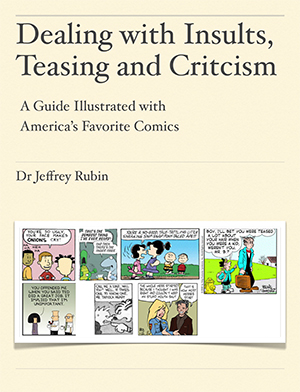
peanuts opium

dilbert criticism 1

I have argued that rather than to feel insulted, it is possible to learn to welcome criticism, as well as words that might come off as insulting.  When we learn to respond skillfully to negative criticism and insults, we develop a confidence in these types of situations.  This dramatically reduces our defensiveness.

An important step toward mastering this skill is to learn to clearly recognize when criticism is occurring.  If you can’t identify when a red light is flashing, you won’t be able to know when to apply the brakes on the car, and you are likely to end up in a serious accident.

Illustration by Lois Hubertz

Illustration by Lois Hubertz

Similarly, if you can’t identify when criticism is occurring, you won’t be able to know when to begin to put in place the plans that effectively deal with criticism.

male criticismfemale-criticsm

Although some forms of criticism are as easy to recognize as a red light, some forms of criticism are far more subtle and therefore often go unrecognized as criticism.  I therefore have presented posts that discuss dealing with direct and implied forms of criticism.  I’ve noted that when someone makes a suggestion, this usually implies some negative criticism.

Subtle 3I also explained how recommending that someone get some additional education also usually implies some negative criticism.

Illustration by Lois Hubertz

We also took a good hard look at certain forms of levity, in which negative criticism is designed to be charmingly provocative.  It seeks to get people to think more deeply about an issue.  As George Bernard Shaw put it in his provocative book, Back to Methuselah:

George Bernard Shaw 2“When a thing is funny, search it carefully for a hidden truth.”
Shaw, to ward off defensive reactions to his quips, often created fictional plays and had the characters in the plays say them.  Great examples are:
“No man ever believes that the Bible means what it says: He is always convinced that it says what he means.
“The difference between a lady and a flower girl is not how she behaves, but how she’s treated.”
“Life isn’t about finding yourself. Life is about creating yourself.”

Today we will spend a little more time practicing enhancing our skills for recognizing subtle forms of criticism.  This will help to improve our ability to know when to start using our dealing-with-criticism skills.

More Examples of Subtle Forms of Negative Criticism

As we move forward, please keep in mind that for the purposes of this blog, if someone evaluates something as negative the evaluator has made a negative criticism.

FIRST EXAMPLE

subtle 1In the above Calvin and Hobbes scenario, Miss Wormwood politely asks Calvin to put his tiger, Hobbes, in his locker.  Calvin objects to this request by crying out—“In my locker?!  He’ll suffocate!”

Calvin’s response to Miss Wormwood’s request is an example of indirect negative criticism.  He doesn’t directly state he has evaluated her request and found that there is something wrong with it, or that it is bad, or something of that sort.  Nevertheless, he indicates that if he did what she asked, his tiger would suffocate.  To recognize this as a form of negative criticism, it helps to notice that in addition to Calvin’s statement there are other indications that he thinks there is something wrong with Miss Wormwood’s request.  The exclamation marks after Calvin’s statement, the drawing of Calvin with his mouth being wide open as if he is shouting, and the fact that he is practically flying out of his seat while he is shouting, all add up to indicate that Calvin’s reply is rightfully classified as a form of negative criticism of Miss Wormwood’s request.

Although Miss Wormwood takes Calvin’s negative criticism in stride, other teachers might become defensive, and yell something like, “Don’t you talk back to me, young man!”  This might silence students, but leave them seething with anger that is expressed by a rejection of the school enterprise; or it might lead to shouting back at the teacher, creating an escalation of conflict that takes valuable learning time away from the class.

If Miss Wormwood would have become defensive and started to yell at Calvin in response to his negative criticism, this would, according the the DIG Conflict Model, be rated an immature level of responding (see Responding to Criticism: Four Levels of Maturity). Instead, she steers in the direction of Calvin’s criticism by offering the compromise of putting his “tiger” under his desk where it will be at least out of the way.  This, according to the DIG Conflict Model, is one of the most mature responses (see Responding to Criticism: The Most Mature Level).  We see, in this example, that Calvin quickly complies and his teacher can now go on with her lesson without any further delay.

SECOND EXAMPLE

Here’s a Sally Forth comic that illustrates that whenever there is a transaction involving a request or demand, we would be wise to anticipate negative criticism will be present as well.

Subtle 2In this comic, because Sally is visiting her mother for a few days, Ted is left on his own to deal with his nine-year-old daughter, Hil.  When Ted tells Hil it’s time for bed, she begins to reject his demand.  Is Hil’s rejection of the demand a form of criticism?

Well, consider her reply to her dad:  “But Mom’s not here!  We don’t need a bedtime!”  Hil has negatively evaluated her dad’s demand by expressing her disagreement with it.  If you tell someone you disagree with what he or she has done, you have negatively criticized the person’s act.

If Ted was skillful at first recognizing that Hil was providing him criticism, he would be in a better position to say to himself, “From what I’ve learned about the different levels of maturity, let me see if I can design a mature response.”  What if he came up with something like this?

“Hil, I admire the way you seek to defend your freedom.  I want to encourage that.  And you know I’m crazy about you.  At the same time, I also love your mom, as I know you do. It seems to me that we don’t want to break her rules behind her back.  The bedtime schedule is designed for you to get enough rest so you will do well in school.  Both of us have seen what happens to you when you don’t get enough rest.  When your mom gets home, if you want to discuss the rules, we can do it with her, you and me all altogether.  That would be the fair thing to do, wouldn’t it?”

These Examples are Designed to Encourage Deeper Thought

Above, I provided two examples of someone providing negative criticism.  For each example, a response was described that I think is pretty mature.   Please note, however, that I am NOT claiming that they are the ideal responses.  Nor am I trying to make the case that the responses portrayed in the above examples are the only mature responses that can be made.  There is a great deal of flexibility that we have for coming up with high level responses.  I present the above examples in an effort to challenge you to think more deeply about what mature levels of responding look like according to your own lights.

Well, that’s my post for this week.  To all of you who celebrate the beautiful Christmas season, I wish you good cheer, peace on Earth, and good will toward all of our fellow human beings!

With Warmest Regards,

Jeff

———————
Some people will enjoy reading this blog by beginning with the first post and then moving forward to the next more recent one; then to the next one; and so on. This permits readers to catch up on some ideas that were presented earlier and to move through all of the ideas in a systematic fashion to develop their emotional intelligence. To begin at the very first post you can click HERE.

Categories
anger challenge comic strip conflict management conflict resolution emotional intelligence free social intelligence and emotional intelligence curriculum parenting wisdom

A COMIC STRIP LOVER’S GUIDE FOR TRANSFORMING ANGER INTO CHALLENGE

If you follow the Calvin and Hobbes comic strip, you know that Calvin, from time to time, does some things that upset his Dad.  And it is often not hard to understand why his father might become angry at some of Calvin’s actions.

Calvin flood2Here we see Calvin’s dad blowing up in anger.  My wife and I raised two sons, and I wouldn’t be honest if I claimed that I never lost my temper with them.  And so, I can certainly sympathize with Calvin’s dad in the above comic.

At the same time that I sympathize with Calvin’s dad, I do want to encourage people to consider the value of an alternative to reacting by screaming in fury.  I want to advocate considering transforming the anger into challenge (see post titled “Anger Suppression Versus Challenge”).

clavin dadLet’s suppose that you are Calvin’s dad and just before you blow up in anger, you pause because you realize you are becoming angry.  You had practiced several times over the past week using a special skill to handle this type of situation, and you find that now you can smoothly and comfortably use that skill.  You quickly summarize for Calvin the conflict by saying in a warm, friendly voice, “Calvin, yesterday you desired to have dessert, and I interfered with your desire because I didn’t let you have any.  You feel that I am guilty of being unfair for punishing you for flooding the house.  In the future, you would like me to handle this type of situation in a better way. Is that right?”

After summarizing the conflict in this way, you listen to Calvin’s reply.  Then you explain in a pleasant voice that you will think about his concern over the next few days.

Over the course of the next few hours you take a few minutes to allow yourself to experience the anger within your body, just observing how it feels. By the next day, you have probably calmed down. You begin to try to come up with at least two alternatives to deal with Calvin then shouting.positives and negatives  Then you carefully weigh whatever you can think of about the costs and risks of negative consequences, as well as positive consequences, that could flow from each alternative. You discuss this with your wife and some others that you respect. Once you come up with an alternative with which you feel comfortable, you close your eyes and imagine carrying out the alternative with charm, courage, and determination.  You practice this again in your mind on two other occasions. Finally, you go back to Calvin and give your plan a try.

This, in brief is an example of transforming anger into challenge.

Now, when we start to consider alternatives to our angry outbursts, sometimes people will discourage any consideration of alternatives other than the one they believe is best.

dilbert alternativesNot only do we find that some people with whom we discuss alternatives insist that only one is good and all others are a ridiculous waste of time to even consider, sometimes we, too, will start with the bias that there really is only one alternative that is best even before we first take a good hard look at the pros and cons of other alternatives.  open mindThis attitude is viewed as being “closed-minded.”  Challenge requires a more “open-minded” attitude.

When we utilize challenge, we don’t make a decision by simply adding up the gains and then subtracting the losses for each alternative.  Some gains are far more important than others.  A young woman contemplating having a baby might list on the negative side the pain of childbirth, cost of adding the baby to her health plan, cost to feed the baby, loss of quiet personal time, and nastiness of changing diapers, but just the single positive of having a sweet loving baby as part of the family might far outweigh all of these negatives.  FranklinAnd so, the best we can do is to use an approach similar to what Benjamin Franklin proposed back in 1772.  After listing the pros and cons of each alternative during three or four days, he explained that,

…I endeavor to estimate their respective weights; and where I find two, one on each side, that seem equal, I strike them both out.  If I find a reason pro equal to some two reasons con, I strike out the three.  If I judge some two reasons con, equal to some three reasons pro, I strike out the five; and thus proceeding I find at length where the balance lies; and if, after a day or two of further consideration, nothing new that is of importance occurs on either side, I come to a determination accordingly.  And, though the weight of reasons cannot be taken with the precision of algebraic quantities, yet when each is thus considered, separately and comparatively, and the whole lies before me, I think I can judge better, and am less liable to make a rash step, and in fact I have found great advantage from this kind of equation, in what may be called moral or prudential algebra. (Letter dated September 19, 1772, to the British scientist, Joseph Priestly.)

Franklin’s approach seems to suggest that once the alternatives are identified our task is to simply decide which is best by weighing the pros and cons. But I often find myself, after looking over the pros and cons of each alternative, tweaking one or more of the alternatives depending on the circumstances with which I am dealing.

LUANN Tweek 1LUANN Tweek 2Thus, I am not tied to the alternatives I first come up with.  Those alternatives can be modified as I think more deeply about their pros and cons.  For example, once a teacher referred a 14-year old boy to me because he was being very disrespectful to her whenever she criticized him.  Let’s call him Carl.

In some such cases, just developing a pleasant relationship with the student for a few minutes, and then asking him to treat his teacher with more respect is enough to see a marked improvement.  And sometimes it is not enough.

nate teacherAs I worked with Carl, it soon became apparent that even if he tried to be more friendly and respectful, he would end up botching the attempt.  And so I set myself on teaching him some specific skills.

After I went over the five levels of responding to criticism with Carl and he showed me in role plays that he had mastered the ability to act the highest two levels, we filled out a balance sheet together for him to consider the positives and negatives for each of two alternatives:

  1. Use at least a level four response whenever the teacher criticizes him
  2. Continue doing what he had been doing.

positives-negatives-12575202After filling out the balance sheet, Carl very quickly pointed out that one of the negatives for choosing the first alternative was that his two friends in the class would lose respect for him.  That single negative was enough for him to completely discount any of its positives and he let me know that he therefore decided to continue to be disrespectful to his teacher whenever she criticized him.  I could have left it at that, but I tried to figure out if there was a way to tweak the more mature responding alternative so that the single negative would no longer be the deciding factor.

We ended up modifying the first alternative.  If he chose it, Carl would first have a discussion with his two friends about the five levels of responding to criticism.  changeCarl would begin by explaining the five levels and then asking his friends how they would want him to respond when they criticized him.  Then this alternative called for Carl to explain to his friends that he was in a tough spot because if he kept acting disrespectfully to the teacher, his parent would be called, he would go to in-school suspension after each disrespectful act, and if he still didn’t stop, he would be referred to a committee that would consider placing him in a special education class.  This plan also called for Carl to let his friends know that after trying to help Carl work through his disrespectful behavior, the teacher intends to put both of Carl’s friends through the same process he is going through unless they stopped their disrespectful behavior on their own.  Finally, he was to ask his friends what they thought he should do.

role playBefore Carl decided on whether or not he should choose this alternative or the one that had him continue to be disrespectful to his teacher, I had him act out some role-plays.  First, he acted himself discussing with his friends the alternatives he was facing and I acted the part of his friends.  Then we reversed roles with Carl playing the part of his friends while I took a shot at being Carl.  We switched these roles back and forth several times over the course of an hour meeting.

Once Carl found he was able to get comfortable having this type of discussion with his friends, he came to agree the tweaked alternative was worth a try.  And it turned out that his friends agreed that Carl could be respectful to his teacher when she criticized him, but that he couldn’t be too “lovey-dovey” with her or it would make them throw-up.

classroomInterestingly, once he and his friends began to treat the teacher with more respect, she began to treat them with more respect, and the boys’ initial dislike for the teacher changed, and she became one of their favorite teachers.

This example illustrates that we need not simply reject an alternative when one or more of its negatives lead us to reject it.  We can instead consider whether or not we can make some changes to the alternative that would make one of the negatives less problematic.  Similarly, we may seek to find ways to make one of the positives of an alternative more positive.  And so, there is no single way to use this type of tool.  Feel free to experiment with it as you deem fits the current circumstances.

———————

Some people will enjoy reading this blog by beginning with the first post and then moving forward to the next more recent one; then to the next one; and so on.  This permits readers to catch up on some ideas that were presented earlier and to move through all of the ideas in a systematic fashion to develop their emotional intelligence.  To begin at the very first post you can click HERE.

Categories
anger challenge conflict management conflict resolution criticism dig for the conflict emotional intelligence free social intelligence and emotional intelligence curriculum negative criticism sensory focus wisdom

FROM ANGER TO CHALLENGE: A STEP TWO EXAMPLE

Illustration by Eric Sailer

Audrey is at a fine restaurant with her parents celebrating her law school graduation.

“Well, your mother and I are so proud of you, Audrey,” says her father.

“Thanks, Dad!”

“Now you know, Audrey, I think it best that you begin your career in my Wall Street firm,” says her father.

“Dad, we discussed this already.  I’m going to get a job in the Department of Justice.  I made some connections there and that’s where my heart is.”

“We discussed that several months ago, and just briefly,” her father replies.  “Now that the real decision is right before you it’s time to get serious.  I want to make sure you really think this out thoroughly to prevent you from doing anything foolish.”

I’m twenty-five years old now, Audrey thinks to herself.  Dad should respect my decision on this.  It’s my life for crying out loud! 

audrey17As these thoughts fly through her mind she begins to see that her temper is rising.  She takes a deep breath, and says, “Dad, I know you’re concerned about me because you love me, and I certainly love you for that.  Today I just want to celebrate what I’ve accomplished.  Let’s put some time aside next week to fully discuss your concerns.”

“I don’t see why we can’t discuss it now,” says her father.  “We have the time right now!”

“Not now, Dad!” Audrey says firmly.  “I’m not prepared for this.”

“I think Audrey is being very fair, John,” says Audrey’s mother.  “It’s really Audrey’s decision.  It’s her life.  She agreed to discuss it with you next week.  Make a time to do this and let’s get on with the celebration.”

“Okay, Audrey,” her father says with a frown.  “We’ll have dinner at home next Friday, and we’ll discuss it then.”

“Thank you, Dad,” Audrey says, and she leans over and gives her father a kiss on his cheek.

Illustration by Eric Sailer

Later that night, Audrey is back in her apartment.  She gets comfortable in bed and begins to ponder, while imagining her friendly self is listening.

I’ve heard Dad’s arguments twenty times already! Why should I bother to listen again?  I wish he would just let me make my own decisions.  I’m not a baby anymore! 

She pauses, and wonders what her good friend in her mind might say.  “It is understandable that you are angry,” comes the imaginary reply.  “Don’t you think it would be a good idea to take a few seconds to observe your internal physical sensations?” 

“Oh, OK,” Audrey responds.  She then closes her eyes and observes tightness in her stomach and that she is chewing on her lip.  She continues to observe her internal sensations, without trying to put any words to them.  Soon, her anger fades.

A wave of sleepiness comes over her.  

I’ll think about this some more tomorrow, she says to herself.  Heck, probably the best thing to do is to just listen to Dad once more over dinner next Friday, and then I’ll smile and tell him that I heard him out.  Then I’ll declare that I’m going with a career at the Department of Justice.

Audrey12She smiles, and then she slides down into her bed covers.  After an hour of fitful tossing and turning, she finally falls asleep.

The next day, Audrey once again considers how to deal with her father’s concern. 

audrey13OK, she thinks to herself, it’s time to try out this two-step process.  First Step: Spend a few minutes going through the experience in which I became angry with Dad from a few steps back from what actually occurred, observing my distant self in the event.

After going through this experience, Audrey says to herself, I feel like I can be a little more reasonable about what happened.  Now I’m determined to achieve my desire to resolve this conflict. Don’t forget that the stress I’m experiencing is normal and fulfillment is not found in easy comfort, security, and routine, but rather in the continual growth in wisdom through what is learned from negative and positive experiences of an active, changing life.  Those thoughts are firing me up!

Audrey then takes a deep breath and resolves to get down to the task at hand.  Is the plan I came up with yesterday sufficient? she asks herself.  Hmmm.  Last night I thought that the best way to handle this conflict is to just listen one more time to Dad.  Aaaa, he’ll get angry with my decision and then I’ll get angry with him.  I’m just not comfortable with this.  That means I got to go through a bunch of other stuff to prepare,.  Maybe I should just tell Dad to mind his own business and that’s that!

But then she read a Calvin and Hobbes comic that was sitting on her coffee table.

Calvin1

After smiling, she says to herself, I still have several days before my Friday dinner discussion with Dad. There’s no pressure to come up with an immediate plan.  I think I’ll try out Step 2—Carrying out a more complete decision process.  But I’m going to take another day just to put this all aside.

audrey14It’s the next day.  Audrey reminds herself that she is at Step two. OK, I have to do three things to carry out a more complete decision process.  First, I have to describe my anger conflict using the DIG Conflict Modelconflict triangle1That’s easy.  I desire to get a job with the Department of Justice and Dad is interfering with this by insisting I consider more thoroughly what my job options are.  I think Dad is guilty of not minding his own business.  Let me see if I can frame the conflict from Dad’s perspective. He desires that I go into his Wall Street firm and interfering with this he knows that I’m determined to go to work for the Department of Justice.  He thinks I am guilty of being wrong because I have not thought about this as thoroughly as he would like.

audrey 15Hmmm.  As I think about this some more, my guess is that the real conflict Dad has with me has nothing to do with how expert I am at making these types of decisions—he really just wants me to work with him and to guide my career. But unless I address the conflict as he is now defining it, we’ll never get to the real issue.

Now, the next thing Step 2 has me doing is to go over my ABCs of Power list. Here it is. I see the first source of power is A for Advancing Skills.  This source of power refers to working toward developing a talent that people you care about value.

After Audrey thinks about the other sources of power, she takes a mile walk just to relax for a while.

When she gets back to her apartment, she sits down on her couch and says to herself, Okay then, tomorrow I’m going to go to the library and spend an hour studying up on what it looks like to be an expert on making decisions.  Then when I see Dad on Friday, I’ll impress him with my knowledge, and we’ll go through the decision process together.  I’ll make sure that by the time the evening is over he will know that I heard him out.  I’ll then summarize his position and declare my decision.

Illustration by Eric Sailer

The next day, Audrey begins a search in her library’s bookshelves and comes upon a book titled Decision Making:  A Psychological Analysis of Conflict, Choice, and Commitment, by Irving L Janis and Leon Mann. 

On page 11, she finds that the authors extracted from an extensive literature review seven major criteria that can be used to determine whether decision-making procedures are of high quality.  She writes these down:

Audrey5Decision makers, to the best of their ability and within their information-processing capabilities:

1.  thoroughly canvass a wide range of alternative actions;

2.  survey the full range of objectives to be fulfilled and the values implicated by the choice;

3.  carefully weigh whatever they know about the costs and risks of negative consequences, as well as positive consequences, that could flow from each alternative;

4.  intensively search for new information relevant to further evaluation of the alternatives;

5.  correctly assimilate and take account of any new information or expert judgment to which they are exposed, even when the information or judgment does not support the course of action they initially prefer;

Audrey86.  reexamine the positive and negative consequences of all known alternatives, including those originally regarded as unacceptable, before making a final choice;

7.  make detailed provisions for implementing or executing the chosen course of action, with special attention to contingency plans that might be required if various known risks were to materialize.

Later in the chapter, the authors review some of the research supporting this approach.  Hmmm, Audrey says to herself, there’s some pretty good evidence this procedure can be helpful.

Audrey7She then quickly lists the three job alternatives that made the most sense to her—a job with the Department of Justice, a job with her Dad’s Wall Street firm, or opening a private law practice in a small town.  She then lists the pros and cons  of each.

When Audrey finishes this, she decides that it would be a good idea to talk to some experts about what are, for each of the three alternatives, some pros and cons that she might not be aware of.  She decides that the experts for this task are people who are currently working in each of the three types of jobs. 

Dad is a good expert for the job as a Wall Street lawyer, she thinks to herself.  I’ll have him help with this at our Friday dinner meeting.  But he wants so much for me to join his firm, he’ll probably be biased, and he’ll end up playing down the negatives.  It would be better to ask someone who doesn’t care if I become a Wall Street lawyer.

Audrey10To track down lawyers in each type of job, Audrey emails professors from her law school that then put her in contact with former students of theirs who had gone on to careers in each of the three jobs.  The discussions she has with these former students are very helpful.

By the time Audrey and her father meet for their Friday dinner, Audrey has given her career a great deal of thought.  She impresses her Dad with her knowledge of what it takes to thoroughly consider her job options, the type of research that supports the procedure she had chosen, and the information that she had gathered on the specific options that she considered.  She then asks her father for his input.

When her father is done, Audrey carefully summarizes what he had to say.  She pauses for a good few minutes, showing her dad she is really thinking over all the information she has gathered.  Then she announces her decision that she is going to stick with her initial choice, a job with the Justice Department.  Her father once again objects, making a few final pleas for her to reconsider.  female-criticsmAudrey recognizes this as negative criticism of her decision.

She pauses to think about how she can respond at level five which requires that she try to come up with some way to steer in her father’s direction.  Suddenly, an idea comes to her.

After summarizing what her father had said, using her most loving voice, she says, “Dad, you make some very good points.  Here’s what we’ll do.  After one year of my job at the Department of Justice, you and I will meet again to discuss my career.  I’ll have a lot more information by then about what I like and don’t like about that job.  You’ll have a whole year to think up some new reasons for me to go into your firm.  I’ll only be 26 by then, and so it won’t be too late to change my career path.  And if I do decide to change, I bet at least some of the stuff I’ll be learning at the Justice Department will be helpful for a Wall Street lawyer to know. 

Audrey9Audrey’s father looks a little sad as she tells him of her final decision.  Still, he nods, and says that he appreciates that she will remain open about the possibility of changing her decision after a year.  They conclude their meeting with a sweet hug.

———————

Some people will enjoy reading this blog by beginning with the first post and then moving forward to the next more recent one; then to the next one; and so on.  This permits readers to catch up on some ideas that were presented earlier and to move through all of the ideas in a systematic fashion to develop their emotional intelligence.  To begin at the very first post you can click HERE.

Categories
anger conflict management conflict resolution emotional intelligence free social intelligence and emotional intelligence curriculum interpersonal conflicts wisdom

FROM ANGER TO CHALLENGE: A STEP ONE EXAMPLE

On this blog, we have been discussing how we can move from anger to challenge.  In one post, to help to move in the direction of challenge, I asked you to think of conflict as a great sea.

I explained that there is a region of the Sea of Conflict that is known as Anger.  There, storms are particularly likely to churn up, and some of them have the potential to be very dangerous.  It is for this reason that it is vitally important, whenever possible, to recognize when we begin to approach and enter into this region.

Challenge is a region of the great Sea of Conflict that is very close by to Anger.  Because less experienced sailors are unaware that Challenge exists and where it lies, when they find that they are caught in an Anger storm they often succumb to the lashing of the violent waves.  Great sailors, in contrast, know about Challenge.  In fact, when caught in an Anger storm, just knowing that Challenge is just a knot or two away enables them to gather a sufficient surge of energy to carry out well practiced skills that give them a reasonable chance to reach relative safety.

In another post,  I asked you to consider calling a timeout when you feel that things are getting a bit out of hand, kind of like they do in sports.

timeout3

I went on, in that post, to suggest that in anger arousing situations you might want to call a time out in the following manner:

When you see that you are becoming angry, or the other party is, make a statement in a warm friendly manner indicating that you are very interested in what was said, you plan to think a little more about this over the next few days, and then you’ll be ready to discuss this further.  Then, let the other person have the last words while you listen in a caring way.

And in yet another post, I described a technique to deal with anger arousing situations known as the Signaling to Back-Off Technique.

Anger marty and lena

This technique works best in an ongoing relationship, although I have seen it work well with people who hardly know each other.  The best way to set this up is to discuss this technique with the other person at a time when both of you are not in an angry mood.  You might say to the other party something like:

Sometimes I begin to get really upset about something you are saying.  I know that it’s important for me to hear your point of view and I do want to hear what you have to say.  But there are times when I’m in no condition to give you a fair hearing on a particular topic.  At such times, it would help me a great deal if I could give you a simple signal for you to back off for a while.  I’ll make sure you’ll get your opportunity to have your full say on a topic before too long—almost always within a week.  But I sometimes require a little time to get my act together first.  Would you mind helping me out in this way?

Now once you have removed yourself from the anger arousing situation, I proposed that you consider using a two-step technique to move from anger to challenge.  Today, we will look at a parable of someone using Step 1.

A Step One Example:  You and your Friend, Eric

ANGER STEP 1, 1You and your friend, Eric, were discussing the upcoming election.  Eric had explained why he was going to vote for someone in the upcoming presidential elections you thought would do an awful job.  You both discussed the matter for awhile, and eventually it became clear to you that neither of you were going to change your opinions.

It was at this point that you had felt your anger toward Eric rising up within you.  “Eric,” you said, “I think I understand your position.  Let me think about the points you made today for awhile.”  Then Eric restated a few of his points, and you listened in a caring way.  Part of you strongly wanted to say some things once again to show Eric why you disagreed with him, but because you had practice using this “moving to challenge” technique several times over several weeks, you found that you were able to just give Eric a smile, and then you thanked him for his willingness to discuss this topic.  Finally, you changed the topic, asking Eric how his job was going.

ANGER STEP 1, 2Later that day, you spent an hour thinking through what had happened using the “distancing”  exercise we discussed in an earlier post (see “Does Venting Anger Feed the Flame?“).  In brief, this involves imagining that you have returned to the time and place of the angry experience, and you are preparing to observe the scene just as it happened.  As the unfolding of the event gets underway, take a few steps back.  Move away from the situation to a point where you can watch the event unfold from a distance and see yourself in the event.  Focus on what has now become a distant you.  Watch the situation unfold as if it were happening to the distant you all over again.  Replay the event as it unfolds in your imagination as you observe your distant self.

After you utilize the “distancing” technique, you come to decide that Eric had a right to his opinion and that you were going to let the issue drop.  Moreover, if Eric brought the topic up again, you would smile, pat him on his back, and say, “Well Eric, by now you know my opinion about this and I certainly know yours.  We obviously disagree.  Nevertheless, I’m still very fond of you.”

Another day goes by.  Again you spend a few minutes going through the experience from a few steps back from what actually occurred, observing your distant self in the event. Then you see if you can work up a heightened sense of determination to achieve your desire to resolve this conflict. You consider the twin beliefs that the stress you have been experiencing is normal and fulfillment is not found in easy comfort, security, and routine, but rather in the continual growth in wisdom through what is learned from negative and positive experiences of an active, changing life

Then, you take a deep breath and resolve to get down to the task at hand.  Once again you consider the plan you came up with yesterday.  It still feels like this obvious solution makes sense.  You ask yourself, “If this plan doesn’t work out, are there any serious risks?”

As you consider this, you realize Eric’s opinion might influence a few other votes, but it is not at all likely he will alter the outcome of the election.  You and Eric have had numerous disagreements in the past and it never led to any major break in your relationship.  You therefore decide that your plan does NOT pose any serious risks. 

Thus, you set yourself on carrying out your plan with charm, courage, and determination.  Part of the plan involves practicing three times in your mind what you will say to Eric if the election topic does come up. 

The next time you see Eric, he begins to tease you about whom you plan to vote for.  You smile, and find that you have no problem telling him what you had practice saying.  Eric replies by shrugging his shoulders and then both of you begin to talk about another topic.

Example Discussion

Notice that in this step one example, after coming up with a plan, you take a day to “sleep” on it. If, on the day after you sleep on it, the plan still makes sense even after you use the “distancing” technique a second time, you then ask yourself, If this plan doesn’t work out, are there any serious risks?” In our example, you decide that there are no serious risks, so you set yourself on carrying out your plan with charm, courage, and determination. At this point you have converted your anger experience to challenge.

But what happens if there are serious risks, or you just are not comfortable with the plan that you created?  Then it’s time to go to step two for reaching the region of Challenge on the Great Sea of Conflict.  We will take up this topic next week.

———————

Some people will enjoy reading this blog by beginning with the first post and then moving forward to the next more recent one; then to the next one; and so on.  This permits readers to catch up on some ideas that were presented earlier and to move through all of the ideas in a systematic fashion to develop their emotional intelligence.  To begin at the very first post you can click HERE.

Categories
anger anger venting challenge conflict management conflict resolution free social intelligence and emotional intelligence curriculum interpersonal conflicts sensory focus

DOES VENTING ANGER FEED THE FLAME?

anger suppressionLast week we discussed the theory that anger suppression can be harmful (see ANGER SUPPRESSION VERSUS CHALLENGE).  We found that there is some evidence supporting the theory, and we therefore looked at the possibility that rather than suppressing anger, we can learn to transform this mischievous experience into a state of challenge without suppression.  Since a popular alternative to either suppression or challenge is venting anger, here we take a good look at it.

What do we Mean by Venting?

anger boxingThe first thing that comes to my mind when I think of venting anger is slugging a punching bag, cushion, or bobo doll as a means to provide a safe outlet to release the energy contained in the anger.   Early in my training, in one of my assigned books the author encouraged his readers to smash a pillow while imagining smashing the person with whom they are angry.  Additional proposed ways to vent have been taping a picture of the person who aroused our anger onto a punching bag and then pounding it, throwing darts at the picture; smashing an object , and screaming at the top of our lungs either without any words, or by emitting curses and insults at the party who angered us.
anger darts

anger Bismark

Dithers report

Some people have told me that they vent when they become angry but when I asked them to describe what they do when they vent, they give me surprising answers.  Here is an interesting example:

venting 9“When I vent,” replied one pleasant woman, “I stand and pray. I reach for the stars. I talk to a good friend, and I like to take comfort from a person who is genuine and understanding. Then I usually meditate… and my mom is always by my side. I never vent right at the person I have become angry at.  I find a safe outlet.  Venting my anger at innocent people is not an acceptable outlet either!!!”

Another writes:

“After I have excused myself from the angry situation, I go to a private place to give myself a few minutes to settle down.  As I do this, I will notice my  angry self chattering away, saying things like, ‘That idiot who made me angry is a stupid jerk.’  Other derogatory statements about the source of my anger may come to mind.  Perhaps I will think about how I can do harm to the person my mind is insulting.  I accept that this is part of the anger process, but I don’t deliberately say anything insulting to anyone; it seems to pour out of me.   When it does pour out of me in this way, it feels like I am venting.

Illustration by Deanna Martinez

“At such times, I see if I can observe my angry self in a nonjudgmental manner.  If I can’t, there is no need to punish myself.  I understand that anger is a strong emotion, so I seek to be kind to myself as I go through this process—just like a good, compassionate friend would.

“From time to time, I see if I can take a few seconds to observe the physical sensations I am experiencing.  The chattering in my mind may make this difficult, so if this does not happen, again I do not seek to punish myself.  I just gently remind myself that observing the physical sensations I am experiencing could be useful to do if I can. Usually after a few minutes I calm down.”

And so, venting means a lot of different things to different people.

Research on Venting

In my last post I reviewed some of the research on venting directly at the person who has aroused our anger.  In brief, we found some evidence that:

venting 4People who believe that freely expressing their anger will discourage future negative responding from their antagonist experience relief after anger outbursts.  Those who believe that freely expressing their anger will spur even more severe threatening responses from their antagonist maintain their elevated blood pressure subsequent to angry outbursts.  venting 10Those who believe kindly responses to provocation will discourage future negative responding from the antagonist experience relief after providing a kind response.  Those who believe kindly responses to a provocation will lead their antagonist to take advantage of them will maintain their elevated blood pressure after providing a kind response.

But what about the research that deals with venting anger not directly at the antagonist, but at some object like a punching bag?  Brad J. Bushman published an important study that seeks to answer this question (Does Venting Anger Feed or Extinguish the Flame? Catharsis, Rumination, Distraction, Anger, and Aggressive Responding, Pers Soc Psychol Bull, June 2002 28: 724731).

venting 11He had three groups of people experience an anger arousing experience (someone providing very negative criticism of a paper they wrote).  Participants in the first group vented by hitting a punching bag as long, as hard, and as many times as they wanted to.  While they hit the bag, they were told to think about the other participant who had criticized their essay. For a visual aid, they were shown a photo ID of a same-sex college student described as the “other participant” on a 15-inch computer monitor. Participants in the second group also vented by hitting a punching bag as long, as hard, and as many times as they wanted to. But while they hit the bag, they were to think about becoming physically fit. As a visual aid, they were shown a photo ID of a same-sex athlete from a health magazine on a 15-inch computer monitor. Participants in the third condition did not hit the punching bag. Instead, they sat quietly for a couple minutes while the experimenter supposedly worked on the other participant’s computer. No attempt was made to reduce the anger of participants in this group. After participants in the first two groups finished hitting the punching bag and the participants in the third group sat quietly, they all reported how angry they felt. Next, they were given the chance to administer loud blasts of noise to the person who had angered them. People in the first group (those who were told to think about their antagonist while punching the bag) felt angrier than those in the other two groups. People in the first group were also the most aggressive, giving more loud blasts of noise, followed by people in the second group.  Those in the third group who had sat quietly for two minutes after being negatively criticized were the least aggressive.

DISCUSSION

Whereas Bushman’s study doesn’t condemn every form of venting, the results do suggest that venting to reduce anger can be like using gasoline to put out a fire.

When people try to release their anger by hitting something, eventually they get tired, the workout leads to the release of endorphins which produces a natural high, and eventually they begin to stop the violence against the relatively safe objects.  Thus, they are led to believe that they have now released all of their anger energy.

In my view, people calm down more quickly without the banging, kicking, and punching.  If they want to enjoy a high from exercise while they wait for their calm to return, a good walk or run does the trick.

anger smashIf you find that your angry self is using this banging, kicking, and punching approach, it is not the end of the world.  Nevertheless it can be helpful to let your angry self know that there are some problems with this violent-like approach.  While carrying out the hitting an object approach you are practicing actions that are very similar to violence.  This makes it more likely that if you can’t get to a private place to calm down, you will display these types of behavior in public.  This can come across to some as frightening and immature.  Your reputation may diminish.  Moreover, you may accidentally punch something that you think is soft and find that something in the softness was hard.  You can injure your hand or break something valuable.

anger breakingOf course, if you have practiced the mock-violence technique for a long time, it is not easy to break the habit.  If you go about trying to stop in the wrong way, you will experience frustration that you can easily interpret as suppression.

It is better to first become convinced when you are not angry that you will be better off learning to substitute the mock-violent actions with something more constructive.  If it doesn’t work the first time, there is no reason to turn violent toward yourself, or even insulting.  Instead, be kind, and say to your “angry self” that you will get another chance to try this new approach again in the future.  In time, you will find yourself getting better and better at this.

What may be a more productive way to deal with anger?  I have in previous posts made some suggestions (see for example BEING A WISE FRIEND TO YOUR ANGRY SELF, PART 1, and BEING A WISE FRIEND TO YOUR ANGRY SELF, PART 2).  Here’s a slightly different approach.

venting 6During the time when you have arrived at the time and place where you can fully experience your anger in private without any effort at suppression, you will find that knowing that you have eliminated the pressure of a quick response, along with the passing of time, will result in a period in which you will have calmed down enough so you are capable of a thorough job of problem solving.  Begin by imagining that you have returned to the time and place of the angry experience, and you are preparing to observe the scene just as it happened.  As the unfolding of the event gets underway, take a few steps back.  Move away from the situation to a point where you can watch the event unfold from a distance and see yourself in the event.  Focus on what has now become a distant you.  Watch the situation unfold as if it were happening to the distant you all over again.  Replay the event as it unfolds in your imagination as you observe your distant self.  After going through this imaginary exercise, take advantage of this relatively calm period to map out a strategy to address the concerns raised during the anger arousing situation.[1]

Well, that’s just about all the time we have for today.  I hope that you will stop by again real soon.


[1]Evidence for the effectiveness of this strategy can be found in the following:  O. Ayduk and E. Kross, 2010, “Analyzing Negative Experiences without Ruminating:  The Role of Self-Distancing in Enabling Adaptive Self-Reflection,” Social and Personality Psychology Compass, 4, 841-854.  E. Kross, A. Ducksworth, O. Ayduk, E. Tsukayama, and W. Mischel, 2011, “The Effect of Self-Distancing on Adaptive Versus Maladaptive Self-Reflection in Children,” Emotions, 11 [5], 1032-1039.

———————

Some people will enjoy reading this blog by beginning with the first post and then moving forward to the next more recent one; then to the next one; and so on.  This permits readers to catch up on some ideas that were presented earlier and to move through all of the ideas in a systematic fashion to develop their emotional intelligence.  To begin at the very first post you can click HERE.

Categories
anger challenge conflict management conflict resolution criticism free social intelligence and emotional intelligence curriculum interpersonal conflicts Name calling threats wisdom

ANGER SUPPRESSION VERSUS CHALLENGE

anger pork chopDespite the ample evidence that anger is fraught with danger, human debasement, and ineffective functioning, many people seem reluctant to put their heart and soul into learning more effective alternatives.  Why is this?  One of the biggest reasons is that our culture presents in both direct and subtle ways the theory that suppressing anger can be harmful.  Here we will explore this theory.  As we do so, we will learn that we can, if we so choose, sail from the region of Anger to Challenge—and thereby improve our chances for survival and a safer and more pleasant ride on the great Sea of Conflict.

Illustration by Eric Sailer

SUPPRESSING ANGER

According to Sigmund Freud, if anger reactions are inhibited, they are replaced by substitutes, some of which may lead to harm.  In The standard edition of the complete works of Sigmund Freud, (Strachey, 1974), the clearest statement about this appears below:

When Bismarck had to suppress his angry feelings in the King’s presence, he relieved himself afterwards by smashing a valuable vase on the floor.  This deliberate replacement of one motor act by another corresponds exactly to the replacement of natural pain-reflexes by other muscular contractions….(p. 202)

anger BismarkWe transpose the excitement of anger from the adequate reaction to another one, and we feel relieved provided it is used up by any strong motor innervations.

If, however, the affect can find no discharge of excitement of any kind along these lines, then the situation is the same with anger as with fright and anxiety.  The intracerebral excitation is powerfully increased, but is employed neither in associative nor motor activity…. The excitement arising from the affective idea is “converted” into a somatic phenomenon. ( p. 206)

anger boxingFreud believed that some of these somatic phenomenons were undesirable.  After Freud, others promoted this idea.  For example, Dr. Albert Ellis, one of the most popular psychologists of the twentieth century, stated that anger suppression “can easily result in psychosomatic reactions, including high blood pressure, heart problems, ulcers, and various other physical conditions.”[1]

In an effort to test this hypothesis, scientific individuals began to carry out some systematic studies.   Some seemed to find support for this notion that suppression can be harmful.  For example, Hokanson,[2] Baker & Schaie,[3] and Gambaro & Rabin[4] (1969) found that angered adults often achieved a faster decrease in blood pressure to baseline levels if they counteraggressed toward their antagonist than if they were given no opportunities to respond.  In other studies carried out by Holmes[5] and Kahn[6] however, counteraggression was found to sustain elevated arousal, whereas nonaggressive activities reduced it.

Dr. Albert Bandura,[7] attempting to make sense of these apparently contradictory findings, carefully examined this body of research and finally concluded that the physiological tension of angry individuals is determined by what they do, the perceived consequences of what they do, and also what they think.  People who believe that freely expressing their anger will discourage future negative responding from their antagonist experience relief after anger outbursts.  Those who believe that freely expressing their anger will spur even more severe threatening responses from their antagonists maintain their elevated blood pressure subsequent to angry outbursts.  Those who believe kindly responses to provocation will discourage future negative responding from the antagonist experience relief after providing a kind response.  Those who believe kindly responses to a provocation will lead their antagonist to take advantage of them will maintain their elevated blood pressure after providing a kind response.

James J. Gross has reviewed more recent research on suppression in his fine article titled, “Emotion Regulation:  Taking Stock and Moving Forward” (Emotion, Volume 13, June 2013, pp 359-365).

anger suppressionAffectively, suppression leads to decreased positive but not negative emotion experience, increased sympathetic nervous system responses, and greater activation in emotion-generative brain regions such as the amygdala.  By contrast, reappraisal leads to decreased levels of negative emotion experience and increased positive emotion experience, has no impact on or even decreases sympathetic nervous system responses, and leads to lesser activation in emotion-generative brain regions such as the amygdala and ventral striatum (Gross & Thompson, 2007).  Cognitively, suppression leads to worse memory.  By contrast, reappraisal either has no impact on subsequent memory, or actually improves it, and can enhance exam performance (Jamieson, Mendes, Blackstock, & Schmader, 2010; Richards & Gross, 2000).  Socially, suppression leads to less liking from partners, and to an increase in partners’ blood pressure levels.  Reappraisal, by contrast, has no detectable adverse consequences for social affiliation in the laboratory (Butler et al.,2003).”

Anger Management Training without Suppression

The association of anger suppression with anger management training is understandable, for when one has spent many years acting one way, learning alternative behaviors can be frustrating.  This uncomfortable sensation may be seen as the suppression of one’s “natural” mode of behavior.  It’s a similar experience to how actors might feel when first learning a new role or golfers a new swing.  At first the skill to be learned feels awkward, and the early phase of learning can leave them to observe their heart racing and their blood pressure skyrocketing.

anger golfHowever, by designing a program in small incremental steps and heeding the following suggestions, the feeling of suppressing one’s natural behavior can be largely reduced or even completely eliminated.

First of all, expect occasional missteps.  By studying the posts on this blog, it is likely that several situations will occur that you now find yourself handling much better than before.  If the response by others you are engaged with ends up being favorable, this will encourage you to utilize the same approach again and again until it begins to feel natural, that is, second nature to you.  Other skills will come off a bit awkward or you will get a less than favorable response, and you may experience frustration.  When you try the skill again, you may now feel unsure and your effort may lead you to interpret this as suppressing a more “natural” way to respond.  You may, therefore, give up and conclude that you are helpless to make a meaningful change in this type of skill.

The solution here is to reread the section that discusses the skill, and then practice over and over in your mind a narrative that has you envisioning utilizing the skill.  When you can smoothly imagine in detail carrying out the skill, try it out again in real life.  You may have to do this a few times until you get it right.

As you increase your skill to deal with anger arousing situations, your confidence in handling them will increase.  Because anger arises when we experience a threat, with your increase in confidence you will then find you are less likely to experience situations that use to feel threatening as threatening.  Consequently, you will be less likely to suppress anger because you won’t experience anger as often.

anger video recordingFor more difficult to change behavior, form a small group of two to four people who agree to work together on the skill.  Then assign a leader on a rotating basis.  Conflicts in which the group members typically experience anger are identified.  Then a video recording is created with the group members serving as the actors.   One scenario is acted out demonstrating what actually occurred.  Then a non-angry approach to dealing with the conflict that has the support of the group as being more effective than the angry approach is created.  Video recording devices are readily available these days because of apps on many phones.

Keep in mind that the acting doesn’t have to be an Academy Award winning portrayal.  Just a fun process is encouraged.  By participating in this acting process and then viewing the video recordings displaying alternative behaviors, some will find they will adopt the skills in an effortless manner.

In the next part of this group process, competent behaviors are further encouraged by creating another set of video recordings using slightly different scenarios.  Concrete examples are thus repeatedly affectively, cognitively, and behaviorally rehearsed while clear audiovisual feedback is provided.  Observers can ask to pause at a little section that worked particularly well and review it a few more times until it becomes more and more familiar.

Throughout this process, some of the group participants’ suggestions may begin to feel uncomfortable to one or more of the other participants.  This can interfere with the training process if poorly handled.  anger BohrI have found it useful from time to time to preface my recommendations with the same gentle admonishment that the famous physicist Niels Bohr used to give his students:  “Every sentence I utter should be regarded by you not as an assertion but as a question.”  This tends to disarm those who find that they are resisting suggestions, sets the stage for a helpful collaboration, and fosters interest from the satisfaction derived from fulfilling one’s own internal standards.

As you go through this process several times, you will find more and more that your behavior will begin to change in real life situations.  At such times, you will often find people reacting very positively to your new style, and this will further encourage you to continue to utilize it.  You won’t feel like you are suppressing anger, but rather, comfortably learning a new set of skills that works better than anger.

At other times, even a skilled real life response to a situation that had previously led to anger arousal will be met with someone acting in an undesirable manner.  The group you have formed will provide you the opportunity to have some support to address this type of experience.  Together, you can continue the problem solving required for addressing a wider and wider range of situations until you feel sufficiently confident to go it alone.  It is important to keep in mind that even the most skilled techniques will not produce a perfect result on every occasion.  The best we can hope for is to increase the probability that we will obtain a favorable outcome.

anger nosebreakIf you find it difficult to identify a small group of individuals to do the video recording skill development just described, consider hiring a professional counselor who will go through the process with you.  Most professional counselors and psychologists that I’ve met are particularly skilled at modeling empathic understanding, a crucial skill that is necessary for working through anger arousing situations.


[1] A. Ellis, 1977, How to Live with—and without—Anger, New York:  Reader’s Guide Press, page 200.

[2] J. E. Hokanson, 1970, “Psychophysiological Evaluation of the Catharsis Hypothesis,” In E. I. Megargee & J. E. Hohanson (Eds.), The Dynamics of Aggression (pp. 74-86), New York:  Harper & Row.

[3] J. W. Baker & K. W. Schaie, 1969, “Effects of Aggressing ‘Alone’ or ‘with another’ on Physiological and Psychological Arousal, Journal of Personality and Social Psychology, 12, 80-96.

[4] S. Gambaro & A. I. Rabin, 1969, “Diastolic Blood Pressure Responses Following Direct and Displaced Aggression after Anger Arousal in High- and Low-Guilt Subjects,” Journal of Personality and Social Psychology, 12, 87-94.

[5] D. S. Holmes, 1966, “Effects of Overt Aggression on Level of Physiological Arousal,” Journal of Personality and Social Psychology, 4, 189-194.

[6] M. Kahn, 1966, “The Physiology of Catharsis,” Journal of Personality and Social Psychology, 3, 278-286.

[7] A. Bandura, 1973, Aggression: A Social Learning Analysis, New Jersey:  Prentice Hall.

———————

Some people will enjoy reading this blog by beginning with the first post and then moving forward to the next more recent one; then to the next one; and so on.  This permits readers to catch up on some ideas that were presented earlier and to move through all of the ideas in a systematic fashion to develop their emotional intelligence.  To begin at the very first post you can click HERE.