Categories
anger Bullied Bus stop ignorance conflict resolution criticism free social intelligence and emotional intelligence curriculum insults Name calling negative criticism playful teasing types of criticism wisdom

INSULTS: LESSONS FROM THE CASE OF THE MAN SENTENCE TO JAIL FOR MOCKING DISABLED GIRL

A while back I saw a YouTube video dealing with insults that made someone cry went viral.  It is called, Bus Stop Ignorance.

In the video we see 43-year-old William Bailey taunting Hope Knight, a ten-year old girl with cerebral palsy.  Hope uses crutches and Mr. Bailey, in the video, mocks the way she walks.  He also gets his son to join him in the taunting.

According to ABC news, Mr. Bailey was caught on an iPod camera by Hope’s grandmother, Marie Prince, while she was picking up Hope at the school bus stop.

William Bailey “was dragging his leg and patting his arm across his chest to pick his son Joseph up,” said Hope’s dad. “I asked him to please stop doing this. ‘My daughter can see you.’ He then told his son to walk like the R-word.”

On Nov. 27, Judge John A. Poulos of the Canton Municipal Court sentenced Mr. Bailey to 29 days in jail.

Here, sitting in front of her mother,  we see  Hope covering her eyes to hide her tearful reaction as the taunting is discussed.

disabled2

Hope was born 29 weeks premature after the Knights were involved in a head-on auto collision. When Hope was born, she weighed only two pounds, 12 ounces, which caused several medical problems resulting in two brain surgeries. She fought for her life the first two years.  And now, to have to face this….

Here’s Mr. Bailey and his son being interviewed about this incident.

disabled3

Mr. Bailey at first denied mocking Hope.  But then he said he was reacting to name-calling directed at his son. Mr. Bailey entered a plea of ‘no contest’ to a menacing charge and to disorderly conduct.

Through his lawyer, Mr. Bailey has provided an apology.  “To Hope and her family, please accept my apology for my inappropriate behavior. I know that my actions were immature and lacked the respect you deserve. I didn’t realize the impact this incident would have upon both of our families and I truly regret it.”

So, there you have it.  According to Mr. Bailey, he insulted the girl as a reaction to someone, presumably from the Knight family, calling his son names.  He doesn’t say who started it, but most people would agree that even if someone from the Knight family started the name calling first, Mr. Bailey’s reaction was still wrong.

It is interesting that many people who responded to the video and felt Mr. Bailey’s actions were wrong included in their criticism of him, insults and advocated that someone needed to beat him up.  For example, one person wrote, “I’d be worried about this idiot and his idiotic son retaliating when he’s released. Anyone with that cruel type of mentality is not to be trusted.”  Another wrote, “Would love to beat the living crap out of this turd.”

According to the DIG Conflict Model we have been discussing on this blog, providing criticism with physical attacks is the lowest level of psychological maturity on a five-level scale (see HERE).  Calling a person names or insulting the person in other ways is a level 2 response, the second lowest level of maturity.  Both physical attacks and insults increase the probability of an escalation until someone gets killed.  The last thing that is in the best interest of ten-year old Hope is for her father to end up dead.

Rather then to think of Mr. Bailey as an idiot, the DIG Conflict Model teaches us to view him at some very specific level of psychological maturity.  It also provides us some very specific information about what he has to learn to reach a higher level.

I know that many people feel that for most situations the five levels of criticism make sense but when someone acts as Mr. Bailey did, it’s time to put the five levels aside.  Moreover, they feel that it is perfectly correct to call him every name in the book!

Well, let me see if I can encourage those individuals to change their minds without calling them any names.

First of all, one reason that I view styles of providing criticism in a developmental framework is it fits my own personal experience.

When I was very young, I remember distinctly some kids in my elementary school insulting someone that was a little different than the rest of us.  I laughed along, finding the situation genuinely funny.

As I matured, at one point, some students called a kid that was also a little different than us some names, and I laughed, but as I did, I remember feeling that it wasn’t quite right.  Later that day, as we went down the stairwell at school, I told the kid I was sorry.

Then, one day I had a party and many of my friends brought dates.  At one point during the party, a couple of my friends started teasing another friend about bringing a girl to the party who wasn’t very smart.  They teased him in front of the girl, and I noticed her face turning very red.  I found that I did not laugh at all.  I thought the girl’s reaction would be enough to get my friends to stop insulting her, but a couple of minutes later they said something about her that was even more insulting.  I asked to speak to them, and we went into another room for some privacy.

“You know I love you guys,” I began, “but the things you’re saying about that girl, I’d like you to cut it out.”

“Hey,” said one of my friends, “can I help it if that girl has the intelligence of a kumquat!”

I must admit that I did let out a little involuntary laugh at this–something about the kumquat comparison struck me funny.  But I very quickly recovered and said, “The girl is really feeling bad about this teasing.”

“Listen,” said my friend, “we all tease each other and have some fun with it.  If she can’t take a little teasing, it’s her own damn fault!”

“I don’t think continuing to humiliate her is the best way to get her to be more mature,” I replied.  “Please, give her a break.”

They waved their hands at me, complaining I was turning into a political correctness police officer, but in the end, they let her alone.

Notice that as I criticized them, I didn’t use any name calling and it was certainly not my intention to throw any insults at them.  Also notice that from my experience, I changed in a particular direction as I matured.

Now, there are a great deal of additional arguments that I can make about the value of a developmental perspective, but allow me just one more for today’s post.

The story involves the first black major league baseball player, Jackie Robinson and his team mate, Pee Wee Reese.

disabled5

Just before Mr. Robinson began to play in the majors for the Brooklyn Dodgers, the Dodgers’ general manager, Branch Rickey, made it clear to him that he would face criticism in the form of the most vile insults. If he was to play, Robinson had to show the courage to not return insults with insults or to lose his temper and jeopardize the chances of all the blacks who would follow him if he could help break down the race barriers.

Jackie Robinson and Branch Rickey

If Mr. Robinson couldn’t return the insults, could nothing be done?  On one particular day when fans were being particularly insulting to Mr. Robinson, the smallest ballplayer on his team, Pee Wee Reese, stepped out of the dugout.  Mr. Reese was a beloved player with the fans for his hard, hustling play.  He stepped over to Mr. Robinson,  put his arm around him and stood by his side.

This gesture was discussed around the country, and even today.  And a monument honoring this moment stands tall and strong in Brooklyn.

disabled6

If you go by it some day and watch for a while, from time to time you’ll see a grandfather describing to his grandson how the statue symbolizes what can be done even by two men who responded to insults without returning insults.  I must admit that I’m no kid anymore, and yet, whenever I walk by that statue, I get all misty inside.

disabled7

——————————-

Some people will enjoy reading this blog by beginning with the first post and then moving forward to the next more recent one; then to the next one; and so on. This permits readers to catch up on some ideas that were presented earlier and to move through all of the ideas in a systematic fashion to develop their emotional and social intelligence. To begin at the very first post you can click HERE.

Categories
anger conflict resolution criticism emotional intelligence Joe Biden Mitt Romney negative criticism Paul Ryan playful teasing President Obama presidential debates psychological maturity types of criticism wisdom

RESPONDING TO CRITICISM: LESSONS FROM THE PRESIDENTIAL DEBATES

If you have been following this blog, you know that lately we have been working on becoming masters at dealing with criticism.  One important lesson that we have focused in on is that in designing our response to a particular criticism it is crucial that we figure out why the person is criticizing us.

Let’s say, for example, that John, upon entering my home and noticing the TV show I’m watching, criticizes me, saying, “Jeff, you’re an idiot for watching this stupid comedy.”  As he says this, I look at him and see from his eyes and the way he says it, that his comment is designed with the genuine hope I might make some improvement in my TV viewing habits.  In that case, a reasonable reply to John’s criticism would be to say warmly, “I appreciate your concern, John.  I think it does make some sense that I start thinking about how much time I spend watching lightweight shows.”   Such a response would show John that I respect what he has to say enough that I’m willing to give it some real thought.

Now, what if John had used the exact same words to criticize me about the comedy show that I’m watching, but I notice that he has a twinkle in his eye and that he watches the same show.  I put this together with the fact that I know John likes to playfully criticize people.  Under this set of circumstances, a reasonable reply to John’s criticism would be to look directly into John’s eye, give him a light chuckle and then a nod of my head.  This would show him that I can take a little kidding around without getting defensive, and that I appreciate his attempt at a little humor.

Just as it makes sense for us to figure out why someone is criticizing us in order to design the best way to respond to the criticism, it makes an equal amount of sense for the president and vice president, as they prepared for their debates, to try to figure out why their opponent in the debate might seek to criticize them.

President Obama versus Governor Romney

Perhaps the president, while preparing for the debate, thought, “My opponent will be criticizing me to convince other voters to vote for him.”  But actually that thought would have been too imprecise.  More likely, the president thought that his opponent was interested in convincing only a small group of voters to vote for him–those who were still undecided and lived in the “battleground states” such as Ohio and Florida.

An analysis of this group of voters indicated that they hate it when the candidates are nasty and uncivil against their opponents.  As Ben Feller of the Associated Press wrote last night, “The danger for the aggressor is that both campaigns know the remaining undecided voters at home want answers for them, not partisan bickering.”  And so, President Obama, understanding this, was friendly with his opponent, Governor Romney,  and avoided personal attacks.

After the debate, many declared that the president lost the debate.  And it is true that nationally, Governor Romney did get a clear bump from his debate performance.  But according to Gail Collins of today’s New York Times, in the election-deciding battleground states that matter, most polls suggest the first presidential debate has not had a significant impact.  The president had a lead before the debate, he wanted to avoid significantly damaging that lead, and he largely succeeded.

Vice President Biden versus
Congressman Ryan

Now, in contrast to how President Obama acted toward his opponent in his debate, Vice President Joe Biden in his debate with Congressman Paul Ryan abandoned his boss’s caution.  He called some of his opponent’s ideas “a bunch of malarkey,” repeatedly interrupted Ryan, and made smirks when he was speaking.

Furthermore, Biden derisively laughed at some of Ryan’s comments and waved his hands in disgust.

This raises the question, “Didn’t Biden want to influence the same group of voters that President Obama wanted to influence?”

Actually, it turns out that this was not an issue for Biden or his opponent.  Authoritative analyses have indicated that vice presidential debates simply never influence the outcome of presidential elections.  Given that, Biden properly should have asked himself, “Whenever Ryan criticizes me during the debate, what does he hope to achieve?”  The most probable answer is that Ryan saw this as an opportunity to gain some respect as a leader in case he wants to run for president in the future.  With that in mind, according to Gail Collins, Biden “spent the entire run-up week listening to Democrats beg him not to be passive. It’s a wonder he didn’t run onto the stage and instantly bite Ryan on the ankle.”

It’s interesting that after the vice presidential debate polls indicate that about an equal number of people felt Biden won and Ryan won.  My research indicates that when a typical person, let’s call her Mary Doe, criticizes another person, Mary would lose respect for the person she is criticizing if the person responded like Joe Biden did.  And yet about half of those viewing the debate seemed OK about how Biden had acted.   How can that be?

Keep in mind that viewers of the debate saw Biden not criticizing them, but rather, someone else.  My guess is that some people who viewed the debate said to themselves, “If Biden responds to criticism from Ryan like the way he did, that’s how he would treat me if I ever criticized him.”  These people probably ended up losing respect for Biden.  Other people who viewed the debate focused in on the fact that they didn’t like Ryan’s answers and loved the fact that Biden had made it absolutely clear that he didn’t like Ryan’s answers as well.  This group of people probably ended up respecting Biden even more.  For this group of people, perhaps it never occurred to them that if Biden treated Ryan this way he could have just as easily treated them that way as well.

So there you have it, some lessons from the presidential debates.  I hope the biggest lesson that you take from this is that to become a master at responding to criticism you would be wise to seek to figure out why someone is providing you the criticism.  That can be a crucial guide to help you to design your response.

——————————-

Some people will enjoy reading this blog by beginning with the first post and then moving forward to the next more recent one; then to the next one; and so on. This permits readers to catch up on some ideas that were presented earlier and to move through all of the ideas in a systematic fashion to develop their emotional intelligence. To begin at the very first post you can click HERE.

Categories
anger Bullied conflict resolution criticism emotional intelligence Jerry Seinfeld Kramer psychological maturity wisdom

JERRY SEINFELD, KRAMER, INSULTS AND THE N-WORD

Over the past couple of months on this blog in weekly posts I have been discussing criticism.  This past week on the internet I came upon an episode of Jerry Seinfeld’s internet show “Comedians in Car Getting Coffee.”  There, Jerry and his fellow comedian, Michael Richards, discuss a very unfortunate incident that dramatically illustrates some of the ideas I’ve been trying to convey to my readers.

As most of you know, one of the most popular TV comedy series in history is “Seinfeld.”

And one of the funniest characters on the show is Kramer, played by Michael Richards.

After the cast stopped making new episodes, Michael began to perform as a standup comedian.  One night, about seven years ago, a black man interrupted Michael’s  act and criticized him, saying, “You’re not funny.”  Michael, according to his own words that he expressed during a nationally televised apology, went into a rage and used the N-Word to insult the black man.

Now, in posts on this blog I have made the argument that when responding to criticism there are five levels of maturity (see RESPONDING TO CRITICISM: FOUR LEVELS OF MATURITY and RESPONDING TO CRITICISM: THE MOST MATURE LEVEL).  I am now going to describe the five levels, and as you look them over, see if you can identify which level best describes how Michael handled the criticism he received during his act.

RESPONDING TO CRITICISM: FIVE LEVELS OF MATURITY

1.  This level requires displaying one or more of the following:

  • Weeps or sobs with tears or pouts
  • Physically attacks the criticizer
  • Damages property

2.  This level requires displaying one or more of the following:

  • Insults the criticizer (either with words, hand gestures, the sticking out of a tongue, the rolling of the eyes, or smirks)
  • Glares at the criticizer
  • Threatens the criticizer
  • Punches, kicks, or throws an object without physically hurting someone or damaging anything
  • Criticizes the criticizer without first fully addressing the original criticism.

3.  This level requires displaying one or both of the following:

  • Displays defensiveness without directly insulting the criticizer (raising voice’s volume or pitch)
  • Displays a lack of interest either by verbally indicating this, or with nonverbal cues, or complete silence. 

4.  Level 4 individuals listen to the criticizer in a supportive, warm, friendly style, and then make it clear that they fully understand what was said.  Moreover, they put the criticizer at ease by making statements that indicate that the wise learn from criticism.  Some time is spent on showing that they are thinking about the criticism.  If, after thinking about the criticism the criticism is deemed to be correct, they make a statement frankly indicating, “I can see your ideas have merit and I intend to use them in the future.”  If they are not sure if they agree, they make a statement indicating that they are very interested in what was said, plan to think a little more about this over the next few days and then they will be ready to discuss this further.  If, after thinking about the criticism, the criticism is deemed to be incorrect, a statement is made designed to disagree without being disagreeable.  More specifically, a sense of humor, some listening in a caring way and a few smiles help to traverse rough terrain.  As the episode winds down, the criticizer is encouraged to feel comfortable communicating suggestions in the future.

5. In addition to actions consistent with level 4, people responding to criticism in a manner consistent with level 5 seek ways to use, whenever they disagree with the criticism, a technique known as steering in the direction the criticizer would prefer to go.  That is, rather than just disagreeing without being disagreeable, the criticized person seeks to find a new choice of action that creatively utilizes some aspect suggested from the criticism.  Steering cannot be incorporated into all situations, but it is an additional goal of the most mature individuals.

YOUR ANSWER, PLEASE

After looking over the description of the five levels, which best matches the response that Michael used to respond to the criticism he received at the comedy club?  After you decide, you get to compare your answer to mine.

MY ANSWER

Level 2 strikes me as describing best Michael’s response.  Referring to a black person with the N-Word strikes me as seeking to insult the person.  His response is viewed as one of the lowest levels of maturity for a variety of reasons already discussed on this blog.  In this particular case, we readily see what kind of harm can occur when we respond in this way.  Michael, on Seinfeld’s internet show, describes how he has been unable to work for seven years after the event took place.  “I busted up after that event.  It broke me down.  It was a selfish response.  I took it too personally, and I should have said, ‘You’re absolutely right.  I’m not funny.  I think I’ll go home tonight and work on my material.'”

If Micheal had responded as he said he should have, what level would that have been?  I think level 4 is a pretty good match.  If Michael did respond at level 4, the past seven years would have been dramatically better for him.

Now, I’m not attempting to suggest that every time someone responds to criticism as Michael did such awful things occur.  In most cases that you might respond in an immature way, people just become  angry and lose a little respect for you.  But sometimes even worse things happen to someone who responds to criticism with insults, as the Michael Richards’ case illustrates.  And sometimes even worse things happen then what happened in the Michael Richards’ case.  There are cases when the insults led to an escalation of a conflict until people turned violent and were murdered.

——————————-

Some people will enjoy reading this blog by beginning with the first post and then moving forward to the next more recent one; then to the next one; and so on. This permits readers to catch up on some ideas that were presented earlier and to move through all of the ideas in a systematic fashion to develop their emotional intelligence. To begin at the very first post you can click HERE.

Categories
anger Bullied child discipline conflict resolution criticism emotional intelligence negative criticism parenting types of criticism William James wisdom

TEACHING CHILDREN HOW TO DEAL WITH CRITICISM

For the past few weeks we have been discussing how to deal with criticism.  As I have noted, because criticism is often accompanied by name calling, insults, threats, and even violence, it can be very hard to handle.  Even when criticism is provided in a more supportive manner, threats to our desires to be liked and to be free to do whatever we want can arise, bringing with them feelings of frustration, defensiveness and anger (see post titled WHY IS CRITICISM SO HARD TO BEAR?).

Because these feeling can be so very strong, simply reading about mature ways to respond to criticism, although oftentimes helpful, is not enough to become a master at dealing with criticism.  I have therefore been encouraging exercises that lead us to practice the skills sufficiently so that they become so second-nature to us that even in the most stressful situations we can expertly carry them out.  One of the best ways to practice these skills is to teach them to children.

Teaching Children to Handle Criticism

You notice your five-year old is not making his “B” correctly.  “That’s not quite right,” you say.  “Here, watch me.”

As you begin to demonstrate, your child becomes defensive, crumbles up the paper, and shouts, “I hate you!  I hate you!  I hate you.”

“How dare you speak that way to me!” you respond.  And the conflict escalates from here.

A parent is often confronted with what William James liked to call the “balky will.”  Certain children, if they do not succeed immediately in doing something just right and are then criticized, flare up in anger and refuse to cooperate.  Such children are oftentimes treated as sinful and are punished; or else the parent pits his or her will against the child’s will.

John Wesley
John Wesley
William James
William James

Some have argued that children should be forced to do as they are told, even if one has to whip them ten times running.  “Break its will, in order that his soul may live!” exclaimed John Wesley, an eighteenth century theologian.  But William James disagreed.  “Such will breaking is always a scene with a great deal of nervous wear and tear on both sides, a bad state of feeling left behind it, and the victory not always with the would-be will breaker.”

When a situation of this kind occurs, and the child is all tense and excited, James believed that it is best to drop the subject for awhile.  Direct the child’s mind to something else, and then, a little later on, bring it up again.  As likely as not, the child will go over it now without any difficulty.

“It is in no other way that we overcome balkiness in a horse,” said James.  “We divert his attention, do something to his nose or ear, lead him around in a circle, and thus get him over a place where flogging would only have made him more invincible.”

Of course, nothing works perfectly all the time, and this technique is no exception.  I have found that I can greatly increase the success rate of James’s approach by playing a game with children called “Criticism.”  It can be played during car rides, walks in the neighborhood, and waiting for the food to come in a restaurant.  To teach your children the game you first have to go over the first four levels of responding to criticism.  Let’s take a look at these levels:

Four Levels of Responding to Criticism

Level 1 is viewed as the most immature, and each higher level is viewed as more mature (see HERE and HERE for an explanation of how this model was developed as well as the evidence that utilizing the higher levels lead to more respect by others.

1.  This level requires displaying one or more of the following:

  • Weeps or sobs with tears or pouts without also using level 4 responses
  • Physically attacks the criticizer
  • Damages property

2.  This level requires displaying one or more of the following:

  • Insults the criticizer (either with words, hand gestures, the sticking out of a tongue, the rolling of the eyes, or smirks)
  • Glares at the criticizer
  • Threatens the criticizer
  • Punches, kicks, or throws an object without physically hurting someone or damaging anything
  • Criticizes the criticizer without first fully addressing the original criticism.

3.  This level requires displaying one or both of the following:

  • Displays defensiveness without directly insulting the criticizer (raising voice’s volume or pitch)
  • Displays a lack of interest either by verbally indicating this, or with nonverbal cues, or complete silence. 

Illustration by Deanna Martinez4.  Level 4 individuals listen to the criticizer in a supportive, warm, friendly style, and then make it clear that they fully understand what was said.  Moreover, they put the criticizer at ease by making statements that indicate that the wise learn from criticism.  Some time is spent on showing that they are thinking about the criticism.  If, after thinking about the criticism the criticism is deemed to be correct, they make a statement frankly indicating, “I can see your ideas have merit and I intend to use them in the future.”  If they are not sure if they agree, they make a statement indicating that they are very interested in what was said, plan to think a little more about this over the next few days and then they will be ready to discuss this further.  If, after thinking about the criticism, the criticism is deemed to be incorrect, a statement is made designed to disagree without being disagreeable.  More specifically, a sense of humor, some listening in a caring way and a few smiles help to traverse rough terrain.  As the episode winds down, the criticizer is encouraged to feel comfortable communicating suggestions in the future.

Using This Model to Teach Children To Deal With Criticism

It’s important to tell the children first not to worry if they remember everything you are about to tell them because once you start to play, they will catch on before long.

To introduce this game, I like to use the Peanuts comic that has Charlie Brown criticizing Sally’s swirls and Sally getting defensive.

In this comic, when Sally hears Charlie Brown’s criticism of her swirls, it’s not long before Snoopy’s shades are sent flying.

Once you explain what criticism is and then go over the four levels of responding to criticism, you describe a situation in which Charlie criticizes Sally and Sally responds.  Then the child guesses what level Sally’s response was at.  So, in addition to the example depicted in the above comic, I could say, “Charlie says to Sally, ‘Those sneakers you’re wearing are ugly.’  Sally responds by saying, ‘Oh yeah?!  Well what do you know about sneakers?  You’re the worst dresser around here, you jerk!’  What level is Sally at?”

After you discuss the child’s answer, then role-play with the child the situation so that you provide the criticism and the child acts out a level four response.  If the child fails to do this correctly, reverse the roles by having the child criticize you and you provide the level four response.  Then let the child try to imitate your level four response.

I have found that kids, rather quickly, get a thorough understanding of the four levels by playing this game.  Once they do, during a typical day I catch them responding to criticism.  When I do, I ask them to rate the level of their response.  I also try to catch them using a level four response, and then I play up like it’s a big deal that such a young kid can be so mature.

One way to come up with fun descriptions of a character being criticized and another character responding, is to cut out newspaper comics that depict these kinds of scenarios.

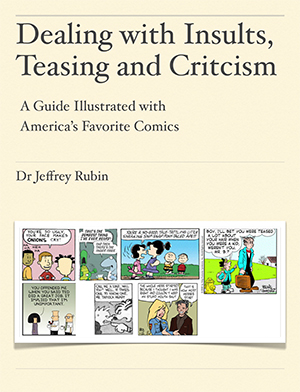
Or you can go to the top of this page where it says “Free Book: Dealing with Insults, Teasing, and Criticism” and click on it. This will permit you to download a free PDF book that utilizes, to teach these skills, many of the comics kids of all ages love.

In addition to James’s approach of dropping the subject for awhile and my approach of playing the “Criticism” game, there is one more crucial point I shall make here about teaching children to handle criticism.  Children are very dependent on their parents.  There is a theory that in the back of the minds of children they are aware of their dependence.  They somehow realize that without their parent’s support they would be in big trouble and this is associated with anxiety and even terror.  Each time children are criticized by their parents, it brings this fear to the fore of their thoughts, and they can only take so much of it without attempting to banish this fear, either by running away, dreaming magical thoughts, or screaming to drown out the feeling of terror.  As a rule of thumb, parents would be wise to say at least ten supportive comments for every one negative critical comment that they make.  And if more than two or three negative criticisms have been made in a single day, perhaps it would be wise to put off the next one until the morrow.

Be patient then, and don’t be afraid to drop a subject until a more suitable time.  This will make you, not weaker, but a stronger parent.  During fun times, teach your children how you expect them to act when criticized.  Be on guard against too much negative criticism all at once.  And above all, let your children know you love them.
———————————
Some people will enjoy reading this blog by beginning with the first post and then moving forward to the next more recent one; then to the next one; and so on. This permits readers to catch up on some ideas that were presented earlier and to move through all of the ideas in a systematic fashion to develop their emotional intelligence. To begin at the very first post you can click HERE.

Categories
anger Bullied conflict resolution criticism emotional intelligence jealousy negative criticism psychological maturity stress types of criticism wisdom

PROVIDING NEGATIVE CRITICISM: FIVE LEVELS OF MATURITY

Welcome to From Insults to Respect. Recently I have been discussing a model that describes five levels of maturity when responding to criticism. Today, we switch gears, and take a look at a model that describes five levels of maturity when providing criticism.

The Five Levels

Below you will find preliminary descriptions of how people at five developmental levels of maturity provide criticism, that is, criticism that points out what we don’t like about someone’s actions, beliefs, or appearance.  Level one is the most immature and uses observations of babies as its starting point.  Each successive level is more mature:

  1. This level requires displaying one or more of the following:
  • Cries without stating what the crying is about
  • Physically attacks the person being criticized
  • Damages property

Although these three descriptors may not sound like providing criticism, in some situations we can see that it is the very beginning of the development of this skill.  Let’s say Jill takes baby Bob’s crayon away believing he is done with it.  Bob begins to cry and takes a swipe at Jill.  She manages, by moving away, to avoid Bob’s swipe. Bob now looks even angrier and crumbles up a piece of paper and flings it on the floor.  An observer to this may conclude that Bob, in a sense, is criticizing Jill for taking the crayon.   


   2.  This level requires displaying one or both of the following:

  • The criticizer does not explain what the offending behavior is, but instead expresses displeasure with glares, insults, shouting, silence, or threats that do not involve bodily harm. (For example, someone might be making too much noise and the criticizer might turn to the noise maker and glare, or cry out, “Jerk!”)
  • Threatens bodily harm regardless of what else is said.


     3.  The criticizer clearly states the criticism with enough detail so the criticized person, if he or she wills, can improve the behavior, idea, or appearance, but couples it with glares, insults, shouts, or threats that are not about bodily harm.


   4.   The criticizer states the criticism without bodily attacks, damaging property, glares, insults, threats, or shouts, and with enough details so that the criticized person, if he or she wills, can improve the behavior, idea, or appearance.  If the person receiving the criticism becomes defensive or angry, the criticizer empathizes without returning, glares, insults, threats, or shouts.

   5.  When the criticizer provides criticism, he or she does so in a manner very similar to a level four response, but beforehand, the criticizer considers the person who is the target of the criticism, and the situation that he or she is in.  As a result of such considerations, the criticizer may decide to alter the criticism.

  • Person variables that are considered:  From observing how the person to be criticized handled criticism in the past, he or she determines which of the five levels of responding to criticism is most characteristic of the individual. (For example, if someone tends to physically attack the criticizer when criticized and is big enough to cause real bodily harm, then a decision is made either to not provide the criticism or to provide it only when there is sufficient security, or else someone else is employed to provide the criticism who is capable of dealing safely with the attack prone person.)  Other person variables considered are how sensitive the person is when criticized, is the person to be criticized currently in an angry or sad mood, is the criticism likely to be perceived as particularly difficult to bear, versus something likely to be viewed as a relatively minor matter, and if the criticizer’s relationship with the person to be criticized is less than ideal.  Depending on such variables, consideration is given to waiting until the person is in a pleasant mood and enlisting someone else to provide the criticism such as a more neutral person, a friend, or someone who is admired by the person who will be criticized.  When the person to be criticized is particularly sensitive about an issue, a fictionalized story with a character who displays the offending behavior may be presented, and then the character’s behavior is discussed.
  • Situation characteristics that are consideredAre there other people around that will lead to face saving behavior coming into play?  Is there enough time set aside to process the criticism?  Has the person who is to provide the criticism been providing too much negative criticism in too short a period of time? (In this case, consideration is given to waiting until some time goes by in which some positive things are said over the course of several days before hitting the person to be criticized over the head yet again!)

PRACTICE

A good way to become familiar with the five levels is to cut out comics from the paper that illustrate someone providing criticism to someone else.  Then, from time to time compare the descriptions of the five levels to how the character in the comic provided the criticism and then see if you can choose which level best matches the criticism style.  For example, in the Peanuts comic that I used above to illustrate a level five response, with Lucy deciding to give Charlie some time to calm down, I actually altered the last panel in the comic for educational purposes.  The real comic, in its entirety appears below.


In this comic, if you will, compare Lucy’s criticism to each of the five levels and see if you can choose which level is the best match.  In coming weeks, we’ll be practicing these types of skills in a variety of fun ways.

———————————
Some people will enjoy reading this blog by beginning with the first post and then moving forward to the next more recent one; then to the next one; and so on. This permits readers to catch up on some ideas that were presented earlier and to move through all of the ideas in a systematic fashion to develop their emotional intelligence. To begin at the very first post you can click HERE.