Categories
anger conflict resolution criticism dig for the conflict stress wisdom

ANGER: A COMIC STRIP LOVER’S GUIDE

If you have been following this blog you know that I have discussed anger on several occasions (See, for example, BEING A WISE FRIEND TO YOUR ANGRY SELF, PART 1 and BEING A WISE FRIEND TO YOUR ANGRY SELF, PART 2).  During these discussions, I mentioned that how you handle anger has a big influence on how much people like and respect you.  Today we delve into the nature of anger a little more with the help of some of our favorite comic strip buddies.

Getting Familiar with Anger


Most of us have a pretty good idea about what it means to be angry.  In the above comic, when Charlie Brown is shouting at Lucy and wildly waving his hands above his head, we’re pretty sure he is in the midst of an angry fit.

Although you already know, in some general way, what it means to be angry, if I was to ask you to quickly create a list of the various expressions and experiences that go along with anger, you might have to pause for a few seconds and your list might end up leaving out several important ones.  Moreover, some readers might have a somewhat different idea of what anger means than I do.  This might lead them to become confused about some of my statements.  And so, because we will be discussing situations that involve anger, it will be a valuable use of our time to take a quick look at anger as revealed in comics and for me to make some comments along the way.

Shouting and Glares

Consider this Luann comic.

Here, we see blond-haired Tiffany planning to put on a beauty pageant contest that she desires to win.  Suddenly, Tiffany experiences a conflict with Crystal.  What I mean by this is, Tiffany seems to desire to enjoy her thoughts about the glory of winning her pageant.  Interfering with this, Crystal throws out statements suggesting Tiffany might not win.  Judging from Tiffany’s angry reaction, I’m guessing she thinks Crystal is guilty of doing something wrong.  I’m hoping that you notice that the first letter of “desire,”  “interfering”,  and “guilt” spell out the word DIG.  It can remind you how to summarize a conflict. (To learn more about what it means to have a conflict, see my post, DIG for the Conflict).

In a sense, Tiffany set sail on the great Sea of Conflict just about when Crystal asks, “And if they don’t pick you?”

When Tiffany begins to glare at Crystal and shout, she has probably sailed into a region of conflict known as anger.  Assuming that someone isn’t pretending to be angry, the actions of glaring and shouting are pretty clear signs that indicate someone is angry.

Quiet Anger

Even when someone is not shouting, anger may be present.

In the above exchange between Luann and Tiffany, when they are whispering it is obvious that they are angry with each other.  The glaring and insult darts that they are throwing at each other provide us adequate signs that they are angry at each other.

Other Expressions of Anger

During conflicts, besides glaring, insults, and shouting there are a few other signs that indicate we are in the region of anger.  Consider the following Blondie comic.

Here, we see not only shouting, insults and glaring as signs of anger, but also pointing while waving a finger, insults and name calling.  I notice in the last panel that Blondie is giving Dagwood a little love.  I wonder if that will ease his anger.

See if you can see some additional anger signs in the following Retail comic.

Val, the woman with black hair, begins her expression of anger by placing her hands on her hips and widening her eyes.  She then crosses her arms in front of her, lowers her eyebrows, and threatens Courtney.

Below, we see Marcie express her anger a little differently.

In addition to shouting, Marcie throws up her hands and then begins to throw objects at Peppermint Patty.

Can you describe the turtle’s expression of anger in this next one?

As I see it, in this Sherman’s Lagoon comic when the turtle yells “THAT’S THE DUMBEST THING I’VE EVER HEARD!” he expresses his anger by insulting Sherman.  He also expresses his anger by banging his fist on the table.

In the comic below, how does the woman in orange express her anger?

The woman is shouting while leaning forward in a threatening manner and baring her teeth.

Next, we have a Piranha Club comic.

Notice that the woman goes beyond threats to express her anger, using direct physical violence.

In our next example, again someone goes beyond a threat to express anger.

Lucy expresses her anger by waving her fist, and then she ends up throwing a snowball at poor ol’ Charlie Brown.

Next, Helga doesn’t display any of the signs we already mentioned, and yet we and her husband still recognize that she is angry.

As this comic illustrates, withdrawing love may be a sign of anger.

Overt and Covert Anger

Overt anger refers to anger that is expressed in ways that we can clearly see, hear, or—as in the example of the woman slugging a guy—feel.

Other overt cues that may be interpreted as anger are frowning, blushing in the face or neck, not smiling, agitated rigid movements, apparent tension in the body, heavy walking, grinding one’s teeth, and a protruding neck vein.

In addition to overt anger, sometimes people attempt to hide their anger.

When people are angry inside but don’t show us outwardly that they are angry, we may say that they are experiencing covert anger.

When we attempt to determine if someone is angry, we may only be partially successful.  Because of the subtlety and variety of the clues that may suggest someone is covertly angry, we will at times guess wrongly.

In an effort to avoid offending some of their readers, there are several overt expressions of anger that we don’t observe in newspaper comics.  Crying out, “Jesus Christ!” and “God almighty!” are examples of religious-themed anger responses.  Shouting out curses are very popular in some circles.  Sometimes people, knowing these expressions of anger will get them in trouble, find themselves saying these words silently to themselves.

Often people show some aspects of their anger overtly while experiencing a commotion of other aspects of their anger inside of themselves that they do not wish to share with others.  They may find themselves silently cursing while imagining attacking the perceived cause of their anger.  They may feel hot, nervous, a tightness in their forehead, or a pounding in their blood vessels and heart.  Covert anger refers to all of the thoughts and body reactions of anger that others can’t observe.  Both overt and covert anger go along with the entire experience of anger.

Not All Expressions of Anger are Real Anger

On occasion, people will act angry when they are not.  This may be done, for example, because they think such actions will scare someone into fulfilling their desires.  At other times, they may desire to appear manly and believe displaying anger is manly.  And sometimes their friends are acting angry about something and in an effort to support their friends they may pretend that they are also angry.

Not All Conflicts Contain Anger

When we are in a conflict with someone, we are not always angry at the person whom we believe is guilty of doing something wrong.

In this Garfield comic, Jon may very well have a conflict with Liz that can be described as follows—Jon desires that Liz develop a better sense of humor and that she not twitch her nose when she is angry, but interfering with this, her actions have been suggesting to him that she will not be changing these attributes in the foreseeable future.  If asked, Jon might admit that Liz is guilty of being less than a perfect companion.  Nevertheless, Jon appears so in love with Liz that if we were to ask him if he is angry with her it’s not hard to imagine him saying, “Are you kidding!?  I’m not angry at her, I’m crazy about her!”

When we are engaged in a conflict, instead of feeling angry, we may feel fear, hope, loving kindness, sadness, humorous, and a sense of challenge.

Sometimes a Conflict begins in Anger and then it Fades Away Into the Distance

Oftentimes, when a conflict first begins, a person initially becomes angry.  As time goes by, people often find that they can sail away from anger to other less hostile regions on the great Sea of Conflict.

Illustration by Eric Sailer

Summary

This blog post was designed to introduce you to some basic ideas about anger.  We focused on the various expressions and experiences of anger.  In future blog posts, we will go over such topics as how anger is related to other emotions, what we mean by emotions, what are the functions of the various emotions, and how we can learn to use our emotions wisely.  Although these topics can be very serious, with the help of our comic strip buddies, we can have some fun along the way.

——————————-

Some people will enjoy reading this blog by beginning with the first post and then moving forward to the next more recent one; then to the next one; and so on. This permits readers to catch up on some ideas that were presented earlier and to move through all of the ideas in a systematic fashion to develop their emotional intelligence. To begin at the very first post you can click HERE.

Categories
anger Bullied child discipline conflict resolution criticism emotional intelligence negative criticism parenting types of criticism William James wisdom

TEACHING CHILDREN HOW TO DEAL WITH CRITICISM

For the past few weeks we have been discussing how to deal with criticism.  As I have noted, because criticism is often accompanied by name calling, insults, threats, and even violence, it can be very hard to handle.  Even when criticism is provided in a more supportive manner, threats to our desires to be liked and to be free to do whatever we want can arise, bringing with them feelings of frustration, defensiveness and anger (see post titled WHY IS CRITICISM SO HARD TO BEAR?).

Because these feeling can be so very strong, simply reading about mature ways to respond to criticism, although oftentimes helpful, is not enough to become a master at dealing with criticism.  I have therefore been encouraging exercises that lead us to practice the skills sufficiently so that they become so second-nature to us that even in the most stressful situations we can expertly carry them out.  One of the best ways to practice these skills is to teach them to children.

Teaching Children to Handle Criticism

You notice your five-year old is not making his “B” correctly.  “That’s not quite right,” you say.  “Here, watch me.”

As you begin to demonstrate, your child becomes defensive, crumbles up the paper, and shouts, “I hate you!  I hate you!  I hate you.”

“How dare you speak that way to me!” you respond.  And the conflict escalates from here.

A parent is often confronted with what William James liked to call the “balky will.”  Certain children, if they do not succeed immediately in doing something just right and are then criticized, flare up in anger and refuse to cooperate.  Such children are oftentimes treated as sinful and are punished; or else the parent pits his or her will against the child’s will.

John Wesley
John Wesley
William James
William James

Some have argued that children should be forced to do as they are told, even if one has to whip them ten times running.  “Break its will, in order that his soul may live!” exclaimed John Wesley, an eighteenth century theologian.  But William James disagreed.  “Such will breaking is always a scene with a great deal of nervous wear and tear on both sides, a bad state of feeling left behind it, and the victory not always with the would-be will breaker.”

When a situation of this kind occurs, and the child is all tense and excited, James believed that it is best to drop the subject for awhile.  Direct the child’s mind to something else, and then, a little later on, bring it up again.  As likely as not, the child will go over it now without any difficulty.

“It is in no other way that we overcome balkiness in a horse,” said James.  “We divert his attention, do something to his nose or ear, lead him around in a circle, and thus get him over a place where flogging would only have made him more invincible.”

Of course, nothing works perfectly all the time, and this technique is no exception.  I have found that I can greatly increase the success rate of James’s approach by playing a game with children called “Criticism.”  It can be played during car rides, walks in the neighborhood, and waiting for the food to come in a restaurant.  To teach your children the game you first have to go over the first four levels of responding to criticism.  Let’s take a look at these levels:

Four Levels of Responding to Criticism

Level 1 is viewed as the most immature, and each higher level is viewed as more mature (see HERE and HERE for an explanation of how this model was developed as well as the evidence that utilizing the higher levels lead to more respect by others.

1.  This level requires displaying one or more of the following:

  • Weeps or sobs with tears or pouts without also using level 4 responses
  • Physically attacks the criticizer
  • Damages property

2.  This level requires displaying one or more of the following:

  • Insults the criticizer (either with words, hand gestures, the sticking out of a tongue, the rolling of the eyes, or smirks)
  • Glares at the criticizer
  • Threatens the criticizer
  • Punches, kicks, or throws an object without physically hurting someone or damaging anything
  • Criticizes the criticizer without first fully addressing the original criticism.

3.  This level requires displaying one or both of the following:

  • Displays defensiveness without directly insulting the criticizer (raising voice’s volume or pitch)
  • Displays a lack of interest either by verbally indicating this, or with nonverbal cues, or complete silence. 

Illustration by Deanna Martinez4.  Level 4 individuals listen to the criticizer in a supportive, warm, friendly style, and then make it clear that they fully understand what was said.  Moreover, they put the criticizer at ease by making statements that indicate that the wise learn from criticism.  Some time is spent on showing that they are thinking about the criticism.  If, after thinking about the criticism the criticism is deemed to be correct, they make a statement frankly indicating, “I can see your ideas have merit and I intend to use them in the future.”  If they are not sure if they agree, they make a statement indicating that they are very interested in what was said, plan to think a little more about this over the next few days and then they will be ready to discuss this further.  If, after thinking about the criticism, the criticism is deemed to be incorrect, a statement is made designed to disagree without being disagreeable.  More specifically, a sense of humor, some listening in a caring way and a few smiles help to traverse rough terrain.  As the episode winds down, the criticizer is encouraged to feel comfortable communicating suggestions in the future.

Using This Model to Teach Children To Deal With Criticism

It’s important to tell the children first not to worry if they remember everything you are about to tell them because once you start to play, they will catch on before long.

To introduce this game, I like to use the Peanuts comic that has Charlie Brown criticizing Sally’s swirls and Sally getting defensive.

In this comic, when Sally hears Charlie Brown’s criticism of her swirls, it’s not long before Snoopy’s shades are sent flying.

Once you explain what criticism is and then go over the four levels of responding to criticism, you describe a situation in which Charlie criticizes Sally and Sally responds.  Then the child guesses what level Sally’s response was at.  So, in addition to the example depicted in the above comic, I could say, “Charlie says to Sally, ‘Those sneakers you’re wearing are ugly.’  Sally responds by saying, ‘Oh yeah?!  Well what do you know about sneakers?  You’re the worst dresser around here, you jerk!’  What level is Sally at?”

After you discuss the child’s answer, then role-play with the child the situation so that you provide the criticism and the child acts out a level four response.  If the child fails to do this correctly, reverse the roles by having the child criticize you and you provide the level four response.  Then let the child try to imitate your level four response.

I have found that kids, rather quickly, get a thorough understanding of the four levels by playing this game.  Once they do, during a typical day I catch them responding to criticism.  When I do, I ask them to rate the level of their response.  I also try to catch them using a level four response, and then I play up like it’s a big deal that such a young kid can be so mature.

One way to come up with fun descriptions of a character being criticized and another character responding, is to cut out newspaper comics that depict these kinds of scenarios.

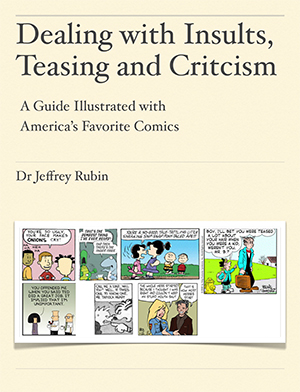
Or you can go to the top of this page where it says “Free Book: Dealing with Insults, Teasing, and Criticism” and click on it. This will permit you to download a free PDF book that utilizes, to teach these skills, many of the comics kids of all ages love.

In addition to James’s approach of dropping the subject for awhile and my approach of playing the “Criticism” game, there is one more crucial point I shall make here about teaching children to handle criticism.  Children are very dependent on their parents.  There is a theory that in the back of the minds of children they are aware of their dependence.  They somehow realize that without their parent’s support they would be in big trouble and this is associated with anxiety and even terror.  Each time children are criticized by their parents, it brings this fear to the fore of their thoughts, and they can only take so much of it without attempting to banish this fear, either by running away, dreaming magical thoughts, or screaming to drown out the feeling of terror.  As a rule of thumb, parents would be wise to say at least ten supportive comments for every one negative critical comment that they make.  And if more than two or three negative criticisms have been made in a single day, perhaps it would be wise to put off the next one until the morrow.

Be patient then, and don’t be afraid to drop a subject until a more suitable time.  This will make you, not weaker, but a stronger parent.  During fun times, teach your children how you expect them to act when criticized.  Be on guard against too much negative criticism all at once.  And above all, let your children know you love them.
———————————
Some people will enjoy reading this blog by beginning with the first post and then moving forward to the next more recent one; then to the next one; and so on. This permits readers to catch up on some ideas that were presented earlier and to move through all of the ideas in a systematic fashion to develop their emotional intelligence. To begin at the very first post you can click HERE.

Categories
anger Bullied child discipline conflict resolution criticism emotional intelligence negative criticism parenting psychological maturity types of criticism wisdom

PROVIDING NEGATIVE CRITICISM: DEFENDING THE FIVE LEVELS

In my previous post I provided readers a discussion titled PROVIDING NEGATIVE CRITICISM: FIVE LEVELS OF MATURITY.  Several of the same arguments that I used earlier to defend the FIVE LEVELS OF RESPONDING TO CRITICISM are equally true for defending the five levels of providing negative criticism.  Perhaps the best argument for the five levels can be derived from the golden rule—Treat others as you want to be treated.  If this strikes you as containing wisdom, then I suggest asking yourself the following.  Do you personally desire, when criticized, to be provided clear, usable information without being bombarded with insults, glares, threats or physical attacks?

If your answer is yes, then to be consistent with the golden rule, it makes sense that you provide negative criticism to others in a manner that is described as level 5.

Although it has been my experience that most people, after some practice, come to agree that the five levels do a pretty good job helping to clarify in their minds the most mature way to provide negative criticism, there are a few questions that come up from time to time.  To address these questions, I will present a discussion based on one I had with a counseling client whom we will call Beatrice.

Discussion with Beatrice 

“Hi, Beatrice.  Say, I was wondering if you read over the pages I gave you that describe the five levels of providing negative criticism?”

“I sure did, Jeff.  I do have some questions, though.”

“I’m very interested in what you have to say, Beatrice.”

“Jeff, when you describe the lowest levels of providing negative criticism, you take a dim view of using physical attacks and shouting.  But I’m a mom.  Just like my mom did with me, when my son Mickey does something wrong, I do shout at him and smack him on his butt.  There’s nothing wrong with that, is there?”

After a few seconds, I say gently, “You know, Beatrice, if I answer you, part of what I say might provide negative criticism to you.”

“Are you saying I’m doing something wrong?!” Beatrice shouts.

Illustration by Aviva Maltin

I pause, and then express my empathy for what she appears to be experiencing.  “I realize discussing this, Beatrice, can be difficult.  If I did think you did something wrong, maybe you’re not up to hearing my opinion?”

Beatrice taps her foot for a few seconds and takes a deep breath.  “Okay, Jeff, I’m ready.  Let me hear what’s on your mind.”

I think to myself, Beatrice seems pretty fragile about this issue.  I better tread lightly.

“Well, Beatrice, first of all, I must admit, I – along with the vast majority of us parents – have come to a point where we were at least mighty tempted to give our kids a good whack.”

“You’re darn toot-in!” Beatrice emphatically replies.

“Some people might raise the following question:  If you hit Mickey when he does something wrong, are you teaching him that it’s okay for him to hit others when they do something he doesn’t like?”

“I don’t think so, Jeff.  The first time I see Mickey hit another kid I’ll smack him good while yelling at him, ‘You’re not the kid’s mother.  It’s only okay for a mother to hit her kid.  Don’t you ever let me see you hit another kid!’”

“I see, Beatrice.  You feel that you can teach him that it’s not okay for him to hit even though you hit him by explaining that it’s only okay for mothers to hit their kids.”

“Yes.”

I pause to think about this for a few seconds.  Then I say, “I think I understand your position, Beatrice.  Having heard what you said, here’s my negative criticism, if you’re still up to hear it.”

Frowning, Beatrice says, “Let’s hear it.”

“I do know kids often pick up more of what their parents do than what their parents say, and some things the kids pick up aren’t always what their parents might want.”

Illustration by Lynn Johnston from her wonderful book, DO THEY EVER GROW UP?

Beatrice shifts in her chair a bit, and then looks up at me.  “Go ahead, Jeff,” she says.

“Well, Beatrice, I’m concerned that hitting Mickey might make it harder for him to get the message that hitting others is not usually the best way to provide criticism.”

“I guess you feel it’s never okay for a mother to strike her child,” she says after a while.

“Well, first of all, I know many, many people who were raised with shouting, spanking mothers, and most of them turned out just fine.  But a few years ago this psychologist, Elizabeth Thompson Gershoff, looked at both positive and negative behaviors in children.  Some parents used hitting and some didn’t.  Gershoff found that the use of hitting was associated with an increase in child aggression and antisocial behavior.

“If you’d like, Beatrice, tell me about the last time you provided negative criticism to Mickey so I can better picture what typically is occurring.”

“We were at the kitchen table and he tipped over his glass of milk.

Illustration by Aviva Maltin

 I yelled at him and smacked him on his bottom.”

Illustration by Aviva Maltin

“I see.  It sure is frustrating when someone spills a glass of milk—the waste, the clean-up.”

“Yes, it is.  So, what would you do with Mickey when he tips over his glass of milk?  You can’t reason with him.”

“If Mickey’s not ready to drink out of a regular glass, there are these cups for children that have a cover with a small opening to drink from.  When these cups are tipped over, they don’t spill.  Now, children do like to learn to act like older people.  For example, Mickey, when he was younger, used to crawl, but he saw older people walking about and he began to try to master that skill, and now he walks just fine.

“If you begin to use this children’s cup, you can, at some point, ask Mickey if he wants to learn to drink out of a ‘big boy’ glass, and show him what it looks like.  When he indicates an interest in doing this, you can tell him that he must show you he can drink from the children’s cup for a while without tipping it over.  Show him what you mean by tipping it over, and see if he understands by asking him to tip it over.  Once he shows you he understands this, you can watch him during meals to see if he is being careful.  When he goes for a few minutes without tipping the cup over, you can praise him enthusiastically, smile, pat his back, and remind him that if he keeps doing a good job he can soon use a ‘big boy’ glass.

“Now, once you feel he’s ready for the ‘big boy’ glass, you can let him try it out and, when you do, remind him to be careful.  Only fill it up about an inch high so if it spills it won’t make as big a mess.  After about a minute, if he hasn’t tipped it over, praise him enthusiastically, smile, pat his back, and remind him that if he keeps doing a good job, he can drink from now on like the big boys.

“Of course, from time to time, there will be an accident.  Then, you can look sad, and have him help you clean up the mess.  If there are too many messes for you to put up with, you may want to decide to go back to the children’s cup for a while.  If you do, you could tell Mickey that it’s just for a little while, just until he can show you that he can learn to use the cup without tipping it over.  Then, again, when he does a good job, you praise him enthusiastically, pat his back, and remind him why you are pleased.”

“I guess, Jeff, I can give that a try.  I like how specific you are.  I understand that more mature people, when providing criticism, are clear enough so that the person being criticized can, if he or she wills, improve the behavior.  You just provided a good example of this.”

“Thanks, Beatrice.  I like the way you were able to hear me out on a topic that is obviously a very sensitive one for you.”

———————————
Some people will enjoy reading this blog by beginning with the first post and then moving forward to the next more recent one; then to the next one; and so on. This permits readers to catch up on some ideas that were presented earlier and to move through all of the ideas in a systematic fashion to develop their emotional intelligence. To begin at the very first post you can click HERE.

Categories
anger Bullied conflict resolution criticism emotional intelligence jealousy negative criticism psychological maturity stress types of criticism wisdom

PROVIDING NEGATIVE CRITICISM: FIVE LEVELS OF MATURITY

Welcome to From Insults to Respect. Recently I have been discussing a model that describes five levels of maturity when responding to criticism. Today, we switch gears, and take a look at a model that describes five levels of maturity when providing criticism.

The Five Levels

Below you will find preliminary descriptions of how people at five developmental levels of maturity provide criticism, that is, criticism that points out what we don’t like about someone’s actions, beliefs, or appearance.  Level one is the most immature and uses observations of babies as its starting point.  Each successive level is more mature:

  1. This level requires displaying one or more of the following:
  • Cries without stating what the crying is about
  • Physically attacks the person being criticized
  • Damages property

Although these three descriptors may not sound like providing criticism, in some situations we can see that it is the very beginning of the development of this skill.  Let’s say Jill takes baby Bob’s crayon away believing he is done with it.  Bob begins to cry and takes a swipe at Jill.  She manages, by moving away, to avoid Bob’s swipe. Bob now looks even angrier and crumbles up a piece of paper and flings it on the floor.  An observer to this may conclude that Bob, in a sense, is criticizing Jill for taking the crayon.   


   2.  This level requires displaying one or both of the following:

  • The criticizer does not explain what the offending behavior is, but instead expresses displeasure with glares, insults, shouting, silence, or threats that do not involve bodily harm. (For example, someone might be making too much noise and the criticizer might turn to the noise maker and glare, or cry out, “Jerk!”)
  • Threatens bodily harm regardless of what else is said.


     3.  The criticizer clearly states the criticism with enough detail so the criticized person, if he or she wills, can improve the behavior, idea, or appearance, but couples it with glares, insults, shouts, or threats that are not about bodily harm.


   4.   The criticizer states the criticism without bodily attacks, damaging property, glares, insults, threats, or shouts, and with enough details so that the criticized person, if he or she wills, can improve the behavior, idea, or appearance.  If the person receiving the criticism becomes defensive or angry, the criticizer empathizes without returning, glares, insults, threats, or shouts.

   5.  When the criticizer provides criticism, he or she does so in a manner very similar to a level four response, but beforehand, the criticizer considers the person who is the target of the criticism, and the situation that he or she is in.  As a result of such considerations, the criticizer may decide to alter the criticism.

  • Person variables that are considered:  From observing how the person to be criticized handled criticism in the past, he or she determines which of the five levels of responding to criticism is most characteristic of the individual. (For example, if someone tends to physically attack the criticizer when criticized and is big enough to cause real bodily harm, then a decision is made either to not provide the criticism or to provide it only when there is sufficient security, or else someone else is employed to provide the criticism who is capable of dealing safely with the attack prone person.)  Other person variables considered are how sensitive the person is when criticized, is the person to be criticized currently in an angry or sad mood, is the criticism likely to be perceived as particularly difficult to bear, versus something likely to be viewed as a relatively minor matter, and if the criticizer’s relationship with the person to be criticized is less than ideal.  Depending on such variables, consideration is given to waiting until the person is in a pleasant mood and enlisting someone else to provide the criticism such as a more neutral person, a friend, or someone who is admired by the person who will be criticized.  When the person to be criticized is particularly sensitive about an issue, a fictionalized story with a character who displays the offending behavior may be presented, and then the character’s behavior is discussed.
  • Situation characteristics that are consideredAre there other people around that will lead to face saving behavior coming into play?  Is there enough time set aside to process the criticism?  Has the person who is to provide the criticism been providing too much negative criticism in too short a period of time? (In this case, consideration is given to waiting until some time goes by in which some positive things are said over the course of several days before hitting the person to be criticized over the head yet again!)

PRACTICE

A good way to become familiar with the five levels is to cut out comics from the paper that illustrate someone providing criticism to someone else.  Then, from time to time compare the descriptions of the five levels to how the character in the comic provided the criticism and then see if you can choose which level best matches the criticism style.  For example, in the Peanuts comic that I used above to illustrate a level five response, with Lucy deciding to give Charlie some time to calm down, I actually altered the last panel in the comic for educational purposes.  The real comic, in its entirety appears below.


In this comic, if you will, compare Lucy’s criticism to each of the five levels and see if you can choose which level is the best match.  In coming weeks, we’ll be practicing these types of skills in a variety of fun ways.

———————————
Some people will enjoy reading this blog by beginning with the first post and then moving forward to the next more recent one; then to the next one; and so on. This permits readers to catch up on some ideas that were presented earlier and to move through all of the ideas in a systematic fashion to develop their emotional intelligence. To begin at the very first post you can click HERE.