Categories
anger Bullied conflict resolution criticism emotional intelligence meditation psychological maturity ruminations stress

ANGER, RUMINATION, AND MEDITATION

Recently, I published posts that discussed dealing with your anger that might arise when you are criticized (see BEING A WISE FRIEND TO YOUR ANGRY SELF, PART 1 and BEING A WISE FRIEND TO YOUR ANGRY SELF, PART 2).  The techniques that are recommended in those posts can be helpful for those who are upset about what was said.  But there are times when we are criticized and we get angry and we kind of think it’s about the criticism, but it really is about something else. Perhaps we realize that if someone else had criticized us in the same way using the same words, we would have been fine about it.  Nevertheless, we ended up getting furious because of who said it. We then went home and our anger about what happened just kept coming up again and again.  We wish it would just stop, but it doesn’t.

Such ruminations can be helpful.  Each time we think over the memory in light of what we have learned since the event first occurred, we might think of some better ways to deal with the conflict.  Then, if a similar event does occur, we may find that we are better prepared than if we hadn’t repeatedly mulled it over.

Despite their helpfulness, there are times when again and again an angry memory keeps creeping ever so annoyingly into our consciousness so that finally we conclude it doesn’t seem to be doing us any good.

Margaret was terribly abused by a man when she was a child. She now finds that even though twenty years have passed, each time she begins to develop a promising relationship with a guy, he ends up doing something that somehow reminds her of something that happened during the earlier abusive relationship. She then ends up recalling all that she had suffered. This leads her to act in a manner that is way out of proportion to what the new guy has done. The new guy runs for the hills and the woman, when she has calmed down, wishes she can become less sensitive.

Illustration by Eric Sailer

There are several approaches that we will be discussing in future posts to help deal with such disturbing ruminations. Today, we will focus on meditation.

Meditation

For thousands of years people have advocated that sitting comfortably while resting one’s thoughts on a mantra—that is, an object to attend to—can help to ease the burdens of life. Teachers of meditation usually mix in ancient wise counsel as the student learns this beautiful art.

Research has demonstrated that meditation can be helpful for improving empathy, working memory, the ability to focus, and relationship satisfaction, as well as reducing stress, anxiety, and ruminations.  Evidence also suggests that mindfulness meditation has numerous health benefits, including increased immune functioning (see http://www.apa.org/monitor/2012/07-08/ce-corner.aspx for a review of the research.)

For those who want to give meditation a try before entering into a course or participating in many of the available wonderful retreats, I offer the following.

A SIMPLE, EFFECTIVE FORM OF MEDITATION

Illustration by Jack Star Rubin

Set aside about twenty minutes. Preferably, choose a time when you haven’t eaten for at least an hour.  This is because right after a meal your stomach begins to work hard to digest what you have just consumed.  It is better to wait until much of this is over.  This way your body can devote more of its energy for your journey into the deepest levels of your mind.

The only tool you need is a clock or watch so you can know when the twenty minutes are up.  Select the most quiet, comfortable place you can find for sitting. With this form of meditation there is no requirement to sit in any unique fashion.  If you desire to shift your position at any time, feel free to go right ahead.

Begin by checking the time and then figure out what time it will be when twenty minutes will have passed.  Then close your eyes, take a deep inward breath, and as you exhale, let your whole body deeply relax.  For approximately thirty seconds, enjoy letting your mind drift wherever it wishes to go.

After the half minute has passed, begin to observe your breathing.  This observation of your breath serves as your mantra.  Do not try to alter the flow of your breath as you observe it, just observe it.  At first you may find that just the act of observing your breathing in and out will result in altering your breathing pattern.  This is very natural and a common experience.  There is nothing wrong with what you are doing when this happens. As long as you gently seek to observe your breathing without influencing its flow you are doing wonderfully.

Now, as you gently seek to do this, not only will you see yourself at times influencing the flow of your breathing, but you will also find, from time to time, that your attention will drift away from your breath altogether. In fact, it is a common experience.  Many of us find that we spend almost no time whatsoever observing our breath as we meditate, our thoughts instead drifting here and there on other matters.  Such experiences are a natural part of meditating.  You are doing nothing wrong.  There is no need to feel guilty.

When you notice that your attention has drifted away from your breathing, very gently see if you can effortlessly return to observing your breath.  If you can, do so.  If you find that your mind drifts back to something else, this is fine. The whole process is effortless.  This is one reason that it is so relaxing.  That is, you give your mind something so simple to do that it requires no real effort, and whenever you begin to drift from this no effort task, you accept this as just a natural part of the process without chastising yourself.

As you do this, from time to time check and when you notice that twenty minutes have gone by, take a deep in-breath, exhale, and then give yourself two minutes to let your breath and mind wander wherever they will go.  In this way, you ease out of meditation and return to your non-meditative state.

SOME QUESTIONS AND ANSWERS

Over the years, when I taught people to meditate, the following questions were often asked.
1. Question: How often should I meditate?
Answer: The research demonstrating the effectiveness of meditation has not yet adequately compared those who meditate twice a day to those who meditate more or less.  Instead of research, we are guided by tradition and our own experience.

From traditional sources, twice a day appears to be the most common practice.  Dr. Herbert Benson, the author of the popular book titled, The Relaxation Response, and a leader in carrying out research on meditation, reports that once or twice a day is sufficient.

I recommend that beginners practice twice a day (preferably before breakfast and before suppertime) for the following reasons.  This is what I was taught by a yoga teacher when I first began to practice forty years ago and it has become a comfortable, valued practice for over 40 years.  Moreover, I have taught many using this technique and have never seen anyone who expressed harm from this practice.  There have been many who have reported dramatic improvements in daily functioning.

2. Question: If I don’t have time to meditate for twenty minutes can I gain some benefits from practicing for less time?
Answer: Dr. Herbert Benson reports that some studies indicate that practicing daily as little as ten minutes per day can produce significant improvements lowering your stress levels.  If you find that you don’t have even ten minutes a day to meditate, you might consider that age old adage that the time to meditate is when you don’t have time to meditate.

A young woman once told me that she didn’t have time to meditate even for ten minutes a day. “How much TV do you watch?” I inquired.  She smiled sheepishly and after a few seconds of calculating in her mind, replied, “Five hours a night.”  She quickly added, “Well, I have to watch my shows!”  In my view, this woman would be wise to reset her priorities.

3. Question: How does meditation help to reduce problems involving recurring angry memories?
Answer: As you meditate, among the thoughts that float into your awareness are angry memories.  When this occurs, you tend to be in a more peaceful state than usual.  The pairing of the memory with this peaceful state allows for a more dispassionate look at the events that had surrounded the original angry episode.  This process often leads to a perspective that is experienced as less threatening.  And sometimes an insightful plan suddenly emerges with great promise should a similar problem cross your path.

The meditation process has been likened to dying a piece of material.  Suppose you have a white sweater and you would like to dye it a nice royal blue.  The first time you dip the sweater in the dye solution and let it sit for a while, when you lift it from the solution you might not notice any change at all.  Upon soaking the sweater again in the solution, letting it sit for awhile, and then lifting it out, this time you may think you notice a slight change, but you are not sure.  You repeat this process several more times and slowly but surely you begin to see the color of the sweater becoming a wonderful hue. In this way, each time you sit in meditation, your anger will ease into something more beautiful.
———————————
Some people will enjoy reading this blog by beginning with the first post and then moving forward to the next more recent one; then to the next one; and so on. This permits readers to catch up on some ideas that were presented earlier and to move through all of the ideas in a systematic fashion to develop their emotional intelligence. To begin at the very first post you can click HERE.

Categories
anger Bullied conflict resolution criticism emotional intelligence psychological maturity stress

BEING A WISE FRIEND TO YOUR ANGRY SELF, PART 2

In my last post, I discussed BEING A WISE FRIEND TO YOUR ANGRY SELF.

Illustration by Deanna Martinez

I received some nice comments from people who found the suggestions helpful.  Thanks!

For some, the suggestions that I put forth on this blog are easy to carry out in real life situations.  For others, old habits that have been used in anger- arousing situations for years are not so easily changed.  This is true even when people become convinced that the new style makes sense.  After a few tries at using the new style and finding that the attempts come off as clumsy, many people may decide that the new style is just not “natural” for them.  They feel that their effort to change is really an effort to suppress their “natural” style, and suppression is not healthy.

The association of anger suppression with learning new skills to deal with anger is understandable, for when one has spent many years acting one way, learning alternative behaviors can be frustrating.  This uncomfortable sensation may be seen as the suppression of one’s “natural” mode of behavior.  It’s a similar experience to how actors might feel when first learning a new role or golfers a new swing.  At first the skill to be learned feels awkward and the early phase of learning can leave them to observe their heart racing and their blood pressure skyrocketing.

Illustration by Eric Sailer

To take a particularly vivid example, consider what happens when human beings have to go to empty their bowels.  When they are first born, they just empty their bowels anywhere.  No one that I know buys the argument that releasing your bowels whenever you feel like doing it is the natural way to live, and that suppressing the urge to release your bowel movements would be unhealthy.  Most of us now understand that when people feel the urge, they can learn to excuse themselves in a pleasant manner and then wait a bit until they get to a more private place to do this type of business.  No real damage is done if we can get to a bathroom in a reasonable period of time.

It is similar with anger.  To not wait until you get to a private place will end up leaving you in a nasty smelling, icky situation that would not be at all in your own best interest or in the interest of others you happen to be with.

Taking the time to calm yourself in the manner suggested in last week’s blog can work, but for most people, it takes practice.  By designing a program in small incremental steps and heeding the suggestions I will be making on this blog, the feeling of suppressing one’s natural behavior can be largely reduced or even completely eliminated.

First of all, Expect Missteps.

By studying the posts on this blog, it is likely that several situations will occur that you now find yourself handling much better than before.  If the response by others you are engaged with ends up being favorable, this will encourage you to utilize the same approach again and again until it begins to feel natural, that is, second nature to you.  Other skills will come off a bit awkward or you will get a less than favorable response, and you may experience frustration.  When you try the skill again, you may now feel unsure and your effort may lead you to interpret this as suppressing a more “natural” way to respond.  You may therefore give up and conclude that you are helpless to make a meaningful change in this type of skill.

A big part of the solution to this problem is to reread the section that discusses the skill, and then practice over and over in your mind a narrative that has you envisioning utilizing the skill.  When you can smoothly imagine in detail carrying out the skill, try it out again in real life.  You may have to do this a few times until you get it right.

Today, I will provide a little fun practice session to help to better learn the skill of being a wise friend to your angry self.

You and your Friend, Eric

Illustration by Deanna Martinez

You and your friend, Eric, are discussing the upcoming election.  Eric explains why he intends to vote for someone in the upcoming presidential election you believe would do an awful job.  After the discussion has gone on for awhile, eventually it becomes clear to you that neither of you are going to change your opinions.

It’s at this point that you feel your anger toward Eric rising up within you.  Before reading on, spend some time thinking about what you would now do. 

After thinking about this, consider trying to come up with a charming way to say to Eric you’d like to take some time to think about the discussion you have both been having and then leading the discussion on to another topic.  Envision in your mind exactly what you would say, and how you would say it.

Illustration by Deanna Martinez

After you have thought about this, see if your response includes summarizing for Eric his main points.  Then a smile, perhaps a good-nature pat on the back of Eric’s shoulder, and then a comment like, “Well Eric, by now you know my opinion about this and I certainly know yours.  We obviously disagree.  Nevertheless, I’m still very fond of you.”  Finally, a comment by you that indicates your willingness to continue the conversation after you had some time to reflect on what has already been said.

It is now later in the day.  You recall the conversation with Eric and anger rises up within you.  Think about what you would do to deal with this.

After thinking about this, reread last week’s post and compare and contrast it with what you came up with.  Practice this exercise until you can,

1. envision in your mind very quickly and smoothly coming up with a charming way to disengage with Eric;

2. describe how you wish to respond to your anger when it flares up after you leave Eric for the day.

When you can do this three times without using any notes, you will find that the next time a similar situation comes up, you will be able to handle it far better than you thought possible.
———————————
Some people will enjoy reading this blog by beginning with the first post and then moving forward to the next more recent one; then to the next one; and so on. This permits readers to catch up on some ideas that were presented earlier and to move through all of the ideas in a systematic fashion to develop their emotional intelligence. To begin at the very first post you can click HERE.


Categories
anger conflict resolution criticism emotional intelligence psychological maturity stress Thich Nhat Hanh

BEING A WISE FRIEND TO YOUR ANGRY SELF, PART 1

In my last post,  CRITICISM AND ANGER, I discussed how sometimes when we are criticized we find ourselves getting angry.  At such times, it’s a good idea to have a well-practiced strategy to summarize the criticism that has been made and then to respectfully call for a break in the discussion to consider all that has been said.

Once you have removed yourself from the anger arousing situation, what are valuable things that you can do to take advantage of your cooling down period? In coming posts, I will discuss a variety of ideas, but today we will focus in on being a wise friend to your angry self.

Wisdom and Anger

If I was wise, how would I respond to a friend who was angry?  If my friend, Steve, was angry, I would gently invite him to take a walk in the country or park.

If he agreed to a stroll, as we went on our way I would listen to him in a caring manner.  If he said he’d rather sit and talk in a quiet place, or not talk at all, I’d offer to do that with him.

Similarly, when I become angry, if at all possible, I take myself for a walk and my friendly, supportive self listens in a caring way to my angry self.

My friendly self doesn’t try to get my angry self to suppress any anger, but rather, to freely express it, but only in private.

Over the years, I have found that whenever my friendly self spends time interacting with my angry self, after awhile my angry self calms down.  During the calm spell, I am far more open to reason.

Now, as you try this out with yourself, please keep in mind that your angry self does not seek to suppress any anger to reach this relatively calm state.  It will occur naturally without any effort at all. Just listen to yourself in a caring manner, and see for yourself what happens.

Once you are in a state of relative calm, you can begin to respond to the conditions that led to anger in a more reasonable manner.

There are some wonderful metaphors that can help you through this process of reaching a relative period of calm.  Thich Nhat Hanh, in his fine book, Anger: Wisdom for Cooling the Flames, reminds us that if we are wise, we do not seek to suppress our anger or wage war against it.  Instead, we can learn to view anger as an organic feeling.

Thich Nhat Hanh
Thich Nhat Hanh

“The practice” Hahn writes, “is to transform yourself.  If you don’t have garbage, you have nothing to use in order to make compost.  And if you have no compost, you have nothing to nourish the flower in you.  You need the suffering, the inflictions in you.  Since they are organic, you know that you can transform them and make good use of them.”

Another Hanh metaphor I like has us thinking of our anger as a potato that we have picked out of a garden.  When we first take it out of the soil it is dirty and hard.  It is not quite ready to provide us with an excellent form of nourishment.  It is much better to take some time to clean it up and then to have it sit in a warm oven for awhile.  Then it soon turns into something delicious.

Similarly, when anger first arises, it is very likely to be a poor form of nourishment.  In fact, it can even turn out to be poisonous.  You have to clean it up first, and then find the right place where it can best be turned into a valued experience.

Now, as you go through this calming period, you will notice your angry self chattering away, saying things like, “That idiot who made me angry is a stupid jerk.”  Other derogatory statements about the source of your anger may come to mind.  Perhaps you will think about how you can do harm to the person your mind is insulting.  This is part of the anger process.

At such times, see if you can observe your angry self in a nonjudgmental manner as this is happening.  If you can’t, there is no need to punish yourself.  Anger is a strong emotion.  Be as kind to yourself as you can throughout this process—just like a good, compassionate friend would.

observing sensationsFrom time to time, see if you can take a few seconds to observe the physical sensations you are experiencing.  The chattering in your mind may make this difficult, so if this does not happen, again you are not encouraged to punish yourself.  Just gently remind yourself that observing the physical sensations you are experiencing could be useful to do if you can.

Now, once you take maybe an hour or so to be a good pal to your “angry” self, even if you have calmed down at this point, if at all possible, don’t leap into trying to come up with a resolution to your angry conflict.  Give yourself a full week, whenever possible, to plan your next discussion with the person with whom you have an angry conflict.

Take advantage of this relacalmtively calm period to map out a strategy to address the concerns raised during the anger arousing situation.  If you come up with some ideas that sound promising, I encourage you to NOT commit to any one idea just yet.  Instead, afterwards, see if you can enter into some different activity unrelated to the conflict such as playing with the kids, doing some housework, watching a movie, going bowling, calling your mother, etc. It is best to take a break from the conflict for awhile and have a night to sleep on it.

This break from formally trying to figure out what your next step should be can be valuable for coming up with creative solutions.  During this period, you’re not badgering yourself to go step by step in any process.  You are aware that you have plenty of time before you will be expected to have a plan to move forward.  There is a reduction in any sense of pressure.  Moreover, your mind does need some rest.  The processing of anger arousing conflicts can be exhausting.

discussionToward the end of the week, if the conflict isn’t too personal, consider discussing what happened with some people you respect and trust.  Two or three heads are usually better than one.

Finally, shortly before meeting again the person with whom you are having the angry conflict, see if you can work up a heightened sense of determination to achieve your desire to resolve this conflict.  Keep in mind that the stress you have been experiencing is normal and fulfillment is not found in easy comfort, security, and routine, but rather in the continual growth in wisdom through what is learned from negative and positive experiences of an active, changing life.
———————————
Some people will enjoy reading this blog by beginning with the first post and then moving forward to the next more recent one; then to the next one; and so on. This permits readers to catch up on some ideas that were presented earlier and to move through all of the ideas in a systematic fashion to develop their emotional intelligence. To begin at the very first post you can click HERE.

Categories
anger conflict resolution criticism emotional intelligence psychological maturity stress

CRITICISM AND ANGER

For the past few weeks, I have been discussing the different reasons why people criticize and how to respond in a mature manner.  To become a master at responding maturely, these mature responses have to be rehearsed.  But even after a great deal of rehearsing, masters at responding to criticism occasionally find themselves becoming so angry at what is being said, that they have to call a time out.  We discussed how to do this in a respectful manner in an earlier post titled SUMMARIZE AND DELAY.

But what is a wise course of action if your best efforts to summarize and delay is ignored by the criticizer and the criticisms just keep coming at a rate that is just too much for you to bear?  Let’s take a look at a parable which points us to a strategy to deal with such a trying situation.


PARABLE OF MARTY AND LENA

One day Marty gets stuck at work.  He calls his girlfriend, Lena, to let her know he will be late for their date. 

Illustration by Eric Sailer

When he finally arrives at Lena’s house, he’s already irritated about how his boss has treated him all day long and he finds himself becoming a little annoyed when Lena starts to raise her voice about how late he is.  “I understand why you are upset,” Marty replies.

Lena then looks at Marty’s clothes and complains that he’s not wearing a tie.

“I didn’t think a tie was necessary for the party we’re going to,” Marty replies.  “Next time we go to a party, I’ll check with you before I pick out my outfit.”

As they leave the house to go to the party, before getting into his car, Lena pauses. “You didn’t have your car washed, and you knew we were going to a party!” she complains.  “It’s filthy.”           

Marty now feels himself getting really angry.  He had run out of time to have the car washed.  To have stopped to get it washed before coming to Lena’s house would have made him even later than he was. 

He takes a deep breath to try to calm himself, and then he begins to think about why Lena has been so negative with him.  He has practiced going down the list of possibilities, and he quickly does so now.

Is she just offering criticism to me in an effort to get me to improve? he says to himself.  There’s just too much criticism all at once for this to be the whole reason, he decides.

Is she just playfully teasing?  She doesn’t look at all like this is any fun for her.

Is she trying to impress some friends so she can better bond with them?  There’s no one around but she and I.

Is she in a bad mood about something?  That has to be it, and I know why.  She’s still angry because I was late. 

“Lena,” he says, “I think you’re still angry because I was late.”

“Yes I am,” she hollers.

“I really wish I could have been on time, Lena.  I had a very rough day at work, and now, in the last five minutes you criticized me three times—first, about my being late, then about not wearing a tie, and now, about not washing the car.  Usually I’m very interested in your criticisms.  But for the rest of the evening I’d like you to hold off on any more.”      

“Don’t give me that!” Lena hollers.  “You didn’t wash the lousy car!  What’s wrong with you?!”           

“Lena, I know you’re going to be disappointed, but I’ve just decided to spend the evening alone.  I’ll call you in a few days and if you’re up to discussing what happened this evening, we’ll do it then.  I’m sorry.”  Then Marty gets into his car and drives away with Lena still yelling.


PARABLE DISCUSSION

Illustration by Eric SailerNotice that in this Marty and Lena parable, Marty first attempts to sail away from the Region of Anger by gently asking Lena to hold off on any more criticism for the rest of the evening.  We will call this the “Signaling to Back-Off Technique.” Although this fails to work for Marty in this parable, the Signaling to Back-Off Technique has the potential to be highly effective.  It works best in an ongoing relationship, although I have seen it work well with people who hardly know each other.  The best way to set this up is to discuss this technique with the other person at a time when both of you are not in an angry mood.  You might say to the other party something like:

Sometimes I begin to get really upset about something you are saying.  I know that it’s important for me to hear your point of view, and I do want to hear what you have to say.  But there are times when I’m in no condition to give you a fair hearing on a particular topic.  At such times, it would help me a great deal if I could give you a simple signal for you to back off for a while.  I’ll make sure you’ll get your opportunity to have your full say on a topic before too long—almost always within a week.  But I sometimes require a little time to get my act together first.  Would you mind helping me out in this way?

If the other party agrees to the Signaling to Back-Off Technique, and I have found that most people do, together you can decide on a signal.  A friend might say something to another friend like, “Please give me a little time to think about this.”  A wife might wish to use with her husband the phrase, “Darling, let’s discuss this later.”  I know one couple who just uses the phrase, “Back off, please.”  This strikes me as a bit abrupt, but it seems to work for them.

In the Marty and Lena parable, when Lena refuses to hold off on any more negative criticism for a while, Marty decides to leave rather than listening to any more insults.

Some people think that it is best to just start yelling at the criticizer to shut up already.  This usually leads to an angry exchange and this can potentially clear the air.  But sometimes some particularly awful things are said in the exchange and events escalate into violence or lasting resentments.

Whereas the quick shouting approach may work well for some people, others find that they sometimes reach a point at which they determine that it would be best to indeed call a time out.  We do it in many sports for four reasons:  To avoid events escalating into violence; to take some time to catch our breath; to think about what has just been happening; and to formulate a plan to go forward.  It is for the same reasons why we call time outs in an anger arousing situation.

After you excuse yourself, what are valuable things that you can do to take advantage of your cooling down period?  Next week’s post will begin to answer this question.

———————————
Some people will enjoy reading this blog by beginning with the first post and then moving forward to the next more recent one; then to the next one; and so on. This permits readers to catch up on some ideas that were presented earlier and to move through all of the ideas in a systematic fashion to develop their emotional intelligence. To begin at the very first post you can click HERE.

Categories
conflict resolution

IS CRITICISM BAD?

In the last blog post, when Marie became frustrated at Carl’s opinion, she criticized it by shouting at Carl and calling him names.

Illustration by Deanna Martinez

Carl ended up feeling insulted.  I then criticized Marie’s style of criticism.

Although I know that sometimes people, when criticized, feel insulted, sometimes when I’m doing my counseling routine, I criticize anyway.

Illustration by Aviva Maltin

“Are you saying I did something wrong?!” Barbara shouts.


Some say about criticism, “If you don’t have anything good to say, don’t say anything at all!  An alternative position is that criticism is the mechanism by which better solutions are found and better decisions are made.

To answer the question “Is criticism bad?” we have to first make sure we understand what “criticism” is.

WHAT DO WE MEAN BY CRITICISM?

My handy Webster’s Ninth Collegiate Dictionary tells us that “criticize” means, “1: to consider the merits and demerits of and judge accordingly : EVALUATE  2: to find fault with : point out the faults of.”

You may have noticed that in Webster’s definition of “criticize,” the word “EVALUATE” is in all capital letters.  This is the main idea regarding this concept.  Therefore, for the purposes of this blog, if someone evaluates something as positive, negative, neutral, or any point in between, the evaluator has made a criticism.

Because “criticism” is so often associated with an unfavorable evaluation, to avoid confusion, let’s distinguish between the various types of criticism by using the words negative criticism for unfavorable evaluations, neutral criticism for evaluations that leave the evaluator feeling neither positive nor negative about what has been evaluated, and positive criticism for favorable evaluations.

Some people believe only negative criticism can start a conflict.   But even positive criticism can lead to a conflict.

The Head of a Law Firm Parable

Illustration by Lois Hubertz

Linda is the head of a big law firm.  One day she writes an argument defending one of her clients.  In an effort to improve it before sending it out to the judge, she gives it to two of her assistants, Gail and Henry, and asks them to criticize it. 

A few hours later, Gail returns it to her boss with some red ink marks that point out two mistakes.  In the margins next to the red marks are clear descriptions written by Gail explaining why she views them as mistakes and how they may be fixed.  Linda, after carefully looking over Gail’s criticism, ends up agreeing with her, makes the corrections, and as a result believes her argument to the judge will be significantly better. 

Henry, in contrast, several days later, comes to Linda’s office and says that he has carefully looked over the argument and it is great.  He says, further, that he was unable to find a single fault in the argument, and then compliments Linda on how brilliant she is.  Henry offers nothing but positive criticism to Linda.      

Linda is very pleased with Gail’s work but not Henry’s.  In fact, Linda now believes she has a conflict with Henry.  The conflict can be described as follows:  Linda desires to provide arguments defending her clients with as few mistakes as possible and interfering with this Henry did not find the faults in her most recent argument.  Linda believes that Henry is guilty of acting wrong by providing useless compliments.

In this Head of a Law Firm parable, negative criticism was viewed as a good thing, and the positive criticism led to a conflict.  Hmmm.

In closing today’s post, let’s take a look at what King Solomon has to say on this topic.

Illustration by Jack Star Rubin

“[H]e who criticizes a wicked man incurs injury.  Do not criticize a scoffer, or he will hate you; criticize a wise man, and he will love you.  Give instruction to a wise man, and he will be still wiser; teach a righteous man and he will increase in learning.”(Proverbs 9)

The first sentence of this proverb tells us that a wicked man, when criticized, injures the criticizer.

Illustration by Deanna Martinez

However, Solomon declares that the wise man loves you if you criticize him.  Hmmm.  Let’s think on this for the week, and then, in my next post I’ll return to this topic.


Assignment: Describe a recent time when someone criticized you. Include how you responded in terms of how you felt and acted.

——————————-

Some people will enjoy reading this blog by beginning with the first post and then moving forward to the next more recent one; then to the next one; and so on.  This permits readers to catch up on some ideas that were presented earlier and to move through all of the ideas in a systematic fashion to develop their emotional intelligence.  To begin at the very first post you can click HERE.

Categories
conflict resolution

The Great Sea of Conflict

Conflict is like a great sea.  At various times any region of this sea can become terribly turbulent.  When you get out on the Sea of Conflict, many of its regions look pretty much like any of its other regions and it’s not hard to get lost out there. 

Illustration by Eric Sailer

There is a region of this sea that is known as Anger.  There, storms are particularly likely to churn up, and some of them have the potential to be very dangerous.  It is for this reason that it is vitally important, whenever possible, to recognize when we begin to approach and enter into this region.  All too often, however, a sailor wanders into this region without knowing it because Anger frequently looks very much like the other regions out on the high sea.  At other times, sailors enter Anger not of their own volition.  The winds and storms of the great sea have blown even great sailors off course.  At such times, recognizing the region of Anger can be made difficult because what is visible to the sailor can look fairly calm, yet just below the waves treachery may lurk. 

Challenge is a region of the great Sea of Conflict that is very close by to Anger.  Because less experienced sailors are unaware that Challenge exists and where it lies, when they find that they are caught in an Anger storm they often succumb to the lashing of the violent waves.  Great sailors, in contrast, know about Challenge.  In fact, when caught in an Anger storm, just knowing that Challenge is just a knot or two away enables them to gather a sufficient surge of energy to carry out well practiced skills that give them a reasonable chance to reach relative safety.

With this image of the Great Sea of Conflict, please consider the following.

PARABLE OF RYAN AND BUD

Ryan decides to ask his friend, Bud, for a favor.  Before he does so, he walks through in his mind what might go wrong.  He knows that if Bud turns him down this will be very frustrating and make him very angry.  Ryan also knows that when he gets that way he begins to start shouting and insulting people.  “Man, I’ve lost some close friends when I blow up like that,” he says.  “The last time I blew up Ted shouted at me that I was a bully.  I’ve never heard from him again!”

To prevent doing this again, Ryan conjures up in his mind the image of the Great Sea of Conflict.  To prepare himself to be able to steer his ship from the stormy region of Anger to the relative safety of Challenge, he rehearses five times in his mind a plan he would carry out in the event that Bud turns him down. He rehearses in the same way on two more days.   

On the day Ryan asks Bud for the favor, indeed Bud turns him down.  Ryan finds that frustration and anger is beginning to build up in the pit of his stomach and smoke is beginning to shoot out of his ears.  Nevertheless, he is able to smoothly carry out his plan which consists of the following.  First, he replies to Bud’s refusal by saying pleasantly, “Well, I appreciate that you heard me out.  Thanks.  I’m going to hurry off.  I need some time to figure out my other options.  I’ll catch you later.”  Then Ryan gives his friend a quick nod, and leaves.

Illustration by Deanna Martinez

This Ryan and Bud parable illustrates the technique of putting off any in depth discussion of how you are feeling with a friend while you are experiencing anger.  There will be plenty of time to do this later after you have some time to calm down and to consider if any further discussion is worthwhile, and if so, the best way to wisely present your case.  Because of the nature of anger, it is crucial to practice this technique if you wish to be able to carry it out during an anger arousing episode.

If you continue to follow this blog from time to time you will find that I will be encouraging you to practice some skills in various ways. This will lead you to become a master sailor on the Great Sea of Conflict.


Assignment: Write one or two paragraphs that relates what you have just read to something that personally happened to you. Include not just what happened, but also how you were feeling while it was happening.

——————————-

Some people will enjoy reading this blog by beginning with the first post and then moving forward to the next more recent one; then to the next one; and so on.  This permits readers to catch up on some ideas that were presented earlier and to move through all of the ideas in a systematic fashion to develop their emotional intelligence.  To begin at the very first post you can click HERE.

Categories
conflict resolution

Getting your Reasoning and your Actions to Work Together

NAME 7In this blog, you will find suggestions for dealing with challenges that occur when someone is treating you in a manner that feels disrespectful.  You may think that once you understand a suggestion and it strikes you as reasonable, then all that’s left for you to do is to try out the suggestion the next time you feel someone is treating you disrespectfully.  And sometimes this can indeed happen.  But when you find your emotions becoming aroused, you may discover that your actions don’t always come in line with what seems reasonable when you are in a calm state.

In his book The Expressions of the Emotions of Man and Animals Charles Darwin reports conducting the following experiment at the London Zoo reptile house.

“I put my face to the thick glass-plate in front of a puff adder in the Zoological Gardens, with the firm determination of not starting back if the snake struck at me; but as soon as the blow was struck, my resolution went for nothing, and I jumped a yard or two backward with astonishing rapidity.  My will and reason were powerless against the imagination of a danger which had never been experienced.”

Darwin found that his belief in his safety if the snake struck at him was not enough to get him to act in a manner that made sense to him.  Nevertheless, it is very likely that with certain forms of practice over a period of time he could have learned to respond calmly to the lunging snake whenever it was safely in back of a glass plate.

I say this not because there have been studies demonstrating this.  It would be unwise to actually train people to avoid leaping away from a lunging snake.  snakePeople so trained might accidentally run into such a snake in the wild and end up dead.  However, there are many studies that involve people who are terrified of harmless snakes that appear in their gardens.  These people continue to act terrified even after becoming convinced that the snakes they come in contact with are indeed harmless.  Their fright and embarrassment at how they act have led them to seek assistance in overcoming their fear.  Research has clearly demonstrated that such individuals can learn to become comfortable when they see nonpoisonous snakes, but they must do some things beyond just becoming convinced about how to act in a reasonable manner.

Similarly, to learn to act wisely when you are treated disrespectfully, once you become convinced that you want to try out a promising approach, oftentimes you will have to take some additional steps so that your actions will come in line with your reasoning.

Fortunately, you can dramatically improve your conflict resolution skills without costing you a dime. By following this blog, I’ll be encouraging you, from time to time, to place some reminders about some basic ideas on your refrigerator, and to rehearse a few fun bits with some friends. I’ll also encourage you to rehearse some ideas in the privacy of your own mind with the help of my team of artists, Lois Hubertz, Aviva Maltin, Deanna Martinez, Jack Star Rubin, and Eric Sailer.


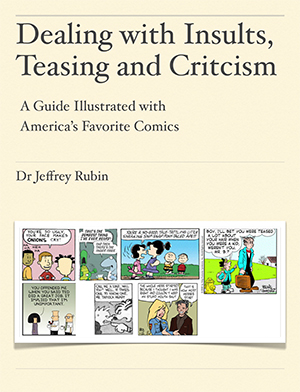
Another free resource can be found at the very top of each of my blog post. There you will find a link that says, “FREE BOOK: DEALING WITH INSULTS, TEASING AND CRITICISM.” By clicking on that link, you will find that you can get a free PDF book that you can download on any computer. It uses America’s favorite comics to teach, in a fun manner, a number of useful social skills.

Another approach that I recommend is also free.  It involves reading a novel called, A Hero Grows in Brooklyn in an ebook format that can be downloaded on any computer or ebook reader. The novel, along with its two sequels that make up the Cool Steve Trilogy, provides the reader an in depth narrative of a boy struggling to find a path toward respect despite his father being sent to prison and the violent actions of a neighborhood gang.

I hope you enjoy following this blog and I encourage my readers to provide comments, suggestions and criticism.

My Best,

Jeff


Assignment: See if you can remember what the letters in the nemonic DIG stands for. If you are having difficulty remembering, click HERE and glance over the material presented there. Once you can recall what the letters stand for, summarize a conflict you had with another person. Try to describe it in terms of what you desired, what interfered with your desire, and whether or not you felt the other person in the conflict was guilty of doing something wrong.

——————————-

Some people will enjoy reading this blog by beginning with the first post and then moving forward to the next more recent one; then to the next one; and so on.  This permits readers to catch up on some ideas that were presented earlier and to move through all of the ideas in a systematic fashion to develop their emotional intelligence.  To begin at the very first post you can click HERE.

Categories
conflict resolution

Summarize and Delay

Please consider the following parable:

PARABLE OF KATE AND HER BOSS

Illustration by Eric Sailer

Kate’s boss, Nelson, left for a week vacation in the Bahamas during a particularly busy time.  When Nelson returned, he started to insult Kate because she and the rest of her team did not complete all that he had expected.  Nelson’s tone of voice began to infuriate Kate.

Rather than exploding, she had a well-rehearsed plan that she enacted.  She managed to keep the expression on her face looking concerned about what her boss had to say.  digShe recalled the word DIG which reminded her to dig to look for her boss’s desire, what happened that interfered with his desire, and what he thinks she is guilty of doing wrong. 

When Nelson finished yelling, Kate replied, “You’re the boss, Nelson. It’s clear to me that it is your desire that we had accomplish more work while you were gone and this didn’t get done. You feel that we are guilty of letting you down.  You deserve a thorough reply.  After I discuss your concerns with the rest of my team and I have a few days to think this through, I’ll get back to you.”

“I want an answer now!” Nelson demanded.

“Sure boss, here’s the best answer I can offer you now—I don’t have a good answer now. I’m sorry I’m not ready with any helpful answer just yet.  I will be ready to move this discussion forward within a week.”  She then looked into Nelson’s eyes and said gently, “Please give me a little time.” 

Nelson frowned, and then hollered, “I better have an answer in a week or else!”

“Thanks, Nelson,” Kate replied. “I’m sorry you are disappointed in us.”  Then she left.

Kate managed to calm down in a few hours. Then she began to confer with all involved. 

Throughout the week, Kate and Nelson worked together on many other issues that required some attention, but both stayed clear of the topic that led to Nelson’s angry outburst.

During the week, Kate spent some time discussing what had happened with some people that she particularly respected.  By the time she again discussed her boss’s concern with him, she was much better prepared than if she discussed it with him when he first brought it up.

PARABLE DISCUSSION

For Kate to express her anger at her boss while both she and her boss are frustrated could potentially silence him.  It might also get her fired or decrease the chances of a promotion.  By remaining polite, while also being firm, she demonstrates a respectful professional tone and buys herself time to consider the best way to respond to her boss in a more reasonable manner.  It also gives her boss some time to calm down.  In a few days he might even apologize on his own for shouting at her.

dig2If a friend insults you, using the same plan can oftentimes be very helpful.  Respectfully summarize the conflict using the DIG format (see March 8, 2012 blog post) and then set a time in a few days into the future to discuss it.  Giving yourself a few days allows both of you to calm your frustrations and to confer with anyone else involved as well as people that you particularly respect.  When you do return to your friend, you will be able to handle the conflict with far greater wisdom than if you try to resolve it without giving yourself some time for reflection.

This plan, to be done in a way that will increase how much respect others will have for you, requires practice.  In my next blog post, I will discuss how to rehearse this plan so that you can carry it out even in the most frustrating circumstances.


Assignment: Summarize a conflict you had with another person. Try to describe it in terms of what you desired, what interfered with your desire, and whether or not you felt the other person in the conflict was guilty of doing something wrong.
——————–
Some people will enjoy reading this blog by beginning with the first post and then moving forward to the next more recent one; then to the next one; and so on. This permits readers to catch up on some ideas that were presented earlier and to move through all of the ideas in a systematic fashion to develop their emotional intelligence. To begin at the very first post you can click HERE.

Categories
conflict resolution

Conflicts and Frustration

Please consider the following parable:

THE MARTY AND LENA PARABLE

Illustration by Eric Sailer

Marty got stuck at work.  He calls his girlfriend, Lena, to let her know he’s going to be late for their date. 

When Marty finally arrives, it’s apparent that Lena has a conflict with him.  That is, she desires he be on time.  When Marty arrived late this interfered with this desire.  She believes Marty is guilty of being wrong for arriving late. 

Conflict=DIG=Desire+Interferes+Guilt

As Lena makes her frustration known to Marty, she does so by shouting and calling him selfish and a stupid jerk.  Now Marty has a frustrating conflict with Lena.  He desires to be treated respectfully and Lena’s tone of voice and her name calling interferes with his desire.  Marty believes Lena is guilty of being wrong for treating him disrespectfully.  

We experience frustration when someone or something interferes with any of our desires. On this blog we refer to this as a desire-interference problem. When people who have this type of problem believe someone will be guilty of doing something wrong if the person does interfere with their desire we call this a conflict.

frustrationWhen people become frustrated, their attention becomes so narrowly focused that it becomes difficult to focus on anything other than their own immediate frustration.  Keeping this in mind, we can plainly see why it is challenging for Lena and Marty to successfully deal with their situation.  Lena is frustrated because she wanted Marty to arrive on time.  Her frustration leads to her narrowly focusing on Marty’s lateness.  Any effort by Marty to convince Lena that he is not guilty for arriving late is made harder because of Lena’s narrow focus on the fact that he arrived late.

Meanwhile Marty suddenly becomes frustrated when Lena begins to shout and call him names.  Now Marty becomes narrowly focused on his own frustration that he has been treated disrespectfully.  Therefore it is very difficult for him to broaden his focus so he can understand Lena’s frustration.  As long as Lena’s and Marty’s frustrations remain high, their narrow attention will lock them into their own narrow personal frustration and interfere with resolving their mutual conflicts.

fire1To get a sense of how very difficult it can be to reason clearly when frustrated, consider what has happened when fires have flared up in buildings.  Naturally, at such times people indoors want to get out.  If they come to a door leading outside and they push on it, if it doesn’t immediately open, oftentimes they become very frustrated and this narrows their reasoning ability.  This narrowing leads them to push harder and harder, and they never come to realize that the door may be open but that they need to pull on the handle instead of pushing.  Because many people have died desperately pushing and pushing, many cities have passed fire laws that require all doors that lead outside to open when pushed.

To become a master at dealing with name calling, insults and teasing, we must learn a skill that is so well practiced that even when we are embroiled in frustrating experiences we can carry it out in a wise manner.  In the next blog post we will begin to take a close look at this skill.


Assignment: Write one or two paragraphs that relates what you have just read to something that personally happened to you. Include not just what happened, but also how you were feeling while it was happening.
————————-
Some people will enjoy reading this blog by beginning with the first post and then moving forward to the next more recent one; then to the next one; and so on. This permits readers to catch up on some ideas that were presented earlier and to move through all of the ideas in a systematic fashion to develop their emotional intelligence. To begin at the very first post you can click HERE.

Categories
anger conflict resolution criticism dig for the conflict emotional intelligence stress

DIG for the Conflict

To become a master at dealing with disrespectful acts, an important skill to learn is to identify the reason you are being treated this way.  In future blogs, I will discuss a total of eight reasons.  Today we’ll focus just on one of them.

Oftentimes the reason for the insulting behavior is that the insulter has a conflict with you. If you can quickly identify the conflict in very simple, clear terms, you will help both you and the other party to resolve the underlying cause for the disrespectful behavior.  Therefore, today’s blog post begins to teach you how to do this.  First, I’ll clarify what we mean when we use the word “conflict.”  Then I’ll teach you a simple strategy to summarize a conflict as you deal with disrespectful behavior.

WHAT IS A CONFLICT

dig2When I look to see if someone has a conflict, I think of the word DIG and it reminds me to dig to find what the person DESIRES in this situation, what is INTERFERING with the person’s desire, and whether or not the person believes someone is GUILTY of doing something wrong.

USING DIG TO HELP YOU DEAL WITH DISRESPECTFUL BEHAVIOR

Suppose I suggest to Judy that she should consider quitting her highly stressful job, and she responds as follows:

Illustration by Eric Sailer

Feeling that the way Judy yelled at me is insulting, I could yell back at her that she is stupid.  Would that help to resolve the conflict or make it more intense?

Consider another approach.  I respond to Judy in a very concerned way, saying “Wow, you really got upset about what I said.  Are you OK?”

digThen, I listened in a caring manner to Judy’s reply, and summarize what she has said, thus reassuring her that I had listened. I then look to see if she has a conflict with me. I do this by remembering the word “DIG.” That reminds me to look for Judy’s DESIRE, what she might think I did to INTERFERE with her desire, and what she thinks I am GUILTY of doing wrong.

Now, from Judy’s reply to me, I might not know for sure what the desire, the interfering act, or the guilt is in the conflict. So, I would ask her some questions to clarify what she wants/desires me to do differently in the future. I might ask, for example, “Judy, from what you said, I think you desire from me that I don’t give you my opinion unless you ask for it. Is that right?”

Let’s say she responds, “No, that’s not it. I think your idea that I should quit my job makes no sense. How will I pay my bills?”

Now, I have a clearer idea about her concern. However, I might not be sure why my giving her my opinion about her quitting her job would interfere with whatever she wants to do, so I could ask her in a caring manner a question or two to clarify this.

Finally, because Judy became angry with my suggestion, it seems that she thinks I am guilty of doing something wrong. So I might gently ask her about this, with the goal of avoiding, if at all possible, doing again what she thinks I was guilty of doing.

Now, it is certainly possible to have a desire-interference problem in which neither party is viewed as guilty for doing anything wrong. For example, let us suppose that after working for a few years I desire to become a nurse. I realize interfering with fulfilling my desire is, I don’t have the credentials to become a nurse. I don’t blame myself for this, but I still have to figure out how to earn the necessary credentials.

This is just a brief introduction to the DIG approach. We’ll be going over some more specifics of how to use the DIG model in future posts. For example, some of the questioning that we use to clarify what are the desire, the interference, and the guilt components of the conflict might be better persued when the angry person has had some time to calm down. But for now, I’ll just point out that when you get skilled at this model, you would show a genuine interest in people who become upset with you and that you care enough about them to try to clarify what the issues are.

There is far more to resolving a conflict than clearly identifying the conflict. In future posts, step by step, we will be learning techniques for doing so. But showing an interest in why someone is upset and clarifying the nature of the conflict are important first steps.


Assignment: Write one or two paragraphs that describes a conflict that you had with someone. In your description, identify each of the elements of the DIG Conflict Model, that is, the desire, the interfering act, and the perceived guilt.
——————-
Some people will enjoy reading this blog by beginning with the first post and then moving forward to the next more recent one; then to the next one; and so on. This permits readers to catch up on some ideas that were presented earlier and to move through all of the ideas in a systematic fashion to develop their emotional and social intelligence. To begin at the very first post you can click HERE.