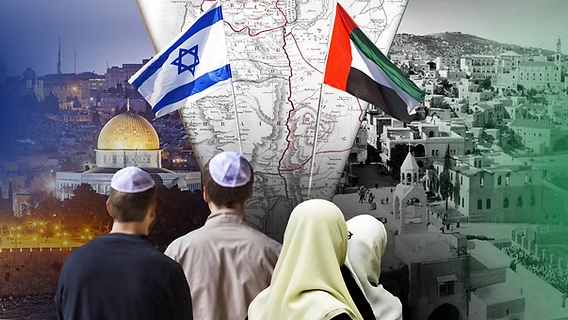
Welcome to From Insults to Respect.
 Recently, I happened to be at a social gathering, and I ran into a guy I hadn’t seen in a few years. When we had last met, I said something that he took to be criticism of Israel, and he angrily rebuked me, making furious statements that Israel has a right to exist.
I don’t remember exactly what I said that set him off, but it in no way was it meant to argue against Israel in some general way. Probably I had read something in the news about one of its leaders having said something that I found objectionable, and I had mentioned it to him. In any case, what amazed me, is this. When I recently met him, I happened to ask him if he was still a huge supporter of Israel, and he had a total conniption, crying out that Israel had committed genocide against the Palestinians and that the country is an apartheid state. The change in his attitude toward Israel astounded me.
 Afterwards, I did some research and discovered his attitude change extends far beyond just him. A Pew Research Center survey, for example, found that as of March of this year, 60 percent of Americans now hold an unfavorable view of Israel, compared with 42 percent in 2022.
 I then did some research regarding the notion that Israel has “a right to exist.” I quickly came upon an article in the New Republic by titled: “Israel’s ‘Right to Exist’ Is a Rhetorical Trap: No country has a right to exist, so what do people really mean when they say Israel does?”
Early in the article, it says Dani Dayan, the Israeli consul general in New York, wrote, “The day Palestinians accept Israel’s right to exist as the legitimate homeland of the Jewish people, a real peace process will begin.” It goes on to say,
Just last month, the House of Representatives passed a resolution that “denying Israel’s right to exist is a form of antisemitism.” The phrase and its long history compels us to ask: What does it mean for a nation to “exist,” and who judges its right to do so?
The article goes on to mention that the 1967 U.N. Joint Resolution 242 affirms every Middle Eastern nation’s “right to live in peace within secure and recognized boundaries free from threats or acts of force.”
The article concludes,
Israel has no right to exist because no nation does; only people do. Israelis exist; so do Palestinians. They all have a right to exist but only because they are human beings. And there is no justice in securing your own right to exist by denying it to others.
 Relevant to this issue, just before the creation of Israel, the Jews that were rounded up from Nazi concentration camps were held in another camp while discussions about what to do with them was being ironed out. At that time, a survey was conducted asking those in the camp what they wanted to happen to them. Approximately 70 percent wanted to be sent to live with relatives in various countries like the U.S.. Canada, Great Britain, and Argentina. The idea of sending them to a section in the Middle East which was surrounded by people who didn’t want them was not at all appealing to them, especially after what happened to them in regions controlled by Nazis. A minority were religiously Zionist–those who believe in the establishment and development of the state of Israel. In 1948, due to, not Jews, but the powerful political influences of many Christians, the United Nations partitioned Palestine into a Jewish region and a region for people who viewed themselves as Palestinians. Ever since, violence has regularly sprung up between Israel and the surrounding Mideast countries. The stated issue is Israel has been defending against entities that have been violently opposed to the existence of the Jewish state.
Certainly, there are people in this region that are indeed against Israel’s existence, and many Palestinians are bitterly angry that they were forced to leave land that is now part of Israel, land that had been their home for many years. No doubt, if the Israelis were now forced to leave the land that has become their home for about eighty years, they, too, would be bitterly angry. However, I would like to make the argument that the loss of land of people who had grown attached to it is not really the central reason for the violence in this region.
A Theory Of The Real Reason For Violence
In The Middle East
 This theory argues that the real central violent conflict in the Middle East region is due to the desert geographical conditions of large sections of the region which cannot be escaped by the inhabitants.
Why do I support this theory? First of all, if you check any history book specializing on this region, you will find that violence has been recurring there for well over a thousand years, and certainly began well before the partitioning of the land by the United Nations.
Also note that in the land where Israelis and Palestinians are living, there are regions where we see land beside the beautiful Mediterranean Sea. There, many people are thriving. Their jobs support seafood harvesting, international trade, and tourists arriving on ships. There are a few other regions where the inhabitants do very well, such as where the religious sites are. There, tourists flock, and by engaging in the restaurant, tour guide, and hotel industries, many in the region make out very well.  There are also regions where the land is relatively fertile, and life on farms can be rather fulfilling. Regions in which universities and other educational institutions that have sprung up tend to be laid out on fairly attractive grounds. Earning a living by supporting these facilities tends to lead to a reasonably comfortable way of life.
In stark contrast to these regions, very nearby we find land that approaches desert conditions, with stony, rocky grounds, very scarce water supplies, and a few sparsely growing green shrubs here and there.  The rest of the area is dominated by the Negev desert and the Judean desert. More than half of the region’s total land area is desert.
Where the Palestinians live, the terrain of the Gaza Strip is flat or rolling with dunes near the coast. It is intersected by the Wadi Ghazza (Gaza River), which is only replenished with water during the rainy season in the winter, running dry for the rest of the year.
 The other area where most Palestinians live is the West Bank, which is mostly rugged dissected upland, with some vegetation in the west, but somewhat barren in the east. In springtime, the khamsini, a dry, warm easterly wind, often blows from the extensive deserts of Jordan, Syria, and Saudi Arabia. This continues for a period of roughly fifty days. The khamsini carries fine desert sand that lends the sultry air an ominous yellow hue during the day. The desert sand falls to the ground as a result of short rain showers. The fine sand is a health hazard for people suffering from bronchitis, and is detrimental to vegetation, motors, and machinery.
 The water situation in Palestine (the West Bank and Gaza Strip) is dire and it affects the quality of life, health and economic situation of every Palestinian. In some rural areas the water supply is far below the amount recommended by the World Health Organization (WHO). Where most of the Israelis live, the water situation is somewhat better, but it is far more expensive to keep it flowing than what most Americans and Europeans have to deal with. Currently, those who are living in this Middle East region have every reason to believe they are stuck there–with armed guards stationed at their borders.
Now, in considering this theory, I note that I grew up in Brooklyn’s Brighton Beach community which, at the time, was made up largely of Jewish folks. Separating this community from an adjacent community is Ocean Parkway. On one side of the parkway sits a Jewish temple, while a few feet down from it, on the other side of the parkway sits a Catholic Church. Members of both religious groups never engaged in any organized violence against one another, and one of my best friends belonged to the church. Why the lack of violence? In this theory, it is because we did not live in the midst of desert conditions, there was plenty of drinking water, there was plenty of fruits and vegetables available in our grocery stores, and if we wanted to move to another neighborhood within the 50 U.S. States, there were no armed guards preventing us from doing so.
Strong additional evidence for my theory comes from further knowledge of Brooklyn, New York.  There we find a vibrant neighborhood officially known as Bay Ridge, but it has been given the nickname “Little Palestine.” Thousands of Arab-Americans live there. They have their share of rally’s advocating for the freeing of Palestine, but they are peaceful. Another neighborhood, Bensonhurst, is an easy walk from Bay Ridge. Thousands of Jews live there, and yet there are no rockets being fired from Bay Ridge into Bensonhurst. Nor do we find any of the Arab-Americans flinging rocks at anyone.
In another Brooklyn neighborhood, a yeshiva (a Jewish school) sits across the street from a mosque without any incidents of violence between the members of these two institutions and their community members. And if you go on line and do a Google search to verify what I am saying, you will find not a single hit indicating an incident of violence between Jews and Arab-Americans in Brooklyn.
Why such peaceful cohabitation? Viewed in light of my theory, the reason is that Jews and Arab-Americans have in Brooklyn plenty of running water with the massive Hudson River flowing year round.  Then there are the numerous tree-lined streets and green, wooded Prospect Park with rowers enjoying its lovely lake.
It is now over seventy years since the United Nations General Assembly declared its majority recommendation that Palestine be partitioned into separate Jewish and Arab regions, and both sides have been violently fighting over this ever since. It is not that there is something inherently evil about Palestinian or Jewish people. When Jews were seeking to establish the Israel lands as theirs, a group of them organized a terrorist organization. Palestinians have found that sections of their population are willing to carry out terrorists acts. Why can’t this be settled peacefully? If my theory is correct, it doesn’t matter if you are Palestinian, Jewish, Christian or anything else. When any people find themselves living on lands that are too hard to thrive, and they are stuck living there, some of them will act violently to seek a better life. Blaming such groups, viewing them as being entirely evil serves nothing but to further hate and distractions.
According to the theory I am proposing, if folks truly want to create peace for the people in this region, there must be the creation of a plan that would allow them to migrate to regions where water is plentiful, the soil is richly fertile, and no armed guards are preventing them from integrating with other surrounding communities.
———————————
Some people will enjoy reading this blog by beginning with the first post and then moving forward to the next more recent one; then to the next one; and so on. This permits readers to catch up on some ideas that were presented earlier and to move through all of the ideas in a systematic fashion to develop their emotional intelligence. To begin at the very first post you can click HERE.


3 replies on “On Israel’s Right to Exist”
Hi Jeff, there are indeed claims to a common land by some of the warring parties in the name of certain invisible entities both parties call God. I think this creates a lot of non sense and fanaticism. There isn’t that in Brooklyn.
If we analyze the Zionist perspective, I think some, but not all, claim that Palestine is a land promised by the God of the Jews to the Jewish people. Not all Zionists believe this. And not all Jews are Zionists either, far from it.
If we analyze the Palestinian Islamist perspective, I think we find a similar claim to a land given by the God recognized by Muslims. I find this in Hamas proposals.
Not all Palestinians are Muslim, and not all Muslims are Islamists, and probably not all Islamists would have this claim, but I’m not an expert on the matter.
So, to simplify, and if we only consider Israelis and Palestinians, setting aside regional conflicts, there’s already a fringe of people adhering to intractable beliefs, and I think this is fueling radicalization.
I think it’s therefore not a question of fertility or desert, but of the interpretation of ancient texts.
If you allow me, I would like to explain why both interpretations are disconnected from reality.
In fact the invisible entity is not the same God, contrary to a widely shared opinion.
I think the God of Israel is supposedly the interpretation given by Moses’ group in the Book of Exodus. But if you examine it carefully, the Book of Exodus is a mythical narrative full of fabricated miracles, a patchwork of stories, and one that portrays this group in a favorable light. I cannot develop this opinion here, however, it would be too complicated, and take too long.
The Muslim god is not what it is supposed to be, either. I find evident that the Muslim God is his prophet himself, since he was the only spokesperson, treasurer, and general of the God he claims to represent. If you read his supposed sermons carefully, you’ll find gross incompetence in the mythologies he invokes, and a great deal of immorality, all set against a backdrop of violent narcissism. But I can’t elaborate here.
Both Moses and Muhammad are dead and buried. In my opinion, their respective deceptions are worthless today as a legal argument. I would add that their reported actions and words are quite doubtful as a personal guidance, even if the religions they are credited for still have their place.
To conclude, I believe that international law and human rights must take precedence over any religious claim.
Hi Luc Thibaud,
Super thanks for expressing with us your reaction to the various points I discuss in this post.
At one point, you wrote, “I think it’s therefore not a question of fertility or desert, but of the interpretation of ancient texts.” I agree that the interpretation of ancient texts can lead to very strong reactions for some, however, my theory based on my own experiences and many historical events suggests that if those people who have such very strong reactions are way less likely to convert their reaction into violence if the don’t live under the desert-like conditions that exist in the Israeli- Palestinian region, while also unable to migrate to better geographical regions.
Thanks for the thoughtful post Dr. Rubin. Along the lines of your theory on the land being so much more fertile and hospitable in Israel fueling the hatred, I think a lot of Palestinians also feel like things are very unfair because the US gives billions of dollars more in support to Israel every year than it does to Palestine.