Welcome to From Insults to Respect. Today’s post describes a basic misunderstanding regarding the nature of the Israeli–Palestinian Conflict, and how this understanding leads to a promising proposal for a peaceful resolution.
 Today, most people conceptualize the main issues of the conflict pretty much like the independent, nonpartisan think tank Council On Foreign Affairs— “The decades-long conflict between Israelis and Palestinians is rooted in competing claims to the Holy Land, and includes disputes over borders, Jerusalem, security, and Palestinian refugees.”
These issues indeed inflame the various interested parties, so much so that they divert all attention to them. This creates an illusion, much like how clever magicians apply misdirection, resulting in people failing to notice what really must occur if a lasting peace is to be achieved. The real central conflict involves the geographical conditions of the region which cannot be escaped by the inhabitants.
An Ancient Story Begins to Reveal the Conflict’s True Basic Cause
 The biblical story of Moses describes a narrative that is helpful for understanding this theory. After struggling to survive for forty years in the desert that lies between Egypt and Israel, Moses’ weary followers come to view, off in the distance, the “land of milk and honey.” Moses then tells his Jewish people that God has declared that this land can belong to them if they kill all of the people currently living there. Even though the inhabitants of this desirable land had never done the desert wanderers any harm, they choose to engage in the brutal slayings.
Admittedly, the historical facts about the accuracy of this story are pretty sketchy, but it nevertheless raises the following theory–If a group of people find themselves living in such an awful set of conditions, will at least some of them become willing to engage in actions that under a better set of conditions would seem terribly wrong? Is there reliable, well-documented evidence supporting this?  The Pulitzer Prize winning historian, David McCullough, has acquired a set of relevant information.
The Story of the American Pioneers Enlightens Us About the True Nature of the Israeli-Palestinian Conflict
As McCullough tells us in his fine book, The Pioneers, the post-American Revolutionary War economy was pretty much in a mess. Although those who already owned land prior to the war were doing relatively okay, for most landless people any hope of acquiring land to establish a home even after a period of hard work and frugal savings seemed impossible.  And then George Washington, with the support from others, opened the vast Northwest Territory to pioneers who were willing to face incredible risks, hard work, and, like Moses’ followers, kill the natives of the region so they could gain ownership of a piece of property that had an ample water supply and fertile land.
As part of giving the reader a sense of what these pioneers were willing to deal with, McCullough tells us at one point in his book about Ephraim Cutler and his family. With his wife and four children, Ephraim set off for the Northwest Territory with their conveyance, a wagon drawn by a yoke of an oxen. First, their youngest child took ill and died. Then their oldest child became violently ill and quickly died. Farther on, his wife slipped and fell and suffered two broken ribs. About the same time Ephraim was struck by an attack of dysentery. When he finally arrived on his new land, fully three months after leaving, he came to write about how bleak the beginning was:
 We had landed sick among strangers, with no well-known friend to meet us with kindly greeting, and myself destined to be confined to bed from which, for a time, there seemed little hope that I should ever rise in health. Such was our introduction to pioneer life.
Ephraim’s experience was common. And even after arriving, the pioneers had to deal with the clearing of trees, building their homes and infrastructure for the settlements, diseases such as smallpox, and fear of attacks from the natives. As part of illustrating this fear, McCullough tells us about Joseph Barker who wrote in his diary that while planting apple trees in newly cleared land, the whole time he felt compelled to “hold his scalp on with one hand while he dug holes for the trees with the other.”
 To risk your own life along with that of your wife and children would typically be viewed as terribly wrong under most situations. Typically viewed as terribly wrong is the willing killing of fellow human beings because you want the land they are living on. To choose to do all of this while also knowing that the life you are heading toward involves backbreaking work may seem crazy to most of us, but such was the decision made by the hundreds of thousands of pioneers, all of this for a piece of rich land they could call their own. Please note that these pioneers were not Muslims, but Christians. For those who think the cause of the current Middle East is due the Muslim faith, please keep this in mind.
I now ask you to consider the current geographical situation in which Israelis and Palestinians are living.
The Current Situation
 In the land where Israelis and Palestinians are living, there are regions where we see land beside the beautiful Mediterranean Sea. There, many people are thriving. Their jobs support seafood harvesting, international trade, and tourists arriving on ships. There are a few other regions where the inhabitants do very well, such as where the religious sites are. There, tourists flock, and by engaging in the restaurant, tour guide, and hotel industries, many in the region make out very well.
  There are also regions where the land is relatively fertile, and life on farms can be rather fulfilling. Regions in which universities and other educational institutions that have sprung up tend to be laid out on fairly attractive grounds. Earning a living by supporting these facilities tends to lead to a reasonably comfortable way of life.
In stark contrast to these regions, very near by we find land that approaches desert conditions, with stony, rocky grounds, very scarce water supplies, and a few sparsely growing green shrubs here and there.  The rest of the area is dominated by the Negev desert and the Judean desert. More than half of the region’s total land area is desert.
Where the Palestinians live, the terrain of the Gaza Strip is flat or rolling, with dunes near the coast. It is intersected by the Wadi Ghazza (Gaza River), which is only replenished with water during the rainy season in the winter, running dry for the rest of the year.
 The other area where most Palestinians live is the West Bank, which is mostly rugged dissected upland, with some vegetation in the west, but somewhat barren in the east. In springtime, the khamsini, a dry, warm easterly wind, often blows from the extensive deserts of Jordan, Syria, and Saudi Arabia. This continues for a period of roughly fifty days. The khamsini carries fine desert sand that lends the sultry air an ominous yellow hue during the day. The desert sand falls to the ground as a result of short rain showers. The fine sand is a health hazard for people suffering from bronchitis, and is detrimental to vegetation, motors, and machinery.
 The water situation in Palestine (the West Bank and Gaza Strip) is dire and it affects the quality of life, health and economic situation of every Palestinian. In some rural areas the water supply is far below the amount recommended by the World Health Organization (WHO). Where most of the Israelis live, the water situation is somewhat better, but it is far more expensive to keep it flowing than what most Americans and Europeans have to deal with.
A Few More Relevant Facts
Currently, those who are living in this region have every reason to believe they are stuck there. The Jews in Israel well know their history.  After World War II, no nation was willing to take any but a tiny few of the Jewish survivors of the Holocaust. Where could those now living in Israel go if they are pushed out of Israel? The answer leads them to hold on to the land they currently possess for dear life.

Meanwhile, of the Arab nations, only Jordan offered to take in some of their fellow Arabs that became Palestinian refugees as a result of the creation of Israel. The vast amount of those refugees are stuck in the Gaza Strip and the West Bank, with no other place they can go.
 Add to all of this, the fact that these Palestinians are living in one of the most densely populated regions in the world. Moreover, they know the population there is rapidly growing. So, it is pretty clear to everyone living in this region that life for their children is likely to get worse.
Now, some view the problem between those living in this region is due to the religious differences between the Jews and the Palestinian Arabs. However, in the history of this region we find extensive periods during which the Arabs were fully in control and yet there were constant wars between different Arab factions.  Although different reasons are given for these violent conflicts, according to my theory, the real central reason was that the have nots who were being pushed out toward the more desert parts of this region could readily see from views up in the hills those who were living in the dramatically better lands; this aroused violently strong desires to obtain what they did not have–fertile land with ample water.
Strong additional evidence for my theory comes from my knowledge of Brooklyn, New York.  There we find a vibrant neighborhood officially known as Bay Ridge, but it has been given the nickname “Little Palestine.” Thousands of Arab-Americans live there. They have their share of rally’s advocating the freeing of Palestine, but they are peaceful. Another neighborhood, Bensonhurst, is an easy walk from Bay Ridge. Thousands of Jews live there, and yet there are no rockets being fired from Bay Ridge into Bensonhurst. Nor do we find any of the Arab-Americans flinging rocks at anyone.
  Recently, these Jews and Arabs marched shoulder to shoulder with one another and with their Black brothers in support of Black Lives Matter.
In another Brooklyn neighborhood, a yeshiva (a Jewish school) sits across the street from a mosque without any incidents of violence between the members of these two institutions. And if you go on line and do a Google search to verify what I am saying, you will find not a single hit indicating an incident of violence between Jews and Arab-Americans in Brooklyn.
Why such a peaceful cohabitation? Viewed in light of my theory, the reason is that Jews and Arab-Americans have in Brooklyn plenty of running water with the massive Hudson River flowing year round.  Then there are the numerous tree-lined streets and green, wooded Prospect Park with rowers enjoying its lovely lake. If these people want to grow some vegetables or fruit trees in their back yard, there is plenty of rich soil that can be brought to the task and rain is normally sufficient. However, for brief dry periods, if these people want to water their garden with a hose, that is perfectly permitted. For those folks who don’t live in a house with a backyard, they typically have jobs that put the purchase of such a home within reach, if not for themselves, then at least for their children.
 If these people happen to fall on hard times and can’t afford to continue to live in Brooklyn, they know they could move across the Hudson River onto the New Jersey side where it is a bit more affordable. If Jersey is a little too densely populated for their taste, there are a total of fifty states that they can freely move. Throughout the US are numerous regions sparsely inhabited, and no passport is required to go there. In my view, this knowledge takes the edge off of any disagreements Arab-Americans and Jews might face.
The Importance of Understanding the Real Central Cause Of the Conflict Between Israelis and Palestinians
 It is now over seventy years since the United Nations General Assembly declared its majority recommendation that Palestine be partitioned into separate Jewish and Arab states, and both sides have been violently fighting over this ever since. It is not that there is something inherently evil about Palestinian or Jewish people. When Jews were seeking to establish the Israel lands as theirs, a group of them organized a terrorist organization. Palestinians have found that sections of their population are willing to carry out terrorists acts. Why can’t this be settled peacefully? If my theory is correct, it doesn’t matter if you are Palestinian, Jewish, Christian or anything else. When any people find themselves living on lands that is too hard to thrive, some of them will act violently to seek a better life. Blaming such groups, viewing them as being entirely evil serves nothing but to further hate and distractions.
Should the Palestinian refugees be permitted to return to the areas of their ancestors? This too is also a distraction, as is all the other issues that people believe are important to achieve peace.
According to the theory I am proposing, the folks living in this region must have the equivalent of a “Northwest Territory” that they can choose to go to if they wish. Thus, if the United Nations were to fully recognize this, redirect its attention to the task of how such a region can be purchased, rather than murdering the current inhabitants, only then can the three thousand years of violence have a chance to finally end.

Is the idea that the United Nations might come up with a successful plan to purchase such a “Northwest Territory” realistic. I think it is. Please note that the world population of Jews, Muslims, and Christians combined is over four billion people, all of whom have some religious interest in promoting peace in the region we are discussing. If they think about the cost of war and preparation for war that has been spent in the centuries of violent interactions, and then think of the cost to continue the conflict forever, just maybe funds could be raised to finally end the killings and destruction.

If I am right, once the new land has been purchased, those who would choose to remain in Israel, Gaza, and the West Bank would discover that all of the other issues currently being bitterly fought over would be able to be peacefully negotiated. Likely, neither side would be fully delighted with the final agreement, but the heat that now leads to continuing violence would be replaced by visions of improved economic conditions, owning fertile land, ample life sustaining water, and a better future for their children.
———————————
Some people will enjoy reading this blog by beginning with the first post and then moving forward to the next more recent one; then to the next one; and so on. This permits readers to catch up on some ideas that were presented earlier and to move through all of the ideas in a systematic fashion to develop their emotional intelligence. To begin at the very first post you can click HERE.

 A primary U.S. goal in this negotiation process is to arrange for a process that will assure that Iran will never develop nuclear weapons. Many billions of dollars have been spent toward achieving this goal, along with lives lost, including school children, and widespread building and infrastructure destruction. Given these losses, it is time to ask, how important is it to spend even more effort and resources to get an agreement with Iran to give up its nuclear bomb ambitions?
 Consider these facts. The U.S. engaged in a lengthy, deadly war with Vietnam, the military goal of which was to prevent Vietnam from becoming a communist country. Despite the U.S. having many nuclear bombs, they were never used, ended up serving no military purpose, and the U.S. lost the war.
 The U.S. has since engaged in several other wars, one with Iraq, one with Afghanistan, and most recently, with Iran. Its goal for fighting them was regime changes that would be cooperative with the U.S. Throughout these wars, the U.S. has had plenty of nuclear weapons. Nevertheless, they ended up serving absolutely no military purpose, and the U.S. failed to accomplish its military goal.
 Russia has plenty of nuclear weapons. It engaged in a war with Afghanistan and is currently engaged in one with Ukraine. Its nuclear arsenal has been absolutely zero in helping achieve its military goals. Meanwhile, China has long desired to take over the government of Taiwan. Despite having numerous nuclear bombs, it has not achieved its goal.
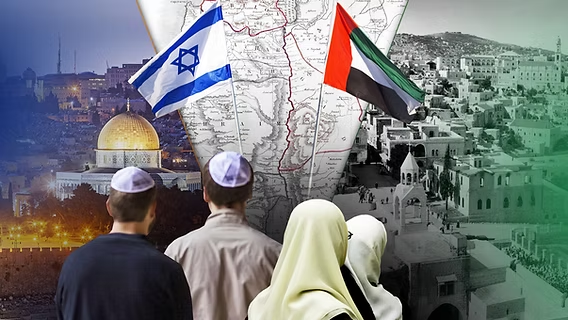 Now, let’s consider what would happen if Iran did obtain nuclear bombs. It has the goal of getting people living in Israel to leave so the Palestinians can return to lands now inhabited by the Israelis. If Iran was to use a nuclear bomb on Israel, the radiation fallout would drift over to where the Palestinians are currently residing, killing and sickening tens of thousands, and the very land that the Palestinians want to return to would become poisonous.
 Though some may argue that since the two atomic bombs used on Japan did manage to quickly end World War II eighty years ago, they may yet serve a military purpose in the future. But let’s think about why such bombs have not been used since then?
 And since the creation of atomic bombs, there have been new developments to these weapons, moving them from fission explosions to fusion explosions which is several hundred times more deadly. Radiation spread from such explosions would not just kill and sicken the perceived enemies, it would also kill and sicken millions of people in countries that are friends with the country using the bomb, thus making their use unthinkable.