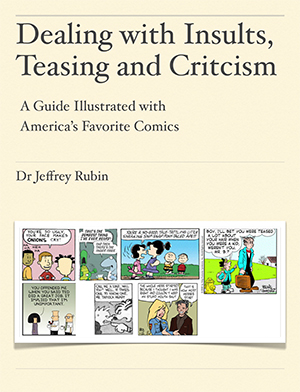
“Judy, it’s so nice to see you,” I say as she comes into my office and sits down on my couch.
“I’ve been reading your blog again, Dr Rubin. It’s filled with a bunch of hogwash.”
“Hmmm, it sounds like there are some ideas in it that you don’t care for.”
“I read last night two of your blog posts–Is Criticism Bad and Criticism and Wisdom. What a bunch of nonsense!”
“I’m very interested in your point of view, Judy. Please tell me more specifically about what you disagree with in those posts.”
“Well, you talk about this John Stuart Mill. According to him, if people criticize us, even for holding an opinion we are very sure of, we should thank them for it, open our minds to listen to them, and rejoice. That’s ridiculous! If you don’t have something nice to say to somebody you should keep your stupid mouth shut! And, as far as I’m concerned, unless I give someone permission to criticize me, that person has no right to inflict it upon me!”
Judy (not her real name) raises some important issues about unsolicited criticism. And many people have quite a bit of sympathy for her position.
SYMPATHY FOR JUDY’S POSITION
Consider the following comic:

The above Baby Blues comic comically plays around with this idea that you should not offer an opinion to people unless they invite you to give it. In the comic, not only are unsolicited opinions being provided by the girl, but she is actually charging people for the opinion—a double slap in the face.
Why aren’t unsolicited negative criticisms welcomed?

They hurt because it brings up the feeling of “not being liked.” When we come to realize this, we may pause before giving an opinion, which is a type of criticism, and ask ourselves if it is worth the risk of starting a conflict about being liked.

 Thomas Jefferson felt that even hurtful criticism should not be against the law, especially when directed against government officials. He felt this way even though he personally experienced criticism as deeply painful. Thus, he wrote to James Monroe that the criticism he received while war governor of Virgina “had inflicted a wound on my spirit which will only be cured by the all-healing grave.”
Despite how very painful criticism was, at times, for Jefferson, he supported the right to provide criticism–even unsolicited criticism–to the end of his life. To Jefferson, freedom to criticize was protection from tyranny.
CRITICISM AND OUR BASIC HUMAN RIGHTS
Judy spoke about her “right” to NOT be given any criticism unless she gives her permission. Does this mean she thinks it is against the law for someone to criticize unless the criticism is invited? Although I am no legal scholar, it is my understanding that the issue of a person’s “rights,” as understood in this country, points the other way. Rather than the right to silence speech, don’t we have a right to speak up whenever we disagree with someone?
It seems to me that insisting that no one has the right to provide another person criticism unless invited to do so just won’t work. The Soviet Union tried to squelch criticism and despite being backed up by an enormous military, failed miserably. Criticism soon oozed out of every joint that government tried to seal.
CRITICISM IS COMING OUR WAY WHETHER WE LIKE IT OR NOT
My mother, whom I loved dearly, passed away a few years back. She was a strong verbal supporter of the proverb–If you don’t have anything nice to say, don’t say anything at all. And yet, from time to time, she would frown at something someone would do, and, far more rarely, she would blow-up in an outrage.
I doubt that anyone can live in a manner completely consistent with one of my mother’s favorite proverbs. And any government insisting on this principle would be as successful as the United States was when it went through its period of alcohol prohibition.
The plain fact is that all of us will be provided with negative criticism from time to time. Even if we choose to be a hermit, we’ll probably spend some of our alone time criticizing ourselves.
SINCE IT IS COMING OUR WAY, WE WOULD BE WISE TO LEARN TO DEAL WITH IT
Criticism is just part of our shared human existence. And sometimes something is bugging us about what someone is doing and it can unnecessarily lead to the end of a valued relationship if we don’t discuss it with that person. Rather then seeking to squelch the criticism, we are better off learning to provide it in a wise and thoughtful manner (see post titled PROVIDING NEGATIVE CRITICISM: FIVE LEVELS OF MATURITY), and to respond to it in a wise and thoughtful manner as well (see post titled RESPONDING TO CRITICISM: FOUR LEVELS OF MATURITY.)
Now, don’t misunderstand me. There are times when someone is providing me one criticism after another and it is becoming too much for me to process all at once. There are other times when someone is providing me with criticism that is in a style using a tone of voice that is hard for me to bear. Sometimes I have been bombarded by some other type of stress, and then I come in contact with someone, and I may not be in any mood to hear any criticism for the rest of the day. Under these sets of circumstances, I believe it makes perfectly good sense to briefly let the person I’m with know that I’m usually very open to hearing criticism, but for right now, I need a little break (see blog post SUMMARIZE AND DELAY). Then I can, over a period of time, regain my sense of balance and figure out how best to move forward. And I also think that it is OK to encourage others to provide you criticism in a manner that is easier for you to handle.

My preference is to let anyone that I know clearly understand that I am open to receive criticism most of the time, and I accept that it might feel, at times, hurtful. I feel that to do otherwise may, perhaps, result in people keeping silent to my face but end up talking behind my back. I would be left unable to address the concerns expressed in the criticism. Moreover, I have learned that for me the challenging feelings that come up when I am criticized and are sometimes experienced as hurtful are really part of a helpful emotional process that leads me into deeper thought about the issues that come up upon receiving the criticism. Finally, I think openness to criticism and seeking to address criticism is the path to wisdom.
I also think that people have a higher degree of respect for those who are open to criticism and can respond to it in a self-assured, mature manner. People tend to admire a person who recognizes that even hurtful criticism, when wisely considered, has the potential to be of value; that facing criticism head-on is our only opener of our eyes to the fulness of truth.
Some people will enjoy reading this blog by beginning with the first post and then moving forward to the next more recent one; then to the next one; and so on. This permits readers to catch up on some ideas that were presented earlier and to move through all of the ideas in a systematic fashion to develop their emotional and social intelligence. To begin at the very first post you can click HERE.