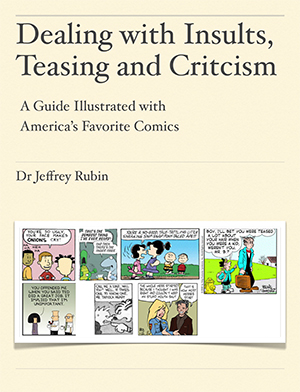
“How’d things work out between Blondie and you?” you ask in a concerned voice upon running into your friend, Dagwood. “Did you manage to resolve your conflict?”
“Yeah, um…well, I’m kinda not sure,” he replies.
 When it comes to whether or not a conflict has been resolved, sometimes people feel confused, or they end up engaging in needless arguments about this. Today we spend some time clarifying this issue.
The DIG Conflict Model removes much of the uncertainty about this issue by:
- being precise about the definition of a conflict
- introducing the concept of conflict intensity
- being precise about the point at which a conflict is resolved
- introducing the concept of related conflicts
The Definition of a Conflict
A conflict exists whenever the following three conditions exist:
- Party A desires an act will occur.
- Party A perceives that another party is likely to act in a manner that interferes with the desire.
- Party A perceives that the other party would be guilty of doing something wrong if he or she carries out the interfering act.
When using the DIG Conflict Model, we describe a conflict by using the word “DIG” to remind us to identify the three conflict conditions, the desire, the interference, and the guilt. Sometimes a given situation has more than one conflict but people end up getting confused because they think that all of the conflicts are one big conflict. When using the DIG Conflict Model, we clearly describe each of the conflicts separately and systematically. This process dramatically reduces confusion and simplifies finding resolutions to each of the separate conflicts. Sometimes we have to dig to identify all of the conflicts in a situation but the DIG Conflict Model provides us some tools to make this relatively easy (see posts titled DEALING WITH CRITICISM BY DIGGING DEEPER and RESOLVING RECURRING CONFLICTS).
Conflict Intensity
Toward reaching our goal of reducing confusion about whether or not a conflict has been resolved, we have just clarified what it means to have a conflict. We now move on toward this goal by learning about the intensity of a conflict.
The three conditions of a conflict (desire, interference and guilt) are not just present whenever a conflict exists. Each of these three conditions may be present at a very high degree, a medium degree, or a low degree.

As an example, let’s say that in the picture on the right, John desires Mary with all of his might. Asked to rate how much he desires Mary on a scale of 1 to 10, with 10 being the greatest desire he can possibly have, he rates his desire for her a 10.
We asked John a few months later to rate his desire for Mary. Some of Mary’s mannerisms have begun to annoy him, and there are times when he has begun to think of finding a new girlfriend. He still has some desire for her but at a lower degree then when he first met her. This example illustrates how the desire component of a conflict can vary over time.

Now let’s look at an example of how the interference component of a conflict can be present at higher and lower degrees. In the picture on the left, Sue desires to get to a long-eared stuffed animal but Fred is interfering. Sue knows Fred pretty well and she is convinced that once he decides to not let her get something, he usually sticks to it for quite some time. Asked to rate how much Fred is likely to interfere with the achieving of her desire on a 1 to 10 scale, she answers 8.
But let’s say a few months later Fred’s behavior begins to change. He still will interfere with Sue achieving her desire to get something but only for a minute or two. By then he has grown tired of that game. When Sue wants to get her long-eared friend down from the shelf and Fred tries to stop her, she knows that by waiting for a short period of time things will work out fine. Now when asked to rate how much Fred will interfere with her achieving her desire, she answers 2.

Finally, let’s look at an example of how the guilt component of a conflict can be present at higher or lower degrees. In this picture on the right, Mike comes home from work and sees his wife and some guy in each other’s arms passionately kissing. Mike’s first reaction is that his wife and this guy are guilty of doing something terribly wrong. If he was asked to rate just how guilty they were, he might say 10. But let’s say that moments after he first sees this kissing scene he notices that there are four other people in the room all holding a script for a play.
His wife quickly withdraws from the embrace of the male stranger and warmly greets her husband. Then she says, “Honey, I got the part I tried out for. We’re all here rehearsing.”
Now Mike recalls that his wife did have plans to go this morning to a play audition. He doesn’t like the fact that his wife usually gets sexy, passionate parts, but he had agreed to marry her anyway.
Once Mike understands that his wife was rehearsing her part in a play when he had walked into the house, he still feels uncomfortable about what he had seen, but he now recognizes that his wife and the male stranger are not as guilty as he originally thought. If asked to rate how guilty they are, he may say 2, or even a zero.
In the DIG Conflict Model, the higher each of the three components are rated, the higher the intensity of the conflict. Sometimes when a conflict’s intensity had been very high, if it is no longer as high, people think the conflict has been resolved, but not according to the DIG Conflict Model.
The Point that a Conflict is Resolved
According to the DIG Conflict Model:
Whenever Party A perceives that a conflict exists, it will be resolved from Party A’s perspective when Party A lowers his or her rating of any of the three conflict conditions to zero.
An example of a resolved conflict will be provided in the next section. But first, let’s take a look at what a related conflict is. Then we will be familiar with four important aspects of conflicts–its precise definition, its degrees of intensity, the point that it is resolved and that some conflicts are related to other conflicts. Then we will see how this will help us to avoid many misunderstandings that lead to needless confusion and arguments.
Related Conflicts
The best way to understand what is meant by a related conflict is by considering the following parable:
The Parable of Jack in the Restaurant
 A dad takes his wife and five-year old son, Jack, to a restaurant. Jack’s meal comes first, a nice big plate of spaghetti and meatballs. After Jack quickly shovels into his mouth a couple of forkfuls of his dinner, the dad says, “That looks pretty good, Jack. Do you mind if I have a little taste of the tomato sauce? If I like it, I might want to get something with it next time we come.”
“NO, DAD! I just have enough for me!”
This is frustrating to the dad and he perceives that he has a conflict with his son because he desires a taste of the sauce and perceives that his son is interfering with his desire. Additionally, he believes his son is guilty of being selfish.
 As he thinks about what to do about this conflict, his wife and he receive the meals that they ordered.
About fifteen minutes later, the dad still desires a taste of the sauce, but not quite as intensely as before because his hunger has subsided. He then glances over to Jack and notices that there is about half of his original portion of spaghetti left on his plate and the pace of his eating has slowed up quite a bit. His son’s desire to eat his spaghetti has also become less intense.
“Jack,” the dad says softly, “do you still mind if I have just a little taste of your sauce?”
 “Sure, you can have some, Dad. I’m starting to get full.” And with that, Jack slides about a third of the remaining spaghetti on his dad’s plate while making sure that there is an ample amount of sauce along with it.
In the fifteen minutes that the dad first desired a taste of the sauce, the situation transformed from a clear conflict situation to a non-conflict situation because the dad has achieved his desire to taste the sauce. But wait! A minute later, the dad, still a bit bugged about something, suddenly realizes he still does have a conflict with his son. He tries to summarize it by using the DIG Conflict Model. “I desire that Jack not be selfish,” he thinks to himself, “but his actions at dinner suggest that he will continue to interfere with this desire if I don’t do something about it, and he’ll continue to be guilty of being selfish.”
This conflict, although related to the earlier one, is different for it has a different desire. The original conflict’s desire was about getting a taste of the tomato sauce. That conflict was resolved when the dad got a taste of the tomato sauce. If asked to rate how much he wants to taste the sauce right now on a 1 to 10 scale, he would say zero. This new conflict’s desire is about Jack not being selfish. Thus it is different enough to be thought of as a new conflict with perhaps a distinctly different set of approaches required to address it.
Now that the dad has clarified in his mind what the new conflict is all about, he begins to reflect upon possible resolutions. “Perhaps I expect too much from a five-year old boy. There is still plenty of time to teach Jack to care about others, and as he matures, he may just naturally become more altruistic. Perhaps it might help if I tell Jack some stories, from time to time, about heroes who act in unselfish ways even when they are hungry or are struggling to meet other needs. And if I model altruistic behavior for Jack with my own behavior, this too can help. As I think on this some more it occurs to me that maybe in the future if I would like to have a taste of Jack’s food, it would be wise for me to wait until he is at least half done with it. This way, if Jack was in a particularly irritable mood because of his hunger, he will have some time to take care of his own hunger desires and to calm down a bit.”
A conflict is related to another conflict when at least one of the three conflict conditions of the original conflict is similar to at least one of the conflict conditions of the other conflict. In the parable about Jack and his dad, initially the dad had the following conflict with his son— I desire a taste of the sauce and perceive that in attempting to get a taste, Jack will create a loud disturbance in the restaurant. Additionally, I believe Jack is acting selfish. A few minutes later, the dad, recognizing he has resolved his first conflict but now has another conflict, says to himself, I want Jack to not be selfish, but his actions at dinner suggest that he will continue to act selfishly if I don’t do something about it. It’s wrong to be selfish.” Both the initial conflict and its related conflict are connected because both of their guilt conflict conditions are similar (Jack is guilty of being selfish).
Discussion
We have now become familiar with four aspects of a conflict–its precise definition, its degrees of intensity, the point that it is resolved and that some conflicts are related to other conflicts. Familiarity of these four aspects of conflicts help to avoid some unnecessary confusion and arguments.
For example, let’s say a young woman named Sally had a very high intensity conflict with her boyfriend. A week later she now finds that it is much less intense. She may think, perhaps it has been resolved. How can she decide?
She can begin by describing her conflict when it originally surfaced using the DIG Conflict Model. Then she can rate what the degree of each of the three components (desire, interference and guilt) had been on a scale of 1 to 10 . Then she can rate each of these three components as they are currently perceived. If none of the three components are at zero, she would recognize that she still has the same conflict with her boyfriend, but it is just at a lower intensity.
This process clarifies in her mind that she still has some work to do if she really wants to fully resolve the conflict. It also draws her attention to each of the three specific components of the conflict.
If you practice using this process, in time you will discover that this simplifies what remains to be done and opens avenues that may lead to problem solutions. For an excellent illustration of this, see the post titled THE ABCs OF POWER AND THE GUILT CONDITION.
Now, let’s change our Sally example a bit. This time she goes through the process of clearly defining her conflict and rating the degree of each of its three conditions. She discovers that she actually did resolve her original conflict, but it has turned into a related conflict. She now has a clear way to understand what has happened. Moreover, as with the Jack in the Restaurant parable, the process of defining precisely what the new conflict is can point her to some solutions she might not have otherwise considered. Recall that Jack’s dad, once he clarified in his mind what his related conflict’s desire is–reducing his son’s selfishness–found it helpful for coming up with ideas about how to teach his son to become more altruistic.
Well, I hope you find in this week’s post some food for thought. May you all have a week with some peace, some excitement and moments of wonder.
Some people will enjoy reading this blog by beginning with the first post and then moving forward to the next more recent one; then to the next one; and so on. This permits readers to catch up on some ideas that were presented earlier and to move through all of the ideas in a systematic fashion to develop their emotional and social intelligence. To begin at the very first post you can click HERE.

 On the right we see Mary and Ron. Ron desires Mary and she desires him. They currently are not experiencing a conflict.
 Some people think guilt occurs whenever they see that someone has done something wrong. It is not wrong to define it this way except when we are using the DIG Conflict Model. But even when we are not using the DIG Conflict Model, it will still be beneficial to keep the idea of angrily desiring punishment when someone does something wrong separate from the idea of learning from the experience of making a mistake by experiencing frustration in a friendly, non-punishing manner.
 A husband comes home from work. He doesn’t look like he is responding in a friendly, gentle manner as he perceives that his wife is doing something wrong. His face looks angry about it. We can easily imagine that he is likely to make some punishing statements toward the two people who are kissing, and perhaps he might even go further by making some other punishing acts such as hitting or seeking to divorce his wife.