Categories
conflict resolution

The Great Sea of Conflict

Conflict is like a great sea.  At various times any region of this sea can become terribly turbulent.  When you get out on the Sea of Conflict, many of its regions look pretty much like any of its other regions and it’s not hard to get lost out there. 

Illustration by Eric Sailer

There is a region of this sea that is known as Anger.  There, storms are particularly likely to churn up, and some of them have the potential to be very dangerous.  It is for this reason that it is vitally important, whenever possible, to recognize when we begin to approach and enter into this region.  All too often, however, a sailor wanders into this region without knowing it because Anger frequently looks very much like the other regions out on the high sea.  At other times, sailors enter Anger not of their own volition.  The winds and storms of the great sea have blown even great sailors off course.  At such times, recognizing the region of Anger can be made difficult because what is visible to the sailor can look fairly calm, yet just below the waves treachery may lurk. 

Challenge is a region of the great Sea of Conflict that is very close by to Anger.  Because less experienced sailors are unaware that Challenge exists and where it lies, when they find that they are caught in an Anger storm they often succumb to the lashing of the violent waves.  Great sailors, in contrast, know about Challenge.  In fact, when caught in an Anger storm, just knowing that Challenge is just a knot or two away enables them to gather a sufficient surge of energy to carry out well practiced skills that give them a reasonable chance to reach relative safety.

With this image of the Great Sea of Conflict, please consider the following.

PARABLE OF RYAN AND BUD

Ryan decides to ask his friend, Bud, for a favor.  Before he does so, he walks through in his mind what might go wrong.  He knows that if Bud turns him down this will be very frustrating and make him very angry.  Ryan also knows that when he gets that way he begins to start shouting and insulting people.  “Man, I’ve lost some close friends when I blow up like that,” he says.  “The last time I blew up Ted shouted at me that I was a bully.  I’ve never heard from him again!”

To prevent doing this again, Ryan conjures up in his mind the image of the Great Sea of Conflict.  To prepare himself to be able to steer his ship from the stormy region of Anger to the relative safety of Challenge, he rehearses five times in his mind a plan he would carry out in the event that Bud turns him down. He rehearses in the same way on two more days.   

On the day Ryan asks Bud for the favor, indeed Bud turns him down.  Ryan finds that frustration and anger is beginning to build up in the pit of his stomach and smoke is beginning to shoot out of his ears.  Nevertheless, he is able to smoothly carry out his plan which consists of the following.  First, he replies to Bud’s refusal by saying pleasantly, “Well, I appreciate that you heard me out.  Thanks.  I’m going to hurry off.  I need some time to figure out my other options.  I’ll catch you later.”  Then Ryan gives his friend a quick nod, and leaves.

Illustration by Deanna Martinez

This Ryan and Bud parable illustrates the technique of putting off any in depth discussion of how you are feeling with a friend while you are experiencing anger.  There will be plenty of time to do this later after you have some time to calm down and to consider if any further discussion is worthwhile, and if so, the best way to wisely present your case.  Because of the nature of anger, it is crucial to practice this technique if you wish to be able to carry it out during an anger arousing episode.

If you continue to follow this blog from time to time you will find that I will be encouraging you to practice some skills in various ways. This will lead you to become a master sailor on the Great Sea of Conflict.


Assignment: Write one or two paragraphs that relates what you have just read to something that personally happened to you. Include not just what happened, but also how you were feeling while it was happening.

——————————-

Some people will enjoy reading this blog by beginning with the first post and then moving forward to the next more recent one; then to the next one; and so on.  This permits readers to catch up on some ideas that were presented earlier and to move through all of the ideas in a systematic fashion to develop their emotional intelligence.  To begin at the very first post you can click HERE.

Categories
conflict resolution

Getting your Reasoning and your Actions to Work Together

NAME 7In this blog, you will find suggestions for dealing with challenges that occur when someone is treating you in a manner that feels disrespectful.  You may think that once you understand a suggestion and it strikes you as reasonable, then all that’s left for you to do is to try out the suggestion the next time you feel someone is treating you disrespectfully.  And sometimes this can indeed happen.  But when you find your emotions becoming aroused, you may discover that your actions don’t always come in line with what seems reasonable when you are in a calm state.

In his book The Expressions of the Emotions of Man and Animals Charles Darwin reports conducting the following experiment at the London Zoo reptile house.

“I put my face to the thick glass-plate in front of a puff adder in the Zoological Gardens, with the firm determination of not starting back if the snake struck at me; but as soon as the blow was struck, my resolution went for nothing, and I jumped a yard or two backward with astonishing rapidity.  My will and reason were powerless against the imagination of a danger which had never been experienced.”

Darwin found that his belief in his safety if the snake struck at him was not enough to get him to act in a manner that made sense to him.  Nevertheless, it is very likely that with certain forms of practice over a period of time he could have learned to respond calmly to the lunging snake whenever it was safely in back of a glass plate.

I say this not because there have been studies demonstrating this.  It would be unwise to actually train people to avoid leaping away from a lunging snake.  snakePeople so trained might accidentally run into such a snake in the wild and end up dead.  However, there are many studies that involve people who are terrified of harmless snakes that appear in their gardens.  These people continue to act terrified even after becoming convinced that the snakes they come in contact with are indeed harmless.  Their fright and embarrassment at how they act have led them to seek assistance in overcoming their fear.  Research has clearly demonstrated that such individuals can learn to become comfortable when they see nonpoisonous snakes, but they must do some things beyond just becoming convinced about how to act in a reasonable manner.

Similarly, to learn to act wisely when you are treated disrespectfully, once you become convinced that you want to try out a promising approach, oftentimes you will have to take some additional steps so that your actions will come in line with your reasoning.

Fortunately, you can dramatically improve your conflict resolution skills without costing you a dime. By following this blog, I’ll be encouraging you, from time to time, to place some reminders about some basic ideas on your refrigerator, and to rehearse a few fun bits with some friends. I’ll also encourage you to rehearse some ideas in the privacy of your own mind with the help of my team of artists, Lois Hubertz, Aviva Maltin, Deanna Martinez, Jack Star Rubin, and Eric Sailer.


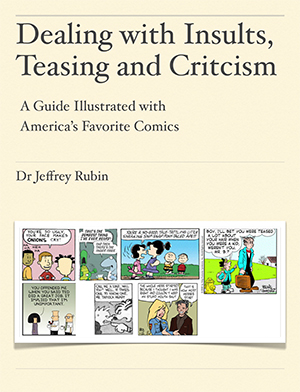
Another free resource can be found at the very top of each of my blog post. There you will find a link that says, “FREE BOOK: DEALING WITH INSULTS, TEASING AND CRITICISM.” By clicking on that link, you will find that you can get a free PDF book that you can download on any computer. It uses America’s favorite comics to teach, in a fun manner, a number of useful social skills.

Another approach that I recommend is also free.  It involves reading a novel called, A Hero Grows in Brooklyn in an ebook format that can be downloaded on any computer or ebook reader. The novel, along with its two sequels that make up the Cool Steve Trilogy, provides the reader an in depth narrative of a boy struggling to find a path toward respect despite his father being sent to prison and the violent actions of a neighborhood gang.

I hope you enjoy following this blog and I encourage my readers to provide comments, suggestions and criticism.

My Best,

Jeff


Assignment: See if you can remember what the letters in the nemonic DIG stands for. If you are having difficulty remembering, click HERE and glance over the material presented there. Once you can recall what the letters stand for, summarize a conflict you had with another person. Try to describe it in terms of what you desired, what interfered with your desire, and whether or not you felt the other person in the conflict was guilty of doing something wrong.

——————————-

Some people will enjoy reading this blog by beginning with the first post and then moving forward to the next more recent one; then to the next one; and so on.  This permits readers to catch up on some ideas that were presented earlier and to move through all of the ideas in a systematic fashion to develop their emotional intelligence.  To begin at the very first post you can click HERE.

Categories
conflict resolution

Summarize and Delay

Please consider the following parable:

PARABLE OF KATE AND HER BOSS

Illustration by Eric Sailer

Kate’s boss, Nelson, left for a week vacation in the Bahamas during a particularly busy time.  When Nelson returned, he started to insult Kate because she and the rest of her team did not complete all that he had expected.  Nelson’s tone of voice began to infuriate Kate.

Rather than exploding, she had a well-rehearsed plan that she enacted.  She managed to keep the expression on her face looking concerned about what her boss had to say.  digShe recalled the word DIG which reminded her to dig to look for her boss’s desire, what happened that interfered with his desire, and what he thinks she is guilty of doing wrong. 

When Nelson finished yelling, Kate replied, “You’re the boss, Nelson. It’s clear to me that it is your desire that we had accomplish more work while you were gone and this didn’t get done. You feel that we are guilty of letting you down.  You deserve a thorough reply.  After I discuss your concerns with the rest of my team and I have a few days to think this through, I’ll get back to you.”

“I want an answer now!” Nelson demanded.

“Sure boss, here’s the best answer I can offer you now—I don’t have a good answer now. I’m sorry I’m not ready with any helpful answer just yet.  I will be ready to move this discussion forward within a week.”  She then looked into Nelson’s eyes and said gently, “Please give me a little time.” 

Nelson frowned, and then hollered, “I better have an answer in a week or else!”

“Thanks, Nelson,” Kate replied. “I’m sorry you are disappointed in us.”  Then she left.

Kate managed to calm down in a few hours. Then she began to confer with all involved. 

Throughout the week, Kate and Nelson worked together on many other issues that required some attention, but both stayed clear of the topic that led to Nelson’s angry outburst.

During the week, Kate spent some time discussing what had happened with some people that she particularly respected.  By the time she again discussed her boss’s concern with him, she was much better prepared than if she discussed it with him when he first brought it up.

PARABLE DISCUSSION

For Kate to express her anger at her boss while both she and her boss are frustrated could potentially silence him.  It might also get her fired or decrease the chances of a promotion.  By remaining polite, while also being firm, she demonstrates a respectful professional tone and buys herself time to consider the best way to respond to her boss in a more reasonable manner.  It also gives her boss some time to calm down.  In a few days he might even apologize on his own for shouting at her.

dig2If a friend insults you, using the same plan can oftentimes be very helpful.  Respectfully summarize the conflict using the DIG format (see March 8, 2012 blog post) and then set a time in a few days into the future to discuss it.  Giving yourself a few days allows both of you to calm your frustrations and to confer with anyone else involved as well as people that you particularly respect.  When you do return to your friend, you will be able to handle the conflict with far greater wisdom than if you try to resolve it without giving yourself some time for reflection.

This plan, to be done in a way that will increase how much respect others will have for you, requires practice.  In my next blog post, I will discuss how to rehearse this plan so that you can carry it out even in the most frustrating circumstances.


Assignment: Summarize a conflict you had with another person. Try to describe it in terms of what you desired, what interfered with your desire, and whether or not you felt the other person in the conflict was guilty of doing something wrong.
——————–
Some people will enjoy reading this blog by beginning with the first post and then moving forward to the next more recent one; then to the next one; and so on. This permits readers to catch up on some ideas that were presented earlier and to move through all of the ideas in a systematic fashion to develop their emotional intelligence. To begin at the very first post you can click HERE.

Categories
conflict resolution

Conflicts and Frustration

Please consider the following parable:

THE MARTY AND LENA PARABLE

Illustration by Eric Sailer

Marty got stuck at work.  He calls his girlfriend, Lena, to let her know he’s going to be late for their date. 

When Marty finally arrives, it’s apparent that Lena has a conflict with him.  That is, she desires he be on time.  When Marty arrived late this interfered with this desire.  She believes Marty is guilty of being wrong for arriving late. 

Conflict=DIG=Desire+Interferes+Guilt

As Lena makes her frustration known to Marty, she does so by shouting and calling him selfish and a stupid jerk.  Now Marty has a frustrating conflict with Lena.  He desires to be treated respectfully and Lena’s tone of voice and her name calling interferes with his desire.  Marty believes Lena is guilty of being wrong for treating him disrespectfully.  

We experience frustration when someone or something interferes with any of our desires. On this blog we refer to this as a desire-interference problem. When people who have this type of problem believe someone will be guilty of doing something wrong if the person does interfere with their desire we call this a conflict.

frustrationWhen people become frustrated, their attention becomes so narrowly focused that it becomes difficult to focus on anything other than their own immediate frustration.  Keeping this in mind, we can plainly see why it is challenging for Lena and Marty to successfully deal with their situation.  Lena is frustrated because she wanted Marty to arrive on time.  Her frustration leads to her narrowly focusing on Marty’s lateness.  Any effort by Marty to convince Lena that he is not guilty for arriving late is made harder because of Lena’s narrow focus on the fact that he arrived late.

Meanwhile Marty suddenly becomes frustrated when Lena begins to shout and call him names.  Now Marty becomes narrowly focused on his own frustration that he has been treated disrespectfully.  Therefore it is very difficult for him to broaden his focus so he can understand Lena’s frustration.  As long as Lena’s and Marty’s frustrations remain high, their narrow attention will lock them into their own narrow personal frustration and interfere with resolving their mutual conflicts.

fire1To get a sense of how very difficult it can be to reason clearly when frustrated, consider what has happened when fires have flared up in buildings.  Naturally, at such times people indoors want to get out.  If they come to a door leading outside and they push on it, if it doesn’t immediately open, oftentimes they become very frustrated and this narrows their reasoning ability.  This narrowing leads them to push harder and harder, and they never come to realize that the door may be open but that they need to pull on the handle instead of pushing.  Because many people have died desperately pushing and pushing, many cities have passed fire laws that require all doors that lead outside to open when pushed.

To become a master at dealing with name calling, insults and teasing, we must learn a skill that is so well practiced that even when we are embroiled in frustrating experiences we can carry it out in a wise manner.  In the next blog post we will begin to take a close look at this skill.


Assignment: Write one or two paragraphs that relates what you have just read to something that personally happened to you. Include not just what happened, but also how you were feeling while it was happening.
————————-
Some people will enjoy reading this blog by beginning with the first post and then moving forward to the next more recent one; then to the next one; and so on. This permits readers to catch up on some ideas that were presented earlier and to move through all of the ideas in a systematic fashion to develop their emotional intelligence. To begin at the very first post you can click HERE.

Categories
anger conflict resolution criticism dig for the conflict emotional intelligence stress

DIG for the Conflict

To become a master at dealing with disrespectful acts, an important skill to learn is to identify the reason you are being treated this way.  In future blogs, I will discuss a total of eight reasons.  Today we’ll focus just on one of them.

Oftentimes the reason for the insulting behavior is that the insulter has a conflict with you. If you can quickly identify the conflict in very simple, clear terms, you will help both you and the other party to resolve the underlying cause for the disrespectful behavior.  Therefore, today’s blog post begins to teach you how to do this.  First, I’ll clarify what we mean when we use the word “conflict.”  Then I’ll teach you a simple strategy to summarize a conflict as you deal with disrespectful behavior.

WHAT IS A CONFLICT

dig2When I look to see if someone has a conflict, I think of the word DIG and it reminds me to dig to find what the person DESIRES in this situation, what is INTERFERING with the person’s desire, and whether or not the person believes someone is GUILTY of doing something wrong.

USING DIG TO HELP YOU DEAL WITH DISRESPECTFUL BEHAVIOR

Suppose I suggest to Judy that she should consider quitting her highly stressful job, and she responds as follows:

Illustration by Eric Sailer

Feeling that the way Judy yelled at me is insulting, I could yell back at her that she is stupid.  Would that help to resolve the conflict or make it more intense?

Consider another approach.  I respond to Judy in a very concerned way, saying “Wow, you really got upset about what I said.  Are you OK?”

digThen, I listened in a caring manner to Judy’s reply, and summarize what she has said, thus reassuring her that I had listened. I then look to see if she has a conflict with me. I do this by remembering the word “DIG.” That reminds me to look for Judy’s DESIRE, what she might think I did to INTERFERE with her desire, and what she thinks I am GUILTY of doing wrong.

Now, from Judy’s reply to me, I might not know for sure what the desire, the interfering act, or the guilt is in the conflict. So, I would ask her some questions to clarify what she wants/desires me to do differently in the future. I might ask, for example, “Judy, from what you said, I think you desire from me that I don’t give you my opinion unless you ask for it. Is that right?”

Let’s say she responds, “No, that’s not it. I think your idea that I should quit my job makes no sense. How will I pay my bills?”

Now, I have a clearer idea about her concern. However, I might not be sure why my giving her my opinion about her quitting her job would interfere with whatever she wants to do, so I could ask her in a caring manner a question or two to clarify this.

Finally, because Judy became angry with my suggestion, it seems that she thinks I am guilty of doing something wrong. So I might gently ask her about this, with the goal of avoiding, if at all possible, doing again what she thinks I was guilty of doing.

Now, it is certainly possible to have a desire-interference problem in which neither party is viewed as guilty for doing anything wrong. For example, let us suppose that after working for a few years I desire to become a nurse. I realize interfering with fulfilling my desire is, I don’t have the credentials to become a nurse. I don’t blame myself for this, but I still have to figure out how to earn the necessary credentials.

This is just a brief introduction to the DIG approach. We’ll be going over some more specifics of how to use the DIG model in future posts. For example, some of the questioning that we use to clarify what are the desire, the interference, and the guilt components of the conflict might be better persued when the angry person has had some time to calm down. But for now, I’ll just point out that when you get skilled at this model, you would show a genuine interest in people who become upset with you and that you care enough about them to try to clarify what the issues are.

There is far more to resolving a conflict than clearly identifying the conflict. In future posts, step by step, we will be learning techniques for doing so. But showing an interest in why someone is upset and clarifying the nature of the conflict are important first steps.


Assignment: Write one or two paragraphs that describes a conflict that you had with someone. In your description, identify each of the elements of the DIG Conflict Model, that is, the desire, the interfering act, and the perceived guilt.
——————-
Some people will enjoy reading this blog by beginning with the first post and then moving forward to the next more recent one; then to the next one; and so on. This permits readers to catch up on some ideas that were presented earlier and to move through all of the ideas in a systematic fashion to develop their emotional and social intelligence. To begin at the very first post you can click HERE.

Categories
conflict resolution emotional intelligence free social intelligence and emotional intelligence curriculum free stress management curriculum social intelligence

Introducing a Free Psychological/Social Intelligence Curriculum

As we interact with others, sometimes we find someone treating us disrespectfully. For example, someone might shout at us words like, “You’re a jerk!” or “You’re a piece of trash!”

It’s no secret that when we are treated disrespectfully, we may have feelings of anguish and be moved to tears. Or we may explode in anger. To deal with these rough feelings it often helps to keep the following in mind:

Illustration by Lois Hubertz

We have all experienced name calling, insults and teasing, even the greatest presidents, the most talented athletes, and every member of your favorite band.  If someone insults you, calls you names, or teases you, it does NOT mean that you are a bad person.

Although being treated disrespectfully does not mean that you are a bad person, skillful handling of these types of situations can have an enormous influence on how much you are liked and respected by others, and how you regard yourself as a person.  This blog, From Insults to Respect, is designed to help you to learn to handle these challenges, along with other challenging situations. And it provides, through comments and replies, an opportunity for me to learn from all of you.

To use this blog as a free psychological/social intelligence curriculum, after reading this introduction lesson, whenever you are ready to move on to the next lesson, all you have to do is scroll down past the last paragraph of the post and on the right you will see the title of the next post and then double arrows pointing to the right. If you click on the double arrows, it will take you to the very next post, which is the next lesson. After that lesson, you can again go to the very next lesson in the curriculum by clicking on the double arrows which appears in a similar place at the bottom right of each lesson, and so on. In this way, you can go systematically through each lesson at your own pace.

As you go through each lesson, there is a comment box at the bottom of each lesson, and there you can ask questions, or join others in making comments. Although I can’t promise to respond to every question or comment, I will do my very best.

So, please give at least the first few lessons a chance to see if they can help you to develop some enormously helpful skills,

My Best,
Dr. Jeffrey Rubin