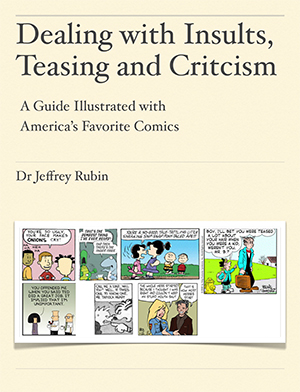
Welcome to From Insults to Respect. Today’s topic, “payback.” There are a couple of definitions for payback, so to be clear, I’m referring to a tactic involving punishing someone, or a group of people, for something done in the past. Synonyms include revenge, reprisal, retaliation, retribution, and vengeance.
When discussing a topic such as this, it helps to utilize a vivid narrative that is not only illustrative, but also provides some emotionality to the topic. G. B. Trudeau, with his Doonesbury comic strip, is a master at this. Recently, he has been turning his impactful colorful art to President Donald Trump’s style of dealing with people.
 For example, in this panel from a recent comic, we see a caricature of Trump insulting several news outlets. Whenever the president has been asked why he has been utilizing these types of insults, he claims that the other side started it. He’s just getting back at them, he explains, because they insulted him first.
After that caricature of Trump, Trudeau published the following:

Now, before we move on, I want to make it clear that I am not here today to claim that the above comic scenario is a factual depiction of anything currently going on in President Trump’s administration. Sure, Trudeau probably believes the scenario does capture something of the president’s style of leadership, but whether or not he is correct is not the point of today’s discussion. Let’s just utilize the narrative to help us seek out what lies deep below the surface of the “payback” tactic.
On the surface, of course, all that many people see is a simple understanding that can be stated thusly: “It is proper to do something bad to anyone who does something bad to you, for that is only fair.” But, there is considerably more to see if only we are willing to look a little deeper.
 In the comic, TRFF, the guy with a mustache and cigar, views himself as an authoritarian and is just delighted that he has been appointed Deputy Director of Payback. Let’s begin our exploration below the surface with a quick discussion of what it means to be an authoritarian.
What Does It Mean to be an Authoritarian?
According to Wikipedia,
“An authoritarian leadership style is being used when a leader dictates policies and procedures, decides what goals are to be achieved, and directs and controls all activities without any meaningful participation by the subordinates. This leader has full control of the team, leaving low autonomy within the group.[1] The leader has a vision in mind and must be able to effectively motivate their group to finish the task. The group is expected to complete the tasks under very close supervision, while unlimited authority is granted to the leader. Subordinate’s responses to the orders given are either punished or rewarded.”
Now we can contrast this authoritarian leadership style with one that may be referred to as an “authoritative” approach. There are several very different descriptions of an authoritative leader, so, to be clear, what I mean by this is the following:
An authoritative leader provides a vision of the group’s goals, somewhat like an authoritarian leader, but there is a distinctly more willingness to engage in verbal give and take with regards to how the common goals are to be articulated and achieved. Moreover, the leader is far more likely to be forgiving of shortcomings as the group operates, viewing them as an opportunity to problem solve how best to move forward. Authoritative leaders are less controlling as authoritarians, allowing group members to explore more freely, thus having them make their own decisions based upon their own reasoning. Authoritative leaders seek to encourage more independent and self-reliant group members.

 Perhaps one of the best known leaders who embodied the authoritative style of leadership was Nelson Mandela. After serving 27 years in jail for seeking justice for the majority of South African people, he had plenty of reasons to seek payback. But in a speech delivered to the European Parliament in 1990, he stated:
“Great anger and violence can never build a nation. We are striving to proceed in a manner and towards a result, which will ensure that all our people, both black and white, emerge as victors.”
Throughout his leadership as the president of South Africa, he advocated forgiveness toward his former oppressors, and served his country with a smile full of wisdom and kindness.
Back to the Payback Tactic
 In contrast to the image that many people have of Nelson Mandela’s leadership style, take another look at the caricature in the Doonesbury comic of a authoritarian in charge of payback for the president’s administration. As a response to some guy who is disloyal to the administration, TRFF says that if it was up to him, he’d throw the guy out of a plane. TRFF is just loving the fact that he gets to demean, threaten, or fire people every day.
How effective are punishments of this type?  In the short run, there are people who are willing to Kowtow to them, but there is a spirit within that slowly begins to get riled, and danger lurks below. It is not always easy to see this in the muddy complexity of large organizations, but search your own heart and you will know of its existence.
Doing scientific research to demonstrate the problems involved in using the payback approach has always been challenging. Real life is so much more complicated than the types of approaches that can be systematically studied scientifically. However, when such studies contrast punishment with a reward, the results indicate that people view those who use a reward approach as both more attractive and more likely to gain compliance.
 A while back, I heard about a company that had been having a hard time getting its workers to arrive on time. The company executives had a policy of punishing those who came late by docking their pay. Not only didn’t this work well, but the workers became bitter toward the executives, and many workers, after being trained at great expense, would soon leave for employment at competing companies.

When the company executives decided to discuss these problems directly with the employees, they came up with an alternative approach to the lateness problem. No longer would the employees be punished, but instead, each month an employee came to work without being late a single time, he or she was rewarded with a monetary bonus. This dramatically decreased lateness, and increased the respect the employees had for their executives, who became more open to involving the employees on how developing goals were to be carried out. The results were spectacular. An enormous amount of money was saved because of the decrease in the downtime of productivity from lateness and a reduction in recidivism.
 Recently, President Trump advocated that the current US health plan be replaced with a new health care law. He was unable to get enough votes for its passage. Will he now unleash the dogs of payback? Should he?
Please let me know your thoughts by leaving a comment in the Comment Section at the bottom of this blog post.
In closing, here’s hoping you found some food for thought in today’s post, and you soon join us again right here at From Insults to Respect.
———————————————-
Some people will enjoy reading this blog by beginning with the first post and then moving forward to the next more recent one; then to the next one; and so on. This permits readers to catch up on some ideas that were presented earlier and to move through all of the ideas in a systematic fashion to develop their emotional intelligence. To begin at the very first post you can click HERE.

 Welcome to From Insults to Respect. Today we take up the question, can the science minded and religious minded legitimately take up an attitude of mutual respect?
 There are, of course, people who fervently believe that opinions that do not rest firmly on the broad shoulders of scientific evidence are nothing more than superstition. Many of these individuals, as soon as they hear that a person is religious, give off vibes of disdain.
 Meanwhile, there are religious folks who believe that science minded individuals have led to a world of atomic energy catastrophes, billowing coal chimneys, people with their noses in their devices while tending to their babies, etc. In their hearts, these religious folks angrily believe that the science minded are leading humanity down a filthy, destructive path.
 Then there are people who richly agree with Albert Einstein when he wrote, “Science without religion is lame, religion without science is blind.”
 “First, what is the nature of it? what is its constitution, origin, and history? And second, What is its importance, meaning, or significance, now that it is once here? The answer to the one question is given in an existential judgment or proposition. The answer to the other is a proposition of value…. Neither judgment can be deduced immediately from the other. They proceed from diverse intellectual preoccupations, and the mind combines them only by making them first separately, and then adding them together.”
 Religion, in contrast, seeks to deliberately nurture the moral sense. For Einstein, “A person who is religiously enlightened appears to me to be one who has, to the best of his ability, liberated himself from the fetters of his selfish desires and is preoccupied with thoughts, feelings, and aspirations to which he clings because of their super-personal value.”
 Did Laura and Harry make the right decision? The question may seem easy if they had a great time and came back uninjured. But what if they had had a terrible accident? Would this require that they conclude that they had made the wrong decision? Can science answer this question?
 Now, some science minded folks well recognize that some decisions must be made before the availability of sufficient scientific evidence. They argue that in such cases, they don’t need any religion to tell them what is right and what is wrong, they can decide that perfectly well on their own. I, for one, am on friendly terms with these people. I am not seeking to force religion on them. At the same time, I know there are people who choose to participate in a religion, valuing the stirring lessons from their clergy, the social connections, and the community support for worthy causes. They choose to use some of what they experience by being a member of their religion to make some of their decisions. I, for one, am on friendly terms with them. I don’t see the sense of automatically disdaining either the science minded or religious minded.
 Some people in the science camp like to point to several religious related incidents, such as planes crashing into the World Trade buildings, in order to condemn all religion. But there were people in the science camp during the religious hating Soviet Revolution that participated in the slaughter of millions. Moreover, during the Nazi regime, Hitler found plenty of science minded people willing to aid in the carrying out of atrocities.
 Perhaps the greatest difficulty science minded people have with religion is that it promotes magical thinking. I hasten to point out that not all religions do so. For example, the Transcendentalists, with Ralph Waldo Emerson as one of their most eloquent writers, embraced principles of science. The Dalai Lama, as well, presents us a religion very open to what science can teach us.
 Let me add as well, with regards to this magical thinking issue, that many people who view themselves as religious, well recognize the magical thinking that appears in their scriptures, but do not accept them. Instead, they view them as comforting to those who don’t have a scientific mind, then they slip by those sections of scripture to those that they more highly value. We can liken it to a guy who recognizes that his mother holds some beliefs with which he completely disagrees, but he continues to love her for all the other aspects of her life that so beautifully nourishes his existence.
 This one has to do with the wisdom of remaining skeptical until we have sound science evidence to support our position. I can see some merit in that. At the same time, in real life circumstances, a question comes up regarding just what is the point at which our opinion should be coerced by the existence of sound science? Bear in mind that there was not so very long ago a procedure known as lobotomies. This brain surgical procedure was viewed as being backed by such solid scientific evidence that powerful people were able to involuntarily subject less powerful folks to the scalpel. It didn’t turn out well, at least not for those who had part of their brains gouged out.
 So, there are good people who are hesitant to accept what science folks tell us. Is it wise to treat them with disdain, or to remain on friendly terms with them while respectfully disagreeing?
 James points out that in most areas of human life, science simply has not come far enough to determine with any great precision what is the most favorable road to travel. The variables that in a controlled lab seem somewhat predictable frequently become entangled in so many other variables out in the more natural world that we must make decisions as best that we can, guided by nonscientific lights. Having some faith, even without sufficient scientific evidence, may be helpful.
 For James, some people possess a strong religious sense, others less so, and others find a void in that section of their brain. Where is the evidence that any one of these types are somewhat less human, or less worthy of respect? Perhaps there is some value in having some diversity within the human species.

 One day I was watching Donald Trump’s first news conference since he became president. There, the remarks that I found most interesting had to do with his expressed outrage about how hateful the press has been toward him. The first time it came up, he was asked the following question by a reporter:
 “Well, the leaks are real. You’re the one that wrote about them and reported them, I mean the leaks are real. You know what they said, you saw it and the leaks are absolutely real. The news is fake because so much of the news is fake. So one thing that I felt it was very important to do — and I hope we can correct it. Because there’s nobody I have more respect for — well, maybe a little bit but the reporters, good reporters.
 “And if I may follow up on that, just something that Jonathan Karl was asking you about. You said that the leaks are real, but the news is fake. I guess I don’t understand. It seems that there’s a disconnect there. If the information coming from those leaks is real, then how can the stories be fake?”
 A great model to consider as an alternative to Trump’s style is that of John F. Kennedy’s. Over the whole of his presidency, Kennedy averaged a 70.1 percent approval rating, comfortably the highest of any post-World War II president. By comparison, the average for all presidents between 1938 and 2012 is 54 percent. Trump, last I looked, was at about 40 percent.


 Perhaps he has come to believe that many of his most ardent supporters actually believe him when he lies, and it is the media who are telling the lies. Trump may also believe that others of his supporters don’t care that he lies because they believe business folks always exaggerate as they promote their goals, and that Trump is just promoting causes that match their values. Many Americans may therefore see his behavior not as a sign of mental illness, but simply that he is a shrewd businessman.
 “I should note that nothing I am saying should besmirch the reputations of men like President Abraham Lincoln or Sir Winston Churchill, both of whom are said to have fought the ravages of major depression or bipolar disorder. One was instrumental in ridding America of slavery. The other was instrumental in saving the world from tyranny. Mahatma Gandhi, by the way, also reportedly suffered from depression. Psychiatric illness does not, a priori, disqualify a person from rendering extraordinary service to mankind.”
 In the February 14, 2017 edition of the New York Times, there appears a
 “Although no definition can capture all aspects of all disorders in the range contained in the DSM-5, the following elements are required:
 Judy becomes bitter when she finds out that her husband, Glen, lied to her. That bitterness leads to a loss of the tenderness she had for him on their glorious wedding day. Despite efforts by Glen to straighten things out, his previous loving relationship ends in divorce.
 As regular visitors to this blog well know, it is my habit of utilizing, from time to time, Bob Dylan’s Theme Time Radio Hour show to provide a literary spin on a topic of interest. To that end, today we’ll turn to his wonderful episode that focused on the theme, “Truth and Lies.” You can listen to the show for free by clicking
 If the truth will hurt someone you love,
  If you are going to tell a lie, make it a white lie. The dictionary defines that as an often trivial, diplomatic, or well-intentioned untruth. According to a survey, 4 out of 5 people admit to telling white lies at least once a day, and I’m telling you that that other guy, he’s lying.
 Even if lying is a sin, it is only a venal sin. It becomes a mortal sin only when the intention of deceiving risks mortal consequences. And just as a reminder, here are the seven deadly sins: pride, envy, anger, sloth, greed, gluttony, and lust. Let me see, I’m good for about five of them.
 “Don’t Play that Song” was a major hit not only for Aretha, but for several other musical artists. Its popularity is due, at least in part, to it so powerfully capturing the emotional pain that many experience when it becomes apparent that the person they fell in love with has lied about loving them. Such painful memories can last a lifetime.
 Well, let’s talk it over
 A liar lies to nations
 When I was very young, I lied without any forethought. For example, I remember when I was in second grade, one day in the lunchroom a boy at my table announced that he just got a toy Tommy gun for his birthday. Seeing the enthusiastic reaction of some of the guys at my table, I announced that I got one also for my birthday, despite the fact that I hadn’t, and I didn’t even know what a Tommy gun was. The lie just shot right out of my mouth.
 One of the biggest influences on my ability to have some forethought when it came to lying was meeting a couple of people in high school that displayed a degree of humbleness. I came to admire this. Both appeared comfortable about their shortcomings, and although both had some impressive skills in a few areas, rather than bragging about them, they let their performance speak for themselves. I soon found myself modeling their style, and each time I was tempted to exaggerate something about myself, I found I could catch myself beforehand, and pretty often I chose a more truthful path.
 Empathy, as we have been lately discussing (see
  To give us a sense of the power of literature to promote empathy, Kathleen tells us about her own experience reading All Quiet on the Western Front by Erich Maria Remarque. The novel is based on Remarque’s experiences as a German soldier in World War I.

 Professor Pinker notes that prior to the invention of the printing press there were very few books available. Those people who lived in the upper classes rarely had much direct contact with the lower classes. A nobleman’s quick glance while passing by a downtrodden worker often merely left the impression of a filthy, smelly soul, hardly human at all. After novels became available, a nobleman might read of a poor young woman pressed into very sad circumstances by a cruel person of the upper classes, and discover tears running down his cheeks. To discover that people all over the world, in all classes, and other religions have very similar desires, dreams, and feelings that we can all relate to, increases empathy and the desire to deal with a wider range of humanity in kind and respectful ways.
 Of particular importance here is that their studies indicate that reading just any book is not likely to significantly improve empathy skills. Neither nonfiction or popular fiction did the trick. Only what they referred to as “literature” clearly enhanced empathy skills even though there was some indication that most folks liked the popular fiction best.
 things–rock formations, how to do quilting, etc. If you choose to read one of these books it is because you share a common interest with the author. No time is spent on getting to intimately know people who have opinions and views that are much different than yours.
 Consider as an exemplar, the movie Star Wars, a phenomenally successful form of popular fiction. Within minutes, we come to know who the bad and good guys are. And the bad guys are pretty much completely evil, and the good guys, ever so swell. Moreover, the plot is rather simple–the good guys have to kill as many bad guys as they can, with the ultimate goal of destroying their headquarters known as the Death Star.
 For children within the age range of 4 to 8, I recommend the free guide titled “Developing Empathy Though Children’s Literature.” It has been published by the US government, and you can retrieve it on line at:
 The first in the trilogy is titled A Hero Grows In Brooklyn, and although you can buy an inexpensive paperback copy of it, I have made it available to be downloaded for free (For your free download, click
  Steve gets in his lunch line. The aroma of chicken soup, peanut butter sandwiches, and fried fish cakes drifts into his nostrils. He picks out a peanut butter sandwich, a container of milk, and some ice cream. Then he shows the cashier his free lunch pass.
  The other two novels in the trilogy take the same characters that we met in the first of the series into high school. More and more mature themes are addressed as they approach their date of graduation.
 For adults, in addition to my own trilogy, I recommend making selections from the list of fiction finalists of the National Book Awards, which, each year, is readily retrievable from a Google search. For those who prefer short stories, O’Henry Award winners are great. Some of these stories were used in the research study published in the journal Science that was mentioned earlier in this post and found to increase empathy. You can find collections of these short stories by doing an internet search using the key words, “short stories, O’Henry Award Winners.

 So, to me, empathy is a pretty good thing–I mean, what’s not to like?
 “So, what they do when they give, is to give to a lot of different charities, and give a little bit of money to each one because for each one they get a little rush–‘Oh, I’m helping the blind babies. Oh, I’m helping the farm workers. Oh, I’m helping the chickens.’ The problem is that when you give a small amount of dollars to a charity, often it doesn’t do much good because the dollars they need to process your donation, in some cases, actually ends up with the charity taking a loss on your donation.”
  “Empathy’s engagement, being caught up in the suffering of victims, is usually the number one argument in a democratic country for going to war…. If we ever go to war against ISIS, a full blown military war, it will be motivated by our feelings for the suffering of their victims. But that’s just one consideration. Other considerations are, how many people will die in the war? How many other victims will the war create? But our empathy, our selfish moralizing, zooms us in and says, ‘Oh, my God, there are these people who are suffering, let’s bomb the crap out of them; Let’s destroy the whole country to save these people.’ And then people are later surprised that apparently we killed, you know, we killed 50 thousand people. Gosh, who would have known?”
 It seems to me that the good professor confounds in his argument the experience of empathy with what one chooses to do when experiencing empathy. Yes, in some situations in which we experience empathy we could choose to take actions that in the long run causes more harm then good, but in other situations we act in enormously helpful ways.
 Consistent with Dr. Bloom’s position, there is some evidence available that indicates that sometimes people will, upon experiencing empathy, act altruistic without much thought to the consequences. For example, in a
  This type of evidence is far from conclusive because the donors may have retrospectively distorted their accounts to present themselves in a favorable light. However, a number of other studies (see
  I think that Dr. Bloom’s real worthwhile point is not that empathy is bad, but rather, when we experience empathy we should be careful. If our empathy seems to be urging us to be helpful in some way, we would be wise to indeed consider the long term, as well as short term consequences of our actions. This, in truth, is how all of our decisions are best made.


 The evidence supporting learning these skills includes studies demonstrating that prolonged stress is related to adverse psychological and physical health effects, as well as an increased risk of premature mortality (See
  There is some support for the “more skillful” theory. For example, in the Keller, et al. article, most of the people that these researchers studied believed their stressful experiences could make them ill, and indeed these folks did often experience more illnesses when they faced high chronic stressful experiences. However a resilient subgroup of individuals tended to not support the stress-illness connection. When faced with high stress, they had learned to believe that the physical sensations they experienced with stress was their body’s way to help them to rise to the challenges that they face.
 The skeptics would like to see studies that first identified people who were having ill effects from too much stress, and then, after learning stress management skills, they ended up having better health outcomes than a randomly assigned control group who were not taught these skills. Without such studies, it can be argued that it is just a coincidence that those who appear to be skillful at dealing with stress happen to be individuals who are also healthier. These skeptics point out that there are already a few randomly controlled studies that have been completed that provided some brief stress-skill training to people experiencing heart problems. The results from these studies turned out to be discouraging.
 Circulation, one of cardiology’s premier journals, published an article on March 21, 2016 titled, “
 Patients engaged in aerobic exercise three times a week for 35 minutes. Patients also received education about coronary heart disease, nutritional counseling, and two classes devoted to the role of stress in this disease.
 Patients in CR+SMT received the identical comprehensive CR intervention plus SMT. The SMT program combines education, group support, and cognitive-behavior therapy. The intervention is delivered in 12 weekly one and a half hour sessions in groups of 4 to 8 participants. Strategies for reducing demands are presented including prioritizing, time management, establishing personal values, and avoidance. Participants are encouraged to apply the skills that they have learned to address their own everyday problems.
 Subsequent sessions focus on modifying responses to situations that cannot be readily changed. Several sessions are devoted to training in progressive muscle relaxation techniques and the use of visual imagery to reduce stress. Emphasis is placed on the importance of cognitive appraisals in affecting stress responses, with recognition of irrational beliefs and cognitive distortions such as overgeneralization, catastrophizing, and all-or-nothing thinking.
 Hopefully, the above discussion will increase the chances that you will take up the challenge of mastering stress management skills. I can tell you that from my own experience it is possible to transform many old entrenched habits, which typically escalate stressful experiences, to new ones that leave me in a far more comfortable state of mind.
 Many soon become cognitively convinced of this, and yet the next time they come in contact with such a snake their bodies still become as stressed as ever. Such individuals, with guided practice, and a little patience, do learn to become comfortable when they see nonpoisonous snakes.
 I suggest the following format for such groups. Everyone in the group would come prepared having read the post that will be discussed for the week. After 5 minutes of greeting each other, take twenty minutes to have a group meditation. A simple form of meditation is described
 William James explained that certain children, if they do not succeed immediately in doing something just right and are then criticized, flare up in anger and refuse to cooperate. Such children are oftentimes treated as sinful and are punished; or else the parent pits his or her will against the child’s will.

 “It is in no other way that we overcome balkiness in a horse,” said James. “We divert his attention, do something to his nose or ear, lead him around in a circle, and thus get him over a place where flogging would only have made him more invincible.”
 Well, it just so happens that if you use the William James approach consistently, you really don’t reinforce balkiness because children soon realize that they have not won. They simply come to the understanding that “dropping the subject” does not mean that anyone has won. Instead, they soon connect the “dropping the subject” fact with the “bringing the topic up again later” fact. Dropping the subject, comes to mean their parents will be returning to the subject after they and their parents have some time to calm down and think about the issues in a more calm state.
 See to it now, I beg you, that you make freemen of your pupils by habituating them to act, whenever possible, under the notion of a good. Get them habitually to tell the truth, not so much through showing them the wickedness of lying as by arousing their enthusiasm for honor and veracity. Wean them from their native cruelty by imparting to them some of your own positive sympathy with an animal’s inner springs of joy. And, in the lessons which you may be legally obliged to conduct upon the bad effects of alcohol, lay less stress than the books on the drunkard’s stomach, kidneys, nerves, and social miseries, and more on the blessings of having an organism kept in lifelong possession of its full youthful elasticity by a sweet, sound blood, to which stimulants and narcotics are unknown, and to which the morning sun and air and dew comes as sufficiently powerful intoxicants.
  The general idea here is that in the arena of the moral life, whenever a positive ideal is aroused, it is as if the whole scale of values change its equilibrium. As James makes this point, he declares that at such times, “The force of old temptations vanishes, and what a moment ago was impossible is now not only possible, but easy.”
 Middle school students can read A Hero Grows in Brooklyn on their own, and it can be downloaded on a computer or any of the popular electronic readers for free
  “Be patient, then, and sympathetic with the type of mind that cuts a poor figure in examinations. It may, in the long examination which life sets us, come out in the end in better shape than the glib and ready reproducer, its passions being deeper, its purposes more worthy, its combining powers less commonplace, and its total mental output consequently more important.”