This week I happened to be listening to the old Graham Parker song, “Nobody Hurts You.” As I interpret the lyrics and how they are sung, it seems to me that they are a useful jumping off point for a discussion about so many of us being, at times, so disrespectful to ourselves.
Graham’s Song
The first line, sung with anger, goes:
I try to pull my weight, study my geography It doesn’t seem to get me anywhere
Here we learn that the singer, and in a metaphorical sense, many of us as well, sometimes find we are in a situation in which we begin to feel angry because we are trying to get somewhere, but find we are not making progress.
As the song continues, frustration begins to mount. And then Graham cries out,
Hey baby, I’m out of favor You can’t always be the right flavor It just seems that no matter what you do Someone, somewhere, suddenly gotta punish you
Nobody hurts you, nobody hurts you Well, nobody hurts you, nobody hurts you Harder than yourself.
Here, Graham explains to someone he calls “baby” that he is out of favor, and you can’t always be the right flavor. The use of the word “you” in these lines, as I read them, refers to himself, and he is actually calling himself a baby. Punishing himself for not matching what others respect is viewed by him as an immature, baby-like way to act.
Graham then belts out,
Suffocating in suburbia The new estates build claustrophobia Grandfather’s money only in the finest stuff That’s enough! That’s enough! That’s enough!
Well, nobody hurts you, and nobody hurts you Well, nobody hurts you, nobody hurts you Harder than yourself.
Here I’m reminded that so many of us hurt ourselves when we see we are in a situation that clashes with what we respect. As Graham cries out the lines, “That’s enough! That’s enough! That’s enough!” he is expressing anguish as he goes about hurting himself over these perceptions.
The next few lines go:
You make me tag along, run into the rent-a-crowd But they’re just imitation I try to write the song, you and me are laughing loud But it comes out frustration
Look no one’s going to illuminate you All the odds are stacked against you You’re just caving in right there in front of me It’s a picture I don’t ever want to see
Nobody hurts you and nobody hurts you Well, nobody hurts you and nobody hurts you Harder than yourself.
At this point, the singer leaves us in a fit of exasperation, saying discouraging pessimistic words. Many of us connect with the anger in his voice, recognizing that how the singer is reacting to his frustration is somewhat similar to how at times we may react.
Hurting Ourselves When We Perceive Disrespect
One of the most common way that we begin to hurtfully treat ourselves is when we perceive someone is treating us disrespectfully. Apparently, some people are less likely to succumb to this pattern. I came upon a great example of someone who utilized an alternative pattern while reading Ron Chernow’s best selling biography of Ulysses S. Grant.
There we learn about John Rawlins, who acted as General Grant’s Chief of Staff during the Civil War:
Rawlins “was always getting excited about something that had been done to Grant,” recalled Lieutenant Frank Parker. When someone showed disrespect for Grant, “he would prance around and say, General, I would not stand such things’ to which Grant would say, ‘Oh, Rawlins! what’s the use in getting excited over little things like that; it doesn’t hurt me and it may make the other fellow feel a little good.'”
Grant was widely respected in his day, not only for his leadership during the Civil War, but also for his tenure as US President, serving a full two terms. Sure, he had his flaws, as all human beings do. Nevertheless, his pattern of dealing with perceptions of disrespect does suggest the possibility that it is possible to achieve respect with the use of his pattern.
The pattern I am talking about is more fully described by several of the lines that Rudyard Kipling wrote in his poem, “If.”
If you can keep your head when all about you
Are losing theirs and blaming it on you,
If you can trust yourself when all men doubt you,
But make allowance for their doubting too;
If you can wait and not be tired by waiting,
Or being lied about, don’t deal in lies,
Or being hated, don’t give way to hating,
And yet don’t look too good, nor talk too wise:
If you can meet with Triumph and Disaster
And treat those two impostors just the same;
If you can bear to hear the truth you’ve spoken
Twisted by knaves to make a trap for fools,
Or watch the things you gave your life to, broken,
And stoop and build ’em up with worn-out tools:
If you can talk with crowds and keep your virtue,
Or walk with Kings—nor lose the common touch,
If neither foes nor loving friends can hurt you,
If all men count with you, but none too much;
Yours is the Earth and everything that’s in it,
And—which is more—you’ll be a Man, my son!
Can We Learn Skills that Help Us to Be More Supportive Of Ourselves Even When We Perceive From Others Disrespect?
It may be true that some of us are born with a calmer, more supportive way to react to perceptions of disrespect. If you believe this, you may come to believe that there is nothing you can do to change your innate pattern. However, I, and many others as well, have found that if we come to realize lashing out at others and ourselves at such times is less than ideal, there are some very useful skills that can be learned over a period of time despite innate tendencies.
Now, a major reason people become discouraged from taking helpful action to learn such skills is that they read on this topic, became convinced that the skills make sense, but end up finding that this understanding led to no change in their own behavior. “Oh, I know all about such skills,” they say to themselves, “but with my temperament, I can’t really do anything about this.”
Well, as I explained in an earlier post (see HERE), learning certain skills requires more than just knowing the basic principles of these skills, it requires practice over an extended period of time. Consider, for example, an actor who gets a part on Broadway. This person well knows the basics of acting having gone to the Juilliard School of Performing Arts. Moreover, the script explains what is to be done during the play and the director explains even more what are the motivations and emotions to be expressed. Nevertheless, even after all of this and all the lines are well memorized, there is no way the actor is ready to get up in front of the Broadway critics without some practice over a period of time under less stressful conditions.
Learning skills that are helpful to respond to perceptions of disrespect is similar in many ways. To learn them, you have to apply what you have heard or read by first doing them under relatively safe circumstances, make mistakes, and try again and again until you get smooth at coordinating the skills even in very challenging circumstances.
One of the best ways to learn the skills regarding being supportive of ourselves when we perceive others are treating us in a less than ideal respectful manner is to seek counseling or psychotherapy from a supportive professional. As you discuss with the professional situations that typically have resulted in your being very hard on yourself, these professionals over a few months typically respond in a very supportive manner, modeling for you the type of skills you want to learn. Some will then give you some homework assignments that lead in time to your learning a far more helpful style of functioning during these challenges.
Some counselors and psychotherapists will also encourage you to learn to meditate and utilize other mindfulness techniques. Here you practice observing your physical sensations when you are dealing with the disrespectful perceptions. In time, the disrespectful words that you tend to direct at yourself come to lose their disturbing nature. For a period of time these words still come, but you end up smiling at them as you realize they are not matching reality. In time, they may completely fade away.
This has been described as decentering. In essence, to decenter is to take a figurative step back from our beliefs and thoughts. Instead of a reality of “I can’t do anything right,” one learns that they had a thought “I can’t do anything right.” We come to learn that we do not need to believe all our thoughts that were learned over many years from people who treated you in less than respectful ways.
An important component of mindfulness practice is to not resist our thoughts. Otherwise, marked frustration may ensue. We notice them, accept that they have come, observe them, and peacefully observe the physical sensations that come with them. You can find, and learn about two personal counselors that are highly skilled in all of these approaches HERE.
Now, I understand that most people can’t access the kinds of mental health services I am describing because they are too expensive or they are not available in their community. It is for this reason that I have been writing this blog. It provides a free, accessible way to learn the skills at your own pace. By going to the first postof this blog and then systematically going through each of the other posts over an extended period of time, a more supportive style of dealing with these types of problems are described, along with simple exercises that are required to really learn the skills well enough so you can actually carry them out in real life situations.
Assignment: Write one or two paragraphs that relates what you have just read to something that personally happened to you. Include not just what happened, but also how you were feeling while it was happening.
——————————-
Some people will enjoy reading this blog by beginning with the first post and then moving forward to the next more recent one; then to the next one; and so on. This permits readers to catch up on some ideas that were presented earlier and to move through all of the ideas in a systematic fashion to develop their emotional and social intelligence. To begin at the very first post you can click HERE.
Welcome to From Insults to Respect. Very recently, the US government passed a bill that provides a major overhaul of our taxation policy. Since the bill was signed into law, some of my friends have begun to ask me what I think of it. In response, I first tell them about a psychological study.
The Study
In the study, primatologists Sarah F. Brosnan and Frans B.M. de Waal trained capuchin monkeys to perform a certain task for which they receive, as a reward, cucumber slices. The monkeys performed the task just fine until they were permitted to see another monkey being rewarded with grapes, a higher-value payment. Suddenly many of the cucumber-receivers refused the cucumber, sometimes even throwing those measly, unfair cucumber payments at the experimenter who was giving out the reward. In a delightful YouTube video that you can access for free HERE, you can witness this for yourself. Behavioral economists call the behavioral characteristic exhibited by the monkeys “inequity aversion”—the tendency to turn down a perfectly good offer if others are getting a better deal.
Do Capuchin Monkeys Comprehend Something Middle Class Supporters of the Tax Bill Fail to Grasp?
The new tax policy would deliver more than 50 percent of its benefits to the top 1 percent, according to an analysis by the nonpartisan Tax Policy Center (TPC). Meanwhile, America’s poorest families would get a tax benefit less than 1 percent growth in after-tax income. A middle-class household with $67,000 of income will receive an average tax cut of $930 next year, while a fairly wealthy family with $348,000 of income will get an average tax cut of $7,640. Very wealthy families will get a far larger break. One in five Americans making the median household income would actually see a tax hike.
The new tax policy is estimated to increase the national debt by over a trillion dollars, which eventually will have to be paid, plus interest. That interest will be paid to financial institutions that benefit the rich. The tax breaks for the rich in this bill were written in a way that make them permanent, whereas the parts of the bill that will give the slight benefits to a majority of middle income people are temporary.
Despite these facts, there are some middle class voters who are actually supporters of the new tax policy. What are they thinking? Well, the most common defense comes down to the old trickle down theory. So, let’s take a look at this.
Trickle-down Economics
Trickle-down economics, also referred to as trickle-down theory, is an economic theory that advocates reducing taxes on businesses and the wealthy in society as a means to stimulate business investment in the short term and benefit society at large in the long term. For those who want to see how much support there is for this theory, I suggest placing the following words into your search engine–Trickle-down theory, evidence for support. By doing so, you will find that the theory has been a dismal failure. For a brief summary of these findings, I recommend Wikipedia’s entry on this topic. Here are some quotes:
The term trickle-down originated as a joke by humorist Will Rogers and today is often used to criticize economic policies which favor the wealthy or privileged, while being framed as good for the average citizen. In recent history, it has been used by critics of supply-side economic policies…
Multiple studies have found a correlation between trickle-down economics and reduced growth.[6][7][8][9]
A 2012 study by the Tax Justice Network indicates that wealth of the super-rich does not trickle down to improve the economy, but tends to be amassed and sheltered in tax havens with a negative effect on the tax bases of the home economy.[9]
A 2015 paper by researchers for the International Monetary Fund argues that there is no trickle-down effect as the rich get richer: [I]f the income share of the top 20 percent (the rich) increases, then GDP growth actually declines over the medium term, suggesting that the benefits do not trickle down. In contrast, an increase in the income share of the bottom 20 percent (the poor) is associated with higher GDP growth.[6]
Rather Than Hoping That the Middle Class Might Indirectly Benefit From Giving a Larger Tax Break to The Rich, Why Not Directly Give The Middle Class The Larger Tax Break?
Those who supported the bill claimed that it was designed to help the middle class. Two ways our heavily lobbied representatives could, if it really wanted to help the middle class, is to increase the Earned Income Tax Credit (EITC), and to increase the minimum wage to $15 an hour.
Representative Ro Khanna has proposed a $1 trillion expansion to the EITC. The plan would give about 50 million households an average tax benefit of roughly $3,000 per year; Americans earning more than $100,000 would get no tax benefit. In the graph below, the nonpartisan Center for Budget and Policy Priorities compares the distributional effects of a trillion-dollar EITC expansion versus the tax bill recently signed by President Trump.
The Trump Tax Cut vs. an Expansion of the Earned Income Tax Credit
Such an EITC expansion would raise by 5 percent the after-tax income of households making less than $30,000. That’s 10 times more than what those households would get under the new tax plan. People earning from $30,000 to $50,000 would also do better under this plan as well, though not as much as those earning less. This program’s impact on the national debt would be significantly less than the new tax policy.
Now, if you look closely at the above graph you will notice that people whose income is in the range of $50,000 to $100,000 don’t receive as much of a cut as they will get under the estimated Trump tax cuts. Arguably this group of people should be viewed as part of the middle class, especially if they are the major wage earner of a family who is also living in a region of the country where cost of living is above average. So, is there a way to make the tax code fairer for them, as well as for those earning less than $50,000.
What if the tax code was to actually raise the taxes of those who are making a hefty $200,000 a year by a modest 2 percent, and for those earning more than $400,000 a year by 4%? This additional revenue for the government would make it affordable to decrease the tax burden for those in the $50,000 to $100,000 range so it equals what they would get under the Trump tax cuts. With this tweak, the plan proposed by Representative Ro Khanna would be fairer to all families making less than $100,000 a year while eliminating any increase in the national debt. That would put distinctly more buying power into the economy, thus a benefit for all–poor, middle, and rich alike. Include into the plan a $15 an hour minimum wage law, and the economy would dramatically improve the bottom line for businesses across the country because it would stimulate an increase in spending.
Despite the merits of a plan that would expand EITC, increase the minimum wage to $15 an hour, and make some additional tweaks for those earning from $50,000 to $100,000 a year some argue that increasing taxes for the rich while reducing taxes for the working non-rich would be unfair? To understand why actually it is very fair, we first have to understand the nature of “capital.”
The Nature of “Capital”
There are a few definitions of capital. Here, whenever I use the word, I am referring to property such as money, land, housing, and tools that people own that they do not require for their basic needs such as food, shelter, healthcare, and transportation to and from work. In our society this type of capital can be uniquely used to earn more capital without the necessity to do any labor. Rather than labor, capital earns more capital via rental properties and interests from other investments. The way our society is structured, it is only the rich that have a significant amount of capital.
Those who are in a significant portion of the middle class actually have to supplement their labor earnings by taking out loans to pay for their homes, cars, and post high school education. The interest that they pay on these loans go to financial institutions that the rich benefit by having investments in them.
Those who are in another significant segment of the middle class don’t have to take loans to pay for basic needs; their earnings from their labor just manage to cover those expenses. However, those in this segment have no money left over that can be considered capital.
Finally, those in another significant segment of the middle class find that after their earnings from their labor manages to pay for all of their basic needs, they do have a little money left over to save for their retirement, if they get injured, sick, or lose their job. What savings that they manage to put aside often increase from interest. Since this money is targeted for use to pay for basic needs in the future, it is not quite the same thing as the capital that the rich have.
In contrast to the middle class, the rich uniquely typically earn yearly, without the need to do any labor, more money from their capital than middle class people earn yearly through their labor. In fact, many rich folks earn yearly from their capital more money than middle class folks earn their entire lifetime.
Now, this difference between the type of earnings rich people have and middle class people don’t have is not something that we normally see in nature. Even a lion, said to be king of the forest, must labor to earn his basic needs. Thus, he has to exert himself to get food, and when he finishes eating the food that he labored to obtain, must then go out and exert himself to get more food.
The phenomenon of capital eliminates the requirement for rich people to labor in order to earn their basic needs. In fact, without labor, their capital most often keeps increasing, which is referred to as capital gains. So, even when the rich pay higher taxes then the middle class, they tend to live far more lavishly, only work if and when they want, and their capital continues to increase at no pains taken by them.
So, for those middle class folks who support the new US tax policy, I suggest that they take a good look at the YouTube video of the capuchin monkey who is throwing cucumber slices at the experimenter. Perhaps these middle class people can learn from the monkey a basic principle of fairness and equity.
———————————
Some people will enjoy reading this blog by beginning with the first post and then moving forward to the next more recent one; then to the next one; and so on. This permits readers to catch up on some ideas that were presented earlier and to move through all of the ideas in a systematic fashion to develop their emotional intelligence. To begin at the very first post you can click HERE.
Welcome to From Insults to Respect. Today, let’s see if we can tie together some of the loose threads of mylast post, which chronicled Joni Mitchell’s experience of depression. There we found that she explicitly rejected the idea that her experience indicated that she was mentally ill. Instead, she came to believe that, “Most of my best work came out of it. If you get rid of the demons and the disturbing things, then the angels fly off, too. There is the possibility, in the mire, of an epiphany.”
We also discussed that in contrast to Joni’s position is the medical model, which views people who experience depression as having an illness that requires, as the first line of treatment, taking pills that are called “antidepressants.” Many who hold this view have absolutely no respect for people who hold the view expressed by Joni.
Upon publishing my post about Joni, one person that has impressed me over a period of time as being highly intelligent expressed a concern that attitudes like Joni’s will lead people to view depression as perfectly normal. The consequences of so doing, he feared, will lead to all of the efforts to increase access to mental health services getting flushed down the toilet. If depression is normal, why wouldn’t the majority of people decide to ignore this group of sufferers and their needs?
Well, in my opinion, this is a legitimate concern, and before this post draws to a conclusion I intend to address it. But first, let’s take a look at another example of someone who, like Joni Mitchell, came to believe that the experience of depression can be of enormous value.
Leo Tolstoy’s Experience
In his painfully personal book, My Confession, the great Russian writer Leo Tolstoy tells us about his two-year period of despair. At about the age of 50, his life had become “flat, more than flat: dead.”
“I felt that something had broken within me on which my life had always rested, that I had nothing left to hold on to, and that morally my life had stopped. An invincible force impelled me to get rid of my existence, in one way or another…. Behold me then … hiding the rope in order not to hang myself from the rafters of the room where every night I went to sleep alone; behold me no longer going shooting, lest I should yield to the too easy temptation of putting an end to myself with my gun.”
All of this took place at a time when Tolstoy’s outer circumstances seemed excellent.
“I had a good wife who loved me and whom I loved; good children and a large property which was increasing with no pains taken on my part. I was more respected by my kinsfolk and acquaintances than I had ever been; I was loaded with praise by strangers; and without exaggeration I could believe my name already famous.”
Tolstoy goes on to explain how his melancholy stimulated a gnawing questioning that eventually led to one insight after another. His trouble had not been with life in general, not with the common life of common men, but with the life of the upper, intellectual, artistic classes, the life that he had personally always led, the cerebral life, the life of conventionality, artificiality, and personal ambition. He had lived wrongly and had to change.
Then, one day in early spring, while he was alone in the forest listening to its mysterious noises, he was filled with a sense of deeper meaning. “After that,” he wrote, “things cleared up within me and about me better than ever, and the light has never wholly died away.” According to Tolstoy, his suicidal feelings disappeared, and he went on to live a productive life until he passed away at the age of 82 of natural causes.
Some Thoughts on Tolstoy’s Experience
The great psychologist and philosopher William James was someone who viewed the pathologizing of human experience as simple minded and nothing more than superficial medical talk. Rather than resorting to mentally ill jargon, the good professor explained in his monumental book, Varieties of Religious Experience, his view of Tolstoy’s experience:
It was logically called for by the clash between his inner character and his outer activities and aims. Although a literary artist, Tolstoy was one of those primitive oaks of men to whom the superfluities and insincerities,the cupidities, complications, and cruelties of our polite civilizationare profoundly unsatisfying, and for whom the eternal veracities lie withmore natural and animal things. His crisis was the getting of his soulin order, the discovery of its genuine habitat and vocation, the escapefrom falsehoods into what for him were ways of truth. It was a case ofheterogeneous personality tardily and slowly finding its unity and level.
Tolstoy’s anguishing experience appeared at first to come on him as if out of the blue. Later, Tolstoy came to understand it as having been due to living wrongly. Only by questioning deeply and repeatedly the meaning of his despair did he come to this understanding.
Now, with all of this as background information, let’s return to the concern that came up at the beginning of this post–if we don’t accept the medical model, might it provide a perfect justification for not funding mental health services?
In my view, the medical model actually gets in the way of adequately funding services.
Viewing someone in the midst of an anguishing experience as someone with an illness that is no different than any other illness leads many prescribing doctors to most often send the client home with some pills. That is viewed as sufficient. The patient is left with a host of negative side effects, and maybe in time, the patient will begin to feel better and attribute the improvement to the pills. If not, they go back to the doctor who will try adjusting the dose, trying a different pill, or adding other pills.
It is my view that even when people learn to value, even treasure, depression experiences, they don’t say that’s all there is to life. These experiences lead them to more deeply delve into their personal concerns thereby potentially leading them to seek more effective, efficient, economical, and beautiful ways to address their concerns.
Although Tolstoy did manage to successfully work out his most pressing concerns without professional help, keep in mind that he was an extraordinarily gifted person with a great deal of supportive people around him, and he was financially comfortable. Even with all of that, a well trained mental health service provider who avoided pathologizing his experience may have been of enormous help.
In my previous post, we saw that Joni Mitchell was not only experiencing the physical sensations of depression. Fully part of her experiences was to delve deeply into several concerns– “How am I going to get back in the saddle? And what about the audience? Would you still love me if you knew what I was really like?” She sought help from a psychotherapist.
As someone who provided mental health services for many years, let me present an example of what I am trying to get at.
Phil, not his real name, came to my office troubled about how depressed he had been feeling. After some time listening in a caring way to his concerns, I discussed this notion that depression can be viewed as a valued experience. He was pleased to learn this. At the same time, he didn’t in the slightest bit come to the conclusion that with this interpretation of the nature of depression there was no more need to continue to see me. However, I do think that framing depression as often a very valuable experience that many of our most gifted people put to good use was far more hopeful than framing it as due to defective genes.
Over the course of a year I found that the concerns Phil was most troubled about was his drinking, and that he had trouble developing close relationships. Both of these concerns are genuine health risk factors. My job was to help Phil to transform these risk factors to “health protective factors.” By doing so, this could prevent far more serious health issues down the line.
So we explored what was interfering with his developing close friends. It soon became apparent that he was very critical of people he met, and his style of criticizing was very nasty. For example, he would call people he disagreed with stupid in a very nasty way. And it also became apparent that he would criticize himself in the same disturbing manner.
I explored with Phil options that have been helpful to others. He selected learning to meditate, and to get more exercise in order to work off his anger in a positive, healthy manner. He learned the value of saying more supportive things to people he met, and to himself as well. He came to realize the value of minimizing the negative criticism that he provided, and when he did criticize, to do so in a far more charming manner. In the end, he made a new group of friends, joined AA, and was in a far more healthy state when my services came to an end.
So, as this example illustrates, rather than a mental illness model, in which pills are often viewed as sufficient, we can utilize a mental health concern model to advocate additional support for mental health services. With a mental health concern model, counselors and psychotherapists can be viewed as valued members of the allied health profession because they help to transform health risk factors into health protective factors.
The need for these types of mental health services, therefore, need not be reduced by framing depression as a valued experience. Rather, it allows us to move on from this understanding to advocate that our services fully address real mental health concerns.
——————————-
Some people will enjoy reading this blog by beginning with the first post and then moving forward to the next more recent one; then to the next one; and so on. This permits readers to catch up on some ideas that were presented earlier and to move through all of the ideas in a systematic fashion to develop their emotional and social intelligence. To begin at the very first post you can click HERE.
Welcome to From Insults to Respect. From time to time I have been discussing two distinct ways of looking at the nature of depression–the medical model and what we may wish to refer to as the creative temperament view.
The medical model views people who experience depression as having an illness that requires, as the first line of treatment, taking pills that are called “antidepressants.” The enormously wealthy pharmaceutical industry puts its full promotional apparatus behind this approach.
The creative temperament view lacks the backing of any huge corporate interest, but news of it trickles in from a variety of sources. For example, those interested in the history of psychology may learn how the brilliant psychologist and philosopher William James viewed his “bass notes of experience” (see “William James’s Personal Bout with a ‘Mental Illness“). He wrote that many so called “healthy-minded” individuals believe that those who worry are “morbid-minded” and “diseased,” but it may very well be true that “the world’s meaning most comes home to us when we lay them most to heart.” He, himself, learned to appreciate these visits of melancholy as something of extraordinary value, and stated that,
“there is no doubt that healthy-mindedness is inadequate as a philosophical doctrine, because the evil facts which it refuses positively to account for are a genuine portion of reality; and may after all be the best key to life’s significance, and possibly the only openers of our eyes to the deepest levels of truth.”
From there, James reviewed the biography of some of the most creative people in history, and noted that they often experienced depression.
Ms. Laren Stover
A more recent example of someone discussing depression in a manner consistent with the creative temperament view appeared in a New York Times articletitled “The Case for Melancholy.” There we learn from American writer Laren Stover about her own personal experiences. After telling us of her weariness of all those folks on the internet promising to show us how to be delightfully happy in just a few short steps, she writes:
“Whatever happened to experiencing the grace of melancholy, which requires reflection: a sort of mental steeping, like tea? What if all this cheerful advice only makes you feel inadequate? What if you were born morose?”
Laren continues to weave her creative images of melancholy with such words as:
“Sadness has a bad reputation. But I soon came to feel that melancholy — the word itself is late Latin from the Greek melancholia — is a word with a romantic Old World ring, with a transient beauty like the ring around the moon.”
Most recently, I discovered a particularly revealing example of someone who experienced her depression in a manner similar to Prof Willam James and Ms. Stover.
Joni Mitchell’s Experience
Reckless Daughter, is a new biography of seven-time Grammy Award winner Joni Mitchell. Prior to reading it, I had already gotten a sense of Joni’s view of melancholy from her soulful rendition of her song “Hejira.” There she sings,
I’m sitting in some cafe
A defector from the petty wars
That shell shock love away
There’s comfort in melancholy
When there’s no need to explain
It’s just as natural as the weather
In the moody sky today
Now, having read the book, I found a clearer sense of this sensitive soul’s perspective.
In 1971, Joni released her album Blue, which, according to her biographer David Yaffe, deals with “the feeling underneath the tears, before the tears, the surge and power of heartbreak.” Although the success of the album might make you think she was thrilled, and perhaps there was some of that, but it was a time of a great depression. There must be more to life, she figured. How does she handle this?
“I bought every psychology book I could lay my hands on. Jung, Freud, theology, self help, psychiatry.” She ended up throwing them all against the wall. And then she was introduced to Nietzsche, and learned from him that to live is to suffer, to survive is to find meaning in the suffering.
She decided to spend some extensive alone time in nature along the beautiful coast of British Columbia. It was there that she discovered that “Depression can be the sand that makes the pearl…. Most of my best work came out of it. If you get rid of the demons and the disturbing things, then the angels fly off, too. There is the possibility, in the mire, of an epiphany.”
Concerns that she was dealing with were, “How am I going to get back in the saddle? And what about the audience? Would you still love me if you knew what I was really like?” And then, in the midst of all of these swirling heartfelt feelings, the words and music for her next album, For the Roses, began to flow through her soul.
An interesting characteristic of Joni is that she so values her melancholy that she doesn’t like it when someone tries to cheer her up. “If somebody’s dark and brooding, you’re better off brooding beside them,” she explains. “Don’t go acting cheerful. You’re just a reminder of what they’re not. They’ll hate you for it. The last thing you want is a cheerful person when you’re down like that.”
Of course, there is a great deal more to the life of Joni Mitchell. Nevertheless, I shall pause here, for I think I achieved my purpose of giving readers an added sense of the creative temperament view of depression. In one of her interviews that appears in Yaffe’s biography, Joni explicitly rejected the idea that she was mentally ill.
Was she wrong? Would she have been better off fully accepting the notion that she was suffering from a mental illness? Is her experience with depression really no different from diabetes, as many claim?
Certainly, there were times during which she experienced suffering. But just as suffering occurs as part of the process of giving birth, it can also be part of the process of giving life some deeper, truer meanings to this crazy, incredible experience we call life.
———————————
Some people will enjoy reading this blog by beginning with the first post and then moving forward to the next more recent one; then to the next one; and so on. This permits readers to catch up on some ideas that were presented earlier and to move through all of the ideas in a systematic fashion to develop their emotional intelligence. To begin at the very first post you can click HERE.
Welcome to From Insults to Respect. Today’s topic, a problematic condolence call from President Trump to a grieving soldier’s widow.
What Happened
Myeshia Johnson’s husband, Sgt. La David Johnson, died in an ambush in Niger on Oct. 4, 2017. Shortly afterwards, Mrs. Johnson received a condolence call from President Trump. Mrs. Johnson then told ABC news that the president struck a callous tone during their conversation–telling her, “He knew what he signed up for”–and that he repeatedly forgot her husband’s name.
Verifying what Mrs. Johnson heard was her long time friend, Frederica Wilson, a Texas congresswoman. Wilson was in the car with Mrs. Johnson when the president’s call came, and Mrs. Johnson chose to put the call on speaker mode so her friend could hear.
Upon hearing Wilson’s take on what happened, the president publicly derided her as “wacky” and called her account a “total lie.” In doing so, he indirectly said that the grieving widow had lied, since Wilson’s account of what happened matches what the widow said. Additionally, he publicly insulted the widow’s close friend.
So, at this point, in addition to grieving the loss of her husband, Mrs. Johnson began to also deal with the experience of hearing all of this being broadcast in front of the whole world. Then, the White House Chief of Staff John Kelly appears in the White House briefing room seeking to defend the president and clarify what had occurred.
Kelly, a former four-star general, began by describing in some detail what happens when US military personnel are killed in combat. As to phone calls, Kelly explained:
“Typically, the only phone calls a family receives are the most important phone calls they could imagine, and that is from their buddies. In my case, hours after my son was killed, his friends were calling us from Afghanistan, telling us what a great guy he was. Those are the only phone calls that really mattered.”
Kelly further explained that in these cases presidents typically write a letter, and he recommended to Trump that he not make calls because “it’s not the phone call that parents, family members are looking forward to.” Nevertheless, Trump elected to make phone calls in the cases of four young men who were killed in Niger. I note here that Trump also chose to politicize his calls by going before the national press to inform the public of his decision, and that former President Obama did not make such phone calls.
Kelly, during his White House briefing room speech, mentioned that once it was decided that these calls were going to be made, the following question came up between him and Trump:
“…how do you make these calls? If you’re not in the family, if you’ve never worn the uniform, if you’ve never been in combat, you can’t even imagine how to make that call….”
So Kelly offered his advice to Trump about what to say, explaining it this way:
“Let me tell you what my best friend, Joe Dunford, told me — because he was my casualty officer [when my son was killed in action]. He said, Kel, he was doing exactly what he wanted to do when he was killed. He knew what he was getting into by joining that 1 percent. He knew what the possibilities were because we’re at war. And when he died, in the four cases we’re talking about, Niger, and my son’s case in Afghanistan — when he died, he was surrounded by the best men on this Earth: his friends.”
Then Kelly describes to his audience his view of what Trump said when he made the phone call to the grieving wife. As he does so, Kelly includes his own reaction to what he heard Congresswoman Wilson say about Trump’s call:
“That’s what the President tried to say to four families the other day. I was stunned when I came to work yesterday morning, and broken-hearted at what I saw a member of Congress doing. A member of Congress [Wilson] who listened in on a phone call from the President of the United States to a young wife, and in his way tried to express that opinion — that he’s a brave man, a fallen hero, he knew what he was getting himself into because he enlisted. There’s no reason to enlist; he enlisted. And he was where he wanted to be, exactly where he wanted to be, with exactly the people he wanted to be with when his life was taken.
“That was the message. That was the message that was transmitted.”
Now recall that Trump declared that what Wilson had said was a total lie. In Kelly’s description he actually verifies that Trump indeed said during his call to Mrs. Johnson that her husband knew what he signed up for. So Wilson’s statement had not been a total lie. Kelly was silent about whether or not Trump had had trouble recalling Mrs. Johnson’s husband’s name during the phone call.
At the White House briefing room, Kelly went on to say:
“It stuns me that a member of Congress [Wilson] would have listened in on that conversation. Absolutely stuns me. And I thought at least that was sacred….”
“And when I listened to this woman and what she was saying, and what she was doing on TV, the only thing I could do to collect my thoughts was to go and walk among the finest men and women on this Earth. And you can always find them because they’re in Arlington National Cemetery. I went over there for an hour-and-a-half, walked among the stones, some of whom I put there because they were doing what I told them to do when they were killed.”
Kelly finished up by further attacking Wilson, calling her an empty Barrel and falsely claiming she used a speech commemorating a building named for two fallen FBI agents to brag about her role in getting funds for the project. A video of the event shows that this did not happen, but Kelly, like his boss, Trump, has been refusing to apologize.
Commentary
Here I’ll make a few general comments about condolence calls, and then give my personal critique of how the president and his chief of staff handled this situation.
Condolence calls, in my opinion, are about paying one’s respect to the bereaved. This involves giving the bereaved a chance to express their grief and joy for having had the opportunity to share a life together. For the person who is mourning, it is very important to know there are people who are supportive of what they are going through. So the condolence call lets those in the family, and others particularly close to the deceased, know you are thinking about them in their time of need. It also gives you an opportunity to share in that grief.
The general format of what to say is something like this, “I am truly sorry for your loss.” Then we listen in a caring manner.
It is often nice to say something like, “I really respect your husband’s contributions to our community” and then mention a specific example or two. Another nice thing to add is something like, “He was a wonderful friend to me, helping me during times of need, and I’ll never forget his kindness.”
Upon making such comments, the bereaved party may often make some replies, and here again, listening in a caring manner is crucial. The main focus is on a caring tone, and saying things that you feel would be helpful to the bereaved, while avoiding attacking the bereaved for any perceived transgressions.
Now, there are times when the bereaved, being in such a low state, may lash out in anger if he or she thinks you might have had anything to do with the death. Sometimes the accusations are unfair. I remember when the family cat died in my household. My son was ten-years old and he saw me and my wife as the heads of the household and therefore we should have done something to prevent the cat’s death. Our son angrily yelled at me. In my opinion, this is not the time to dispute such claims, but rather, to listen and sympathize. There will be opportunities to discuss in a reasonable manner what might have been done differently after the mourning period is over. Counterattacking the person doing the blaming will only make a difficult situation much worse.
Another example of this occurred when then President George W. Bush met the families of slain soldiers. Some screamed at him and blamed him for their deaths. Bush stood and took it, holding them and weeping with them. Despite those verbal attacks occurring in a public setting, he never tried to defend himself by insulting any of the family members.
Now, if you will, contrast what I wrote above with what Trump and Kelly did.
Although we did not personally hear what was said during the phone call, afterwards, Mrs. Johnson made it clear that she did not find what the president said on the phone helpful. Rather than attacking her and her friend as lying, I think Trump and Kelly, after taking some time to calm down from what they perceived as negative criticism, would have done far better to ask themselves why she might have reacted as she had.
I think what seems fairly evident to me is that Kelly and Trump botched things when they thought that the grieving wife would somehow be comforted by a statement that her husband “knew what he signed up for.” We can plainly see why Trump and Kelly might be comforted by such a statement if they were to get a condolence call in a similar situation. The reason why is revealed by Kelly when he said at the White House briefing,
“I went over there [to Arlington National Cemetery] for an hour-and-a-half, walked among the stones, some of whom I put there because they were doing what I told them to do when they were killed.”
As a general who has considerable responsibility for sending soldiers into conditions in which some end up dying, and as a president who has the ultimate responsibility for what the military does, a statement like “he knew what he signed up for” can salve any guilt such people may have deep inside for the death of military personnel. But for a bereaved wife, such a statement does not hold the same value, and can rather serve as an attempt to make excuses for the decision makers who are perceived as having some of the responsibility for sending her husband into a situation that ended in death. Making such excuses at a time of what was supposed to be a condolence call could come off as disrespectful.
Another miscalculation, in my opinion, came when Kelly took great offense that Mrs. Johnson chose to put her phone on speaker mode when Trump made the call to her. Framing it as violating something sacred seems to me as rather puzzling. Where did Kelly get this principle that it is somehow sacred for a grieving woman to not share a president’s call with others? This is certainly not anything I, or anyone else that I talked with, ever heard of. Rather than becoming angry about some unheard of principle of sacredness, it seems far more plausible that he was actually incensed that there was a witness to the call that didn’t go down very well.
Getting back to Trump’s reaction to all of this, I think he would have done much better if rather than getting defensive and insulting Mrs. Johnson and her friend, he simply said something like,
I understand that Mrs. Johnson took offense at what I said when I made the phone call to her and how I said some things. I sincerely apologize for I only meant to pay my respect to her and her family and to let her know that all Americans honor her husband’s service to his country.
Another thing that I would have also done is to let the public know that in order to better handle these types of situations I shall be inviting a large group of Gold Star family members to the White House to confer with them on their views about what is the best way for US presidents to respond whenever loved ones die in combat. After all, paying one’s respect to Gold Star families should not be about what the president views as helpful, but rather what the family members view as helpful.
Finally, from the personal perspective of this writer, Trump’s effort to make the condolence calls a way to make political points by saying Obama didn’t make such phone calls failed miserably to achieve its purpose.
Well, those are some of my thoughts about this very sensitive situation. I hope they provide some ideas worth considering. Until next time, may you all have a healthy, productive week.
——————————-
Some people will enjoy reading this blog by beginning with the first post and then moving forward to the next more recent one; then to the next one; and so on. This permits readers to catch up on some ideas that were presented earlier and to move through all of the ideas in a systematic fashion to develop their emotional and social intelligence. To begin at the very first post you can click HERE.
On Sunday, November 5, 2017, I sat down in front of my computer to write this week’s blog post. Just as I put my fingers on my computer keyboard, a little message popped up in the lower right hand screen of my monitor.I glanced over to see that at a Texas church in the small town of Sutherland Springs numerous people had been shot and over twenty had died.
Instantly, I thought back to the first time I was writing a blog post and was stopped in my tracks by a message of a mass killing. That one had the heading, Elementary School Shooting: 20 Children Dead.
I remember, moments later, I was sitting in front of my TV screen watching the gut-wrenching images.
At one point, a camera showed a young woman who may have been one of the mothers whose child was killed. The anguish and horror on her face as she listened on a cellphone led to tears streaming down my face.
It was sometime afterwards when I saw on news feeds images of the parents of the children who were killed tearfully walking through the halls of Congress pleading its leaders to take some reasonable action on gun control. Under heavy pressure from the gun lobby, national lawmakers chose to express sympathy to the parents while refusing their pleas.
Since then, we have had additional mass shootings including:
San Bernardino
14 killed
Pulse night club
49 killed
Charleston Church
9 Killed
The Harvest Music Festival, Las Vegas
58 killed
The Las Vegas killing was particularly deadly because of the shooter turning his assault rifle into a weapon that dramatically increases its number of shots per second with the use of a device called a bump stock. When shortly after the October 1, 2017 shooting occurred, the issue of banning the sale of bump stocks was brought up. The majority of our congressional leaders cried out that it was an outrage to bring up this political issue so close to the shooting. It is now over a month since that shooting, and though the state of Massachusetts has had time to ban the sale of this device, our national government leaders continue to do nothing. Bump stocks are currently available online.
So, we, as a nation, grieve once more.
I feel an urgency to write something that can be constructive in some way. And yet, at this point in time, to present something clearly useful is beyond me. The best that I have at this moment is to share the grief and to search within for some way to prevent such horrors in the future.
In our culture of way too much violence, it has been my calling to discuss ways to deal with insults, anger, conflict and respect. My resolve has been amplified by this terribly gruesome incident in Texas. I will have to take a few days off after writing this to allow myself to get through all of the struggling feelings that these events produce within my soul. And then, I’m determined to get back to doing my small part in trying to teach less violent, and yet far more powerful, ways to resolve our life problems.
Until then, may we all find some ways to bring some peace and goodwill into the world.
From time to time, I like to provide posts that offer some suggestions derived from my parenting course, “How to Discipline Your Children and Have Them Still Like You.” For example, in one such post (see HERE), I explain how to teach children to deal effectively with criticism. In another (see HERE), I provide child discipline suggestions made by William James, one of the greatest thinkers America has ever produced.
Reacting to these posts, many parents and grandparents have asked for some additional advice about how to handle certain challenging situations. So today I provide a little parable that describes a family that uses weekly family meetings to deal with their discipline challenges, and then I highlight some of the main themes the parable is designed to illustrate.
The Anderson Family Parable
“I want!” cries three-year old Ivy as her mother, Hanna, wheels her in the half-filled grocery cart down the cereal aisle of their grocery store.
Looking at the box of Sugar Smacks that Ivy is pointing to, Hanna declares that the cereal has too much sugar and resumes walking.
Upon seeing her mother passing by the Sugar Smacks, Ivy again cries out even louder, “I want!” Her face is turning red while squirming to get out of the cart.
Hanna, positioning Ivy back into her cart seat, softly tries to explain that the cereal has too much sugar and so it is not a healthy choice for Ivy, but Ivy responds by exploding into a full scale tantrum. A woman a few feet away, scrunches up her face in distress. Hanna, noticing this, quickly heads for the service section of the store, and even though there are two people in line before her, she calls out to the person behind the counter, “Please watch my grocery cart until I can take care of my child.”
The person behind the counter nods as Hanna pulls Ivy from the cart and carries her to the grocery store’s exit. She then takes Ivy several yards from the entry of the store so Ivy’s screaming won’t be bothersome to the goings and comings at the store. Then Hanna listens sympathetically to Ivy who yells that she saw the kids on her TV show eating the cereal and they loved it. They didn’t get sick eating it so she wants it.
Hanna, in a caring tone of voice repeats what Ivy just said. She then says she understands that TV shows make certain foods look a lot better than they are so people will buy it. “I love you and I have to make sure you eat only the most healthy foods so you stay healthy.”
“I want it!!!” screams Ivy, and she continues to scream for another five minutes while Hanna provide’s Ivy a sympathetic ear. And then, slowly, Ivy begins to quiet down. When the tantrum has run its course, Hanna asks Ivy if she’s ready to go back into the store.
“No!” cries Ivy.
“OK,” says Hanna. “We’ll wait until you are ready.”
About a minute later, Ivy takes her mother’s hand and leads her back into the store. The rest of the shopping experience goes by without any further disruptions.
Two days later, it is time for the family meeting of Hanna, her husband, Aaron, and their two children, Ivy and Joel. Joel is a couple of years older than his little sister, and has recently started kindergarten. Their family meeting occurs during the evening meal.
“Well,” says Aaron, “another week has gone by, so it is time to have another family meeting. We have these meetings because we love each other and we want to celebrate things that are going well for the family and we also want to figure out ways to solve problems so things keep getting better and better.”
“I want to celebrate,” says Hanna, “what a great job Ivy did at the supermarket a couple of days ago. She wanted some cereal, and although she got upset at first, after she calmed down we went back in the store and we had a very good time finishing the shopping. Great job, Ivy!” And with this, Hanna patted Ivy on her shoulder. Ivy smiles.
“Great job!” says Aaron, and he too pats Hanna on her shoulder. Then he looks over at Joel, and says, “Don’t you think Hanna did a great job?”
“I guess so,” says Joel, but not with the enthusiasm his parents would have liked.
“I like the way Joel and I played catch before dinner tonight,” says Aaron. “I was throwing these high flies to him, and he caught almost every one!”
Joel beams as his dad is saying these words.
“I want to play catch, too,” says Ivy.
“OK,” says Aaron. “After supper I’ll get the bean bag and we’ll work on that.”
“Is there anything else that you liked that happened this week?” says Hanna to the whole family.
“I like that you took us for ice cream,” says Ivy.
“Me too,” says Joel.
“Are there any problems that we need to work on?” asks Aaron.
“Yeah, Dad,” Joel replies. Last night you yelled at me when it was time to go to bed. That’s not very respectful.”
“You don’t like to get yelled at,” Aaron replies.
“No,” says Joel. “You always say we should treat each other respectfully, and yelling is not respectful.”
“I see,” says Joel. “I don’t like it when someone yells at me either. When I yelled, I told you it was time for bed and you ignored me.”
“I didn’t ignore you. I told you I would get ready as soon as I finished my game.”
“OK. It felt like you ignored me, but you are right, you did say that. I want you to go to bed on time so you stay healthy and do your best at school.”
“That doesn’t mean you should yell at me.”
“What would be a better way for me to deal with this type of problem?”
“You should let me finish my game.”
“Well, some of your games go on and on, and you’ll end up going to bed too late. The computer game that you were playing doesn’t really have an end; it just keeps going.”
“At least let me get to the next board in that game. It won’t take long.”
Aaron thinks about this for a few seconds. Joel usually finishes a board in about five minutes. What I can do is give Joel a five-minute warning before it’s time to go to bed and see if that works out.
“OK, Joel. I’ll give you a five-minute warning before it’s time to head up to bed. Does that make sense?”
“Well, even then, I don’t think you should yell at me if I need a little more time.”
“What should I do instead if you are not heading up to bed after five minutes?”
“Just remind me again without yelling, Dad.”
“OK, this week we’ll give your plan a try and we’ll discuss how well it worked at the next family meeting.”
At the next meeting, Aaron mentioned that he thought Joel’s plan worked well, and patted him on the shoulder. Then he asked Joel if he thought it went well.
“You didn’t yell, but Mom did.”
“I yelled?” Hannah replied in a concerned, but soft voice. “When?”
“At the restaurant when I couldn’t decide what I wanted to order.”
“Oh, everyone was very hungry, Joel, and you were just sitting there. At some point you have to decide. We can’t just sit there all night. Besides, I didn’t yell. I was a little frustrated, and my voice did get a little louder, but there’s a difference between yelling and expressing a little frustration.”
“It still felt like you weren’t treating me respectfully, Mom!”
“Well, Joel, I don’t like it either when people raise their voice at me even a little. But I think if it’s just a little louder, maybe we should let it slide. We sometimes are unhappy about what is happening and to express those feelings may be something we might want to accept by those we love without making a big deal of it. What do you think about this, Aaron?”
“I think we should try to be as respectful as we can, but showing some feelings when we are frustrated, maybe that’s something we should learn to accept. We are only human, and human’s have feelings.”
“How about this week we just watch for times we get frustrated, and how we act at such times, and next week we’ll discuss this topic further?” says Hanna.
Everyone agrees.
Discussion
The above parable tries to indicate how family meetings can work to help solve discipline problems. These meetings tend to go much better if the parents have spent some time teaching their children how to maturely respond to and provide criticism.
In the parable, when Hanna brings up the supermarket problem, instead of framing it as Ivy being bad in the supermarket for having a temper tantrum, she instead framed it as a success. She focusses on Ivy calming down and how afterwards the rest of the shopping experience was pleasant. Then she and her husband patted Ivy on her shoulder to celebrate a success. This is an important parenting skill worth learning.
The parable also illustrates how parents can involve a child in coming up with a plan to solve a problem. I suggest that even if the parents think there may be some weakness of the plan, it is usually worth giving it a try for a week. Then, when the problems of the plan really occur, it can be discussed at the next meeting. Oftentimes, because the child is so intent on proving his or her plan is a good one, he or she makes it work well.
In the plan that Joel came up with to deal with his dad’s yelling, it worked well for getting him to bed on time. Nevertheless, Joel was still upset about his mom raising her voice at the restaurant because he couldn’t make up his mind what to order. Here, Hanna tries to make a distinction between yelling and expressing some frustration by talking a little louder. Although she recognizes that she doesn’t like it when others raise their voice to express their frustration at her, she expresses a concern that people do have feelings that they want to express among family members. How do you balance this with the desire to also be respectful to family members? Rather than to decide on this issue right then, the family decides to be mindful of how this occurs in the family over the course of the week and then to discuss it further at their next family meeting. This is one of the wonderful aspects of the family meetings. It is a growing experience that deals with problems not when folks are all riled up and angry, instead, during pleasant family time.
Family meetings help to build:
Listening skills
Brainstorming skills
Problem-solving skills
Mutual respect
An understanding of the value of cooling off before solving a problem
Concern for others
Cooperation
Respectful behavior patterns
Well, there you have it, some ideas about how to use family meetings to deal with the parenting problems that typically occur. I hope you find them helpful.
For those of you who have some experience using family meetings, please let us know how they have been going. Thanks for stopping by, and may all of your discipline problems be handled with love and respect.
———————————-
Some people will enjoy reading this blog by beginning with the first post and then moving forward to the next more recent one; then to the next one; and so on. This permits readers to catch up on some ideas that were presented earlier and to move through all of the ideas in a systematic fashion to develop their emotional and social intelligence. To begin at the very first post you can click HERE.
Welcome to From Insults to Respect. I hope the beauty of spring is helping to make your daily challenges more pleasant.
Regular readers know that from time to time I write a post advocating that mental health service providers change the way people access their services so that it becomes more respectful and more consistent with the principles of science. What I mean by this, is that currently those who have a health insurance policy that includes mental health services discover that when they seek to access those services they have to first be declared as a person with a mental disorder. Not everyone is happy about this, as the following parable suggests.
The Parable of Julianne and Dr. Robles
“Hi Julianne,” says Dr. Robles, as he greets his new counselee. “What can I help you with?”
“Well, Dr. Robles, I…I….” Tears begin to form in Julianne’s lovely hazel eyes. She takes out a tissue, blows her nose, wipes her eyes, and continues. “You see, I have two young children, age 3 and 5, and my husband left us a couple of months ago. I’ve been trying to keep it together, especially for the children, you know, and, well, it’s been so hard.”
“I can imagine it would be,” Dr. Robles replies gently. “Raising two kids even under the best of circumstances is quite a challenge.”
“Yes. And now I’m trying to do it all bymyself, and I’ve been feeling so depressed, and if I get any worse…. I mean I thought I better come in to prevent myself from crawling into bed and not getting out. I have to think of the children. I checked and I have mental health coverage on my insurance policy.”
“Yes, my secretary looked into that, and you do have mental health service coverage. Your insurance company requires that I must place a diagnosis on your health insurance form for you to access that service. I hear, so far, that you are concerned about….”
“Wait! What do you mean you have to place a diagnosis on my health form? You aren’t going to write in there that I have some sort of mental disorder, are you?”
“Well, I wish we didn’t have to get into this labelling issue. Personally, I think it’s best to treat each person that I provide counseling to as an individual. It is understandable that many people don’t want to be placed in a diagnosis box, especially one known to be stigmatizing. But the insurance companies do require a diagnosis.”
“That’s not fair! I’ve been paying insurance premiums for years and I never signed any agreement that to access this service I had to be labeled like this?”
“Well, I can easily see why you feel that it is unfair. I actually agree with you. Perhaps it would help if I let you know that in the vast number of cases the information in your medical records remains confidential?”
“No, it doesn’t help! Even the most confidential government records have been hacked, and my husband and I are in a legal fight over custody of the children. If he petitions the court to see my medical records, what guarantee do I have that the court won’t end up seeing them?”
“Computer hacks do occur, and I have heard about very rare instances when courts did manage to view a person’s medical records over the patient’s objections, so your concerns are reasonable. I wish I knew of some way around this labelling requirement, but for now we are stuck with this system.”
The Purpose of the Above Scenario
In today’s scenario, we see an example of both the person seeking counseling and the mental health service provider desiring that a certain requirement of accessing mental health services be eliminated.
Unlike them, some people actually find it reassuring when a doctor declares that they have a diagnosable condition, and they experience no objection when they learn that this condition is to be placed in their medical records.
For those who believe the current mental disorder classification system is helpful, I seek not to interfere with their ability to access services in the manner that they prefer. What I do seek is that for the significant number of people who do object to the current psychiatric labelling system, they nevertheless have equal access to mental health services without the mental disorder labelling requirement.
The above scenario provides readers an example of why some object to this type of labelling, but recent surveys indicate there are many others as well. In an article published in the Journal of Humanistic Psychology (Click HERE to access the article), I discuss these surveys.
Jonathan D. Raskin, PhD
For example, here’s what Jonathan D. Raskin and Michael C. Gayle wrote when they summarized their survey data of psychologists who regularly use the standard mental disorder classification system known as the DSM(DSM-5: Do Psychologists Really Want an Alternative?2015, pages 1-18).
“Although more than 90% of psychologists report using the DSM, they are dissatisfied with numerous aspects of it and support developing alternatives to it—something that psychologists over 30 years ago supported, as well. The finding that almost all psychologists use the DSM despite serious concerns about it raises ethical issues because professionals are ethically bound to only use instruments in which they are scientifically confident.”
In my journal article, I go on to propose a practical, more scientific alternative to the DSM. I call this alternative, the Classification and Statistical Manual of Mental Health Concerns (CSM). The first words in the CSM would be: “The developers of the CSM fully recognize that individuality outruns any classification system. It is for this reason that the CSM does not seek to classify anyone. Instead, it classifies the expressed concerns of individuals seeking to have their concerns addressed by a mental health service provider.”
After publishing my journal article, I discovered at a number of forums that many people after hearing me out, expressed that the CSM approach makes a great deal of common sense. Some also readily saw that its scientific merits are enormous because the expression of a mental health concern is a clearly observable event that occurs at a specific time and place, and therefore its use would beautifully solve the reliability problems that have been plaguing the DSM’s far more abstract, vague, theoretical construct of “mental disorder.”
On the other hand, some resisted the CSM approach. As I began to question them, seeking to figure out where exactly the disconnect was, I discovered that for some, it had to do with their belief that the DSM is a classification system based on solid principles of science and nothing could possibly be better. As I questioned them further, I discovered that their understanding of what a scientific classification system is designed to do was a bit incomplete. So, in today’s post, I explain in an easy to understand manner the nature of scientific classification systems, beginning with a description of a classification system with which we are all so very familiar–birds. This will enable us to see clearly why the bird classification system is useful as a scientific instrument. We will then look at the DSM classification system in light of what we learned about the bird system, and this will reveal the DSM‘s serious scientific shortcomings. Finally, we will compare and contrast the DSM system with the proposed CSM system in a manner that can make the superior scientific merits of the latter crystal clear.
The Bird Classification System
A branch of science begins with something some people are so interested in that they want to study it carefully and share what they find with others, while at the same time learn from others what they find out. As it turns out, there are some people very interested in birds.
The next thing that happens in a branch of science is careful observation of the topic of interest. After some early observations, the scientists begin to put together a classification system, which is also known as developing a taxonomy. This begins with explicitly defining what that something is that they are interested in. Said in another way, they describe that something of interest in a clear and detailed manner, leaving no room for confusion or doubt. So, in our example of “birds,” scientists have decided that they are a group of endothermic vertebrates, characterized by feathers, toothless beaked jaws, the laying of hard-shelled eggs, a high metabolic rate, a four-chambered heart, and a strong yet lightweight skeleton.
Once scientists carefully define their general topic of interest, they describe different types of what they are interested in. So in our bird example, the scientist interested in them came up with a taxonomy that lists bluejays, pigeon, sparrow, and so forth as subtypes of the general category of birds, describing each subtype in a precise manner that can reliably distinguish each from the others on their list. Why bother to do this?
The main reason is that when they discuss their findings with others, they want to make sure they are using words that mean the same thing, and it is a great time saver. For example, let’s say John is a bird scientist and he says to Judy, another scientist, “I saw a bird the other day and I didn’t know what type it was; can you help me figure out what it is?” Notice that since both of these scientists know the meaning of a bird, it saves John quite a few words. Just imagine if instead every time John uses the word bird he had to say, “I saw something that had an endothermic vertebrae, characterized by feathers, toothless beaked jaws, the laying of hard-shelled eggs, a high metabolic rate, a four-chambered heart, and a strong yet lightweight skeleton.” That’s quite a mouthful to have to say each and every time you refer to a bird. In this example, just saying bird saves a scientist about 30 words each time the word bird is used.
The word bird, once explicitly defined also saves time in other ways. For example, let’s say there was no agreed upon definition of what a bird is and no classification systems at all. And let’s say John, the scientist, wants to find in a library some information about a particular type of bird. He would have to waste time looking at every single book in his library until he found one that seemed to be talking about what he was interested in.
As another example of the time saving value of classification systems, let’s say “bird” was vaguely defined as a flying creature. This would result in John having to unnecessarily wade through numerous books on flying insects, of which there are hundreds of thousands of types, bats, and some fish that sort of can fly. With the current bird classification system, anyone can go to a library and quickly find the specific section that houses information on just birds. Similarly, placing the word “bird” in a search engine enables John to more quickly retrieve relevant information than would a less explicit definition.
The DSM Classification System
Dr Ralph Slovenko
The DSM‘s overarching topic of interest is something it calls “mental disorders.” Dr Ralph Slovenko was a renowned psychiatrist. Prior to his death in 2013, he authored hundreds of articles and more than 10 books, including Psychiatry in Law/Law in Psychiatry, which went into a second edition in 2009. Let’s take a look at how he described the definition of mental disorder:
“Although this manual [the DSM] provides a classification of mental disorders, it must be admitted that no definition adequately specifies precise boundaries for the concept of “mental disorder.” The concept of mental disorder…lacks a consistent operational definition that covers all situations. All medical conditions are defined on various levels of abstraction–for example, structural pathology (e.g., ulcerated colitis), symptom presentation (e.g., migraine), deviance from a physiological norm (e.g., hypertension), and etiology (e.g., pneumonoccal pneumonia). Mental disorders have also been defined as variety of concepts (e.g., distress, discontrol, disadvantage, disability, inflexibility, irrationality, syndrome pattern, etiology, and statistical deviation). Each is a useful indicator for a mental disorder, but none is equivalent to the concept, and different situations call for different definitions.”
Dr. Slovenko goes on from here to tell us what the definition was used in the edition of the DSM back in 1994.
“In the DSM-IV, each of the mental disorders is conceptualized as a clinically significant behavioral or psychological syndrome or pattern that occurs in an individual and that is associated with present distress (e.g., a painful symptom) or disability (i.e., impairment in one or more important areas of functioning) or with a significant increase risk of suffering death, pain, disability, or an important loss of freedom.”
Now I ask you, does this definition meet your standard for being explicit? To me, it is like saying that the definition of a bird is, something that has feathers, or scales, or teeth, or is beaked, or is warm blooded. It is actually worse than that, because the difference between such descriptors as teeth and a beak can be determined with excellent reliability. Can we determine the difference between “clinically significant” and “not clinically significant” with the same degree of precision? Clinically significant is subjective, in contrast to being objective, and science requires objective definitions.
The latest edition of the DSM (DSM-5) is just as vague. It begins, “Although no definition can capture all aspects of all disorders in the range contained in the DSM-5, the following elements are required.” Although it says the following elements are required, it then makes it clear that the elements that it lists are not required. As I provide the rest of the definition, notice the use of the word “or” and “usually.”
“A mental disorder is a syndrome characterized by clinically significant disturbance in an individual’s cognitive, emotion regulation, or behavior that reflects a dysfunction in the psychological, biological, or developmental process underlying mental functioning. Mental disorders are usually associated with significant distress in social, occupational, or other important activities. An expected or culturally approved response to a common stressor or loss, such as the death of a loved one, is not a mental disorder. Socially deviant behavior (e.g., political, religious, or sexual) and conflicts that are primarily between the individual and society are not mental disorders unless the deviance or conflict results from a dysfunction in the individual, as described above.”
Again, the descriptor “clinically significant” is used, as it was in the previous edition of the DSM. This is about as vague a descriptor as one can possibly conjure up. How about the descriptor “dysfunction?” This, too, is left to the subjective opinion of mental health providers who often have financial interests in declaring that someone has a mental disorder.
My above critique of the mental disorder definition begs the question, Can scientists reliably distinguish those with a mental disorder from those who do not?
There is a simple scientific way to determine this. It involves randomly selecting a few hundred people from the population. Then, perhaps 20 scientists familiar with the definition would interview each in the time period usually devoted to making a so-called diagnosis in clinical practice. After each interview, each scientist would separately indicate on a piece of paper his or her decision about whether or not the person has, or does not have, a mental disorder. Each decision would be made independently from the other scientists, that is, without knowledge of the other scientists’ decisions. After this data were collected, statisticians would look to see how well the different scientists agreed with each other.
Recently, I tried to retrieve this type of study using Google Scholar by putting in the search window, “Reliability of determining who has a mental disorder and who does not.” Nothing of value came up. I tried other search terms to retrieve this basic scientific information. Again, nothing.
Eventually I found some relevant information. The vast majority of mental disorders listed in the DSM were never assessed for reliability, and the few that were indicate that this is a major area of weakness for this classification system.
Barbara S. Held, PhD
Relevant to this issue is a recent peer reviewed article by Barbara S. Held in the Review of General Psychology (2017) that discusses the various mental disorder categories (p. 82-94). She states that these heterogeneous categories have produced a lack of scientific progress because of their “internal incoherence, such that any given instance (diagnosed person) may share few and, in some cases, none of the category-defining features of other persons given that same categorical label.” (p. 83)
Dr. Held goes on to say:
“This is called the problem of “polytheticity” in the theoretical/philosophical clinical literature, and is seen as a primary source of obstacles to building a progressive science of mental disorder; it is also seen as related to the daunting problem of comorbidity, which calls into question the presumably discrete nature of disorder categories.”
So, boiling down the above critique of the mental disorder construct to its basics, the construct violates principles of science because its definition is neither explicit nor objective.
The CSM Versus the DSM
I, for one, am interested in a phenomenon that I, and others, call mental health concerns. Obviously there is wide interest in this. After all, there are numerous educational institutions that provide training to people so they can become credentialed to address mental health concerns. Numerous people actually voluntarily go to these educational institutions, devoting considerable time and expense. Once completing the credentialing requirements, they apply to their state credentialing board, pay a fee, and then after the board checks to see if all of its requirements have been fulfilled, it grants a license permitting the person to legally provide mental health services. That person then sets up a practice that offers mental health services. People wishing to access these services first devote some time to decide where to go. They then make an appointment, show up for the appointment, and then express their mental health concern to the mental health service provider. Aspects of all of this occur each and everyday and involves tens of thousands of people working in a coordinated fashion to have mental health concerns addressed in a professional manner.
Now, as someone interested in this mental health concern phenomenon, I have spent some time observing the phenomenon by matriculating into undergraduate and graduate programs, and then meeting all of the requirements to provide some mental health services in my state. I’m not permitted to prescribe psychiatric drugs, and if you think electroconvulsive shock treatment is a mental health service, I can’t provide that service either.
But other then those two services, people have made appointments with me for over thirty years and expressed various mental health concerns, and I did my best to work with them to address these concerns.
So, now that I carefully observed this something that I am keenly interested in, I’m ready to put together a classification system with others interested in scientifically studying the same something. To begin the process, I first proposed in a peer-reviewed format a tentative proposal which was accepted for publication (see HERE). It defines my something of interest as follows:
A mental health concern occurs when a person seeking mental health services expresses to a mental health service provider a concern that he or she wants to have addressed.
This definition of a mental health concern requires all of the following items for a mental health concern to exist:
A person seeking mental health services
A mental health service provider offering his or her services
The mental health service provider had to fulfill undergraduate and graduate training that meets the standard of his or her state licensing department.
The person seeking services expresses a concern to a mental health service provider with the desire that he or she will work to address the expressed concern
Notice that the phenomenon that I am talking about requires that all of the various items listed exist in order for a mental health concern to be present. It is therefore far more explicit about what constitutes a mental health concern than the DSM‘s set of criteria for a mental disorder which uses language indicating that a disorder can’t really be defined clearly, but sometimes this is present, or maybe this, or maybe this, unless it is this other thing….
Also notice that no one doubts that each of the 4 listed items that, taken together, make up the mental health concern concept exists. Everyone agrees that there are people who seek mental health services in our society. Everyone agrees there are people licensed to provide mental health services. If you go further down the list, there is no question whatsoever, that these other conditions also exist. So the definition, I contend, meets the scientific standard that it describes the something of interest (mental health concern) in a clear and detailed manner, leaving no room for confusion or doubt. Once the CSM classification system comes to be fully developed, people would be able to use the term “mental health concern” as a short way to indicate a phenomenon that contains all four of its defining characteristics.
With regards to the various types of concerns that mental health service providers are asked to address by those seeking their services, two major types would be, 1. concerns expressed about oneself, and 2. concerns expressed about someone else. Under the headings of each of these two major types would be concerns regarding behavior, emotion, mood, meaning of life, death, dying, managing chronic pain, addiction, work, relationships, education, eating, cognition, sleep, hearing voices others don’t hear, and challenging life situations. This, of course, is just a preliminary list of types, and through survey data that ask psychologists and mental health advocacy groups about the various mental health concerns that they are asked to address, the list would become more fully developed.
Conclusion
The above explanation was designed to clarify just one of the reasons why the proposed CSM’s mental health concern concept provides a far more solid scientific foundation on which to build a classification system than the DSM‘s mental disorder concept. Despite the fact that many people have become convinced that the DSM‘s classification system is a sound scientific instrument, its definition is far more vague than how I propose defining a mental health concern.
Many people, including professionally trained psychiatrists and psychologists, have long argued that the mental disorder concept fails to meet the very basic principles of a valid scientific concept. We can do better by using the basic scientific standard of explicitly defining core concepts in our mental health classification system, and giving people seeking mental health services a choice about whether or not their expressed mental health concerns are to be converted into pathologizing language.
——————————-
Some people will enjoy reading this blog by beginning with the first post and then moving forward to the next more recent one; then to the next one; and so on. This permits readers to catch up on some ideas that were presented earlier and to move through all of the ideas in a systematic fashion to develop their emotional and social intelligence. To begin at the very first post you can click HERE.
Welcome to From Insults to Respect. I hope all is well in your neck of the woods.
Recently, I wrote a post titled “On Being Gullible,” the goal of which was to guide gullible people we care about toward more discerning ways. We focussed on three sets of skills that people use to avoid being gullible–Plausibility Checking, Trust Calibration, and Assessing Argumentation. In my earlier post, I sought to deepen our understanding of these skill sets by applying them to an example of a rumor that was being spread in a work setting. Today I thought it would be useful to apply these same three skill sets to a topical issue, President Trump and his supporters. To that end, we’ll utilize a parable about a supporter of President Trump having a discussion with someone who thinks the supporter is gullible.
Before we go directly to the parable, I think it’s only fair to bring out an essential point. Although I based the Trump supporter characterization on some Pew Research Center data (see HERE) and several discussions with supporters of Trump that I personally have had, along with some interviews that I’ve seen on TV, no single parable can claim to accurately characterize all of his supporters. So the arguments made in the parable by the two people having a discussion is best viewed as an interesting way to illustrate some principles regarding being gullible, rather than being a way to view all of those who are Trump supporters.
The Parable
Ann, a nurse from Rochester, NY, has come to visit her sister, Judy, and brother-in-law, Bob, in their small town of Lawrenceville, PA. Upon her arrival, she glimpses a Trump sign on Bob’s car and experiences a bang in her heart.
“I’m not going to get into a political conversation with Bob,” she says to herself. “I’m here to spend a pleasant weekend with my sister. Talking with Bob about Trump will do nothing but aggravate me.”
But after dinner, the picture of Trump above the fireplace begins to stir up angry embers, and finally Ann is set aflame and lets out, in as pleasant a voice as she can muster, “Bob, are you still a supporter of Trump?”
“Oh, yes!” he cries enthusiastically. “He’s great!”
“I just don’t see what you can possibly see in him,” Ann replies.
“Oh, he’s great, and don’t let all the fake news tell you different.”
“Gee, Bob, you grew up in a very modest few rooms above your father’s gas station. With little more than a public high school education, you managed to save a little money to open your own small convenience store. From your background, isn’t there anything indicating to you that Trump is not out to help people like you and those in your family and community?”
“Someone with good business sense, that’s what we need running the country, and Trump has a billion dollars worth of good sense in that department.”
“Donald Trump, who was born rich, went to the finest private schools, was set up in the real estate business by his wealthy father, has always associated with rich people. He was over 70-years old when he began to run for president, and prior to that never showed any passion to help people like you and me. In fact, he has a long history of screwing people like us. You really think Trump cares one bit about people like you? Sure, he’ll say anything to get your vote, but we’ve seen him lie over and over again.”
“I don’t care about any of that,” Bob replies. “I like Trump because he’s not a politician ― he’s a real American not corrupted by Washington, and he’s not beholden to no one. Besides, “Trump loves America, he’s a good businessman, and he’s too rich to be bought by the Washington power elite.”
“You are right that he was not a politician, at least not until he began running for office,” says Ann. “Now he is a politician, and if he wants to get something done, he’s going to have to work with the other politicians. Instead, he’s alienating them. And what the hell do you mean, ‘he’s a real American!?'”
“He knows how to get things done. If he doesn’t, how in the world did he end up making billions of dollars? Answer me that?”
“He certainly knows how to get some things done for the millionaires he associates with, though he has had plenty of business failures. His Trump University project ended up costing 30 million dollars to settle charges of fraud. You say he’s not beholden to anyone, but he and his associates are beholden to their own enormous financial interests. That’s why he has put the richest people he could find in top political positions.”
“Ann, you don’t know what you are talking about! Those rich people are solid business folks who know how to get things done. Trump has great plans to fix this country and make it great again. We are already seeing job growth and lower unemployment under his great leadership.”
“What plans? The national economy is currently running under the plans put in place under the Obama administration. Under Obama, unemployment went from 10 percent to 5 percent, and the economy was improving steadily while he was in office. The fact that it has slightly further improved the first few months under Trump was during a time when there was not a single congressional bill passed designed to aid the economy. Despite this, you are completely convinced that the improvement, slight as it is, has to do with Trump?”
“Oh, you are listening way too much to fake news, Ann. Trump has set the tone for great improvement in business opportunities.”
“OK, if that’s what you believe. Let’s move on to health care. Trump vaguely said when he was running for president that he had a great health plan he would enact as soon as he is elected. He said he will repeal and replace the Affordable Health Care Plan, and his own plan would be great and cover everyone. It turned out that he had no plan of his own. The plan he first supported came out of the House of Representatives, a bill that cut coverage for millions according to the Congressional Budget Office, so he plainly lied. Then, when the bill went to the Senate, they didn’t like it and so Trump ended up saying that the House bill was really mean. Then he supported the Senate bill that also cut services for millions of Americans. Nothing got passed, and he antagonized in the process the very people he has to work with if he is to get anything of his agenda through the congressional process. Why do you remain so gullible that he knows what he is doing and trust what he says?”
“He says the things I believe in. Like we have to build a wall to secure our borders, and we got to get rid of the illegal immigrants who aren’t true Americans.”
“Bob, he said he was going to build the wall and have Mexico pay for it. He now has backed off of the idea of Mexico paying for it and says instead he wants the money to come from the American budget. And surely you must understand why there is enormous resistence to the wall. It would cost billions of dollars. The plan he is calling for is to make sure that you can’t build any tunnels under it for at least 6 feet deep. But everyday grave diggers dig graves six feet deep by the tens of thousands in a few minutes using easy to access digging machines. Digging a few feet more is no enormous engineering feat. So, in time there will be numerous tunnels. And people can climb over walls using rope ladders or cherry pickers. Drilling a little hole in the wall and sticking a stick of dynamite in it will blast a hole in the wall that will allow people to walk right through it. In a matter of a few years the wall will look like Swiss cheese. Maintaining the wall will cost tax payers like you and me billions and billions of dollars. His arguments for the need for the wall makes absolutely no sense.”
“We have to stop the flow of illegal immigrants, that’s all I know,” Bob replies. “And we have to send back the illegal immigrants that we have already.”
“It’s one thing to say, we have to stop the flow of illegal immigrants and have to send 11 million people already embedded into our economy back to Mexico, it is another thing to present a reasonable plan to do it.”
Discussion
Now that we looked over today’s parable, let’s see if we can determine how well our Trump supporter utilized the three sets of skills that help to keep us from being gullible–Plausibility Checking, Trust Calibration, and Assessing Argumentation.
A simple way to understand what “Plausibility Checking” means is to imagine your reaction if I told you that there was a green elephant in your yard. Chances are that you would think that I was probably pulling your leg. After all, you have a set of background information and you have never heard of a green elephant unless someone decided to go through the enormous bother of painting one, and what would any elephant be doing in your yard? Comparing what you know to be true, or at least very likely to be true, with what someone is telling you is the first skill that prevents us from being strongly gullible.
In the parable, the only evidence I can see that Bob used any plausibility checking occurs when he says Trump is a business man. Apparently that is enough for him despite the fact that the practice of business pits some business interests with other interests. When Ann points out that Trump’s business interests lie in big business and Bob’s business is a small business, this has no apparent effect on him.
The next set of skills involve “Trust Calibration.” In the parable, we get a sense that any argument or piece of evidence that Trump might not be a trustworthy person is discounted because it is nothing but fake news. Trump’s lack of interest in doing anything to help people like Bob until he ran for president, the fact that he has clearly lied about having a health care plan that would insure everyone, and his other lies as well, has no impact on Bob’s trust for the president.
The final skill set that helps to prevent people from being strongly gullible is “Assessing Argumentation.” In the parable, Bob does mention that Trump’s rhetoric appears to have led to the economy improving. But he does not explain why he is convinced that Trump’s rhetoric is the reason for the improved economy. Moreover, Bob’s support that somehow building a wall on the Mexico border makes sense is backed up with nothing more then declaring that we have to stop illegal immigration. There is not a single argument that he provides to defend that the wall would be a reasonable way to accomplish what he desires.
Well, there you have it, a little exercise in assessing someone’s use of the three sets of skills to prevent being strongly gullible. As I mentioned above, other supporters of Trump may have a completely different set of reasons for their support and perhaps they are more justifiable than Bob’s. In any case, this post can’t really decide if all the people who support Trump are particularly gullible. What it can do is to help people to think about what skills to look for in deciding if someone is, or is not particularly gullible.
———————————
Some people will enjoy reading this blog by beginning with the first post and then moving forward to the next more recent one; then to the next one; and so on. This permits readers to catch up on some ideas that were presented earlier and to move through all of the ideas in a systematic fashion to develop their emotional intelligence. To begin at the very first post you can click HERE.
Welcome to “From Insults to Respect.” Today we spend a little time on the topic of being gullible. We begin with a parable that illustrates someone who is acting gullible. Then we sift through a research article that deepens our understanding of this topic. Our goal throughout is to guide the gullible people we care about toward more discerning ways.
A Short Parable
The scene, the offices of a large import, export business. Alice and Jill have just left their desks to go to lunch.
“Did you hear the big news!” Alice whispers excitedly. “Trish from sales and her boss, Ralph, are having an affair!”
“Is that so, Alice?” says Jill doubtfully. She knows Trish and her husband for a few years now and judging from their apparent warm, loving relationship, Jill is somewhat skeptical of Alice’s pronouncement.
“Oh, yeah,” replies Alice. “I heard it from Margaret. Her desk is right next to Trish’s.”
“From Margaret, hmmm. What exactly did Margaret see that makes her so sure about this?”
“Well, I don’t know, but I’m sure she wouldn’t say it if it wasn’t true.”
“Wasn’t it Margaret who was telling everyone last month that Pete was going to be fired and he ended up getting promoted?”
“Well, gee, Jill, anyone can make a mistake. But don’t forget, she was right when she told everyone that they were going to hire another secretary in Accounting.”
“So, Alice, that seems to mean that sometimes Margaret is right and sometimes she’s wrong.”
Now the two ladies reach the lunch cafeteria, with its rich aroma of coffee, and the clattering of dishes.
“There’s Margaret over there,” says Jill, and she hurries over to her, with Alice following close behind.
Margaret, with her curly blond hair and bright blue eyes, is just opening up a brown paper bag with her baloney sandwich inside when Jill arrives by her side.
“Hi Margaret,” says Jill. “I’d like to have a word with you in private for a few seconds if you don’t mind.”
“Oh, sure,” says Margaret, and the three ladies go off into a hallway where no one else is around.
“Alice just told me you told her Trish and Ralph are having an affair,” says Jill. “What exactly did you see that made you conclude this?”
“Yipes, I think I screwed up on that one,” replies Margaret. “You see, I saw them in an embrace and then the way they smiled at each other afterwards, it was pretty clear they were in a secret relationship. But it now turns out that the both of them were working on a huge China deal worth over seven million dollars, and they had heard that it was going to go through, though the papers weren’t signed yet, so they had to keep it secret. So, the embrace was probably them just being thrilled when they heard that news. This morning, just a few minutes ago in fact, the papers were signed, so everyone began embracing one another now that it’s out in the open and Sales is throwing a big celebration after work over at O’Henry’s Bar. We ought to go.”
“Great!” says Jill. “There will be bonuses for the whole team! But putting that aside, Margaret, I’m hoping you make sure you tell everyone you told about this so-called love affair that it’s not true. You can really hurt someone by spreading rumors like that, and if the boss found out about it, you can even get yourself fired.”
“Oh, you are so right, Jill!” Margaret exclaims.
Parable Discussion
Here we see that Alice assumes that what Margaret tells her is true without first finding out any details of how her informant, Margaret, has come by her information. Moreover, Alice assumes Margaret’s gossip is true even though Margaret’s gossip has been wrong in the past. Jill, on the other hand, is not so easily convinced when a rumor comes her way. From this little parable, we see an example of someone who is gullible (Alice) and someone who is not (Jill).
Here’s another, more famous, example of a gullible person:
Recently, an article by Hugo Mercier appeared in the journal Review of General Psychology (2017, vol. 21, pp. 103-122) with the title, “How Gullible Are We? A Review of the Evidence From Psychology and Social Science.” I thought the topic would be particularly of interest to readers of this blog because when people come off as gullible, it can have an influence on how much respect they command. So, let’s take a look at what the author has to say.
The Research Article
Mr. Mercier, a French cognitive researcher, begins his article with the following words:
Are we too easily influenced by what people tell us? Do we accept messages that turn out to be harmful to us, even when we should have known better? Do we defer too easily to authority figures? In other words, are we gullible. Many scholars, from ancient philosophers to contemporary psychologists, have claimed that the answer is yes. (p. 103)
Mr. Mercier goes on from here to say that actually people in general are typically a lot less strongly gullible than is commonly believed. They are endowed, he goes on to say, with a set of skills that allow them to do a pretty good job when evaluating communicated information. However, there are some people who apparently are less skilled at this than most, and they are the ones who are most likely to be viewed as gullible. So, it seems to me that if we familiarize ourselves with the main set of skills that prevent us from being strongly gullible, perhaps we can help those that we care about who are a bit too gullible to sharpen their skills.
The Skills
The first set of skills falls under the heading of “Plausibility Checking.” If I told you that there was a green elephant in your yard, there is a good chance that you would think that I was probably pulling your leg. After all, you have a set of background information and you have never heard of a green elephant unless someone decided to go through the enormous bother of painting one, and what would any elephant be doing in your yard? Comparing what you know to be true, or at least very likely to be true, with what someone is telling you is the first skill that prevents us from being strongly gullible. In our parable, Jill knew that Trish and her husband have had a wonderful relationship for years and it struck her as somehow implausible that Trish would risk all of that by falling into a romance with Ralph. She knows that sometimes such relationships do happen, but she pauses, based on her background information regarding Trish’s relationship with her husband, and then begins to seek some more information. Mr. Mercier describes this process in the following manner:
There is substantial evidence that people detect inconsistencies between their background beliefs and communicated information, that such inconsistencies tend to lead to reject communicated information, and that information that is more inconsistent with one’s prior belief is more likely to be rejected. (p. 105)
He then points out that sometimes this mechanism does not completely reject a communication that strikes one as inconsistent with his or her prior beliefs, but instead, leads one to do more thorough checking. This is exactly what Jill does when she asks Alice some more specific information about what Margaret had told her, and when she went directly to Margaret to get some additional information.
The next set of skills that Mr. Mercier discusses is “Trust Calibration.”
Trust calibration is one of two main mechanisms that can supersede plausibility checking (the other being argumentation…) Thanks to trust calibration, receivers can accept messages whose content is inconsistent with prior beliefs. (p. 106)
People who are skilled at not being gullible use a variety of cues to infer someone’s trustworthiness. We saw in the parable that Jill did not completely trust what Margaret had told Alice because Margaret had been wrong in the past when she had claimed that someone was going to be fired. Alice, on the other hand, inferred that Margaret accurately knew about the relationship between Trish and Ralph because Trish’s desk was right next to Margaret’s. For Jill, this was not enough to convince her that Margaret’s conclusion was accurate.
When people are not gullible, they rely on more then just one type of cue to gage a person’s trustworthiness. Has the person been accurate in the past? How competent is this person? Is the person telling the information the one who directly witnessed what happened, or is this purely hearsay? And, on the whole, when someone’s report is very specific, rather then vague generalities, it is more likely to be viewed as trustworthy. For example, “I saw Trish and Ralph passionately kissing on their lips” is more specific than, “I heard that Trish and Ralph were having an affair.”
Now some forms of Trust Calibration may be misleading. For example, many believe that gaze avoidance or fidgeting is a sign that someone is lying. However, in the research reviewed by Mr. Mercier, these cues are not very dependable. “By contrast, statements that are implausible or illogical tend to be deceptive, as well as ambiguous statements that contain few details.” (p. 108)
The next set of skills that people use to avoid being viewed as gullible is assessing “Argumentation,” or said in another way, assessing the reasonableness of an argument. As examples of these skills, Mr. Mercier points out that studies demonstrate that participants find less compelling an argument from authority when the authority is not an authority in the relevant area, or if he or she has a vested interest. In an earlier post titled, “Making Judgments that Shine,” I delve far more into the skills that when utilized tend to lead to people respecting a person’s judgments.
Well, there are far more issues related to this topic, and Mr. Mercier delves into many of them in considerable detail in his fine article. But, for now, I hope this brief summary helps to deepen your understanding of what can be done to guide gullible people to think a little more before they jump to unwarranted conclusions.
———————————
Some people will enjoy reading this blog by beginning with the first post and then moving forward to the next more recent one; then to the next one; and so on. This permits readers to catch up on some ideas that were presented earlier and to move through all of the ideas in a systematic fashion to develop their emotional intelligence. To begin at the very first post you can click HERE.

 This week I happened to be listening to the old Graham Parker song, “Nobody Hurts You.” As I interpret the lyrics and how they are sung, it seems to me that they are a useful jumping off point for a discussion about so many of us being, at times, so disrespectful to ourselves.
Hey baby, I’m out of favor
Suffocating in suburbia
 One of the most common way that we begin to hurtfully treat ourselves is when we perceive someone is treating us disrespectfully. Apparently, some people are less likely to succumb to this pattern. I came upon a great example of someone who utilized an alternative pattern while reading Ron Chernow’s best selling biography of Ulysses S. Grant.
 Grant was widely respected in his day, not only for his leadership during the Civil War, but also for his tenure as US President, serving a full two terms. Sure, he had his flaws, as all human beings do. Nevertheless, his pattern of dealing with perceptions of disrespect does suggest the possibility that it is possible to achieve respect with the use of his pattern.
If you can keep your head when all about you
Are losing theirs and blaming it on you,If you can trust yourself when all men doubt you,But make allowance for their doubting too;If you can wait and not be tired by waiting,Or being lied about, don’t deal in lies,Or being hated, don’t give way to hating,And yet don’t look too good, nor talk too wise:If you can meet with Triumph and DisasterAnd treat those two impostors just the same;If you can bear to hear the truth you’ve spokenTwisted by knaves to make a trap for fools,Or watch the things you gave your life to, broken,And stoop and build ’em up with worn-out tools:If you can talk with crowds and keep your virtue,Or walk with Kings—nor lose the common touch,If neither foes nor loving friends can hurt you,If all men count with you, but none too much;Yours is the Earth and everything that’s in it,And—which is more—you’ll be a Man, my son! It may be true that some of us are born with a calmer, more supportive way to react to perceptions of disrespect. If you believe this, you may come to believe that there is nothing you can do to change your innate pattern. However, I, and many others as well, have found that if we come to realize lashing out at others and ourselves at such times is less than ideal, there are some very useful skills that can be learned over a period of time despite innate tendencies.
 Now, a major reason people become discouraged from taking helpful action to learn such skills is that they read on this topic, became convinced that the skills make sense, but end up finding that this understanding led to no change in their own behavior. “Oh, I know all about such skills,” they say to themselves, “but with my temperament, I can’t really do anything about this.”
 Learning skills that are helpful to respond to perceptions of disrespect is similar in many ways. To learn them, you have to apply what you have heard or read by first doing them under relatively safe circumstances, make mistakes, and try again and again until you get smooth at coordinating the skills even in very challenging circumstances.
 Some counselors and psychotherapists will also encourage you to learn to meditate and utilize other mindfulness techniques. Here you practice observing your physical sensations when you are dealing with the disrespectful perceptions. In time, the disrespectful words that you tend to direct at yourself come to lose their disturbing nature. For a period of time these words still come, but you end up smiling at them as you realize they are not matching reality. In time, they may completely fade away.
 In the study, primatologists Sarah F. Brosnan and Frans B.M. de Waal trained capuchin monkeys to perform a certain task for which they receive, as a reward, cucumber slices. The monkeys performed the task just fine until they were permitted to see another monkey being rewarded with grapes, a higher-value payment. Suddenly many of the cucumber-receivers refused the cucumber, sometimes even throwing those measly, unfair cucumber payments at the experimenter who was giving out the reward. In a delightful YouTube video that you can access for free
  The new tax policy would deliver more than 50 percent of its benefits to the top 1 percent, according to an
  Trickle-down economics, also referred to as trickle-down theory, is an economic theory that advocates reducing taxes on businesses and the wealthy in society as a means to stimulate business investment in the short term and benefit society at large in the long term. For those who want to see how much support there is for this theory, I suggest placing the following words into your search engine–Trickle-down theory, evidence for support. By doing so, you will find that the theory has been a dismal failure. For a brief summary of these findings, I recommend Wikipedia’s entry on this topic. Here are some quotes:
 The term trickle-down originated as a joke by humorist
  Representative Ro Khanna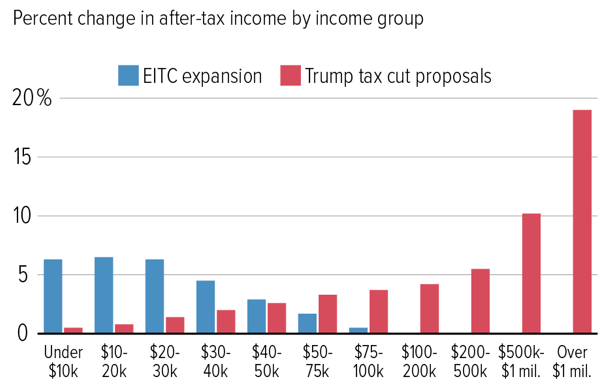


 There are a few definitions of capital. Here, whenever I use the word, I am referring to property such as money, land, housing, and tools that people own that they do not require for their basic needs such as food, shelter, healthcare, and transportation to and from work. In our society this type of capital can be uniquely used to earn more capital without the necessity to do any labor. Rather than labor, capital earns more capital via rental properties and interests from other investments. The way our society is structured, it is only the rich that have a significant amount of capital.
 Those who are in a significant portion of the middle class actually have to supplement their labor earnings by taking out loans to pay for their homes, cars, and post high school education. The interest that they pay on these loans go to financial institutions that the rich benefit by having investments in them.
 The phenomenon of capital eliminates the requirement for rich people to labor in order to earn their basic needs. In fact, without labor, their capital most often keeps increasing, which is referred to as capital gains. So, even when the rich pay higher taxes then the middle class, they tend to live far more lavishly, only work if and when they want, and their capital continues to increase at no pains taken by them.
 So, for those middle class folks who support the new US tax policy, I suggest that they take a good look at the YouTube video of the capuchin monkey who is throwing cucumber slices at the experimenter. Perhaps these middle class people can learn from the monkey a basic principle of fairness and equity.
 Today, let’s see if we can tie together some of the loose threads of my
 We also discussed that in contrast to Joni’s position is the medical model, which views people who experience depression as having an illness that requires, as the first line of treatment, taking pills that are called “antidepressants.” Many who hold this view have absolutely no respect for people who hold the view expressed by Joni.
 Tolstoy goes on to explain how his melancholy stimulated a gnawing questioning that eventually led to one insight after another. His trouble had not been with life in general, not with the common life of common men, but with the life of the upper, intellectual, artistic classes, the life that he had personally always led, the cerebral life, the life of conventionality, artificiality, and personal ambition. He had lived wrongly and had to change.
 Then, one day in early spring, while he was alone in the forest listening to its mysterious noises, he was filled with a sense of deeper meaning. “After that,” he wrote, “things cleared up within me and about me better than ever, and the light has never wholly died away.” According to Tolstoy, his suicidal feelings disappeared, and he went on to live a productive life until he passed away at the age of 82 of natural causes.
 The great psychologist and philosopher William James was someone who viewed the pathologizing of human experience as simple minded and nothing more than superficial medical talk. Rather than resorting to mentally ill jargon, the good professor explained in his monumental book, Varieties of Religious Experience, his view of Tolstoy’s experience:
 Tolstoy’s anguishing experience appeared at first to come on him as if out of the blue. Later, Tolstoy came to understand it as having been due to living wrongly. Only by questioning deeply and repeatedly the meaning of his despair did he come to this understanding.
 In my previous post, we saw that Joni Mitchell was not only experiencing the physical sensations of depression. Fully part of her experiences was to delve deeply into several concerns– “How am I going to get back in the saddle? And what about the audience? Would you still love me if you knew what I was really like?” She sought help from a psychotherapist.
 He selected learning to meditate, and to get more exercise in order to work off his anger in a positive, healthy manner. He learned the value of saying more supportive things to people he met, and to himself as well. He came to realize the value of minimizing the negative criticism that he provided, and when he did criticize, to do so in a far more charming manner. In the end, he made a new group of friends, joined AA, and was in a far more healthy state when my services came to an end.
 For example, those interested in the history of psychology may learn how the brilliant psychologist and philosopher William James viewed his “bass notes of experience” (see


 And then she was introduced to Nietzsche, and learned from him that to live is to suffer, to survive is to find meaning in the suffering.
 And then, in the midst of all of these swirling heartfelt feelings, the words and music for her next album, For the Roses, began to flow through her soul.
 Of course, there is a great deal more to the life of Joni Mitchell. Nevertheless, I shall pause here, for I think I achieved my purpose of giving readers an added sense of the creative temperament view of depression. In one of her interviews that appears in Yaffe’s biography, Joni explicitly rejected the idea that she was mentally ill.
 Certainly, there were times during which she experienced suffering. But just as suffering occurs as part of the process of giving birth, it can also be part of the process of giving life some deeper, truer meanings to this crazy, incredible experience we call life.
 Myeshia Johnson’s husband, Sgt. La David Johnson, died in an ambush in Niger on Oct. 4, 2017. Shortly afterwards, Mrs. Johnson received a condolence call from President Trump. Mrs. Johnson then told ABC news that the president struck a callous tone during their conversation–telling her, “He knew what he signed up for”–and that he repeatedly forgot her husband’s name.
 Verifying what Mrs. Johnson heard was her long time friend, Frederica Wilson, a Texas congresswoman. Wilson was in the car with Mrs. Johnson when the president’s call came, and Mrs. Johnson chose to put the call on speaker mode so her friend could hear.
 Upon hearing Wilson’s take on what happened, the president publicly derided her as “wacky” and called her account a “total lie.” In doing so, he indirectly said that the grieving widow had lied, since Wilson’s account of what happened matches what the widow said. Additionally, he publicly insulted the widow’s close friend.
 Then, the White House Chief of Staff John Kelly appears in the White House briefing room seeking to defend the president and clarify what had occurred.
 Kelly further explained that in these cases presidents typically write a letter, and he recommended to Trump that he not make calls because “it’s not the phone call that parents, family members are looking forward to.” Nevertheless, Trump elected to make phone calls in the cases of four young men who were killed in Niger. I note here that Trump also chose to politicize his calls by going before the national press to inform the public of his decision, and that former President Obama did not make such phone calls.
 Let me tell you what my best friend, Joe Dunford, told me — because he was my casualty officer [when my son was killed in action]. He said, Kel, he was doing exactly what he wanted to do when he was killed. He knew what he was getting into by joining that 1 percent. He knew what the possibilities were because we’re at war. And when he died, in the four cases we’re talking about, Niger, and my son’s case in Afghanistan — when he died, he was surrounded by the best men on this Earth: his friends.”
 “That’s what the President tried to say to four families the other day. I was stunned when I came to work yesterday morning, and broken-hearted at what I saw a member of Congress doing. A member of Congress [Wilson] who listened in on a phone call from the President of the United States to a young wife, and in his way tried to express that opinion — that he’s a brave man, a fallen hero, he knew what he was getting himself into because he enlisted. There’s no reason to enlist; he enlisted. And he was where he wanted to be, exactly where he wanted to be, with exactly the people he wanted to be with when his life was taken.
 “It stuns me that a member of Congress [Wilson] would have listened in on that conversation. Absolutely stuns me. And I thought at least that was sacred….”
 Kelly finished up by further attacking Wilson, calling her an empty Barrel and falsely claiming she used a speech commemorating a building named for two fallen FBI agents to brag about her role in getting funds for the project. A video of the event shows that this did not happen, but Kelly, like his boss, Trump, has been refusing to apologize.
 Here I’ll make a few general comments about condolence calls, and then give my personal critique of how the president and his chief of staff handled this situation.
 Condolence calls, in my opinion, are about paying one’s respect to the bereaved. This involves giving the bereaved a chance to express their grief and joy for having had the opportunity to share a life together. For the person who is mourning, it is very important to know there are people who are supportive of what they are going through. So the condolence call lets those in the family, and others particularly close to the deceased, know you are thinking about them in their time of need. It also gives you an opportunity to share in that grief.
 The general format of what to say is something like this, “I am truly sorry for your loss.” Then we listen in a caring manner.
 Upon making such comments, the bereaved party may often make some replies, and here again, listening in a caring manner is crucial. The main focus is on a caring tone, and saying things that you feel would be helpful to the bereaved, while avoiding attacking the bereaved for any perceived transgressions.
 Another example of this occurred when then President George W. Bush met the families of slain soldiers. Some screamed at him and blamed him for their deaths. Bush stood and took it, holding them and weeping with them. Despite those verbal attacks occurring in a public setting, he never tried to defend himself by insulting any of the family members.
 “I went over there [to Arlington National Cemetery] for an hour-and-a-half, walked among the stones, some of whom I put there because they were doing what I told them to do when they were killed.”
  Another miscalculation, in my opinion, came when Kelly took great offense that Mrs. Johnson chose to put her phone on speaker mode when Trump made the call to her. Framing it as violating something sacred seems to me as rather puzzling. Where did Kelly get this principle that it is somehow sacred for a grieving woman to not share a president’s call with others? This is certainly not anything I, or anyone else that I talked with, ever heard of. Rather than becoming angry about some unheard of principle of sacredness, it seems far more plausible that he was actually incensed that there was a witness to the call that didn’t go down very well.
 Another thing that I would have also done is to let the public know that in order to better handle these types of situations I shall be inviting a large group of Gold Star family members to the White House to confer with them on their views about what is the best way for US presidents to respond whenever loved ones die in combat. After all, paying one’s respect to Gold Star families should not be about what the president views as helpful, but rather what the family members view as helpful.
 Finally, from the personal perspective of this writer, Trump’s effort to make the condolence calls a way to make political points by saying Obama didn’t make such phone calls failed miserably to achieve its purpose.
 On Sunday, November 5, 2017, I sat down in front of my computer to write this week’s blog post. Just as I put my fingers on my computer keyboard, a little message popped up in the lower right hand screen of my monitor. I glanced over to see that at a Texas church in the small town of Sutherland Springs numerous people had been shot and over twenty had died.
 At one point, a camera showed a young woman who may have been one of the mothers whose child was killed. The anguish and horror on her face as she listened on a cellphone led to tears streaming down my face.


 About a minute later, Ivy takes her mother’s hand and leads her back into the store. The rest of the shopping experience goes by without any further disruptions.
 “Well,” says Aaron, “another week has gone by, so it is time to have another family meeting. We have these meetings because we love each other and we want to celebrate things that are going well for the family and we also want to figure out ways to solve problems so things keep getting better and better.”
 “I like the way Joel and I played catch before dinner tonight,” says Aaron. “I was throwing these high flies to him, and he caught almost every one!”
  “Yeah, Dad,” Joel replies. Last night you yelled at me when it was time to go to bed. That’s not very respectful.”


 Your insurance company requires that I must place a diagnosis on your health insurance form for you to access that service. I hear, so far, that you are concerned about….”
 “Well, I wish we didn’t have to get into this labelling issue. Personally, I think it’s best to treat each person that I provide counseling to as an individual. It is understandable that many people don’t want to be placed in a diagnosis box, especially one known to be stigmatizing. But the insurance companies do require a diagnosis.”

 In my journal article, I go on to propose a practical, more scientific alternative to the DSM. I call this alternative, the Classification and Statistical Manual of Mental Health Concerns (CSM). The first words in the CSM would be: “The developers of the CSM fully recognize that individuality outruns any classification system. It is for this reason that the CSM does not seek to classify anyone. Instead, it classifies the expressed concerns of individuals seeking to have their concerns addressed by a mental health service provider.”
 On the other hand, some resisted the CSM approach. As I began to question them, seeking to figure out where exactly the disconnect was, I discovered that for some, it had to do with their belief that the DSM is a classification system based on solid principles of science and nothing could possibly be better. As I questioned them further, I discovered that their understanding of what a scientific classification system is designed to do was a bit incomplete. So, in today’s post, I explain in an easy to understand manner the nature of scientific classification systems, beginning with a description of a classification system with which we are all so very familiar–birds. This will enable us to see clearly why the bird classification system is useful as a scientific instrument. We will then look at the DSM classification system in light of what we learned about the bird system, and this will reveal the DSM‘s serious scientific shortcomings. Finally, we will compare and contrast the DSM system with the proposed CSM system in a manner that can make the superior scientific merits of the latter crystal clear.
 As it turns out, there are some people very interested in birds.
 Once scientists carefully define their general topic of interest, they describe different types of what they are interested in. So in our bird example, the scientist interested in them came up with a taxonomy that lists bluejays, pigeon, sparrow, and so forth as subtypes of the general category of birds, describing each subtype in a precise manner that can reliably distinguish each from the others on their list. Why bother to do this?
 The main reason is that when they discuss their findings with others, they want to make sure they are using words that mean the same thing, and it is a great time saver. For example, let’s say John is a bird scientist and he says to Judy, another scientist, “I saw a bird the other day and I didn’t know what type it was; can you help me figure out what it is?” Notice that since both of these scientists know the meaning of a bird, it saves John quite a few words. Just imagine if instead every time John uses the word bird he had to say, “I saw something that had an endothermic vertebrae, characterized by feathers, toothless beaked jaws, the laying of hard-shelled eggs, a high metabolic rate, a four-chambered heart, and a strong yet lightweight skeleton.” That’s quite a mouthful to have to say each and every time you refer to a bird. In this example, just saying bird saves a scientist about 30 words each time the word bird is used.
 And let’s say John, the scientist, wants to find in a library some information about a particular type of bird. He would have to waste time looking at every single book in his library until he found one that seemed to be talking about what he was interested in.
 This would result in John having to unnecessarily wade through numerous books on flying insects, of which there are hundreds of thousands of types, bats, and some fish that sort of can fly. With the current bird classification system, anyone can go to a library and quickly find the specific section that houses information on just birds. Similarly, placing the word “bird” in a search engine enables John to more quickly retrieve relevant information than would a less explicit definition.
 “In the DSM-IV, each of the mental disorders is conceptualized as a clinically significant behavioral or psychological syndrome or pattern that occurs in an individual and that is associated with present distress (e.g., a painful symptom) or disability (i.e., impairment in one or more important areas of functioning) or with a significant increase risk of suffering death, pain, disability, or an important loss of freedom.”
 The latest edition of the DSM (DSM-5) is just as vague. It begins, “Although no definition can capture all aspects of all disorders in the range contained in the DSM-5, the following elements are required.” Although it says the following elements are required, it then makes it clear that the elements that it lists are not required. As I provide the rest of the definition, notice the use of the word “or” and “usually.”
 “A mental disorder is a syndrome characterized by clinically significant disturbance in an individual’s cognitive, emotion regulation, or behavior that reflects a dysfunction in the psychological, biological, or developmental process underlying mental functioning. Mental disorders are usually associated with significant distress in social, occupational, or other important activities. An expected or culturally approved response to a common stressor or loss, such as the death of a loved one, is not a mental disorder. Socially deviant behavior (e.g., political, religious, or sexual) and conflicts that are primarily between the individual and society are not mental disorders unless the deviance or conflict results from a dysfunction in the individual, as described above.”
  This is about as vague a descriptor as one can possibly conjure up. How about the descriptor “dysfunction?” This, too, is left to the subjective opinion of mental health providers who often have financial interests in declaring that someone has a mental disorder.

 I, for one, am interested in a phenomenon that I, and others, call mental health concerns. Obviously there is wide interest in this. After all, there are numerous educational institutions that provide training to people so they can become credentialed to address mental health concerns. Numerous people actually voluntarily go to these educational institutions, devoting considerable time and expense. Once completing the credentialing requirements, they apply to their state credentialing board, pay a fee, and then after the board checks to see if all of its requirements have been fulfilled, it grants a license permitting the person to legally provide mental health services. That person then sets up a practice that offers mental health services. People wishing to access these services first devote some time to decide where to go. They then make an appointment, show up for the appointment, and then express their mental health concern to the mental health service provider. Aspects of all of this occur each and everyday and involves tens of thousands of people working in a coordinated fashion to have mental health concerns addressed in a professional manner.
 This definition of a mental health concern requires all of the following items for a mental health concern to exist:
 Also notice that no one doubts that each of the 4 listed items that, taken together, make up the mental health concern concept exists. Everyone agrees that there are people who seek mental health services in our society. Everyone agrees there are people licensed to provide mental health services. If you go further down the list, there is no question whatsoever, that these other conditions also exist. So the definition, I contend, meets the scientific standard that it describes the something of interest (mental health concern) in a clear and detailed manner, leaving no room for confusion or doubt. Once the CSM classification system comes to be fully developed, people would be able to use the term “mental health concern” as a short way to indicate a phenomenon that contains all four of its defining characteristics.
 With regards to the various types of concerns that mental health service providers are asked to address by those seeking their services, two major types would be, 1. concerns expressed about oneself, and 2. concerns expressed about someone else. Under the headings of each of these two major types would be concerns regarding behavior, emotion, mood, meaning of life, death, dying, managing chronic pain, addiction, work, relationships, education, eating, cognition, sleep, hearing voices others don’t hear, and challenging life situations. This, of course, is just a preliminary list of types, and through survey data that ask psychologists and mental health advocacy groups about the various mental health concerns that they are asked to address, the list would become more fully developed.
 The above explanation was designed to clarify just one of the reasons why the proposed CSM’s mental health concern concept provides a far more solid scientific foundation on which to build a classification system than the DSM‘s mental disorder concept. Despite the fact that many people have become convinced that the DSM‘s classification system is a sound scientific instrument, its definition is far more vague than how I propose defining a mental health concern.
 Recently, I wrote a post titled “
 “Oh, yes!” he cries enthusiastically. “He’s great!”
 With little more than a public high school education, you managed to save a little money to open your own small convenience store. From your background, isn’t there anything indicating to you that Trump is not out to help people like you and those in your family and community?”
 “Donald Trump, who was born rich, went to the finest private schools, was set up in the real estate business by his wealthy father, has always associated with rich people. He was over 70-years old when he began to run for president, and prior to that never showed any passion to help people like you and me. In fact, he has a long history of screwing people like us. You really think Trump cares one bit about people like you? Sure, he’ll say anything to get your vote, but we’ve seen him lie over and over again.”
 His Trump University project ended up costing 30 million dollars to settle charges of fraud. You say he’s not beholden to anyone, but he and his associates are beholden to their own enormous financial interests. That’s why he has put the richest people he could find in top political positions.”
 Under Obama, unemployment went from 10 percent to 5 percent, and the economy was improving steadily while he was in office. The fact that it has slightly further improved the first few months under Trump was during a time when there was not a single congressional bill passed designed to aid the economy. Despite this, you are completely convinced that the improvement, slight as it is, has to do with Trump?”
 “OK, if that’s what you believe. Let’s move on to health care. Trump vaguely said when he was running for president that he had a great health plan he would enact as soon as he is elected. He said he will repeal and replace the Affordable Health Care Plan, and his own plan would be great and cover everyone. It turned out that he had no plan of his own. The plan he first supported came out of the House of Representatives, a bill that cut coverage for millions according to the Congressional Budget Office, so he plainly lied. Then, when the bill went to the Senate, they didn’t like it and so Trump ended up saying that the House bill was really mean. Then he supported the Senate bill that also cut services for millions of Americans. Nothing got passed, and he antagonized in the process the very people he has to work with if he is to get anything of his agenda through the congressional process. Why do you remain so gullible that he knows what he is doing and trust what he says?”
 And people can climb over walls using rope ladders or cherry pickers. Drilling a little hole in the wall and sticking a stick of dynamite in it will blast a hole in the wall that will allow people to walk right through it. In a matter of a few years the wall will look like Swiss cheese. Maintaining the wall will cost tax payers like you and me billions and billions of dollars. His arguments for the need for the wall makes absolutely no sense.”
 Now that we looked over today’s parable, let’s see if we can determine how well our Trump supporter utilized the three sets of skills that help to keep us from being gullible–Plausibility Checking, Trust Calibration, and Assessing Argumentation.
 In the parable, the only evidence I can see that Bob used any plausibility checking occurs when he says Trump is a business man. Apparently that is enough for him despite the fact that the practice of business pits some business interests with other interests. When Ann points out that Trump’s business interests lie in big business and Bob’s business is a small business, this has no apparent effect on him.
 The final skill set that helps to prevent people from being strongly gullible is “Assessing Argumentation.” In the parable, Bob does mention that Trump’s rhetoric appears to have led to the economy improving. But he does not explain why he is convinced that Trump’s rhetoric is the reason for the improved economy. Moreover, Bob’s support that somehow building a wall on the Mexico border makes sense is backed up with nothing more then declaring that we have to stop illegal immigration. There is not a single argument that he provides to defend that the wall would be a reasonable way to accomplish what he desires.
 The scene, the offices of a large import, export business. Alice and Jill have just left their desks to go to lunch.
 As examples of these skills, Mr. Mercier points out that studies demonstrate that participants find less compelling an argument from authority when the authority is not an authority in the relevant area, or if he or she has a vested interest. In an earlier post titled, “