
Welcome to From Insults to Respect.
 No doubt you have all noticed the recent commotion over the new US White House policy of raising tariffs on some manufactured goods. There are those who are enthusiastically supporting this, while others are vehemently arguing that we would be far better off sticking to the previous policy. Well, from my way of thinking, both policies have serious drawbacks. So, in today’s post I would like you all to consider a far wiser alternative, one that I call a “Regional Manufacturing Policy.” Before I explain this alternative, and why it would be so much better, particularly for respecting the environment, let’s review the current commotion as it stands now.
The Current Commotion
The new “raising tariffs policy” is being hailed by President Trump as just the beginning of a trade war that is “easy to win.” He is beginning with steel and aluminum while considering other tariff raises as well.
 Countries that have established trade policies with the US after long and hard negotiations see this move by the Trump administration as a violation of trust and some are threatening retaliation. When the US administration said it might exempt Canada and Mexico, this led to other countries expressing that they are being treated disrespectfully for they have been US allies for years.
Why Trump has decided to focus first on steel and aluminum is not hard to fathom. He managed to win the majority of presidential electoral votes in the state of Pennsylvania by the slimmest of margins. When he campaigned there, he promised to raise tariffs to help the state’s manufacturing industry. If he doesn’t keep his promise, he would have about the same chance of winning Pennsylvania again in the next presidential election as a Nazi would in the state of Israel.
 The reasons some support the raising of tariffs are several. The US has the knowhow to produce any of the goods that would be considered for a tariff increase. US workers are eager to do the job as long as it pays at least a living wage; that is, a wage that permits a person working 40 hours a week, with no additional income, to afford the basics for a modest but decent life, such as, food, shelter, utilities, transport, health care, and child care. Although other countries have workers who are willing to do the job for lower salaries, there are several benefits to the US if it sticks to having US citizens do jobs that can competently be done by them. Though prices may go up a few dollars per item if the US keeps manufacturing jobs in the US, people earning the money in the US will spend their earnings in the US, helping the national economy. Fewer US citizens will need to be drawing on welfare programs. There is a pride that goes along with having local workers being part of what keeps the country rolling along.

The argument that the cost of goods in the US would skyrocket if we didn’t rely on foreign manufacturing seems hollow to those who have lost their jobs to foreign workers. Many remember a time before their jobs went overseas. Products such as cars and refrigerators were being manufactured at affordable prices back then. Moreover, the price of a particular product is not based so much on what the workers get paid, but on what the market will bear. The real reason the jobs went overseas, according to many advocating for the tariffs is not to keep prices for consumers down, but rather to increase the profits of corporations that distribute their financial windfall to their rich stockholders.
 Complicating all of this is the fact that other countries buy some of the manufactured goods made in the US. If the US reduces foreign product purchases because tariffs make them too costly, foreign countries may raise tariffs on US products leading to making them so costly fewer foreigners will buy those products. Then those corporations’ employees in the US that are manufacturing these products will lose their jobs. Pennsylvania workers could end up with an improved job situation while other states will end up with a worse job situation. The complexities in this type of trade war make it extremely difficult to predict what the final outcomes will be.
In broad strokes, the above summarizes how the media describes what the tariff commotion is all about. What you don’t hear about is the major problem with both the new increasing tariff policy and the policy that existed before this commotion began.
Existing Trade Policies’ Effect on the Environment
Why is the trade policy we had prior to the new tariffs terrible for the environment? Consider Ford Motor Company that is located in Detroit. Ford could, under the prior trade policy, decide to buy the steel used to manufacture its cars from China, several thousand miles away, even if Canada has a steel plant a few hundred miles away eager to supply Ford all the steel it needs. Meanwhile, Toyota has an auto manufacturing plant in the Atlanta area. Rather than buy its steel from Pennsylvania, a few hundred miles away, it also can decide to buy its steel from China.  The corporations may make this decision because Chinese workers are paid sufficiently less and the power plants that are used can be run at less expense because there are less pollution control requirements. The result is more profits by maintaining the current policy than if a decision was made to manufacture all manufactured goods within the region those goods are to be sold.
Note also that both Ford and Toyota use their plants to basically assemble their cars. The parts that they use in assembling the cars are made all over the world, from South Korea, Germany, Brazil, etc. And so, to manufacture a car in Detroit and Atlanta, thousands of huge ships are churning their way across huge oceans to bring all of these manufactured parts to seaports.  According to an investigative report form the UK newspaper the Daily Mail, the 16 biggest ships in the world produce more pollution than all the world’s cars. This is because of the higher levels of sulphur oxides and nitrous oxides that large container vessels produce when compared to cars.
Once the ships dock into port, their cargo is then loaded onto trucks to further get these parts to the assembly plants. Then, when the cars are fully assembled, many are sent thousands of miles away for sale in South Korea, Europe, etc. All of this extra needless transportation leads to kicking out tons and tons of pollution for us and the next few hundred generations to breath and to suffer global warming consequences.
 The alternative, raising tariffs plan, offers no real significant improvement in protecting the environment. Prior to Trump announcing his policy to raise tariffs, there were already numerous tariffs in place that were negotiated by all the concerned stakeholders. Despite that, millions and millions of miles of needless transportation was still going on. Meanwhile, the increase of tariffs lead to allies becoming enraged, lawsuits are already being filed, and final consequences of all of the stirred up ill will are unlikely to lead to benefits for all but a very few.
Regional Manufacturing Policy (RMP)
 Imagine the United Nations coming to an agreement about a policy that is in the interest of protecting the environment. This policy calls for a three-year transition period that leads to all manufactured goods that are sold in a region being fully manufactured in that region, with the workers getting paid at least a living wage.
To envision what I mean by this policy, note that right now Toyota is a car manufacturing corporation centered in Japan and it manufactures many of its cars in that region. Nevertheless, it has opened a manufacturing plant in the US region, cutting some of the transportation requirements that would be necessary if it manufactured all of its cars in Japan.
Although this is a step toward a RMP, Toyota still has many of the parts that go into manufacturing its US made cars manufactured in other parts of the world. A true RMP would have all of the manufactured parts, including steel and electronic parts, made in the region those cars are to be sold.
 To further envision what a RMP would require, imagine North America being divided into 5 or 6 regions, Europe divided into 2 or 3 regions, and so on. If Apple intends to sell its iPhones in each of these regions, it would be required by RMP to create manufacturing plants in each of these regions, thus dramatically reducing miles of transportation, along with the pollution that goes with it.
In thinking about RMP, some will find themselves concerned about all of the jobs that will be lost in the transportation industry. But note that within a few years driverless vehicles will become a practical way to transport goods, so it is now time to begin to help these workers to learn new skills for the jobs of the future. A humane way to make this transition is to extend unemployment benefits long enough for these transportation workers to learn these new skills and to make the training affordable.
Benefits of RMP extend well beyond environmental considerations. Tariffs produce anger, feelings of disrespect, and reprisals. Imagine, instead, a world that has its citizens joining together to make RMP work because it is the right thing to do for our planet and for future generations.
Admittedly, the current trade winds don’t appear favorable for the path I am here advocating. Just as I was completing this post I happened to glance at today’s New York Times and saw the following headline:
“E.P.A. Prepares to Roll Back Rules Requiring Cars to Be Cleaner and More Efficient.”
 The article goes on to say, “The Trump administration, handing automakers a victory, is preparing to announce an effort to weaken strict Obama-era pollution standards.”
Yes, such news is understandably discouraging. Nevertheless, any fine sailor will tell you that it is common for a journey to meet up with stormy seas, and yet all the mates working together still succeed in bringing their ship into their desired port.


 “12% of patients will benefit from the treatment, while the remaining 88% will suffer the adverse effects of treatment without any additional therapeutic benefit beyond placebo. Those are the odds that a person contemplating taking an antidepressant drug might want to know.”

 Whenever we learn of a mass shootings, we hear people unfairly connecting the horrendous murderous acts to people who have been classified as having a mental illness.
  For example, at one point immediately after one such tragic event, Paul Ryan, the former speaker of the House, announced, “People with mental illness are getting guns and committing these mass shootings.” Such statements connect in the minds of the public the notion that people who have been labelled mentally ill are dangerous, thereby promoting the stigmatizing of a group of people, the vast majority of whom are no more violent than average citizens.
 In one series of studies we find that violence involvement during adolescence is also a potent risk factor for ongoing violence involvement well into young adulthood (
 People who have been labelled mentally ill come from a full range of social and economic conditions. At the same time, such labelled people are somewhat more likely to be exposed to social and economic risk factors such as poverty, crime victimization, involvement with illegal drugs and drug markets, early life trauma exposure, and ambient neighborhood crime. Perhaps it is this exposure, rather than the vague notion of mental illness, that leads to the statistical increased risk of violence among mentally ill labelled people. Examining this possibility, Swanson et al. (see
  The mental illness explanation for the school atrocities is far too simplistic, unfairly stigmatizes an enormous number of nonviolent individuals, and diverts our attention from coming to understand the real factors that are involved.
 This week I happened to be listening to the old Graham Parker song, “Nobody Hurts You.” As I interpret the lyrics and how they are sung, it seems to me that they are a useful jumping off point for a discussion about so many of us being, at times, so disrespectful to ourselves.
 Hey baby, I’m out of favor
 Suffocating in suburbia
 One of the most common way that we begin to hurtfully treat ourselves is when we perceive someone is treating us disrespectfully. Apparently, some people are less likely to succumb to this pattern. I came upon a great example of someone who utilized an alternative pattern while reading Ron Chernow’s best selling biography of Ulysses S. Grant.
 Grant was widely respected in his day, not only for his leadership during the Civil War, but also for his tenure as US President, serving a full two terms. Sure, he had his flaws, as all human beings do. Nevertheless, his pattern of dealing with perceptions of disrespect does suggest the possibility that it is possible to achieve respect with the use of his pattern.
 If you can keep your head when all about you
  It may be true that some of us are born with a calmer, more supportive way to react to perceptions of disrespect. If you believe this, you may come to believe that there is nothing you can do to change your innate pattern. However, I, and many others as well, have found that if we come to realize lashing out at others and ourselves at such times is less than ideal, there are some very useful skills that can be learned over a period of time despite innate tendencies.
 Now, a major reason people become discouraged from taking helpful action to learn such skills is that they read on this topic, became convinced that the skills make sense, but end up finding that this understanding led to no change in their own behavior. “Oh, I know all about such skills,” they say to themselves, “but with my temperament, I can’t really do anything about this.”
 Learning skills that are helpful to respond to perceptions of disrespect is similar in many ways. To learn them, you have to apply what you have heard or read by first doing them under relatively safe circumstances, make mistakes, and try again and again until you get smooth at coordinating the skills even in very challenging circumstances.
 Some counselors and psychotherapists will also encourage you to learn to meditate and utilize other mindfulness techniques. Here you practice observing your physical sensations when you are dealing with the disrespectful perceptions. In time, the disrespectful words that you tend to direct at yourself come to lose their disturbing nature. For a period of time these words still come, but you end up smiling at them as you realize they are not matching reality. In time, they may completely fade away.
 In the study, primatologists Sarah F. Brosnan and Frans B.M. de Waal trained capuchin monkeys to perform a certain task for which they receive, as a reward, cucumber slices. The monkeys performed the task just fine until they were permitted to see another monkey being rewarded with grapes, a higher-value payment. Suddenly many of the cucumber-receivers refused the cucumber, sometimes even throwing those measly, unfair cucumber payments at the experimenter who was giving out the reward. In a delightful YouTube video that you can access for free
  The new tax policy would deliver more than 50 percent of its benefits to the top 1 percent, according to an
  Trickle-down economics, also referred to as trickle-down theory, is an economic theory that advocates reducing taxes on businesses and the wealthy in society as a means to stimulate business investment in the short term and benefit society at large in the long term. For those who want to see how much support there is for this theory, I suggest placing the following words into your search engine–Trickle-down theory, evidence for support. By doing so, you will find that the theory has been a dismal failure. For a brief summary of these findings, I recommend Wikipedia’s entry on this topic. Here are some quotes:
 The term trickle-down originated as a joke by humorist
  Representative Ro Khanna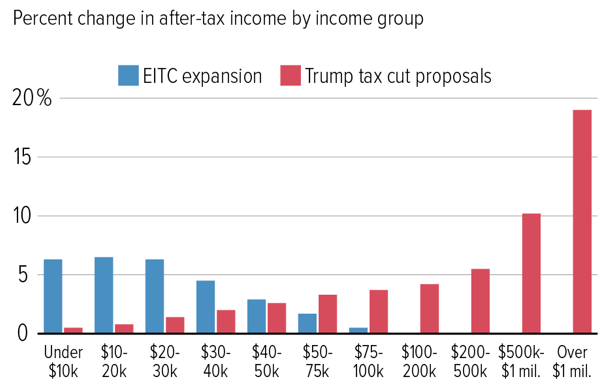


 There are a few definitions of capital. Here, whenever I use the word, I am referring to property such as money, land, housing, and tools that people own that they do not require for their basic needs such as food, shelter, healthcare, and transportation to and from work. In our society this type of capital can be uniquely used to earn more capital without the necessity to do any labor. Rather than labor, capital earns more capital via rental properties and interests from other investments. The way our society is structured, it is only the rich that have a significant amount of capital.
 Those who are in a significant portion of the middle class actually have to supplement their labor earnings by taking out loans to pay for their homes, cars, and post high school education. The interest that they pay on these loans go to financial institutions that the rich benefit by having investments in them.
 The phenomenon of capital eliminates the requirement for rich people to labor in order to earn their basic needs. In fact, without labor, their capital most often keeps increasing, which is referred to as capital gains. So, even when the rich pay higher taxes then the middle class, they tend to live far more lavishly, only work if and when they want, and their capital continues to increase at no pains taken by them.
 So, for those middle class folks who support the new US tax policy, I suggest that they take a good look at the YouTube video of the capuchin monkey who is throwing cucumber slices at the experimenter. Perhaps these middle class people can learn from the monkey a basic principle of fairness and equity.
 Today, let’s see if we can tie together some of the loose threads of my
 We also discussed that in contrast to Joni’s position is the medical model, which views people who experience depression as having an illness that requires, as the first line of treatment, taking pills that are called “antidepressants.” Many who hold this view have absolutely no respect for people who hold the view expressed by Joni.
 Tolstoy goes on to explain how his melancholy stimulated a gnawing questioning that eventually led to one insight after another. His trouble had not been with life in general, not with the common life of common men, but with the life of the upper, intellectual, artistic classes, the life that he had personally always led, the cerebral life, the life of conventionality, artificiality, and personal ambition. He had lived wrongly and had to change.
 Then, one day in early spring, while he was alone in the forest listening to its mysterious noises, he was filled with a sense of deeper meaning. “After that,” he wrote, “things cleared up within me and about me better than ever, and the light has never wholly died away.” According to Tolstoy, his suicidal feelings disappeared, and he went on to live a productive life until he passed away at the age of 82 of natural causes.
 The great psychologist and philosopher William James was someone who viewed the pathologizing of human experience as simple minded and nothing more than superficial medical talk. Rather than resorting to mentally ill jargon, the good professor explained in his monumental book, Varieties of Religious Experience, his view of Tolstoy’s experience:
 Tolstoy’s anguishing experience appeared at first to come on him as if out of the blue. Later, Tolstoy came to understand it as having been due to living wrongly. Only by questioning deeply and repeatedly the meaning of his despair did he come to this understanding.
 In my previous post, we saw that Joni Mitchell was not only experiencing the physical sensations of depression. Fully part of her experiences was to delve deeply into several concerns– “How am I going to get back in the saddle? And what about the audience? Would you still love me if you knew what I was really like?” She sought help from a psychotherapist.
 He selected learning to meditate, and to get more exercise in order to work off his anger in a positive, healthy manner. He learned the value of saying more supportive things to people he met, and to himself as well. He came to realize the value of minimizing the negative criticism that he provided, and when he did criticize, to do so in a far more charming manner. In the end, he made a new group of friends, joined AA, and was in a far more healthy state when my services came to an end.
 For example, those interested in the history of psychology may learn how the brilliant psychologist and philosopher William James viewed his “bass notes of experience” (see


 And then she was introduced to Nietzsche, and learned from him that to live is to suffer, to survive is to find meaning in the suffering.
 And then, in the midst of all of these swirling heartfelt feelings, the words and music for her next album, For the Roses, began to flow through her soul.
 Of course, there is a great deal more to the life of Joni Mitchell. Nevertheless, I shall pause here, for I think I achieved my purpose of giving readers an added sense of the creative temperament view of depression. In one of her interviews that appears in Yaffe’s biography, Joni explicitly rejected the idea that she was mentally ill.
 Certainly, there were times during which she experienced suffering. But just as suffering occurs as part of the process of giving birth, it can also be part of the process of giving life some deeper, truer meanings to this crazy, incredible experience we call life.
 Myeshia Johnson’s husband, Sgt. La David Johnson, died in an ambush in Niger on Oct. 4, 2017. Shortly afterwards, Mrs. Johnson received a condolence call from President Trump. Mrs. Johnson then told ABC news that the president struck a callous tone during their conversation–telling her, “He knew what he signed up for”–and that he repeatedly forgot her husband’s name.
 Verifying what Mrs. Johnson heard was her long time friend, Frederica Wilson, a Texas congresswoman. Wilson was in the car with Mrs. Johnson when the president’s call came, and Mrs. Johnson chose to put the call on speaker mode so her friend could hear.
 Upon hearing Wilson’s take on what happened, the president publicly derided her as “wacky” and called her account a “total lie.” In doing so, he indirectly said that the grieving widow had lied, since Wilson’s account of what happened matches what the widow said. Additionally, he publicly insulted the widow’s close friend.
 Then, the White House Chief of Staff John Kelly appears in the White House briefing room seeking to defend the president and clarify what had occurred.
 Kelly further explained that in these cases presidents typically write a letter, and he recommended to Trump that he not make calls because “it’s not the phone call that parents, family members are looking forward to.” Nevertheless, Trump elected to make phone calls in the cases of four young men who were killed in Niger. I note here that Trump also chose to politicize his calls by going before the national press to inform the public of his decision, and that former President Obama did not make such phone calls.
 Let me tell you what my best friend, Joe Dunford, told me — because he was my casualty officer [when my son was killed in action]. He said, Kel, he was doing exactly what he wanted to do when he was killed. He knew what he was getting into by joining that 1 percent. He knew what the possibilities were because we’re at war. And when he died, in the four cases we’re talking about, Niger, and my son’s case in Afghanistan — when he died, he was surrounded by the best men on this Earth: his friends.”
 “That’s what the President tried to say to four families the other day. I was stunned when I came to work yesterday morning, and broken-hearted at what I saw a member of Congress doing. A member of Congress [Wilson] who listened in on a phone call from the President of the United States to a young wife, and in his way tried to express that opinion — that he’s a brave man, a fallen hero, he knew what he was getting himself into because he enlisted. There’s no reason to enlist; he enlisted. And he was where he wanted to be, exactly where he wanted to be, with exactly the people he wanted to be with when his life was taken.
 “It stuns me that a member of Congress [Wilson] would have listened in on that conversation. Absolutely stuns me. And I thought at least that was sacred….”
 Kelly finished up by further attacking Wilson, calling her an empty Barrel and falsely claiming she used a speech commemorating a building named for two fallen FBI agents to brag about her role in getting funds for the project. A video of the event shows that this did not happen, but Kelly, like his boss, Trump, has been refusing to apologize.
 Here I’ll make a few general comments about condolence calls, and then give my personal critique of how the president and his chief of staff handled this situation.
 Condolence calls, in my opinion, are about paying one’s respect to the bereaved. This involves giving the bereaved a chance to express their grief and joy for having had the opportunity to share a life together. For the person who is mourning, it is very important to know there are people who are supportive of what they are going through. So the condolence call lets those in the family, and others particularly close to the deceased, know you are thinking about them in their time of need. It also gives you an opportunity to share in that grief.
 The general format of what to say is something like this, “I am truly sorry for your loss.” Then we listen in a caring manner.
 Upon making such comments, the bereaved party may often make some replies, and here again, listening in a caring manner is crucial. The main focus is on a caring tone, and saying things that you feel would be helpful to the bereaved, while avoiding attacking the bereaved for any perceived transgressions.
 Another example of this occurred when then President George W. Bush met the families of slain soldiers. Some screamed at him and blamed him for their deaths. Bush stood and took it, holding them and weeping with them. Despite those verbal attacks occurring in a public setting, he never tried to defend himself by insulting any of the family members.
 “I went over there [to Arlington National Cemetery] for an hour-and-a-half, walked among the stones, some of whom I put there because they were doing what I told them to do when they were killed.”
  Another miscalculation, in my opinion, came when Kelly took great offense that Mrs. Johnson chose to put her phone on speaker mode when Trump made the call to her. Framing it as violating something sacred seems to me as rather puzzling. Where did Kelly get this principle that it is somehow sacred for a grieving woman to not share a president’s call with others? This is certainly not anything I, or anyone else that I talked with, ever heard of. Rather than becoming angry about some unheard of principle of sacredness, it seems far more plausible that he was actually incensed that there was a witness to the call that didn’t go down very well.
 Another thing that I would have also done is to let the public know that in order to better handle these types of situations I shall be inviting a large group of Gold Star family members to the White House to confer with them on their views about what is the best way for US presidents to respond whenever loved ones die in combat. After all, paying one’s respect to Gold Star families should not be about what the president views as helpful, but rather what the family members view as helpful.
 Finally, from the personal perspective of this writer, Trump’s effort to make the condolence calls a way to make political points by saying Obama didn’t make such phone calls failed miserably to achieve its purpose.
 On Sunday, November 5, 2017, I sat down in front of my computer to write this week’s blog post. Just as I put my fingers on my computer keyboard, a little message popped up in the lower right hand screen of my monitor. I glanced over to see that at a Texas church in the small town of Sutherland Springs numerous people had been shot and over twenty had died.
 At one point, a camera showed a young woman who may have been one of the mothers whose child was killed. The anguish and horror on her face as she listened on a cellphone led to tears streaming down my face.


 About a minute later, Ivy takes her mother’s hand and leads her back into the store. The rest of the shopping experience goes by without any further disruptions.
 “Well,” says Aaron, “another week has gone by, so it is time to have another family meeting. We have these meetings because we love each other and we want to celebrate things that are going well for the family and we also want to figure out ways to solve problems so things keep getting better and better.”
 “I like the way Joel and I played catch before dinner tonight,” says Aaron. “I was throwing these high flies to him, and he caught almost every one!”
  “Yeah, Dad,” Joel replies. Last night you yelled at me when it was time to go to bed. That’s not very respectful.”
