
Native Americans vs Palestinians
Are the Palestinians' acts of violence toward Israelis due to not having the types of reservations Native Americans have?
Welcome to From Insults to Respect.
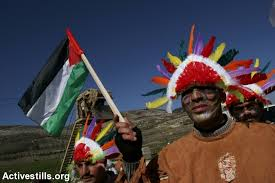 Today we’re going to take a few minutes to compare a Palestinian conflict to one that Native Americans had been engaged in. Doing so, will suggest a path toward peace for the very violence-prone Middle East region.
The Comparison
 The conflict Palestinians are engaged in can be briefly described by using the mnemonic DIG. These letters serve to remind us to dig to identify what party A in the conflict desires, what is interfering with that desire, and what that party believes the other party in the conflict is guilty of doing wrong. (see my “DIG for the Conflict” post for a more complete description of the DIG model.) In the conflict involving the Palestinians, they desire to regain land they lost when the United Nations members voted to create a partition that separated some of the land in the region. Some went to the Palestinians, and some went to what became the country of Israel. Interfering with the Palestinians’ desire is Israel and its supporters refusing to comply with their desire. The Palestinians generally believe Israel and its supporters are guilty of unjustly taking land rightfully belonging to them. For the past eighty years, many Palestinians have engaged in violence in an effort to regain the land taken from them. A similar conflict had befallen the America Natives (often referred to as American Indigenous People or American Indians).
 For several hundred years, American Natives freely resided in the lands we now call the United States (U.S.). When the European settlers came to the U.S., they sought to gain ownership of various parcels of this land. The different authorities that existed over the course of several hundred years organized military forces that supported the settlers. The Native Americans fell into conflict with these settlers, desiring to regain the land they lost to the settlers. Interfering with this desire were military forces supporting the settlers. The Natives believed the military forces were guilty of wrongfully backing the settlers. For several hundred years, many Natives engaged in violence against the settlers in an effort to regain the land taken from them.
Significantly, unlike the Palestinians, for approximately one hundred years the Native Americans have no longer engaged in violence against the settlers. What can account for this?
Why Native Americans No Longer Engage In Violence Against American Citizens?
 When I asked a friend this question, he theorized the Natives have simply been subdued by the sheer might of the American military. I am not convinced of this because the Palestinians have not been subdued despite being acutely aware that the same U.S. military that has supposedly subdued the Native Americans is currently supporting Israel. It seems to me a far more plausible reason Native Americans have ceased to continue the violence is that they successfully negotiated an agreement that established Native American reservations.
It might be thought that the Palestinians were given a reservation–the current partitioned Palestinian lands. However, the conditions for the Palestinians to reside in those lands are dramatically different than what is provided to Native Americans. That is, the Palestinian land is guarded by Israeli military forces. Palestinians are basically imprisoned in this land. In contrast, there are no military forces on the Native American reservation borders. There is nothing preventing Native Americans from leaving their reservations and to return there at will. Without any need for a passport or any other paperwork, Native Americans are free to go anywhere within the U.S. and by 1924 they have been declared U.S. citizens. Moreover, they can just as easily obtain a visa to visit other countries as other U.S. citizens.
 Now, I’m not suggesting that the negotiated agreement concerning reservations has led to an ideal set of conditions for all Native Americans. There remain additional conflicts to be sure. For example, although 75 percent of Native Americans are living better than where the poverty line has been set by economists, understandably there is a desire to further reduce poverty. I’m only saying that the reservation agreement has led to a toning down of aggressive feelings sufficiently so alternative non-violent negotiations have been substituted. To further that end, the U.S. government has a Bureau of Indian Affairs. Past presidential administrations have provided hundreds of millions of dollars to hear and address the concerns of our Native neighbors.
Might this agreement permitting Native Americans to have control of the reservation lands along with being able to freely integrate with the rest of the United States if they so choose, be the reason why Native Americans have ceased their violent ways? We get convincing evidence for this when we take a look at a section of Brooklyn referred to as “Little Palestine.”
Peace Between Jewish and Palestinian Brooklyn Neighborhoods
 In Brooklyn, New York, there is a vibrant neighborhood officially known as Bay Ridge. In the last few generations it has been given the nickname “Little Palestine” because thousands of people had somehow escaped there from the Palestinian region and have become American citizens. Another neighborhood, Bensonhurst, is an easy walk from Bay Ridge. Thousands of Jews live there, and yet there are no rockets being fired from Bay Ridge into Bensonhurst.
In another Brooklyn neighborhood, a yeshiva (a Jewish school) sits across the street from a mosque without any incidents of violence between the members of these two religious institutions. And if you go online and do a Google search to verify what I am saying, you will find not a single hit indicating an incident of violence between Brooklyn Jews and the Brooklyn Palestinians.
Why such peaceful cohabitation? Viewed in light of my theory, the land that the Brooklyn Palestinians are living on is, in essential ways, similar to Native American reservations.
 Like those living on Native American reservations, Palestinians living in Brooklyn’s neighborhood can choose to continue living there, or they could freely move to any of the fifty U.S. states. If they desire, they can freely move back to their old Brooklyn neighborhood. They can obtain visas to visit other countries. In my view, this freedom takes enough of an edge off of any disagreements to eliminate violence.
So, if the members of the United Nations were to fully understand this, it would provide them the answer to what is required for bringing peace to those currently living on Palestinian lands within the Middle East. It would direct their attention to the task of identifying regions that can be purchased for Palestinian reservations. Permitting the Palestinians who freely chose to move to these purchased lands and to freely live under the same conditions existing for those living on Native American reservations will bring the violence to a final end.
Is This Plan Realistic?

Is the idea that the United Nations might come up with a successful plan to purchase such reservations realistic? I think it is.
Please note that the world population of Jews, Muslims, and Christians combined is over four billion people. All of them have some religious interest in promoting peace in the region we are discussing. If they think about the cost of war and preparations for war that has been spent during the centuries of violent interactions, and then think of the cost to continue the conflict forever, this will lead to the funds that could be raised to bring this Native American reservation type plan to life.
If I am right, once the new reservation lands have been purchased and have become available for settlements, even those who would choose to remain on Palestinian lands would discover that just knowing they are not trapped there, all of the other issues currently being bitterly fought over would be able to be peacefully negotiated. Likely, neither side would be fully delighted with the final agreement, but the heat that now leads to continuing violence would be replaced by visions of possible improved economic conditions, and a better future for their children.
———————————
Some people will enjoy reading this blog by beginning with the first post and then moving forward to the next more recent one; then to the next one; and so on. This permits readers to catch up on some ideas that were presented earlier and to move through all of the ideas in a systematic fashion to develop their emotional intelligence. To begin at the very first post you can click HERE.



You are forgetting this one very important fact – the so-called Palestinians (really arabs from surrounding areas of Israel) were offered many times their own land and state, even at the time the state of Israel was given back to the Jews in 1948, but these arabs refused, each and every time. They do not want part of the land of Israel, they want all of it! There are check points for arabs to enter Israel because of their terrorism against the citizens of Israel. So, to sum up, your idea is nothing new.
Hi Jessica Waterston,
Apparently I was not as clear as I had hoped. My peace proposal does not intend to suggest that Israel give part of its land to serve as one or more reservations for Palestinians. Given how bitter the Israelis are about the terrorist attacks by members of the Palestinian people over the years, I don’t think there is any chance any time soon for such an approach working. Moreover there is not enough quality land in Israel to settle comfortably so many Palestinians. The Palestinian lands are extremely densely populated and that is a significant part of the problem that leads to violence. What I am proposing is, the United Nations, in its stated desire to bring about peace, would purchase lands in several other countries that would be used to offer (not force) those Palestinians who would want to break away from the violence that has been going on for centuries in that region. These Palestinians would, on these reservations, be free to practice their cultural and religious ways, and in time some would choose to integrate with the citizens of the countries the reservations are in.
I hope this clarifies my suggestion.
Jeff